
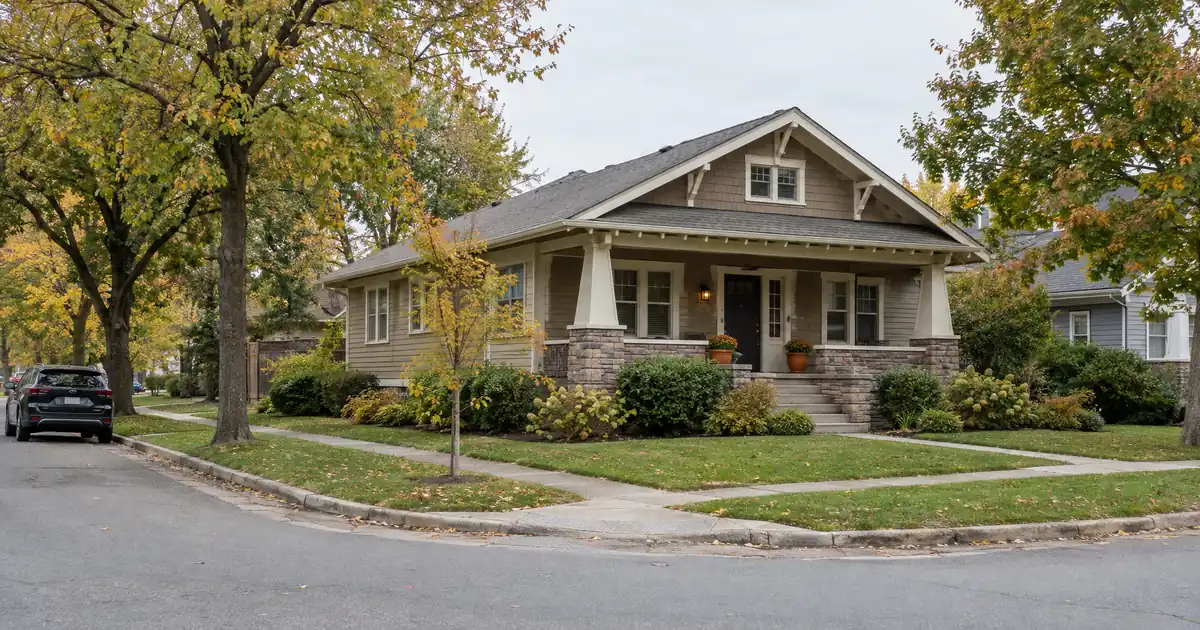
The Quick Read: A HELOC lender counts equity as the finished home’s current value minus every lien ahead of the line. It then applies a combined loan-to-value ceiling to what is left. Build cost does not set that value, and neither does the original forecast.
- Equity is today’s value minus the first-lien balance, not what you spent on the build.
- Your take-out loan sets the first lien the line sits behind, so choose it with the line in mind.
- On an investment property, the network ceiling is 70% CLTV (combined loan-to-value), with a 700 minimum credit score and a $500,000 maximum line.
- A build that appraises under cost leaves little or no room, however good the budget looked.
Say you just finished a ground-up rental, or a house you plan to live in. The construction loan did its job. Now you want to pull cash out of the finished property without refinancing.
How large a line the equity supports.
An equity line is sized by combined loan-to-value, occupancy, and credit — not by rental coverage. Switch the occupancy or the credit band and the ceiling moves with it.
Investment-property lines require a 700 minimum credit score; second-home lines start at a 640 minimum and primary-residence lines at 600, and the combined-LTV ceiling steps down as the credit band drops on primary-residence and second-home lines and holds on investment-property lines; the line cap steps down on primary-residence lines and holds at every tier on investment-property and second-home lines.
A debt-to-income ratio above 45% requires 680+ credit. Profiles under 640 are limited to single-family homes. At least 75% of the approved line is drawn at closing. Ceilings, floors, and caps update from Lendmire’s centralized guideline source.
Line estimate
Illustrative estimate only — not a quote, Loan Estimate, approval, or commitment to lend. The rate is an editable assumption; equity-line pricing is variable through both the draw and repayment periods and never converts to fixed. Occupancy and credit drive the ceiling together: an investment property tops out at 70% combined LTV (minimum credit 700, line cap $500,000); a second home tops out at 90% combined LTV (minimum credit 640, line cap $500,000), with the ceiling stepping down as the credit band drops (the cap holds at every tier); a primary residence tops out at 90% combined LTV (minimum credit 600), and its $750,000 maximum line is available only at 75% combined LTV or below with a 700-or-better credit profile (720 on the longer-runway program) and a full appraisal. Lines above $500,000 require a full appraisal. Credit, debt-to-income, property type, and full underwriting review all affect the final line.
The lender does not look at your build budget. It looks at one number: what the home is worth today, less what is owed on it. This guide walks through that math, the loan structures that change it, and the cases where the usual rule breaks.
Key Terms Defined
CLTV (combined loan-to-value): All loans on the property, including the new line’s limit, divided by the home’s current value.
First lien: The mortgage that gets repaid first if the home is sold to cover debts. A HELOC behind it is a junior lien.
As-completed value: An appraiser’s forecast of what a home will be worth once finished. Construction lenders use it to size the loan.
AVM (automated valuation model): A software estimate of value built from nearby sales and property records, with no site visit.
Seasoning: The waiting period a lender wants after you take title or finish a loan before it will lend again.
Vesting: The name that holds title to the property. For a HELOC, that has to be an individual or a qualifying revocable trust.
What Does a HELOC Lender Mean by Equity?
Equity is value minus debt. The CFPB defines a HELOC as an open-end line you can borrow against repeatedly, with borrowing power tied to the home’s value less what is owed on the mortgage. The same page notes that a lender may restrict further draws if the home’s value drops significantly.
That has two consequences. Value gets re-tested, so a number from last year’s file means little. And the lender subtracts every lien already on the property, not just the one you remember.
The lender sizes the line with CLTV. Bankrate describes CLTV as the figure lenders use to size a line, and it reports that lenders commonly want about 20% equity left untouched. That is a market-wide figure, not a network number. On Lendmire’s network, an investment-property line tops out at 70% CLTV, which leaves at least 30% equity in place.
The formula runs like this:
1. Take the current value.
2. Multiply by the CLTV ceiling that fits your occupancy and credit.
3. Subtract the first-lien balance.
4. What remains is the most the line can be, subject to the program’s line cap.
Why Does a Build Change the Equity Picture?
A new build changes it because the first number in your file was a forecast. A construction lender worries about the finished property’s projected value. As Corporate Finance Institute explains, it orders a special appraisal that uses comparable sales to estimate what the home will be worth when done. That is the as-completed value.
A HELOC lender asks a different question. What is the finished house worth now, and what sits ahead of the line? The forecast helped size your construction loan. It does not bind the line lender, which picks its own current value.
Across the wholesale network, a few things follow from that:
- Construction lenders generally size the loan against the lesser of project cost or as-completed value.
- The HELOC lender ignores that sizing and orders its own valuation.
- Land equity and cash you put in are not counted separately. They are already inside the value.
The investor’s budget sheet and the line lender’s worksheet are two different documents. Expect them to disagree.
Can You Get a HELOC While the House Is Still Being Built?
Rarely. An unfinished house has no stable value, a loan balance that is still moving, and often no certificate of occupancy. A lender that values the property as it stands today gives no credit for rooms that are not built. Most will wait.
Two nuances matter here.
First, an open construction loan may count at its full commitment rather than the drawn balance. This varies by lender. When you screen lenders, ask how they count the undrawn portion of an open commitment.
Second, a construction-only loan that has not been taken out puts the line behind a short-term lien. Some lenders want first position and will insist the existing loan be paid off first. Nobody swaps a construction loan for a HELOC halfway through. They are different products, and the line needs a finished, valued property.
What Changes When the Construction Loan Converts or Pays Off?
The conversion step decides how much room the line has. Depending on the structure you pick, a first-lien balance may sit ahead of the line. Where it does, that balance is usually close to the full build cost, minus whatever cash or land equity you put in.
| Structure | What happens at completion | Effect on the line |
|---|---|---|
| One-close (construction-to-permanent) | Loan converts to a permanent mortgage | First lien stays; line sits behind it |
| Two-step (construction-only) | Loan is paid off by a separate take-out loan | New first lien replaces the old one |
| Cash-funded build | No construction lien to clear | Little or no first lien; most room |
In the two-step case, the take-out loan’s size is your choice. A smaller take-out means more room for a line later. A larger one means less. Plan the exit before you break ground, because the take-out sets the ceiling on everything after it.
A Worked Example: Value, First Lien, and Room for the Line
Run the numbers as a modeled scenario, using percentages of current value so no dollar assumption creeps in. These are illustrative inputs, not market data.
| Case | First lien (% of value) | CLTV ceiling | Room for line (% of value) |
|---|---|---|---|
| Investment, strong appraisal | 55% | 70% | 15% |
| Investment, tighter appraisal | 65% | 70% | 5% |
| Investment, appraisal lower | 72% | 70% | — |
| Primary residence, 720+ credit | 65% | 90% | 25%, up to $500,000 |
The first three rows are the same house with different outcomes. Nothing about the property changed. Only the appraised value moved, and that moved the first lien from 55% of value to 72% of it.
This is why value-to-cost is the real equity measure. Say a build budget implied a comfortable cushion, but the finished home appraises under cost. The first lien is still sized to what you borrowed. The cushion shrinks or disappears.
The last row shows the primary-residence tier. A 90% ceiling exists only at 720 or better credit, with lines up to $500,000. Investment lines never reach it. If your occupancy is ambiguous, quote the ceiling for the use you actually intend.
How Does the Lender Value a Brand-New Home?
Lenders use an AVM or a full appraisal, depending on line size and file risk. New construction is the awkward case for both.
| Method | When it applies | New-build weakness |
|---|---|---|
| AVM | Lines at or below $500,000 ordinarily | Thin comps can return low confidence |
| Full appraisal | Required above $500,000; you can request one at any size | Scarce comparable sales can limit the value |
| Secondary valuation | May be added at higher CLTV | Adds a second opinion to a thin estimate |
An AVM leans on recent nearby sales. A subdivision with few resales gives it little to work with, and a brand-new house may not yet appear cleanly in public records. When the model fails, the remedy is usually a full appraisal. If you think the home is worth more than the model shows, asking for one is often your best move.
A low appraisal does not always end the file. It shrinks the line, because the ceiling applies to a smaller value.
The Timeline From Final Draw to Line Closing
The order of events matters more than the calendar. Most files that run into trouble hit one of these steps out of sequence.
1. Final draw and completion. The builder finishes, and you receive a certificate of occupancy and the final inspection report.
2. Lien releases. Collect waivers from the builder and subcontractors. Unpaid contractor items can leave a mechanics lien that a lender will want cleared.
3. Conversion or take-out. The construction loan becomes a permanent mortgage, or a separate loan replaces it. You then have a clear first-lien balance and a payoff or balance statement.
4. Title and vesting check. The lender confirms who holds title and where the liens sit.
5. Seasoning question. Waiting periods after a title change are lender policy, not a fixed rule. Ask whether the clock starts at land purchase, completion, or conversion. Lenders answer differently.
6. Valuation and application. The lender runs an AVM or orders an appraisal, then checks credit, occupancy, and debt-to-income. Debt-to-income runs at 50% maximum on the network, lower for weaker credit.
Credit still matters beyond equity. The network’s HELOC floor is 600 for primary residences, 640 for second homes, and 700 for investment properties. A strong equity position does not rescue a score below the floor.
Where the Usual Rule Breaks
Title in an LLC. HELOCs on this network require an individual or an inter vivos revocable living trust to hold title. LLCs, corporations, partnerships, and land trusts cannot. If your build sits in an LLC, you need a vesting change or a different product. A DSCR cash-out can work for entity-held rentals, subject to program terms.
Value below cost. The finished home appraises under what you spent. Equity is thinner than planned, and a later dip in value can cut access further.
Land equity. Investors often count the land as a separate deposit. The HELOC lender does not. It sees current value minus liens, and the land is already inside that value.
Ineligible property types. Manufactured homes are not eligible for the network’s HELOC programs. Log homes and barndominiums are not offered on its DSCR programs either.
Lender policy variation. Investment-property lines are scarce, and underwriting is often heavier. Big banks and large retail lenders vary widely on what they will do for a rental. A broker who sees many lenders can screen for the ones that accept your structure before you spend on an appraisal.
Exposure limits. A borrower is limited to three lines, and an owner with more than 15 financed properties is not eligible.
For a related look at reserve expectations, see Lendmire’s piece How Much Equity and Reserves a Rental HELOC Lender Expects.
What If You Want a HELOC on Your Home to Fund the Build?
That is a different transaction. The line sits on your existing home, not the new one. The lender counts equity in the old house, using the same value-minus-liens formula. The new build does not enter the calculation at all.
That is often the cleanest route to a down payment or equity injection. It also means your existing home is the collateral. A drop in its value, or a fully drawn line, affects your qualifying debt-to-income on the new project.
Lines above $500,000 are primary-residence only, cap at 75% CLTV, and require a full appraisal.
What If Your Equity Isn’t Enough?
Then the question changes from “how big a line” to “which loan fits this property.”
A HELOC sizes on value, CLTV, occupancy, and credit. It does not look at rent. A DSCR loan sizes on the opposite: whether the rent covers the property’s monthly obligation. A newly built rental with strong rent and thin equity can look weak to a line lender and fine to a DSCR lender. Lendmire’s complete DSCR loans guide covers the basics.
A DSCR cash-out refinance replaces the construction take-out with a new first lien sized on rent coverage. Across most of the network, cash-out on a standard rental tops out around 75% LTV, with about 6 months of seasoning as the common expectation. On short-term-rental collateral, cash-out runs 70%. Typical credit expectations run around 660, with 700 or better unlocking the strongest leverage tiers. All of it is subject to lender guidelines.
On coverage, 1.00 is where many select programs start. A separate select-lender path takes coverage below 1.00, with leverage and terms adjusted. Reserves vary by lender, leverage, and loan size, commonly around 6 months of PITIA (principal, interest, taxes, insurance, and any association dues).
One caution: clearing 1.00 is not the same as positive cash flow. DSCR compares rent to the property payment only. Repairs, vacancy, management, and utilities sit outside it.
| Option | Sized on | Title in an LLC? |
|---|---|---|
| HELOC | Value, CLTV, credit, occupancy | Not allowed |
| DSCR cash-out refinance | Rent coverage, LTV, credit | Subject to lender program eligibility |
| Hold and wait | Time and market value | Not applicable |
Why Does a Line Come Back Reduced or Declined?
Most problems after a build fall into a handful of causes. Each has a fix.
- First lien is too close to value. Fix it by choosing a smaller take-out, or by waiting for value to build.
- AVM returns low confidence. Ask for a full appraisal.
- Unreleased contractor liens. Get releases from the builder and subs before you apply.
- Wrong vesting. Move title out of the LLC, or switch to a DSCR cash-out.
- Score below the floor. The investment floor is 700, so an investor at 680 will not qualify for an investment line regardless of equity.
- Occupancy mismatch. Quote the ceiling for the use you actually have. An investment line never gets the primary-residence tier.
Ready or Not Yet: A Quick Gate
You are likely ready for a line if the home has a certificate of occupancy, the take-out loan is in place, contractor liens are released, title is in your personal name or a revocable trust, and your credit clears the floor for your occupancy. You also need a first-lien balance that leaves real room under the ceiling.
You are probably not ready if the construction loan is still open, a lien remains, or the appraisal came in under cost.
Keep one last point in mind. At least 75% of the line is drawn at closing, so a line is not a free cushion you open and ignore. Size it to a use you have.
If you are considering a home equity line and want to see how the numbers work, Lendmire can help you compare HELOC options based on the property, the equity available, credit profile, combined leverage, and your goals. Lendmire is a broker that arranges these loans through select lenders, not a lender. HELOC placement runs in 16 full-service states, a narrower set than the 41-market DSCR footprint. You can reach the team at 828-256-2183 or request a quote. The calculator on this page gives an illustrative estimate only, not a quote.
Frequently Asked Questions
Does the as-completed appraisal from my construction loan count for a HELOC?
No. That appraisal was a forecast used to size the construction loan. A HELOC lender orders its own current value, through an AVM or a full appraisal, and sizes the line on that figure.
Can I get a HELOC right after my construction loan converts to a permanent mortgage?
Often yes, if the lender’s waiting rules allow it. Seasoning is lender policy, and some lenders start the clock at title, others at completion or conversion. Ask each lender which date it uses before you apply.
How much can I borrow on a newly built investment property?
At most 70% CLTV on the network, less the first-lien balance, with a $500,000 maximum line and a 700 minimum credit score. If the first lien is already near 70% of value, there is little or no room. Every figure is subject to lender guidelines and full file review.
Does my build cost count as equity?
No. Equity is current value minus all liens. If the home appraises below what you spent, your equity is smaller than your budget implied.
Is a DSCR cash-out refinance a better fit for a new rental build?
Sometimes. It sizes on rent coverage instead of CLTV, and entity-held title can work subject to lender program eligibility. A strong-rent, thin-equity rental often suits it better than a line.
About Lendmire
As a mortgage broker (NMLS# 2371349), Lendmire helps homeowners and real estate investors in its 16 full-service states open home equity lines of credit arranged through wholesale lenders. Lendmire is never the lender; line amounts, ceilings and terms are set by the lender under its guidelines. Scotsman Guide named Lendmire a Top Mortgage Workplace in both 2025 and 2026.
Get Started
Ready to find the right loan for you?
In about 30 seconds you can review financing options available for your home or investment property. No commitment required.
Informational only. Not a Loan Estimate, approval, or commitment to lend. Program availability and eligibility are subject to lender guidelines, credit approval, property review, and underwriting.
References
1. CFPB – What is a home equity line of credit (HELOC)?
2. Bankrate – Requirements to borrow from home equity
3. Corporate Finance Institute – Construction loan
This article is part of Lendmire’s home equity line of credit program — full qualification details, guidelines, and scenarios live on the program page.
Related reading: How a DSCR Lender Counts Airbnb Income From a Garage Conversion · How a DSCR Lender Counts ADU Income for a First-Time Airbnb Host · How a DSCR Lender Reads a Fourplex Run as Four Airbnbs
Brandon Miller
Founder & CEO, Mortgage Loan Originator, Lendmire LLC
- Mortgage Loan Originator · NMLS# 1129696 · Verify on NMLS Consumer Access
- North Carolina Real Estate Broker · License# 343312 · Verify on NCREC
- North Carolina Insurance Producer · License# 19053198 · Property, Casualty, Life, Health · Verify on NAIC SBS
- Lendmire LLC · Firm NMLS# 2371349 · Verify firm licensure
Disclosure information. Lendmire is a state-licensed mortgage brokerage under NMLS# 2371349. Lendmire is not a depository institution, direct lender, or financial advisor — all loans referenced are placed through wholesale lender partners and are subject to each lender's underwriting standards. This article is provided for general informational purposes and is not a commitment to lend, nor does it constitute financial, legal, or tax advice. Loan programs, terms, rates, and qualification standards change without notice and depend on borrower profile, property type, and the state in which the subject property is located. Equal Housing Opportunity provider. NMLS Consumer Access: nmlsconsumeraccess.org.