
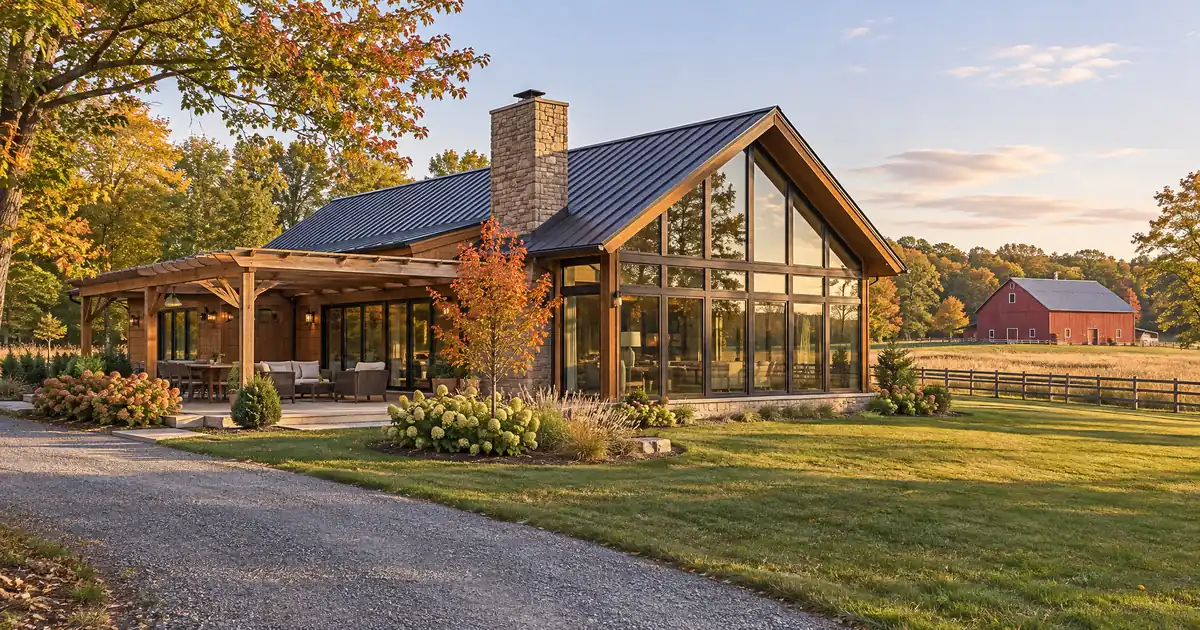
The Quick Read: An investment property HELOC lets an owner borrow against the equity in a rental through a revolving line, and on a rural rental the acreage, the valuation and the way the property is titled decide how much line is realistic. On Lendmire’s wholesale network, an investment line is capped at 70% combined loan-to-value (CLTV) and $500,000, so the equity math has to clear that ceiling after existing liens are subtracted.
- An investment line on this network requires a 700 credit score, subject to lender guidelines.
- Lines of this size ordinarily use an automated valuation instead of a traditional appraisal.
- The line is the capped amount minus existing liens, so thin equity or a cautious value shrinks it.
- LLC-titled rentals and agriculturally zoned parcels are not eligible for these lines.
- When the property is entity-held or the need is large, a DSCR cash-out refinance is the structure to compare.
Acreage can look like equity, and sometimes it is. Sometimes it is land that no buyer will pay a premium for, and the lender’s valuation reflects that. This explainer walks through the mechanics step by step and then shows where acreage bends the rules.
How large a line the equity supports.
An equity line is sized by combined loan-to-value, occupancy, and credit — not by rental coverage. Switch the occupancy or the credit band and the ceiling moves with it.
Investment-property lines require a 700 minimum credit score; second-home lines start at a 640 minimum and primary-residence lines at 600, and the combined-LTV ceiling steps down as the credit band drops on primary-residence and second-home lines and holds on investment-property lines; the line cap steps down on primary-residence lines and holds at every tier on investment-property and second-home lines.
A debt-to-income ratio above 45% requires 680+ credit. Profiles under 640 are limited to single-family homes. At least 75% of the approved line is drawn at closing. Ceilings, floors, and caps update from Lendmire’s centralized guideline source.
Line estimate
Illustrative estimate only — not a quote, Loan Estimate, approval, or commitment to lend. The rate is an editable assumption; equity-line pricing is variable through both the draw and repayment periods and never converts to fixed. Occupancy and credit drive the ceiling together: an investment property tops out at 70% combined LTV (minimum credit 700, line cap $500,000); a second home tops out at 90% combined LTV (minimum credit 640, line cap $500,000), with the ceiling stepping down as the credit band drops (the cap holds at every tier); a primary residence tops out at 90% combined LTV (minimum credit 600), and its $750,000 maximum line is available only at 75% combined LTV or below with a 700-or-better credit profile (720 on the longer-runway program) and a full appraisal. Lines above $500,000 require a full appraisal. Credit, debt-to-income, property type, and full underwriting review all affect the final line.
What Is an Investment Property HELOC?
An investment property HELOC is a revolving line of credit secured by a rental you own. You borrow against equity, which is the property’s value minus what you owe on it. The CFPB explains that you can spend up to your limit during a draw period, and that this period could last 10 years, for example. After that you can no longer borrow, and you move into repayment, where monthly payments are often significantly higher.
Lendmire is a broker. It places these lines through select wholesale partners and never lends directly. Availability is also narrower than the DSCR footprint: these lines are offered only in Lendmire’s 16 full-service states (AL, CA, CO, FL, GA, IN, MI, MT, NM, NC, OH, PA, TN, TX, VA, WA).
Two features set the product apart from a typical loan.
- Revolving access. You can draw, repay and draw again within the limit during the draw period.
- Floating pricing. On these lines, pricing floats through both the draw and repayment periods and never converts to fixed.
A HELOC is also different from a DSCR loan. A line of credit qualifies the borrower on credit, debt-to-income and equity. A DSCR loan is reviewed primarily on property-level rental income covering the payment, subject to lender guidelines. That distinction drives most of what follows.
Key Terms Defined
CLTV (combined loan-to-value): The total of all liens on the property divided by its value, which is the number the lender caps.
Draw period: The stretch of years when you can borrow from the line, usually with interest-only payments.
Repayment period: The later stretch when borrowing stops and the balance amortizes over a set term.
Lien position: Whether the line sits first or behind another mortgage in line to be repaid.
Automated valuation: A computer-generated value estimate used instead of a traditional appraisal on smaller lines.
Surplus land: Acreage that cannot be separated and sold off, so it adds little distinct value to the appraisal.
How Underwriting Treats a Rural Rental, Step by Step
Underwriting follows a fixed order, and a rural rental stresses the valuation step hardest. Here is the sequence.
Step 1: Eligibility screen. The lender first checks borrower and property basics. The borrower must hold title personally or through a revocable living trust. The property must be a single-family home, a 2-4 unit building, a PUD, a townhome or a condominium. Modular factory-built homes are eligible on one of the wholesale programs only. Manufactured homes, log homes, commercial and mixed-use properties, and agricultural zoning are not eligible.
Step 2: Credit and debt. An investment line needs a 700 credit score. The maximum debt-to-income ratio is 50%, and it is qualified on the interest-only payment calculated on the maximum draw. That detail matters because the line is tested as if fully drawn. Exact terms depend on the lender’s guidelines, property type, leverage, and a full review of the borrower’s file.
Step 3: Valuation. Value drives the line size, so this step is the pivot. Because an investment line caps at $500,000, and full appraisals begin only above that, these lines ordinarily use an automated valuation and commonly close with no traditional appraisal. A borrower can still request a full appraisal.
Step 4: Sizing the line. The formula is simple. Max line equals the value times the CLTV ceiling, minus existing liens. The CFPB’s HELOC booklet walks through the same logic, sizing the line as a percentage of appraised value less the mortgage balance. At 70% CLTV on an investment property, every dollar of value lost removes 70 cents of lien room, so a cautious valuation shrinks the line quickly.
Step 5: Structure and draw. The line can sit in first or second lien position. Investment lines run a 5-year interest-only draw followed by a 25-year fully amortizing repayment. At least 75% of the line is drawn at closing. After closing, the minimum subsequent draw is $1,000.
Step 6: Repayment. Once the draw ends, payments amortize principal and interest. The CFPB notes that HELOCs usually carry variable rates and that payments often jump when repayment starts. Plan for the later payment, not the draw-period payment.
How the Network’s Investment Line Is Structured
The investment line is a tighter product than a primary-residence line, and the table shows why. Occupancy sets the ceiling.
| Feature | Investment property | Primary residence |
|---|---|---|
| Max CLTV | 70% | Up to 90% at 720+ |
| Credit minimum | 700 | 600 program floor |
| Max line | $500,000 | Up to $750,000 |
| Draw/repay | 5-year / 25-year | Two structures available |
| Typical valuation | Automated | Full above $500,000 |
Credit above 700 does not buy more leverage on an investment line. Both the 720 and 700 tiers reach 70% CLTV, so a higher score adds eligibility cushion but not a higher ceiling. That surprises some borrowers who expect each score band to unlock more.
Market surveys, such as the BiggerPockets glossary, describe a typical 10-year draw followed by a 20-year repayment across the broader market. Lendmire’s network figures differ: a 5-year draw and 25-year repayment on investment lines, and the market description should not be read as a network term.
A few other limits apply. A borrower is limited to three lines, with combined exposure capped at $2,000,000 on the higher-leverage wholesale program and $750,000 on the longer-runway program. A borrower with more than 15 financed properties is not eligible. Each line is also tied to one property, so equity in one rental cannot support a line on another.
Where Rural Acreage Changes the Answer
Acreage rarely makes a line impossible. It usually makes the line smaller, because the valuation is less certain. Four edge cases do most of the work.
Thin comparable sales
Automated and full valuations both lean on comparable sales, and rural areas have few. Enact’s rural appraisal training says sales-comparison value is hard on rural properties because recent nearby sales are scarce. It adds that appraisers may reach for comps from a considerable distance or ones that are not very similar. McKissock, an appraiser education provider, notes that rural areas have fewer transactions and slower turnover, and that appraisers must explain why distant or dated sales were chosen.
For an investor, the practical outcome is a cautious value. A cautious value feeds straight into the sizing formula, so the line shrinks instead of disappearing. If the rental sits in a county with sparse sales activity, requesting a full appraisal may produce a better-supported number than an automated estimate, and that option is available.
Land value and acreage
Land is the portion of value least supported by comps. Outbuildings, wells, water access and unusual land use have no clean suburban equivalent. Do not assume acreage or outbuildings add a premium unless sold comps show buyers pay one. Treat any acreage figure as an input to the valuation, not a guaranteed contribution to it.
There is also no single acreage cutoff that applies everywhere. Acreage treatment generally comes down to lender overlay and appraiser judgment. One fixed rule does exist on this network: Texas properties are limited to 10 acres. Elsewhere, the property’s zoning and use matter more than the raw acre count.
Zoning and property use
Agricultural zoning is not eligible. A rental on acreage zoned residential is a different file from a working farm parcel. If the land produces farm income, carries a hunting lease, or is zoned for agricultural use, the line is generally not available. The same goes for log homes and manufactured homes, which are not eligible even when the land is attractive.
Access and title
Confirm that the property has a recorded right of way, meaning legal access. AgCarolina, an agricultural lending educator, flags this for acreage homes. It also cautions that acreage homes are often harder to finance, though that source is older and best read as general direction.
Title is the sharpest structural rule. Only an individual borrower or a revocable living trust can hold title on these lines. LLCs, corporations, partnerships, and irrevocable, blind or land trusts cannot. A rental already deeded to an LLC needs a vesting change, or the investor should look at a DSCR cash-out refinance instead.
A Worked Example With Illustrative Inputs
Run the sizing formula on a hypothetical rural rental. These inputs are modeled assumptions, not market data.
- Assumed value: $450,000 on an automated valuation.
- Existing first mortgage: a balance equal to 40% of that value.
- Ceiling: 70% CLTV on an investment property.
- Result: the line room is the gap between 70% and 40% of value, so roughly 30% of value, and it sits under the $500,000 cap.
Now suppose the valuation comes in 10% lower because comps were distant. The 70% ceiling applies to a smaller number, while the mortgage balance stays fixed. The room falls by 7% of the original value, which is a little less than a quarter of the 30% line. That is why a rural appraisal can undercut an investor’s equity math even when the home itself has not changed.
Compare that with DSCR cash-out. A cash-out refinance on a standard rental tops out around 75% LTV across most of the network, with about 6 months of seasoning as the common expectation. It is reviewed on rent covering the full payment instead of personal debt-to-income, and 1.00 is where select programs start, with stronger ratios opening better leverage. A separate select-lender path takes coverage below 1.00, with leverage and terms adjusted. Clearing 1.00 is not the same as positive cash flow, because repairs, vacancy, management and utilities sit outside the ratio. Every figure here varies by lender and program — guidelines, property type, leverage, and credit profile all apply.
HELOC or DSCR Cash-Out on a Rural Rental?
The right structure depends on the property, the title and the size of the need. This table lays out the comparison.
| Factor | Investment HELOC | DSCR cash-out refinance |
|---|---|---|
| Reviewed on | Credit, DTI, equity | Property rent vs. payment |
| Max leverage | 70% CLTV | Around 75% LTV |
| Entity title | Not allowed | Subject to program terms |
| Keeps first mortgage | Yes, if line sits second | No, replaces it |
| Structure | Revolving, floating | Fixed-rate spine, 30-year |
A HELOC tends to fit the investor who holds the rental personally, has a modest first mortgage worth keeping, wants revolving access, and can carry a floating payment. It also avoids resetting the first mortgage. One BiggerPockets thread shows investors valuing exactly that: no cash-out closing costs and no reset of the original loan.
DSCR cash-out fits better when the rental is in an LLC, when the capital need runs past the line limit, or when the investor wants a fixed-rate term instead of floating pricing. Loan sizes on DSCR run up to $3,000,000 on standard programs (smaller balances available through select lenders). Credit floors also differ: a 620 floor exists in parts of the DSCR network and most programs want around 660, while the investment line starts at 700.
There is a third route some investors use: borrow against a primary residence and spend the money on the rental. That is a different collateral and a different file, with its own occupancy-tiered ceiling.
The Risks Worth Pricing First
Floating payments are the main risk. Pricing floats across the draw and repayment periods and never converts to fixed, so payments can change. The CFPB also warns that payments often jump when repayment starts, and that in some cases the full balance can come due. A thin-margin rural rental, where vacancy can run longer between tenants, may not absorb that jump.
Sale triggers payoff. If you sell, you are generally required to pay the line off in full. On this network, at least 75% of the line is drawn at closing, so interest begins on most of the line on day one.
Stack the risks. A line drawn heavily at closing, floating pricing, a rural property that may re-lease slowly, and a cautious valuation can all hit the same file. Size the draw to the project, not to the maximum.
Reserves and exposure matter as well. Reserve expectations vary by lender, leverage, loan size and transaction type, so confirm them at the file stage. Tax treatment varies; consult a qualified professional.
Preparing a Rural File
- A survey or plat showing acreage and boundaries.
- Proof of recorded legal access.
- Zoning confirmation showing residential, not agricultural, use.
- A lease and rent history for the rental.
- Details on outbuildings, wells and septic.
- Recent sold comps you believe support the value.
- Vesting documents confirming personal or revocable-trust title.
If the automated valuation looks low, ask for a full appraisal and hand the appraiser those comps. The appraiser must document why any distant sales were selected, so the more local support you provide, the less guesswork enters the number.
Frequently Asked Questions
Can I get a HELOC on a rental I own?
Yes, though the product is narrower than a primary-home line. On Lendmire’s network an investment line requires a 700 credit score, caps at 70% CLTV and $500,000, and is available in 16 states. Title must be personal or a revocable living trust. Terms are subject to lender guidelines and full file review.
Does having more acreage increase my line?
Not automatically. The line is value times the CLTV ceiling minus existing liens, and acreage only helps if the valuation credits it. Thin rural comps can limit how much value the land adds. Zoning also matters, since agricultural zoning is not eligible.
Can my LLC hold the property and still get a HELOC?
No. LLCs, corporations, partnerships and irrevocable, blind or land trusts cannot hold title on these lines. A rental already deeded to an LLC needs a vesting change or a DSCR cash-out refinance instead, subject to program terms.
Will I need a full appraisal?
Usually not on an investment line. Because the maximum is $500,000 and full appraisals begin only above that, investment lines ordinarily use an automated valuation. You can request a full appraisal anyway, which may help on a rural property with few comps.
Which is better for a rural rental, a HELOC or a DSCR cash-out?
It depends on title, size and payment tolerance. A HELOC suits personally titled rentals with a first mortgage worth keeping. A DSCR cash-out suits entity-held property, larger needs, or investors who prefer a fixed-rate term. The complete DSCR loans guide covers how DSCR files are structured.
If you are considering a home equity line and want to see how the numbers work, Lendmire can help you compare HELOC options based on the property, the equity available, credit profile, combined leverage, and your goals. The most useful number to know before any rural line is the valuation, because acreage only counts for what the comps will support.
About Lendmire
Lendmire (NMLS# 2371349) is a mortgage brokerage serving homeowners and real estate investors in its 16 full-service states. Home equity lines of credit are arranged through wholesale lending channels; Lendmire brokers the line and the lender underwrites each application under its occupancy-based guidelines. Scotsman Guide named Lendmire a Top Mortgage Workplace in both 2025 and 2026.
Get Started
Ready to find the right loan for you?
See your offer in seconds. No credit pull, no obligation.
Informational only. Not a Loan Estimate, approval, or commitment to lend. Program availability and eligibility are subject to lender guidelines, credit approval, property review, and underwriting.
References
1. CFPB: What Is a Home Equity Line of Credit HELOC
4. Enact – Rural appraisal training
5. McKissock – Appraising rural properties
6. AgCarolina
This article is part of Lendmire’s investment property HELOC program — full qualification details, guidelines, and scenarios live on the program page.
Related reading: Can You Get an Investment Property HELOC After a Denial on Returns? · Can You Get an Investment Property HELOC After a Quitclaim From a Parent? · Can You Get an Investment Property HELOC With No Limit?
Brandon Miller
Founder & CEO, Mortgage Loan Originator, Lendmire LLC
- Mortgage Loan Originator · NMLS# 1129696 · Verify on NMLS Consumer Access
- North Carolina Real Estate Broker · License# 343312 · Verify on NCREC
- North Carolina Insurance Producer · License# 19053198 · Property, Casualty, Life, Health · Verify on NAIC SBS
- Lendmire LLC · Firm NMLS# 2371349 · Verify firm licensure
Disclosures. The information presented in this article is general market commentary, not financial, legal, or tax advice. Lendmire is a mortgage brokerage (NMLS# 2371349) — not a direct lender or depository institution — and loan placement is subject to lender underwriting. Nothing in this content represents a commitment to lend. Loan terms, pricing, and program availability vary based on borrower qualifications, property characteristics, and state of subject property, and are subject to change at any time. Lendmire complies with Equal Housing Opportunity requirements. Consumer access: nmlsconsumeraccess.org.