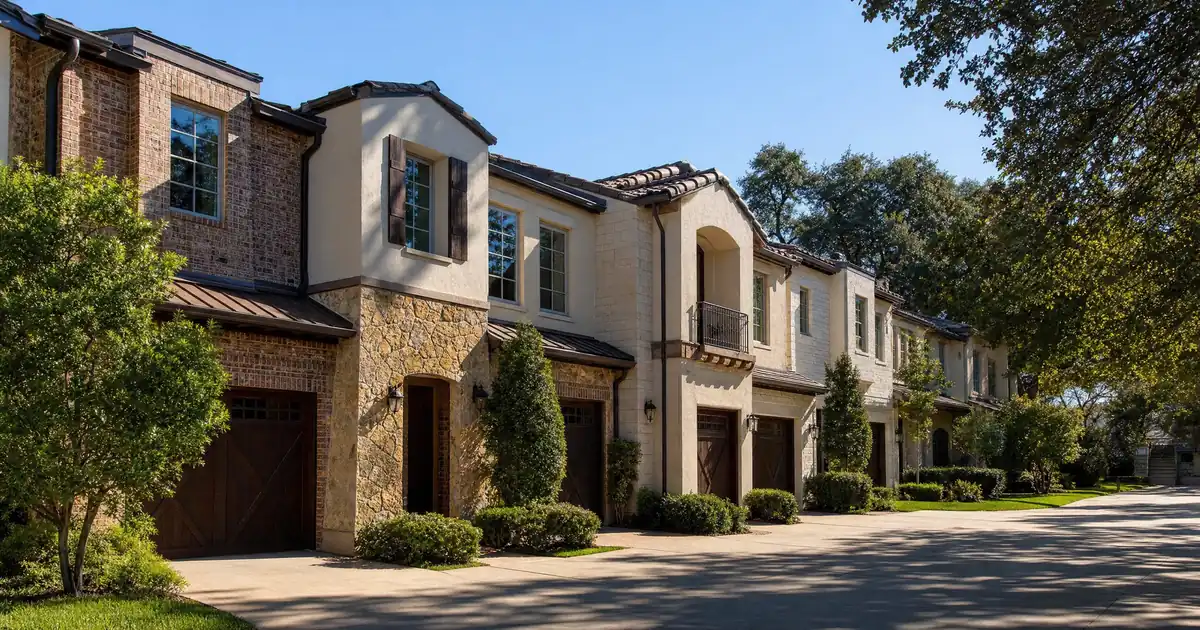
Two Frisco neighborhoods sit fifteen minutes apart and tell opposite stories to a DSCR underwriter. Starwood’s gated streets carry a median single-family price of $1,774,500, the highest of any named submarket in the city, per listing data compiled by Homes.com. Preserve, an older and less glamorous pocket of the city, posts a median sale price closer to $600,000 at roughly $163 per square foot, per VIP Real Estate’s Preserve listing data. Run rent against price in each and the math splits hard: one neighborhood carries a rent ceiling nowhere near its purchase price, and the other gets a rental property most of the way to a workable coverage ratio. For an investor buying with a rental-income loan, that gap between basis and rent — not school ratings, not amenities — is the number that actually decides the deal.
TL;DR: Investment property loans in Frisco, Texas are underwritten primarily on the subject property’s rental income measured against its full monthly obligation, and in this market that structure rewards older, lower-basis submarkets over new-construction luxury pockets where price has outrun what local rents can support.
DSCR Calculator
Run the numbers in your market
Rate source: Freddie Mac 30-yr average via FRED® — Federal Reserve Bank of St. Louis · effective Jul 30, 2026
Prefilled with local estimates — enter your own rent or nightly figures, taxes, insurance, and HOA for a more accurate picture.
Program parameters update from Lendmire’s centralized guideline source. Taxes and insurance are editable estimates.
As of Jul 30, 2026 · General Freddie Mac market benchmark, not a Lendmire loan offer. Rent, nightly rate, occupancy, taxes, and insurance are editable estimates. Short-term rental figures are estimates only and vary significantly by season, property type, management approach, and local short-term-rental rules — confirm local regulations before relying on them. Qualifying income for short-term rentals varies by program — some use appraisal market rent, others use documented STR history or projections — and is confirmed in underwriting. Not a Loan Estimate, approval, or commitment to lend. Program availability and eligibility are subject to lender guidelines, credit approval, property review, and underwriting.
- Preserve’s basis runs near $163/sqft (a market source) — well below new-build luxury stock.
- Starwood’s median single-family price hits $1,774,500 (Homes.com), far outpacing rent ceilings.
- In-city duplexes trade between $518,900 and $575,000 (Homes.com).
- ZIP 75033 (Stonebriar/Starwood corridor) leases in a median of 20 days at $3,500/month.
- ZIP 75035 handled 99 of 172 recent single-family leases citywide — the deepest rental pool.
This split between basis-heavy luxury pockets and older, rent-friendly submarkets is the pattern that recurs across Frisco’s rental-income underwriting: the appraisal is rarely the sticking point in a fast-growth suburb like this one — the rent schedule is.
Frisco Market Snapshot
A quick read on the Frisco investor landscape — figures come from the cited sources below. Confirm current property-level numbers before underwriting.
| Metric | Detail |
|---|---|
| Home prices | $688K median (Redfin – Frisco Housing Market) |
| University enrollment | 3,140+ students at Frisco Landing (UNT News) |
| Population | 245,470 population (City of Frisco – Demographics) |
| Employment | 3,100+ jobs (PR Newswire – Frisco EDC 2025) |
| Vacancy | ~12% DFW-metro multifamily (Colliers Q4 2025) (SolMidas) |
Skip Starwood and Phillips Creek Ranch (For Cash Flow, Anyway)
Starwood and Phillips Creek Ranch are appreciation plays, not coverage plays, and the rent data makes that obvious once it’s modeled against price. Phillips Creek Ranch posts a median single-family price of $1,175,000 (Homes.com), while even the top of Frisco’s single-family rent stack — the 4+ bedroom tier at $3,600 a month per Zumper — falls far short of what a loan that size demands.
Run the numbers on it: at typical purchase-money leverage, financing that price against a modeled long-term payment plus ordinary annual property tax and insurance costs pushes the coverage ratio well under breakeven against that same rent ceiling. That’s not a rounding problem. It’s a structural mismatch between what these homes cost and what a renter will pay to live in one. Starwood’s rental stock does show up on the more affordable side of some rent surveys, but that figure sits against a purchase price high enough to widen the gap rather than close it. Terms vary by lender guidelines, property type, leverage, credit profile, and full file review.
None of this makes Starwood or Phillips Creek Ranch bad real estate. Both are legitimate long-hold, appreciation-driven buys for investors who don’t need the rent to carry the note on day one. It just means neither pencils cleanly for a purchase-money DSCR loan sized to standard leverage, and an investor chasing coverage rather than equity growth should look elsewhere in the city first.
The Rail District, Preston Ridge, and the Preserve — Lower Basis, Closer to Coverage
The Rail District, Preston Ridge, and Preserve share one trait that matters more than curb appeal: they were built before Frisco’s price run-up, so their basis sits well under the city’s new-construction pockets. Rail District carries a median single-family price around $550,000 (Homes.com), the most moderate entry point among the named submarkets. Preserve’s $163/sqft pricing and Preston Ridge’s positioning as an established, mid-size, reasonably priced community per VIP Real Estate’s neighborhood profile put both closer to the rent numbers Frisco actually supports.
That still doesn’t clear a full 1.00x coverage ratio on a single-family basis at standard leverage — that’s the honest read. Model a Preserve-area purchase near $600,000 against the citywide four-bedroom rent median of $2,998 (RentCafe/Zumper composite), and the modeled ratio, including full taxes and insurance, lands closer to 0.75x. Getting that same single-family purchase to a 1.00x floor this way would mean pushing down payment well past 50%, which is not where most DSCR investors want to sit. A 1.00x floor is available on select programs, with most standard files underwritten to stronger coverage above that baseline because rent covers the payment at that level; some select programs may review lower or no-ratio scenarios with stronger compensating factors, lower leverage, or more cash down, and exact eligibility always depends on lender guidelines, credit profile, reserves, and property review.
The number changes when the property is a duplex instead of a single unit — and Frisco actually has duplex stock inside city limits, not just in neighboring Little Elm or The Colony. Multi-family listings in the city price between $518,900 and $575,000 (Homes.com), with two-bedroom, two-and-a-half-bath units on each side. Run a $550,000 duplex with each side leasing near the metro’s two-bedroom median of $2,083 a month per RentCafe, and combined rent against a single loan on that property models to roughly 1.12x-1.13x, including full taxes and insurance — a materially different outcome than the single-family version of the same $550,000 basis, which lands closer to 0.70x on one rent check instead of two.
That’s the core Frisco insight for anyone buying with a rental-income loan: two rent streams carrying one loan payment beats one rent stream carrying the same payment, and this city’s duplex inventory — thin as it is — sits at almost exactly the same price point as its lower-basis single-family submarkets. Investors serious about coverage should be comparing those two property types side by side before comparing neighborhoods. The full breakdown on how the ratio is calculated — and how it differs from a conventional debt-to-income approval — is worth reading before running comps.
ZIP 75035 — the Volume Engine
ZIP 75035, in southeast Frisco, is where the rental transactions actually happen — 99 of the 172 single-family leases closed citywide in the most recent 30-day window landed there, alongside 151 of the city’s 327 active listings. Median rent in the ZIP runs $2,890 a month. That volume matters as much as the rent number itself: a submarket that deep in transaction activity gives an investor real comps to lean on, real tenant demand to model, and an easier exit if the property needs to sell instead of lease.
There’s a recurring pattern in fast-growth suburban markets like this one: the appraisal usually supports the purchase price without much friction, because comps are recent and plentiful in a metro adding this much new housing stock. The harder pull is the rent schedule. In neighborhoods where a meaningful share of the housing stock closed in the past few years, appraisers sometimes lean on builder pro formas or thin trailing rent comps rather than a deep pool of comparable leases, and that gap is exactly where a rental-income file can stall waiting on a rent survey addendum. A ZIP like 75035, with its transaction depth, is one of the easier places in the city to avoid that particular delay.
ZIP 75033 and the Two-Year Watch List
ZIP 75033 — the Stonebriar and Starwood corridor — leases faster and richer than anywhere else in Frisco: a median rent of $3,500 a month against a median time-to-lease of just 20 days, the quickest turnaround in the city. That combination of premium rent and fast absorption is exactly what makes an appreciated property in this ZIP a candidate for a future cash-out structure once it has seasoned, rather than a purchase-day coverage play — refi programs built around equity extraction fit that later-stage scenario better than a day-one acquisition loan.
What deserves tracking over the next 6 to 24 months in this corridor, and across Frisco generally, is new competitive supply. Institutional capital is already running purpose-built single-family rental product in the city — Oxenfree Stonebriar’s three- and four-bedroom rental townhomes with attached garages, and Greenway Village at The Link, a build-to-rent community of homes and townhomes near PGA Frisco. That’s validation that institutional underwriters believe in Frisco rent levels. It’s also a signal that individual investors buying in these exact micro-markets over the next two years should expect more competing rental supply, not less, which caps how aggressively rent growth can be underwritten.
Layer on top of that a broader DFW multifamily vacancy rate hovering around 12% per Colliers’ Q4 report, cited by SolMidas, with Frisco and Plano specifically named as suburban submarkets still absorbing elevated apartment vacancy. None of that changes single-family DSCR math directly, but it argues for conservative rent-growth assumptions on any Frisco purchase closing in the near term — and, on the flip side, it’s part of why acquisition prices have softened enough to create an entry window right now.
The Appreciation-Versus-Cash-Flow Tension, in One Data Point
Frisco’s median sale price actually fell in the most recent annual comparison while neighboring Plano’s rose modestly, according to a regional market outlook from Haistings Real Estate — making Plano the only major Collin County city to post a gain over that stretch. That report frames the divergence as a function of new-construction pipeline: Frisco and nearby Prosper are still absorbing speculative new supply built for demand that hasn’t fully arrived yet, while Plano’s housing stock is largely serving demand that already exists.
For a DSCR investor, that’s not a reason to avoid Frisco — it’s a reason to buy selectively inside it. The city’s older, non-new-construction submarkets (Preston Ridge, Preserve, Rail District) aren’t competing against a wave of builder incentives diluting comps the way some of the newer master-planned pockets are. That’s the honest tension worth sitting with: Frisco overall is still an appreciation-led market riding its build-out toward continued population growth, per the City of Frisco’s demographic projections, but the submarkets that actually clear rental coverage today are the ones building the least right now.
The Employer Base Carrying the Rent Roll
Rent in Frisco holds up because the job base underneath it is unusually dense for a suburb of its size. Frisco’s population has grown substantially since 2000 — reaching an estimated 245,470 residents — per Frisco Economic Development Corporation data corroborated by the U.S. Census Bureau. Household income and labor force participation both sit at healthy levels, per the city’s own demographic reporting.
That income base is anchored by a genuinely unusual employer roster for a suburb this size: the Dallas Cowboys’ corporate headquarters at The Star, the national headquarters of the PGA of America following a large-scale relocation, plus regional or national offices for T-Mobile, Keurig Dr Pepper, TIAA, and SoFi, alongside a technology cluster that includes Oracle, DXC Technology, and McAfee. The Frisco EDC reports meaningful new job creation in a recent year, plus a number of corporate relocations or expansions expected to create or retain jobs across the local economy. That’s a tenant base built on relocating professionals and corporate transferees, not a single-employer town exposed to one layoff cycle.
Two Hospitals, One Growing Campus
Healthcare and higher education round out Frisco’s demand picture, and they’re more layered than a single hospital-town narrative suggests. Baylor Scott & White Medical Center – Frisco, the original campus that’s served the city since 2002, employs a sizable, long-tenured workforce — stable rather than transient. A newer, larger campus, Baylor Scott & White Medical Center at PGA Parkway, opened more recently and represents a second, less-saturated cluster of shift-working healthcare tenant demand in a different part of the city. A third Baylor campus, Centennial, adds further capacity serving Collin and Denton County residents.
On the education side, University of North Texas at Frisco has grown its enrollment with dozens of industry partners — a small but compounding, career-track student population that skews older than a typical dorm-age cohort and drives demand for one- and two-bedroom units rather than group housing. Collin College, the only public college based in the county, serves a large annual body of credit and continuing-education students and is launching a new co-enrollment partnership with UNT. Neither institution anchors Frisco the way a flagship state university anchors a college town, but together they add a durable, if modest, rental demand pool most generic city overviews skip entirely.
What Actually Qualifies Here
Purchase-money DSCR loans in this market generally run 75%-80% loan-to-value, meaning 20%-25% down on a standard file, with the strongest, most well-documented files occasionally reaching higher leverage where program guidelines allow. Programs available through Lendmire’s lender network commonly review credit scores in a range starting well below prime, though higher-leverage tiers typically require stronger credit, and reserve requirements generally run around six months of the full monthly obligation — longer on larger loan balances, which matters given Starwood and Phillips Creek Ranch’s price points. Loan amounts through standard programs generally cover a wide range, with smaller balances routed through specific lenders in Lendmire’s network. All of these figures are program guidelines, not commitments, and review details remain subject to lender overlays, credit approval, and property-level review.
Investors titling a Frisco rental in an LLC — common among the corporate relocators and out-of-state buyers this market attracts — can use the same DSCR structure, subject to program terms, without the personal tax-return documentation a conventional loan would require. Anyone weighing that against a conventional purchase can walk through the side-by-side comparison before deciding which route fits the file. For a direct look at leverage and terms across the state, Lendmire’s Texas DSCR loan programs page breaks down what’s currently available, and investors comparing this metro against other Texas markets can also review the DSCR investor loan platform more broadly. Questions on a specific Frisco file can go to Lendmire at 828-256-2183.
Something else worth flagging before underwriting: Frisco straddles both Collin and Denton counties, which means two properties a few streets apart can sit under different tax jurisdictions. That’s not a reason to avoid a specific block, but it’s a reason to confirm which county a given parcel falls into before finalizing numbers, alongside the standard reminder to verify current property tax rates, insurance costs, and any local rental rules with a qualified local professional.
DSCR vs. conventional financing
Two common ways to finance an investment property in Frisco, TX. They qualify you differently — here’s how investors weigh them.
Why investors choose it
- Qualifies on the property’s rental income — no personal tax returns, W-2s, or pay stubs needed to document income.
- No personal debt-to-income ceiling to clear, so existing mortgages and obligations don’t cap your borrowing the same way.
- Can be closed in an LLC, keeping the property inside a business entity.
- Built for scaling — not held to the limit on number of financed properties that conventional financing applies.
- Underwriting centers on the deal: generally qualifies when the rent covers the payment, a 1.00x coverage ratio being a common baseline (confirmed in underwriting).
- Designed specifically for investment property, including long-term and, where the program allows, short-term rentals.
Where it’s strong
- Often the lowest ongoing financing cost for a buyer who fully qualifies on personal income — a fit for a first property or a cost-first purchase.
Trade-offs for investors
- Requires full personal income documentation and must fit within a debt-to-income limit — salary, existing debts, and other mortgages all count.
- Typically held in your personal name rather than a business entity.
- Caps how many financed properties you can carry, which can become a ceiling as a portfolio grows.
- Evaluates you as a borrower as much as the property, which usually means more paperwork.
How investors usually choose: a first or single property often optimizes for the lowest financing cost; portfolio builders often optimize for leverage, vesting in an LLC, and scaling past conventional caps. The right answer depends on your goals, the property, and current guidelines — both paths run through select lenders in Lendmire’s wholesale network, with eligibility and terms confirmed in underwriting.
Frequently Asked Questions
How do you qualify for a DSCR loan in Frisco, Texas?
Qualification centers on the property’s rental income measured against its full monthly obligation rather than the borrower’s personal income. A lender reviews the market rent (or an existing lease), the projected monthly payment including taxes and insurance, and the resulting coverage ratio, alongside credit score, reserves, and the property itself — with credit, LLC entity documents, and a rent survey or lease among the core file pieces.
What are the requirements for an investment property loan in Frisco, Texas?
Most files need 20%-25% down at standard leverage, a credit score that generally varies by scenario (higher for top-tier leverage), roughly six months of reserves, and clean entity documents if the property is titled in an LLC. Given Frisco’s split across Collin and Denton counties, confirming which jurisdiction a parcel sits in before closing is worth the extra step.
Does a duplex in Frisco qualify differently than a single-family rental?
The underwriting mechanics are the same — rent against payment — but the math often comes out differently. A duplex generates two rent checks against one loan payment, which at current Frisco price points frequently produces a stronger coverage ratio than a comparably priced single-family home carrying just one rent check.
Why do new-construction Frisco rentals often show weaker DSCR coverage than older homes?
New-construction pricing in Frisco has outpaced local rent growth in several submarkets, particularly the master-planned luxury corridors, while older, lower-basis neighborhoods like Preston Ridge, Preserve, and the Rail District carry a smaller gap between purchase price and achievable rent. That gap between basis and rent is the main driver of coverage-ratio strength here, more than square footage or finish level.
Is Frisco’s rental market split by county lines?
Yes — Frisco is one of the few cities in the metro that sits across two counties, Collin and Denton, which affects which tax jurisdiction a given property falls under. It doesn’t change DSCR underwriting mechanics, but investors should confirm the county before finalizing carrying-cost assumptions.
Exact tiers vary by lender, loan size, and property type, so terms should be confirmed for the specific Frisco file.
The single most useful thing an investor can do before writing an offer in this market is pull actual closed-lease comps for the specific ZIP and property type under contract — not a citywide rent average — since the gap between 75035’s transaction depth and 75033’s premium-but-thinner pool, or between a duplex’s two rent checks and a single-family’s one, is exactly what separates a Frisco purchase that clears coverage from one that doesn’t.
About Lendmire
Lendmire is a non-QM mortgage brokerage (NMLS# 2371349) arranging DSCR investor loans in 40 markets, including Washington, D.C. DSCR eligibility is generally reviewed around property-level rental income rather than personal income, subject to lender and program guidelines, a fit for self-employed investors and LLC-owned portfolios. Lendmire was recognized as a top-ranked workplace in 2025 and again as a 2026 Scotsman Guide Top Mortgage Workplace.
Get Started
Ready to find the right loan for you?
In about 30 seconds you can review financing options available for your home or investment property. No commitment required.
Informational only. Not a Loan Estimate, approval, or commitment to lend. Program availability and eligibility are subject to lender guidelines, credit approval, property review, and underwriting.
References
1. Homes.com – Frisco Multi-Family Listings
2. Redfin – Frisco Housing Market
3. UNT News
4. City of Frisco Demographics
5. PR Newswire – Frisco EDC 2025
6. SolMidas – 2027 Supply Cliff
7. Zumper – Frisco Rent Research
8. RentCafe – Frisco Rent Trends
9. Haistings Real Estate – Plano Market Outlook
10. Frisco Economic Development Corporation
11. U.S. Census Bureau QuickFacts – Frisco
12. Baylor Scott & White Medical Center – Frisco
13. Baylor Scott & White Medical Center – PGA Parkway
14. University of North Texas at Frisco
15. Collin College
16. a top-ranked workplace in 2025
17. a 2026 Scotsman Guide Top Mortgage Workplace
Brandon Miller
Founder & CEO, Mortgage Loan Originator, Lendmire LLC
- Mortgage Loan Originator · NMLS# 1129696 · Verify on NMLS Consumer Access
- North Carolina Real Estate Broker · License# 343312 · Verify on NCREC
- North Carolina Insurance Producer · License# 19053198 · Property, Casualty, Life, Health · Verify on NAIC SBS
- Lendmire LLC · Firm NMLS# 2371349 · Verify firm licensure
Disclosures. The information presented in this article is general market commentary, not financial, legal, or tax advice. Lendmire is a mortgage brokerage (NMLS# 2371349) — not a direct lender or depository institution — and loan placement is subject to lender underwriting. Nothing in this content represents a commitment to lend. Loan terms, pricing, and program availability vary based on borrower qualifications, property characteristics, and state of subject property, and are subject to change at any time. Lendmire complies with Equal Housing Opportunity requirements. Consumer access: nmlsconsumeraccess.org.