
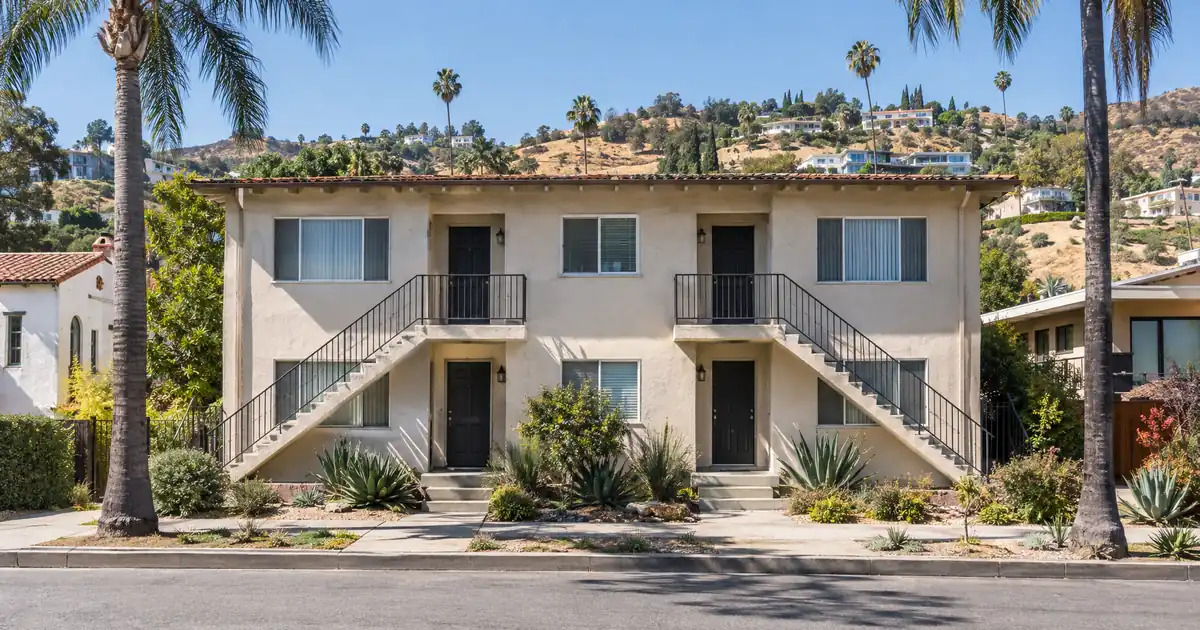
Los Angeles permitted 6,626 accessory dwelling units last year, nearly matching the 7,038 apartment units the entire city approved — a total that ranks among the smallest in more than a decade, according to a Crosstown LA analysis of city building-permit data, and a figure that shapes how investment property loans in Los Angeles are structured and approved. That single comparison tells an investor most of what matters here. The multifamily construction pipeline is thin. The ADU has become the workaround. And the property types that qualify most easily for a rental-income-based purchase loan are not the ones most out-of-state buyers assume.
DSCR Calculator
Run the numbers in your market
Rate source: Freddie Mac 30-yr average via FRED® — Federal Reserve Bank of St. Louis · effective Jul 30, 2026
Prefilled with starting assumptions — enter your own rent or nightly figures, taxes, insurance, and HOA for a more accurate picture.
Program parameters update from Lendmire’s centralized guideline source. Taxes and insurance are editable estimates.
As of Jul 30, 2026 · General Freddie Mac market benchmark, not a Lendmire loan offer. Rent, nightly rate, occupancy, taxes, and insurance are editable estimates. Short-term rental figures are estimates only and vary significantly by season, property type, management approach, and local short-term-rental rules — confirm local regulations before relying on them. Qualifying income for short-term rentals varies by program — some use appraisal market rent, others use documented STR history or projections — and is confirmed in underwriting. Not a Loan Estimate, approval, or commitment to lend. Program availability and eligibility are subject to lender guidelines, credit approval, property review, and underwriting.
At a Glance: Investment property loans in Los Angeles, California are underwritten primarily on a property’s market rental income measured against its full monthly obligation, which is why financing here tends to favor two-to-four-unit buildings and ADU-equipped single-family homes over standalone single-family rentals.
- South LA duplexes trade at price points many investors find approachable, with cap rates among the more attractive in the city’s multi-unit submarkets.
- Buildings of five units or more shift to commercial financing, not residential DSCR programs.
- ADUs made up a sizable share of new permitted units citywide, per Crosstown LA.
- Fourplex and triplex stock dominates East LA, Koreatown, and the San Fernando Valley.
- New apartment deliveries citywide fell to a decade low, tightening comps for existing small multifamily.
Los Angeles Market Snapshot
A quick read on the Los Angeles investor landscape — figures come from the cited sources below. Confirm current property-level numbers before underwriting.
| Metric | Detail |
|---|---|
| Home prices | Median sale price $1.0M (Los Angeles Housing Market) |
| Population | 24.6% of state population (U.S. Census Bureau QuickFacts:) |
| Employment | 1 million+ ca jobs related to port trade (Port of Los Angeles) |
| Vacancy | 8.7% class a (LA Business Journal) |
Why Don’t LA Rents Clear 1.0x on Single-Family Alone?
Because the arithmetic never favored it. Rent growth citywide has sat flat in recent readings, and monthly rents on a typical single-family purchase rarely reach the share of price that the “2 percent rule” investors use in cheaper metros assumes — that shortcut simply does not apply here. Cap rate and net operating income are the only frameworks that hold up.
That gap is structural, not cyclical. A Los Angeles Business Journal commentary on the region’s apartment deliveries since 2020 found a meaningful share of that new construction sitting vacant, with Class A towers running notably higher vacancy than other product — the softness is concentrated in luxury and downtown product, not in the older duplex-and-fourplex stock that dominates DSCR-eligible inventory. Investors reading “LA is oversupplied” headlines and assuming that applies to a Van Nuys dingbat building are reading the wrong data set.
The practical result: a single-family rental purchased at typical citywide pricing often produces a coverage ratio below 1.00 on rent alone. That falls short of the 1.00 qualifying threshold on the standard program — it’s an argument for a different property type. Lendmire’s DSCR guide covers how the ratio is calculated; in Los Angeles specifically, the calculation tends to push buyers toward multi-unit or ADU-added properties almost by default.
The Four-Unit Line That Decides Your Financing
Buildings with four units or fewer can be financed with residential mortgage products, including DSCR loans. The moment a building crosses to five units, financing shifts to the commercial market entirely, and commercial pricing has run meaningfully higher than residential pricing through the recent cycle. That single line — four units versus five — is arguably the most important structural fact in this market for a purchase-side investor. It’s why duplex-through-fourplex assets, not five- and six-unit buildings that otherwise look similar on paper, sit at the center of LA’s DSCR-eligible inventory.
On the financing side, purchase leverage on most DSCR programs runs in the 75 to 80 percent range, with select strong files reaching up to 85 percent loan-to-value where guidelines allow it. Minimum qualifying coverage on standard programs sits at a 1.00x benchmark — rent covering the full obligation — though credit tier, reserves, and property type all move that math. Credit-score tiers commonly cited across the DSCR space run from a 620 floor up through 660, 680, and a 700 threshold tied to the higher-leverage options, with reserve requirements generally landing around six months of PITIA and closer to nine months on loan balances above $1.5 million. Investors comparing this structure against a standard owner-occupant mortgage can review Lendmire’s DSCR-versus-conventional breakdown for the side-by-side. Investors working across multiple submarkets in this state can also review DSCR loan options for California investors for the broader program picture beyond Los Angeles proper.
South LA’s Cap-Rate Case
South LA is the cleanest cap-rate story in the city. Duplex and fourplex pricing here sits at levels many investors find approachable relative to other submarkets, and cap rates run toward the higher end of LA’s multi-unit range — the widest spread among the city’s multi-unit submarkets, and the one place where “rental demand” isn’t a euphemism for “hoping for appreciation.” This is where the gross-rent-to-price math actually functions, relative to the rest of the city.
The Port of Los Angeles sits within reach of the broader South LA/harbor corridor, and its scale is not a small factor. It’s ranked the No. 1 container port in the Western Hemisphere for 26 consecutive years, and a substantial share of California jobs connect to trade moving through the Port of Los Angeles complex. That’s a logistics-driven employment base independent of the entertainment and tech economies that dominate coverage of LA — a useful stabilizer for workforce rental demand in harbor-adjacent neighborhoods that isn’t tied to studio production cycles.
East LA, El Sereno, and the NELA Yield Play
East Los Angeles carries home prices toward the middle of the city’s overall range, with multi-family properties spanning from modest duplexes to larger apartment buildings under one submarket label — a spread wide enough to include everything from an entry-level acquisition to a sizable mid-size building. The stock here skews toward triplexes and duplexes with larger unit configurations, which maximizes gross rent per building relative to lot cost.
Northeast LA has its own micro-market worth flagging: Cypress Park, which shares ZIP code 90065 with Glassell Park but trades at lower acquisition prices and slightly lower rents, pushing gross yields toward the high end of NELA’s range. Direct access to the LA River Bike Path — expanded in 2021 — has functioned as a specific, dated demand driver for the corridor since. It’s the kind of hyperlocal catalyst that a citywide rent chart misses entirely but that shows up in a rent roll.
The ADU Angle
Working DSCR brokers see a recurring pattern in job-rich, rent-thin metros like this one: a single-family purchase files first at a coverage ratio under 1.00, then gets restructured once a second legal unit — an ADU — gets added to the rent schedule. The gap between a decline and an approval is often that second unit, not a better leverage point.
The San Fernando Valley is where this plays out most concretely. Sun Valley, Reseda, and Van Nuys rank as the top neighborhoods for ADU permitting citywide, and a comparable Van Nuys ADU apartment reportedly clears rent well above typical citywide ADU levels. New ADUs also carry a 30-year exemption from LA’s Rent Stabilization Ordinance — still subject to the statewide annual rent cap, but free of RSO’s separate restrictions — which matters when a lender is projecting rent growth on a long-horizon hold.
Run a modeled example, not a quoted market fact: a single-family purchase in the Van Nuys area, financed within a typical purchase-money leverage range, with main-house rent assumed at a modest monthly level relative to the loan amount. On the main unit alone, that rent doesn’t come close to covering the full monthly obligation — coverage lands somewhere near 0.6x. Add a permitted ADU generating a strong additional rent stream, and the combined income from both units pushes modeled coverage to somewhere around 1.2x. Same property, same loan terms — the ADU is what turns a file that falls short on the main unit alone into an approvable file, subject to lender guidelines, appraisal, and program eligibility, and never a guaranteed outcome.
Koreatown’s Displacement Demand
Koreatown is carrying demand pressure that isn’t showing up in a generic citywide rent chart. The January 2025 Eaton and Palisades fires destroyed thousands of structures and displaced a large number of residents, and a meaningful share of those households were still competing for available units well into 2026, according to a Doorstead market report. Koreatown/Wilshire Center — with D Line Metro extension access and a strong Walk Score — has absorbed a disproportionate share of that displaced demand, tightening competition for units in a submarket that was already dense with fourplex and small-apartment stock.
That’s a specific, dated demand shock, not a “rents always go up” narrative. It’s worth distinguishing from the broader softening happening elsewhere in the city, including downtown, where a sizable wave of new units is absorbing into an already-loosening submarket.
Is the Westside Even a Cash-Flow Play?
Not really, and the data says so plainly. Santa Monica, Venice, Mar Vista, Culver City, and Beverly Hills small multifamily trades on appreciation, not yield. West LA multi-family pricing sits well above other submarkets, and cap rates across Westside product run modest relative to cash-flow-focused areas elsewhere in the city — buyers here are accepting lower yield in exchange for land scarcity and long-term appreciation.
That trade is getting tested. Santa Monica’s vacancy rate has climbed markedly off a recent low, according to a Westside Property Management report, with luxury four- and five-star units running notably higher vacancy than the broader submarket as new supply hits the market at once. An investor underwriting a cash-out or purchase scenario on the Westside should model conservative near-term rent growth, not comp-driven appreciation, into any coverage-ratio math — near-term rent income is under active pressure even where land value holds.
Culver City is the one Westside-adjacent pocket that reads differently: Sony Pictures Studios anchors employment there with Metro E Line access, giving small multifamily nearby a tenant base tied to a specific, named employer rather than pure land speculation.
What a First-Time LA Investor Should Actually Budget For
Los Angeles sprawls across a large, multi-jurisdictional county wrapped around a dense city core, per U.S. Census Bureau Vintage 2025 estimates, and that scale means comps and rents genuinely differ block by block. A duplex can price meaningfully higher or lower than one two blocks away depending on lot zoning — LAR4-zoned parcels near Koreatown, for example, can hold redevelopment value above their income-property value, which affects appraised “as-is” versus “as-completed” figures on a purchase where unit-addition upside is part of the pitch.
DSCR vs. conventional financing
Two common ways to finance an investment property in Los Angeles, CA. They qualify you differently — here’s how investors weigh them.
Why investors choose it
- Qualifies on the property’s rental income — no personal tax returns, W-2s, or pay stubs needed to document income.
- No personal debt-to-income ceiling to clear, so existing mortgages and obligations don’t cap your borrowing the same way.
- Can be closed in an LLC, keeping the property inside a business entity.
- Built for scaling — not held to the limit on number of financed properties that conventional financing applies.
- Underwriting centers on the deal: generally qualifies when the rent covers the payment, a 1.00x coverage ratio being a common baseline (confirmed in underwriting).
- Designed specifically for investment property, including long-term and, where the program allows, short-term rentals.
Where it’s strong
- Often the lowest ongoing financing cost for a buyer who fully qualifies on personal income — a fit for a first property or a cost-first purchase.
Trade-offs for investors
- Requires full personal income documentation and must fit within a debt-to-income limit — salary, existing debts, and other mortgages all count.
- Typically held in your personal name rather than a business entity.
- Caps how many financed properties you can carry, which can become a ceiling as a portfolio grows.
- Evaluates you as a borrower as much as the property, which usually means more paperwork.
How investors usually choose: a first or single property often optimizes for the lowest financing cost; portfolio builders often optimize for leverage, vesting in an LLC, and scaling past conventional caps. The right answer depends on your goals, the property, and current guidelines — both paths run through select lenders in Lendmire’s wholesale network, with eligibility and terms confirmed in underwriting.
On leverage: purchase-side DSCR programs typically run 75 to 80 percent loan-to-value, with 85 percent available on the strongest files subject to program eligibility. Down payment sits at 20 to 25 percent for most buyers, expressed as a share of price rather than a fixed dollar figure since it scales with what’s purchased. Reserve requirements around six months of PITIA are standard, moving to roughly nine months above the $1.5 million loan-amount mark — relevant in a city where multi-unit loan amounts cross that threshold routinely. Loans structured through LLC-titled entities are generally available, subject to program guidelines. Lendmire’s DSCR platform is built around exactly this kind of property-income-first underwriting, which tends to fit self-employed buyers and portfolio investors better than a W-2-driven conventional file.
Supply-side context supports patience over panic: the city’s total residential pipeline remains a small share of existing inventory — below the national average — with a limited number of new units projected in the near term, per Matthews Real Estate Investment Services. A multi-year record-low delivery pace outside downtown supports the case that comps in established 2-4 unit submarkets should hold reasonably firm over a 12-to-24-month window. Investors who later want to pull equity back out of a stabilized purchase can review Lendmire’s refinancing options separately, though that’s a different underwriting conversation than the one covered here. Questions on a specific submarket or property type can go to Lendmire at 828-256-2183, or through a request to connect with Lendmire.
Los Angeles isn’t going to solve its housing shortfall in the next two years — the permitting numbers make that plain. What that likely means for a small multifamily buyer is a market where rent comps in South LA, East LA, and the ADU-heavy pockets of the Valley firm up faster than new competing supply can arrive, while the Westside keeps trading on land scarcity regardless of what near-term vacancy does. The better bet over the next 12 to 24 months is the fourplex, not the standalone house — the financing math already points that direction.
FAQ
How do you qualify for a DSCR loan in Los Angeles?
Qualification is based primarily on the property’s projected rental income measured against its full monthly obligation, rather than the borrower’s personal income documentation. Credit-score tier, reserve levels, and property type all factor into the final terms, and outcomes are always subject to lender guidelines and program eligibility.
What are the DSCR loan requirements for a fourplex in Los Angeles?
Fourplexes fall within residential DSCR financing since they sit at four units or fewer. Requirements generally include a qualifying coverage ratio, a credit-score tier within the commonly cited ranges, reserve funds sized to the loan amount, and a down payment expressed as a share of purchase price — all subject to program guidelines.
What property types qualify most easily for DSCR financing in Los Angeles?
Duplexes, triplexes, fourplexes, and ADU-equipped single-family homes tend to qualify more easily than standalone single-family rentals, since Los Angeles rents on a stand-alone house rarely cover the full monthly obligation on their own.
Can adding an ADU help a Los Angeles property qualify for a DSCR loan?
Yes, in many cases. Adding a legally permitted ADU can bring combined rental income high enough to move a coverage ratio from below 1.00x to an approvable range, though results depend on appraisal, lender guidelines, and program eligibility.
Is there a maximum building size for residential DSCR loans in Los Angeles?
Residential DSCR programs generally cover properties up to four units. Buildings of five units or more shift into commercial financing, which follows different underwriting and pricing than residential DSCR products.
About Lendmire
Lendmire is a DSCR and non-QM mortgage broker that connects investors with wholesale lending channels across 41 markets, including California. Qualification centers on the property’s rental income rather than the borrower’s traditional personal-income documentation, which tends to work for self-employed operators and investors carrying more than four financed properties, subject to lender guidelines and program eligibility. Lendmire operates under NMLS# 2371349 and has been recognized by Scotsman Guide as a 2026 Top Workplace.
Get Started
Ready to find the right loan for you?
In about 30 seconds you can review financing options available for your investment property. No commitment required.
Informational only. Not a Loan Estimate, approval, or commitment to lend. Program availability and eligibility are subject to lender guidelines, credit approval, property review, and underwriting.
References
1. Crosstown LA — ADU Housing Analysis
3. U.S. Census Bureau QuickFacts: Los Angeles County
4. Port of Los Angeles — About
5. Los Angeles Business Journal — L.A.’s Housing Crisis More About Policy
6. Doorstead — Los Angeles Rental Market Report
7. Westside Property Management — LA Rental Market Q1 2026
8. Matthews Real Estate Investment Services — Q2 2025 LA Multifamily Report
9. Scotsman Guide as a 2026 Top Workplace
This article is part of Lendmire’s DSCR loan program — full qualification details, guidelines, and scenarios live on the program page.
Related reading: Non Owner Occupied Cash Out Refinance Lenders In Los Angeles · Investment Property Loans in Seattle, WA: What It Takes to Qualify on Seattle Rents · Investment Property Loans in Anaheim, CA: Beyond the Mouse Ears
Guides: DSCR Loans in Los Angeles, CA · DSCR Loans in California
Brandon Miller
Founder & CEO, Mortgage Loan Originator, Lendmire LLC
- Mortgage Loan Originator · NMLS# 1129696 · Verify on NMLS Consumer Access
- North Carolina Real Estate Broker · License# 343312 · Verify on NCREC
- North Carolina Insurance Producer · License# 19053198 · Property, Casualty, Life, Health · Verify on NAIC SBS
- Lendmire LLC · Firm NMLS# 2371349 · Verify firm licensure
Required disclosures. Lendmire (NMLS# 2371349) operates as a licensed mortgage broker, not a direct lender or depository. The discussion in this article is general in nature and should not be relied upon as financial, legal, or tax advice — every investment scenario is unique and should be reviewed by a qualified professional. Any loan inquiry is subject to lender underwriting, and this article is not a commitment to lend or a guarantee of approval. Mortgage rates, loan terms, and program guidelines vary by borrower, property, and state, and may change without notice. Equal Housing Opportunity. Verify licensure at NMLS Consumer Access.