
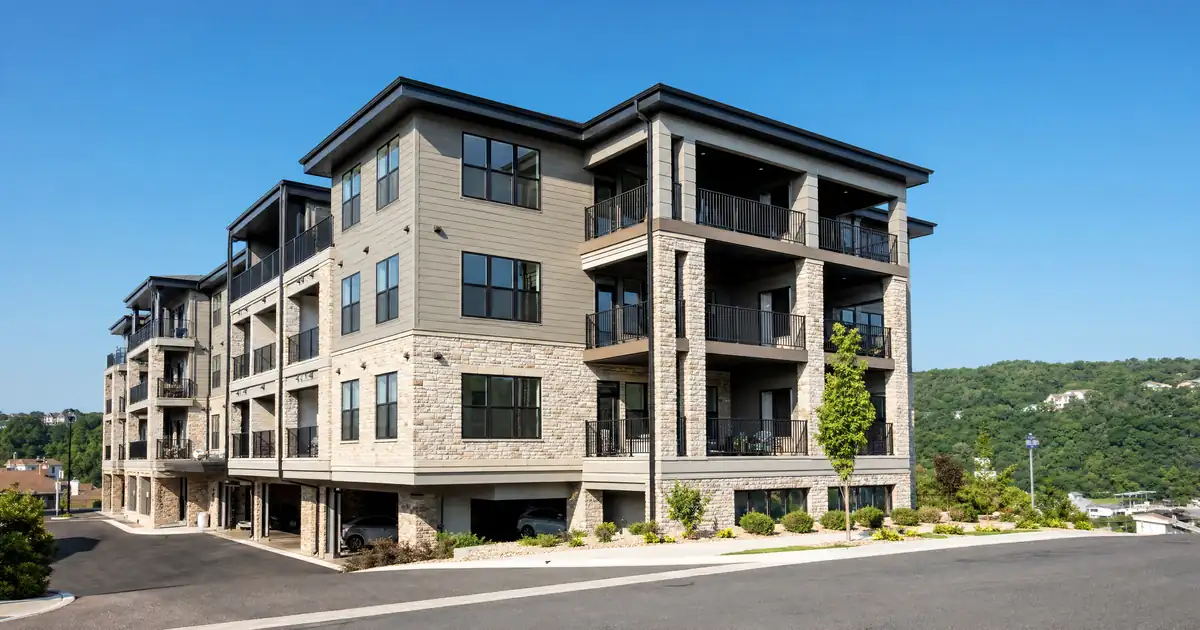
Investors shopping investment property loans in Osage Beach, Missouri usually see the same three things first: private boat docks, nightly rental projections pulled from an Airbnb calculator, and a shoreline that wraps for miles around a lake built by Bagnell Dam generations ago. What they tend to miss is the city underneath the postcard — a small full-time population with a median age well above the statewide figure, according to Census Reporter’s ACS five-year estimates. That’s not a market that fits the standard workforce-rental playbook. It’s a resort town with a hospital anchor, a bifurcated county line, and a rental market so thin on long-term data that most of the underwriting has to be built from proxies rather than a clean comp set.
The Short Version: Osage Beach fits DSCR investors targeting furnished mid-term or long-term rentals near Lake Regional Health System more than classic vacation-rental buyers chasing nightly income, since the property’s rental income — not personal income documents — drives qualification against its full monthly obligation. A few specifics:
DSCR Calculator
Run the numbers in your market
Rate source: Freddie Mac 30-yr average via FRED® — Federal Reserve Bank of St. Louis · effective Jul 30, 2026
Prefilled with starting assumptions — enter your own rent or nightly figures, taxes, insurance, and HOA for a more accurate picture.
Program parameters update from Lendmire’s centralized guideline source. Taxes and insurance are editable estimates.
As of Jul 30, 2026 · General Freddie Mac market benchmark, not a Lendmire loan offer. Rent, nightly rate, occupancy, taxes, and insurance are editable estimates. Short-term rental figures are estimates only and vary significantly by season, property type, management approach, and local short-term-rental rules — confirm local regulations before relying on them. Qualifying income for short-term rentals varies by program — some use appraisal market rent, others use documented STR history or projections — and is confirmed in underwriting. Not a Loan Estimate, approval, or commitment to lend. Program availability and eligibility are subject to lender guidelines, credit approval, property review, and underwriting.
- Lake Regional Health System is the area’s largest single employer, per a funlake.com business profile.
- City employment has grown meaningfully year over year, per Data USA.
- True 2-4 unit multifamily is nearly absent; Redfin recently listed no multi-family units for sale citywide.
- Waterfront listings sit on market roughly twice as long as the citywide baseline.
- Furnished mid-term condo rents near the hospital run well above typical unfurnished workforce rents, per HouseStay.
Osage Beach Market Snapshot
A quick read on the Osage Beach investor landscape — figures come from the cited sources below. Confirm current property-level numbers before underwriting.
| Metric | Detail |
|---|---|
| Home prices | Median home value $392,370 (City-Data.com) |
| Typical rents | Median gross rent $797 (City-Data.com) |
| Recent appreciation | 8.47% 12-mo (NeighborhoodScout Osage Beach) |
| Population | 4,905 population (Census Reporter) |
| Employment | “nearly 1,200 employees,” largest employer (Lake Regional Health System) |
The Numbers Behind the Postcard
Tourism and healthcare, not manufacturing or logistics, drive this economy — a substantial flow of visitors passes through the Lake of the Ozarks region annually, according to Wikipedia’s summary of the area, feeding a retail and hospitality base that dominates local employment. The most common jobs held by Osage Beach residents fall in retail trade, health care and social assistance, and accommodation and food services, per Data USA, and total local employment has climbed noticeably over the past year — a pace of growth that’s hard to find in most small Missouri cities.
Median household income in Osage Beach sits meaningfully below Missouri’s statewide figure, per Census Reporter. That’s a modest wage base, and it matters for underwriting: a typical Lake Regional employee earning the hospital’s average reported wage, according to ZipRecruiter salary data, can reasonably support only a limited monthly rent under a standard affordability check. That limit becomes a ceiling on what an unfurnished, workforce-oriented single-family rental can realistically command near the hospital — a useful sanity check against any overly optimistic pro forma.
Lake Regional Health System is the outsized anchor here. The campus operates a sizable Emergency Department carrying a state-designated Level III Trauma Center status, and Wikipedia’s profile describes a full-service hospital with a substantial physician staff. For a city this size, a hospital system of that scale is unusual — comparable Ozarks resort towns anchored around entertainment or tourism don’t carry an equivalent healthcare employment base relative to population.
Why the Housing Stock Doesn’t Behave Like a Rental Market
Osage Beach’s housing stock skews toward large complexes and single-family homes, not the small multifamily buildings DSCR investors usually hunt for elsewhere. Per NeighborhoodScout, large apartment complexes and high-rises make up the majority of housing units citywide, while duplexes and small conversions are a small minority. Redfin has recently listed no multi-family units for sale citywide. Translation: the classic 2-4 unit “stack the rents, ease the coverage ratio” strategy that works in a lot of Midwest cities simply isn’t available here as a distinct product type.
That reshapes what DSCR math looks like locally. Structure-type pricing data from City-Data shows a clear hierarchy — detached houses pricing highest, two-unit structures a step below, and three-to-four-unit structures trading at a further discount. Where multi-unit product does exist, it trades cheaper per unit than detached single-family — favorable for rent-to-value math on paper — but there’s no dedicated brokerage coverage or investor community built around it. The practical substitute for “multi-unit” here is a condo inside a larger complex, which shifts underwriting toward HOA rules and rental restrictions rather than unit count.
Median home prices also split sharply by segment, and that split matters more than any single “median” number. BestNeighborhood.org puts the citywide median house price below the national figure but above Missouri’s statewide average. City-Data’s separate estimate lands its median house-or-condo value noticeably higher than that BestNeighborhood figure. A local Realtor quoted by Homes.com cites a median sales price well above either of those — almost certainly skewed by lakefront listings rather than reflecting the full market. These aren’t contradictory so much as evidence of a bifurcated market: off-water and inland product prices well below the premium lakefront tier, and averaging them into one number would misrepresent both segments.
Where the Purchase Math Actually Pencils
The strongest DSCR entry points in Osage Beach aren’t the waterfront condos everyone searches for first — they’re the off-water, workforce-adjacent product near the hospital and outlet corridor, and the furnished mid-term rental play that bridges STR-level income with lease stability. The premium lakefront tier carries the recognition, but it also carries the longest resale timelines and the thinnest rent-comp data.
Four Seasons and the affordable entry point. The Four Seasons master-planned community offers condominiums, villas, and homes priced well below the rest of the market — the most accessible entry point identified anywhere in this area. Modeling a purchase at that lower price band on a standard loan-to-value, against a workforce-level rent in line with the average tracked across Osage Beach’s HUD-monitored affordable complexes, per HUD Housing Network, lands coverage right around breakeven — roughly in the 1.00-to-1.01x range on full principal, interest, taxes, and insurance. That’s before condo association dues, which vary by complex and could easily pull the ratio below a workable level. It’s a workable file, but a thin one, and it’s the kind of scenario where reserves and credit tier matter more than usual.
Off-water and inland residential. These communities provide the closest thing Osage Beach has to a traditional workforce-rental submarket — easy drives to the outlet corridor, medical offices, and public boat ramps, without the private-dock premium. Tenant demand here ties to hospital and retail staff rather than tourists, which means steadier occupancy assumptions even if the rent ceiling is lower.
The condo corridor near the hospital. This is where the furnished, mid-term rental thesis gets interesting. Platforms marketing furnished stays in Osage Beach explicitly lead with hospital proximity — one listing pitches itself as minutes from the hospital, same exit — and HouseStay’s tracked data shows furnished, mid-term rents for a two-bedroom, two-bath condo running well above unfurnished workforce rents, across a wide range depending on unit and season. Run that income against a typical City-Data-estimated condo value at a standard loan-to-value, and coverage lands noticeably above 1.00x — comfortably clear of the floor some select DSCR programs use as an eligibility line. That’s a meaningfully stronger number than the unfurnished workforce scenario, and it points to a real pattern: the same physical unit can produce a much larger monthly income depending on whether it’s leased unfurnished and annual or furnished and mid-term. In this market, rent-to-value is less about location and more about lease-structure choice.
DSCR files in resort markets like this one tend to show a consistent pattern: coverage on standard 12-month lease assumptions comes in thin or below 1.00, while the same property modeled on furnished, 30-to-89-day occupancy or trailing STR income clears the bar with room to spare. The stronger files usually document both scenarios and let the lender choose which income stream to credit — rather than assuming the higher number carries the file on its own.
The lakefront and waterfront premium. Waterfront-tagged listings and beach-amenity listings both carry premium pricing and sit on market meaningfully longer than the citywide baseline — nearly double, per Redfin’s tracked inventory. That’s not necessarily a bad segment, but it’s a slower one. A DSCR purchase in this tier faces more price-discovery risk and thinner recent comps than a purchase off-water, which matters when a lender’s appraisal review leans on recent, comparable closings rather than a decade-long trend line.
Financing structure on any of these plays typically runs 75 to 80 percent loan-to-value on standard purchase programs, with the strongest files occasionally reaching up to 85 percent when guidelines allow. Credit tiers generally start around 620 and step up through 660, 680, and 700, with the higher tier usually required to access the top leverage bands. Reserve requirements typically run about six months of the full monthly obligation, moving to nine months on larger balances. None of that is a guarantee of approval — every file still runs through lender review, credit approval, and property underwriting — but it frames what a realistic purchase looks like on the ground.
Appreciation Looks Great — Until You Check Which Chart You’re Reading
Osage Beach’s appreciation story depends heavily on which window an investor looks through, and that’s a genuine risk for anyone sizing a purchase off the wrong one. NeighborhoodScout reports strong trailing 12-month appreciation, ranking well above most cities and towns nationally, and a separate profile cites substantial cumulative appreciation over the past decade. Meanwhile, Redfin’s most current print shows the median sale price across all home types down year over year as of the most recent reporting period. Those two pictures aren’t contradictory as much as they’re measuring different things — a strong multi-year trend against a softer recent print.
The honest read: this is an appreciation-led market on a decade view, with signs of cooling in the most recent market data. An investor sizing a purchase off the multi-year growth rate risks overestimating current value; the more defensible approach anchors to the most recent closed comps, not the long-term trend line. Days-on-market data reinforces the point — Movoto’s tracking shows time on market lengthening in the most recent period compared with the year before, alongside a rising number of homes sold. More transactions, slower absorption per listing: comps depth is improving even as pricing power softens, which is actually useful for a buyer trying to document value to a lender, just not the story the decade-long appreciation stat tells on its own.
The Split-County Quirk (and Why It Matters for Underwriting)
Osage Beach sits across two counties — Camden and Miller — which puts parts of the same city in different television markets (Springfield for Camden County, Columbia/Jefferson City for Miller County) and different school districts, Camdenton R-III and School of the Osage, depending on which side of the line a property falls. Layered on top of that is the region’s private-dock-rights convention: property owners along the shoreline can hold rights to a private dock connected to their land, and in some cases the dock and boat are worth more than the house attached to them. No comparably sized inland Missouri city combines a two-county jurisdictional split with that kind of lake-life property culture, and it’s worth an investor’s time to confirm which county and district a specific parcel falls under before assuming anything about services or tax administration — a detail easy to overlook when shopping listings from out of state.
What This Means for a Purchase-Side DSCR Investor
Lendmire (NMLS# 2371349) arranges DSCR investor loans across 40 states plus Washington, D.C. — 41 markets total — and Osage Beach fits the profile of a market where the property’s income, not the borrower’s W-2 history, carries the file. That framing matters more here than in most cities, because the rent picture bifurcates so sharply between unfurnished workforce leases and furnished mid-term stays. How the rental-income review framework works is a useful starting point for anyone new to the structure, and comparing it against conventional financing helps frame why a self-employed or LLC-titled buyer might prefer it here, subject to program eligibility.
The single biggest blind spot in this market isn’t the private docks or the seasonal vacancy swings — it’s the absence of a real long-term-lease rent comp set. No source tracks year-over-year rent growth or long-term rental vacancy specifically for Osage Beach; every rent figure available, from the HUD affordable-housing average to the furnished mid-term platform data, is a proxy for a different tenant type than the one an investor may actually plan to place. Combine that with a housing market that shows strong appreciation on one measure and a year-over-year decline on another, and the real risk isn’t the deal itself — it’s underwriting a rent assumption or an exit value that no comp actually supports.
Program availability, loan terms, and eligibility are subject to lender guidelines, credit approval, property review, and full underwriting. This article is educational and is not a loan offer or commitment to lend.
DSCR vs. conventional financing
Two common ways to finance an investment property in Osage Beach, MO. They qualify you differently — here’s how investors weigh them.
Why investors choose it
- Qualifies on the property’s rental income — no personal tax returns, W-2s, or pay stubs needed to document income.
- No personal debt-to-income ceiling to clear, so existing mortgages and obligations don’t cap your borrowing the same way.
- Can be closed in an LLC, keeping the property inside a business entity.
- Built for scaling — not held to the limit on number of financed properties that conventional financing applies.
- Underwriting centers on the deal: generally qualifies when the rent covers the payment, a 1.00x coverage ratio being a common baseline (confirmed in underwriting).
- Designed specifically for investment property, including long-term and, where the program allows, short-term rentals.
Where it’s strong
- Often the lowest ongoing financing cost for a buyer who fully qualifies on personal income — a fit for a first property or a cost-first purchase.
Trade-offs for investors
- Requires full personal income documentation and must fit within a debt-to-income limit — salary, existing debts, and other mortgages all count.
- Typically held in your personal name rather than a business entity.
- Caps how many financed properties you can carry, which can become a ceiling as a portfolio grows.
- Evaluates you as a borrower as much as the property, which usually means more paperwork.
How investors usually choose: a first or single property often optimizes for the lowest financing cost; portfolio builders often optimize for leverage, vesting in an LLC, and scaling past conventional caps. The right answer depends on your goals, the property, and current guidelines — both paths run through select lenders in Lendmire’s wholesale network, with eligibility and terms confirmed in underwriting.
Frequently Asked Questions
How do you qualify for a DSCR loan in Osage Beach, Missouri?
Qualification centers on the subject property’s projected rental income measured against its full monthly obligation — principal, interest, taxes, insurance, and any HOA dues — rather than the borrower’s personal income or traditional personal-income documentation. Lenders typically want to see a lease or a market-rent estimate, acceptable credit, and reserves, with exact requirements varying by lender and program.
What credit score is needed for a DSCR loan in Osage Beach?
Most wholesale DSCR programs available through Lendmire start around the 620 tier, with stronger pricing and higher leverage generally reserved for borrowers in the 660, 680, and 700-plus tiers, subject to lender guidelines.
Can furnished mid-term rentals near Lake Regional Health System qualify for DSCR financing?
Yes — furnished, mid-term leases are a common income source for DSCR files in this market, and several Osage Beach condos near the hospital are marketed specifically to that tenant base. Lenders will typically want to see documented rent comparables or platform data supporting the projected income.
Does Osage Beach’s split-county location affect DSCR underwriting?
It doesn’t change how DSCR income qualification works, but investors should confirm which county — Camden or Miller — and school district a specific parcel falls under, since that can affect local administrative details tied to the property.
How much down payment is typically needed for an investment property loan in Osage Beach?
Standard DSCR purchase programs generally run 75 to 80 percent loan-to-value, with some files reaching up to 85 percent when guidelines allow — meaning a down payment in the range of roughly 15 to 25 percent, plus reserves, depending on the lender and borrower profile.
Investors focused on short-term rentals can review DSCR loans for Airbnb and short-term rentals.
For current guidelines and terms, see Lendmire’s DSCR loan programs page.
About Lendmire
Lendmire (NMLS# 2371349) is a non-QM DSCR mortgage brokerage arranging investor loans across 41 markets nationwide — 40 states plus Washington, D.C. Rather than funding loans directly, Lendmire places files with a network of wholesale lenders, giving investors access to a range of DSCR programs and leverage options subject to each lender’s own guidelines, credit approval, and property underwriting. Lendmire does not guarantee approval, leverage, or loan terms on any specific property, including in Osage Beach, Missouri.
Get Started
Ready to find the right loan for you?
In about 30 seconds you can review financing options available for your investment property. No commitment required.
Informational only. Not a Loan Estimate, approval, or commitment to lend. Program availability and eligibility are subject to lender guidelines, credit approval, property review, and underwriting.
References
1. Census Reporter — Osage Beach, MO ACS 2024 5-year profile
2. Lake Regional Health System
4. HouseStay — Furnished Monthly Rentals in Osage Beach, MO
6. NeighborhoodScout — Osage Beach Real Estate
8. Lake Regional Health System
9. ZipRecruiter — Lake Regional Hospital Jobs, Osage Beach, MO
10. Homes.com
11. HUD Housing Network — Osage Beach, Camden County
12. Scotsman Guide 2026 Top Mortgage Workplace
This article is part of Lendmire’s DSCR loan program — full qualification details, guidelines, and scenarios live on the program page.
Related reading: DSCR Loans in Lake of the Ozarks, MO: Investor Financing for Osage Beach, Lake Ozark, Camdenton & Real Estate Investors · Investment Property Loans in Lake Ozark, MO: The 2026 DSCR Financing Guide to the Bagnell Dam Strip · Investment Property Loans in St. Louis, MO: The 2026 DSCR Financing Guide
Guides: DSCR Loans in Osage Beach, MO · DSCR Loans in Missouri
Brandon Miller
Founder & CEO, Mortgage Loan Originator, Lendmire LLC
- Mortgage Loan Originator · NMLS# 1129696 · Verify on NMLS Consumer Access
- North Carolina Real Estate Broker · License# 343312 · Verify on NCREC
- North Carolina Insurance Producer · License# 19053198 · Property, Casualty, Life, Health · Verify on NAIC SBS
- Lendmire LLC · Firm NMLS# 2371349 · Verify firm licensure
Disclosure information. Lendmire is a state-licensed mortgage brokerage under NMLS# 2371349. Lendmire is not a depository institution, direct lender, or financial advisor — all loans referenced are placed through wholesale lender partners and are subject to each lender's underwriting standards. This article is provided for general informational purposes and is not a commitment to lend, nor does it constitute financial, legal, or tax advice. Loan programs, terms, rates, and qualification standards change without notice and depend on borrower profile, property type, and the state in which the subject property is located. Equal Housing Opportunity provider. NMLS Consumer Access: nmlsconsumeraccess.org.