
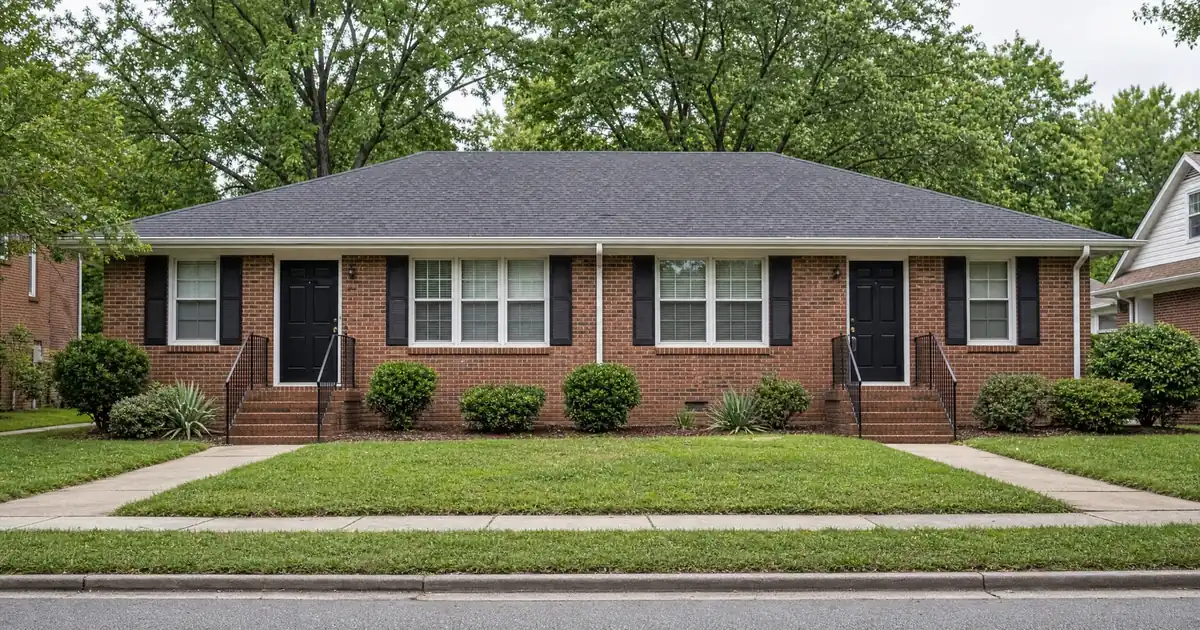
This guide covers investment property loans in Raleigh, explaining how DSCR qualification works across the city’s submarkets. A single-family rental in ZIP 27610 carries a median home value of $316,459 — the lowest of any Raleigh ZIP code — yet commands rent near $1,902 a month, the second-highest rent figure in the city, according to ZIP-level housing data. That inversion is the single most important number in this market for anyone underwriting a coverage ratio here. Most Raleigh submarkets don’t work that way; price and rent tend to move together. Southeast Raleigh breaks the pattern, and that break is exactly what makes a purchase-side DSCR file pencil at a workable leverage point.
The Quick Read: An investment property loan in Raleigh, North Carolina is underwritten primarily against the property’s rental income measured against its full monthly obligation, with lenders leaning on ZIP-level rent data — including the $1,902 average in 27610 — to confirm the number holds before extending leverage.
DSCR Calculator
Run the numbers in your market
Rate source: Freddie Mac 30-yr average via FRED® — Federal Reserve Bank of St. Louis · effective Jul 30, 2026
Prefilled with starting assumptions — enter your own rent or nightly figures, taxes, insurance, and HOA for a more accurate picture.
Program parameters update from Lendmire’s centralized guideline source. Taxes and insurance are editable estimates.
As of Jul 30, 2026 · General Freddie Mac market benchmark, not a Lendmire loan offer. Rent, nightly rate, occupancy, taxes, and insurance are editable estimates. Short-term rental figures are estimates only and vary significantly by season, property type, management approach, and local short-term-rental rules — confirm local regulations before relying on them. Qualifying income for short-term rentals varies by program — some use appraisal market rent, others use documented STR history or projections — and is confirmed in underwriting. Not a Loan Estimate, approval, or commitment to lend. Program availability and eligibility are subject to lender guidelines, credit approval, property review, and underwriting.
- Southeast Raleigh (27610, 27604, 27616) shows the widest rent-to-price spread in the metro.
- Citywide multi-family inventory remains limited, with asking prices trending well below the metro’s premium submarkets, per Redfin.
- NC State’s large student population anchors near-full pre-leasing on small multifamily near campus.
- Apartment-sector vacancy remains elevated, but that dynamic is largely a large-complex story, not a small-plex one.
- Northwest Raleigh/Brier Creek carries a modest price premium tied to scarce new supply.
Raleigh Market Snapshot
A quick read on the Raleigh investor landscape — figures come from the cited sources below. Confirm current property-level numbers before underwriting.
| Metric | Detail |
|---|---|
| Typical rents | 27610 rent $1,902/mo (HousingData.report ZIP analysis) |
| University enrollment | 38,464 total enrollment (NC State University enrollment) |
| Population | 500,000+ population (2024 milestone) (NC Office of State Budget) |
| Employment | Government 91,244 employees (RALtoday (6AM City)) |
| Vacancy | 8.0% (NorthMarq Raleigh-Durham) |
The Southeast Raleigh Rent-to-Price Gap
This is the strongest coverage-ratio submarket in Raleigh right now, and it isn’t close. Southeast Raleigh’s low acquisition basis paired with above-market rent produces the tightest math a purchase-side investor will find in this city — though the leverage point matters more here than almost anywhere else in the metro.
Run a modeled scenario on that 27610 profile: a single-family property priced at $316,459, financed at 75 percent loan-to-value (25 percent down), against a modeled monthly rent of $1,902. Including principal, interest, property tax, and insurance in the full monthly obligation, that scenario lands around 1.02x coverage. Push the leverage to 80 percent (20 percent down) and the ratio slips to roughly 0.97x — a modest but real difference, and a clean illustration of how sensitive this particular submarket’s math is to the down-payment decision. Neighboring 27604, priced at $340,334, and 27616, at $355,944, sit in a similar band and deserve the same leverage discipline.
That’s not a knock on the neighborhood. It’s a reminder that in a market where the rent-to-price ratio is this favorable, the loan structure — not the rent — becomes the swing factor. A borrower with a 700 credit score profile and full reserves might clear a stronger tier; a file with thinner reserves or a lower score may need the extra five points of down payment to hold the ratio above the 1.00x floor available on select programs. Typical purchase leverage across Lendmire’s DSCR network runs 75 to 80 percent, with select strong files eligible up to 85 percent under program guidelines — and reserve requirements around six months of the full monthly obligation, rising near nine months on loans above $1.5 million. None of that is guaranteed on any individual file; it’s the range, subject to lender review, credit approval, and property underwriting.
Files with almost this identical profile show up regularly: modest basis, strong in-place rent, tight but workable coverage at standard leverage. DSCR files from metros with this kind of bifurcated pricing tend to follow a recognizable pattern — the low-basis-ZIP file clears coverage without much friction, while a comparable file from a higher-priced historic district needs either a stronger rent roll or a larger down payment to land in the same range. Lenders reviewing Raleigh files also tend to ask for the actual signed lease rather than a citywide rent estimate when the subject sits in a ZIP with this much price dispersion, since broad averages understate what a property in 27610 alone can support.
The underlying mechanics of how DSCR lender review works apply the same way here as anywhere else — it’s the local rent-to-price relationship that changes the outcome.
What About the Older Duplex Stock Near Historic Oakwood?
Older, lower-basis small multifamily throws off some of the best coverage math in the city — better, in some cases, than the flashier new construction competing for the same buyer pool. One existing Raleigh-area duplex appraised at $166,000 rents its two units for $725 and $695 a month, tenants already in place for more than a year, per listing data from BuySellSearch. Model that at 75 percent LTV and the combined monthly rent produces a coverage ratio near 1.45x — comfortably above the standard threshold, with room to spare even if leverage moves to 80 percent.
Compare that to new construction. A duplex pair near Boyer Street lists at $1,275,000 per building — $2,550,000 combined — per Homes.com listing data. No rent figure that high has been reported for that product, and that’s the point: at that basis, coverage depends almost entirely on premium rent assumptions holding up over time, with far less margin for error than the older stock provides. Historic Oakwood and the surrounding historic districts carry genuine appeal — walkable, near downtown, drawing sophisticated professional tenants — but the DSCR math favors the century-old fourplex over the 2020s-built pair sitting two blocks away.
Citywide, multi-family inventory is thin but active: 29 listings at a median price of $540,000, with roughly 26 units selling in a recent month, per Redfin. That’s not a deep market. Investors hunting the older, lower-basis product in this city need to move when it lists, not wait for a second option to surface.
This is also where the DSCR structure diverges most from a conventional mortgage — the loan is reviewed against the property’s own rent roll rather than a borrower’s personal income documentation, which is where DSCR and conventional diverge in practice.
Northwest Raleigh and Brier Creek: Paying Up for Scarcity
Northwest Raleigh trades at a premium for a reason: there’s almost nowhere left to build. Home values there run roughly 14 percent above the citywide average and are up 11.7 percent year over year, a pace driven by high barriers to entry and limited new development that keeps demand and occupancy tight in the corridor bordering Brier Creek Country Club, William B. Umstead State Park, and RDU International Airport.
Relative to citywide home values reported by Redfin, that premium puts a typical Northwest Raleigh single-family purchase noticeably above the citywide norm. This is a workforce-rental play more than a bargain-hunting one — the tenant base leans toward RTP and tech-adjacent commuters who value the drive time over rent savings, and turnover tends to run lower where good schools and stable employment overlap. Investors underwriting this corridor should pull actual comparable-rent data for the specific property rather than lean on a citywide average; apartment-tracker medians understate what a detached single-family rental in this corridor typically commands.
The NC State Corridor
Nearly 40,000 renters live within walking distance of campus, and that’s before counting graduate students and staff. NC State’s total enrollment for the current academic year runs well into the tens of thousands, spanning both undergraduate and graduate students concentrated along the Hillsborough Street corridor and Centennial Campus. That density supports a captive small-multifamily and ADU market that behaves differently than the citywide rental average.
The clearest evidence: a purpose-built student housing asset near campus — three duplex-style buildings totaling six townhome units and 24 student beds, built in 2020 — sits at 96 percent pre-leased for the coming academic year, per Redfin listing data. That’s not a large purpose-built tower chasing amenities wars; it’s small-scale, duplex-style product locking in near-full occupancy a full year ahead of move-in. For DSCR investors, that pre-lease behavior is a strong signal that 2-4 unit product near this corridor supports dependable coverage math, assuming standard due diligence on lease terms and tenant screening.
Why the Rent Checks Clear: Raleigh’s Employment Base
Skip the tech-hub cliché for a second — the more interesting story in this market is the biopharma wave layered on top of it. Research Triangle Park, the 7,000-acre research park anchoring the broader Research Triangle, hosts more than 300 companies employing roughly 55,000 workers plus another 10,000 contractors, including IBM, Cisco, Fidelity Investments, SAS Institute, Lenovo, and NetApp. Apple’s campus investment is adding more than 3,000 jobs, and Google’s engineering hub is bringing at least 1,000 more.
That’s the layer most Raleigh content already covers. The layer that doesn’t get enough attention: a wave of multi-billion-dollar biomanufacturing investment landing across Wake and neighboring counties. FUJIFILM Diosynth Biotechnologies is expanding its Holly Springs facility by $1.2 billion, adding 680 jobs on top of a $3.2 billion total investment, with employment there reaching 1,400 by the early 2030s, according to Wake County government. Eli Lilly has committed at least $16 billion since 2020 to new manufacturing sites including RTP, and Novo Nordisk’s $4.1 billion expansion in nearby Johnston County is expected to add up to 1,000 jobs, per a WRAL roundup of regional biopharma investment. None of these are single-employer bets — they’re geographically dispersed across the southern Wake and Johnston county line, which spreads tenant-demand risk across multiple anchors rather than concentrating it in one campus.
Layer in the traditional base: Duke University and its health system employ 43,108 across the Triangle, the State of North Carolina employs 24,083, Wake County Public School System employs 17,000, Walmart employs 16,800 in the Triangle, UNC Chapel Hill employs 12,204, and WakeMed Health & Hospitals — a three-hospital, 919-bed system — employs 10,307. Raleigh’s population itself grew by 33,000 people between 2020 and 2024, crossing 500,000 residents and adding more people than any North Carolina city besides Charlotte, according to the North Carolina Office of State Budget and Management. Median household income runs roughly 10 percent above the national figure, per Census Bureau data. That’s a demand base that’s government-stable, healthcare-and-education recession-resistant, and biotech-and-tech growth-oriented, all at once — a combination Charlotte’s finance-heavy economy or the Piedmont Triad’s legacy-manufacturing base doesn’t replicate.
Skip the Vacancy Headline
The apartment-sector vacancy figure making headlines in this market does not describe the properties a DSCR investor actually buys. Raleigh-Durham apartment vacancy closed at 8.0 percent in the first half of a recent year, up 50 basis points year over year, driven by more than 12,000 new apartment-unit completions in a single year, per NorthMarq’s regional multifamily analysis. Rent trackers have also flagged Raleigh among Sun Belt metros posting modest rent declines, grouped with Las Vegas, Austin, and Denver amid elevated vacancy and aggressive new supply.
That softness is concentrated almost entirely in large new-build apartment complexes competing on amenities and concession packages — not in the older duplex, triplex, and fourplex stock, and not in workforce single-family rentals. Zumper’s citywide rent tracker still shows median rent holding at $1,772 a month, essentially flat year over year and 9.1 percent more affordable than the national median. That’s a citywide blended figure across product types, not a sign that 2-4 unit demand has softened. New supply is also cooling fast: completions are on track to fall from more than 13,000 units to roughly 6,000 in a single year, per the Doorstead metro rental report, which should ease the large-complex glut over the next couple of leasing cycles. Investors and appraisers who apply the Class-A vacancy story to a small-plex refinance or purchase file are comping the wrong asset class — and it’s worth pushing back on that comparison when it shows up in an appraisal.
DSCR vs. conventional financing
Two common ways to finance an investment property in Raleigh, NC. They qualify you differently — here’s how investors weigh them.
Why investors choose it
- Qualifies on the property’s rental income — no personal tax returns, W-2s, or pay stubs needed to document income.
- No personal debt-to-income ceiling to clear, so existing mortgages and obligations don’t cap your borrowing the same way.
- Can be closed in an LLC, keeping the property inside a business entity.
- Built for scaling — not held to the limit on number of financed properties that conventional financing applies.
- Underwriting centers on the deal: generally qualifies when the rent covers the payment, a 1.00x coverage ratio being a common baseline (confirmed in underwriting).
- Designed specifically for investment property, including long-term and, where the program allows, short-term rentals.
Where it’s strong
- Often the lowest ongoing financing cost for a buyer who fully qualifies on personal income — a fit for a first property or a cost-first purchase.
Trade-offs for investors
- Requires full personal income documentation and must fit within a debt-to-income limit — salary, existing debts, and other mortgages all count.
- Typically held in your personal name rather than a business entity.
- Caps how many financed properties you can carry, which can become a ceiling as a portfolio grows.
- Evaluates you as a borrower as much as the property, which usually means more paperwork.
How investors usually choose: a first or single property often optimizes for the lowest financing cost; portfolio builders often optimize for leverage, vesting in an LLC, and scaling past conventional caps. The right answer depends on your goals, the property, and current guidelines — both paths run through select lenders in Lendmire’s wholesale network, with eligibility and terms confirmed in underwriting.
Frequently Asked Questions
Why does Southeast Raleigh show the strongest coverage ratios in the metro?
Because its home values sit lowest in the city while its rent sits second-highest. ZIP 27610 carries a median value of $316,459 against rent near $1,902 a month — a spread that doesn’t exist in most of Raleigh’s other submarkets, where price and rent tend to track more closely together.
How do you qualify for a DSCR loan in Raleigh, NC?
Qualification centers on the property’s rental income measured against its full monthly obligation — lenders look for coverage at or above the standard 1.00x floor, alongside credit score, reserves, and down payment. In Southeast Raleigh’s low-basis ZIPs like 27610, the modeled scenario at 75% LTV lands around 1.02x coverage, barely above that floor, while other submarkets may need a stronger rent roll or a larger down payment to land in the same range.
Does NC State’s enrollment actually translate into rental demand near campus?
The evidence points that way. A small-scale, duplex-style student housing property near campus sits at 96 percent pre-leased a full year ahead of occupancy, and NC State’s enrollment of 38,464 keeps that renter pool deep along the Hillsborough Street and Centennial Campus corridor.
Is the 8.0 percent apartment vacancy figure a warning sign for single-family investors?
Not directly. That figure reflects large new-build apartment complexes absorbing a wave of recent completions — not the smaller, older rental stock most DSCR purchasers target. Citywide rent has stayed roughly flat, and new apartment deliveries are projected to fall by more than half in the coming year.
Which submarket has the most duplex and fourplex inventory to buy right now?
Historic Oakwood and the near-downtown historic districts carry the strongest concentration of small multifamily listings, though citywide inventory is thin — 29 multi-family listings at a $540,000 median price. Older, lower-basis stock in that price range tends to clear coverage more comfortably than new construction priced well into seven figures.
What are the requirements for a DSCR loan in Raleigh, NC?
Programs across Lendmire’s network generally start around a 620 minimum credit score, with better pricing tiers opening up at 660, 680, and 700, subject to lender guidelines and property review. Reserve requirements typically run around six months of the full monthly obligation, rising near nine months on loans above $1.5 million, with down payments generally in the 15 to 25 percent range depending on the leverage tier. Higher scores and stronger reserves typically support higher leverage, though nothing here is guaranteed on any specific file.
Investors comparing Raleigh against other markets in the state can review the North Carolina DSCR investor loans program page for a broader look at how coverage ratios trend across the state, and the full investor lending menu covers the range of structures available to entity-titled and multi-property borrowers, subject to program eligibility. For a direct look at how a specific Raleigh property models, investors can run the numbers with Lendmire or call 828-256-2183.
Raleigh’s rent-to-price gap won’t stay this wide indefinitely — Southeast Raleigh has already been flagged as one of the region’s better-positioned buys, and comp depth in adjacent submarkets is thickening as more transactions close. The investors who lock in the low-basis, high-rent product in this market now, before that spread compresses, are the ones who’ll be running the strongest coverage ratios in this metro two years from now.
About Lendmire
Lendmire — NMLS# 2371349 — is a mortgage brokerage specializing in DSCR investor loans, helping arrange financing across 41 markets, including Washington, D.C., through wholesale and investor-lending channels. The model centers on property-level rental income reviewed by the lender rather than W-2 documentation, subject to lender guidelines, suiting entity-owned and multi-property investors. Lendmire has been recognized as a 2026 Scotsman Guide Top Mortgage Workplace and was recognized by Scotsman Guide in 2025 as well.
Get Started
Ready to find the right loan for you?
In about 30 seconds you can review financing options available for your investment property. No commitment required.
Informational only. Not a Loan Estimate, approval, or commitment to lend. Program availability and eligibility are subject to lender guidelines, credit approval, property review, and underwriting.
References
1. HousingData.report ZIP-Level Analysis
2. Redfin Raleigh Multi-Family Listings
3. NorthMarq Raleigh-Durham Multifamily Insight
4. NC State University Enrollment (Data USA)
5. North Carolina Office of State Budget and Management
7. Homes.com Raleigh Multi-Family Listings
8. Redfin Raleigh Housing Market
9. Research Triangle (Wikipedia)
10. Wake County Government — FUJIFILM Press Release
11. WRAL Biopharma Investment Roundup
12. U.S. Census Bureau QuickFacts
14. Doorstead Raleigh-Durham Metro Rental Report
15. a 2026 Scotsman Guide Top Mortgage Workplace
16. recognized by Scotsman Guide in 2025
This article is part of Lendmire’s DSCR loan program — full qualification details, guidelines, and scenarios live on the program page.
Related reading: Cash Out Refinance Investment Property in Raleigh NC · DSCR Loans Raleigh-Durham: Investor Financing for Research Triangle, Duke, NC State & Real Estate Investors · Investment Property Loans in Charlotte, NC: The 2026 DSCR Financing Guide to South End
Guides: DSCR Loans in Raleigh, NC · DSCR Loans in North Carolina
Brandon Miller
Founder & CEO, Mortgage Loan Originator, Lendmire LLC
- Mortgage Loan Originator · NMLS# 1129696 · Verify on NMLS Consumer Access
- North Carolina Real Estate Broker · License# 343312 · Verify on NCREC
- North Carolina Insurance Producer · License# 19053198 · Property, Casualty, Life, Health · Verify on NAIC SBS
- Lendmire LLC · Firm NMLS# 2371349 · Verify firm licensure
Compliance and disclosures. Lendmire (NMLS# 2371349) is a licensed mortgage broker and is not a direct lender, depository institution, financial advisor, or tax professional. Content in this article is general market analysis and educational information — not financial, legal, or tax advice for any specific situation. Lendmire does not guarantee loan approval; every transaction is subject to underwriting by the funding lender. Mortgage pricing and loan program guidelines are subject to change at any time without notice and vary by borrower characteristics, property type, and state regulations. Lendmire complies with Equal Housing Opportunity. Licensure verification: NMLS Consumer Access.