
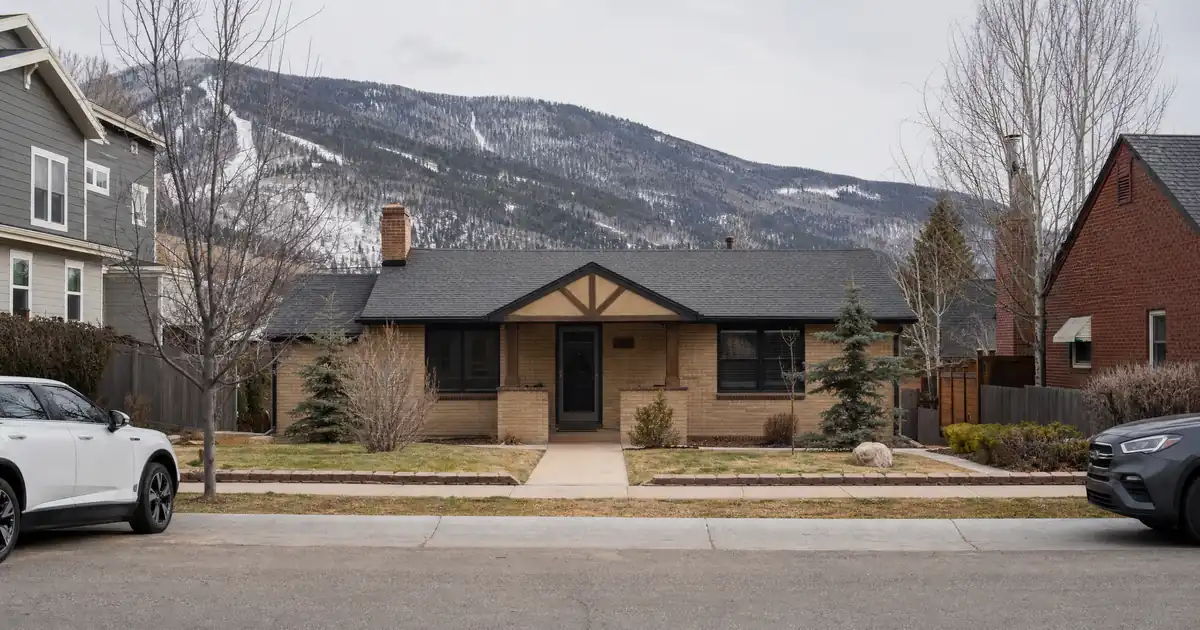
The objection comes up in the first five minutes of almost every conversation about investment property loans in Vail: the numbers look broken. A median property value near $1.4 million against an average monthly rent of $1,592 is not a ratio that inspires confidence in anyone who has ever run a coverage calculation. Fair enough. But the objection assumes every property in Vail looks like a ski-in condo in the core village, and that assumption is wrong. The math changes — sometimes substantially — once the conversation moves to West Vail, East Vail, and the unincorporated pocket called EagleVail, and it changes again once the town’s own deed-restriction program enters the picture.
Key Takeaways: An investment property loan in Vail, Colorado is underwritten primarily on the subject property’s rental income measured against its full monthly housing obligation, not the borrower’s traditional personal-income documentation, with coverage benchmarked against rent data such as the $1,592 average monthly rent Apartments.com/CoStar reported for the town.
DSCR Calculator
Run the numbers in your market
Rate source: Freddie Mac 30-yr average via FRED® — Federal Reserve Bank of St. Louis · effective Jul 30, 2026
Prefilled with starting assumptions — enter your own rent or nightly figures, taxes, insurance, and HOA for a more accurate picture.
Program parameters update from Lendmire’s centralized guideline source. Taxes and insurance are editable estimates.
As of Jul 30, 2026 · General Freddie Mac market benchmark, not a Lendmire loan offer. Rent, nightly rate, occupancy, taxes, and insurance are editable estimates. Short-term rental figures are estimates only and vary significantly by season, property type, management approach, and local short-term-rental rules — confirm local regulations before relying on them. Qualifying income for short-term rentals varies by program — some use appraisal market rent, others use documented STR history or projections — and is confirmed in underwriting. Not a Loan Estimate, approval, or commitment to lend. Program availability and eligibility are subject to lender guidelines, credit approval, property review, and underwriting.
- West Vail and EagleVail carry the most workforce-tenant-oriented rental stock in the valley.
- Vail Village/Lionshead reportedly trade up to $1,700 per square foot versus $950 to $1,200 in East/West Vail (local brokerage estimate). A regional health system employs over 1,800 people including 460 physicians — a year-round, non-seasonal tenant anchor.
- Redfin’s $2.7 million median sale price is up 62.9 percent year over year, a sign of thin transaction volume rather than a broad repricing.
- Vail InDEED returns 15 to 20 percent of appraised value in cash for accepting a deed restriction on a unit.
Vail Market Snapshot
A quick read on the Vail investor landscape — figures come from the cited sources below. Confirm current property-level numbers before underwriting.
| Metric | Detail |
|---|---|
| Home prices | $1,762,792 average home value (Zillow Home Values) |
| Typical rents | $1,592 avg (Apartments.com Rent Market) |
| Recent appreciation | +4.4% yoy (Zillow Home Values) |
| Population | 4,613 population (Census Reporter) |
| Employment | ~1,000 employees (prior period) (CampusAlliedHealth) |
The Price Nobody Can Quite Agree On
Vail’s real estate data does not converge, and that divergence is itself information. Zillow puts the average home value at $1,762,792, up 4.4 percent over the past year. Redfin reports a median sale price of $2.7 million, up 62.9 percent year over year, with homes sitting on market for 109 days versus 48 days a year earlier — and only 15 sales recorded in a recent month against 20 the year before. Data USA’s figure lands at $1.4 million median property value, itself up 34.7 percent year over year.
None of these numbers are wrong. They are measuring a market with almost no transaction volume, where a handful of trophy-property closings can swing a median by tens of percentage points in a single reporting period. That is the single biggest analytical trap in Vail: treating any one of these figures as a stable comp rather than a snapshot of a very thin sample. For underwriting purposes, the Vail Board of REALTORS® MLS is the better source to pull current comps from before finalizing a purchase price assumption — town-wide aggregator figures are directional, not precise.
Behind the pricing noise sits a small, aging, and wealthy population. Census Reporter’s most recent estimate puts full-time population at 4,613 across 4.7 square miles, with a median age of 49.8 — about 25 percent older than the surrounding micro area — and median household income of $98,893. Per capita income runs $103,430. That’s a resident base with buying power but not much bulk. The real demand story is seasonal: local estimates put roughly 5,000 part-time residents layered on top of the full-time count, meaning the town’s effective population roughly doubles during ski season and summer festival months.
Vail Village and Lionshead: Ski-In Convenience, Not DSCR Convenience
Vail Village and Lionshead are the wrong neighborhoods for a straightforward long-term-rental purchase, and the pricing explains why. Per-square-foot figures reportedly run up to $1,700 in the core village (a local brokerage estimate, not MLS-verified) — a number driven by ski-in/ski-out access to Gondola One and the Eagle Bahn Gondola, not by anything a monthly lease payment could plausibly cover.
These two districts are built for transient demand: nightly guests, seasonal corporate housing, and second-home owners who visit a handful of weeks a year. Landmarks like the Grand Hyatt, the Arrabelle, and the Sonnenalp sit in the same footprint as condo-hotel and fractional product. A handful of competitor lenders active in Colorado mountain markets lean hard into short-term-rental income projections for exactly this kind of unit, using trailing nightly-rate data to back into a coverage ratio. That approach can work — DSCR lender review does not require a 30-year lease, and short-term rental income can factor into a file depending on lender guidelines — but it also means the file lives and dies on occupancy assumptions rather than a signed lease, and mountain condo HOA dues, which can run past $400 a month in this footprint, eat directly into that coverage before rent ever gets counted. An investor buying in the core should pull the HOA resale certificate before modeling anything.
Where the Long-Term Rental Math Actually Pencils
West Vail, East Vail, and EagleVail are where a standard 30-year DSCR purchase makes the most sense in this market, because they hold the town’s actual workforce tenant pool rather than its vacation-guest pool. West Vail North looks at Vail Mountain; West Vail South sits along Gore Creek with condos, townhomes, and single-family stock. East Vail — Booth Creek, Bighorn, Pitkin Creek — carries a heavier concentration of duplex and townhome product, which supports small multi-unit income-stacking rather than single-tenant exposure. Local brokerage estimates put per-square-foot pricing in East and West Vail at $950 to $1,200, a meaningful discount to the core village figure above, though investors should confirm current numbers against active MLS listings before underwriting.
EagleVail, home to roughly 4,000 residents, sits just outside Town of Vail limits in unincorporated Eagle County — a distinction that matters for zoning and for eligibility in town-specific programs discussed below, but not for rental demand. Its tenant base skews toward service and hospitality workers commuting up-valley, and its single-family and duplex stock gives an investor a genuine year-round lease rather than a seasonal one.
The Vail Golf Course neighborhood and the Sandstone/Buffehr Creek corridor round out the workforce-friendly tier. The golf course area carries single-family and duplex product with lower density and family-oriented layouts; Sandstone and Buffehr Creek trade at a discount to core pricing and draw a locals-heavy renter base, according to MLS category listings.
A durable, non-seasonal demand driver sits behind all of these neighborhoods: a regional health system. The system now employs over 1,800 people and 460 credentialed physicians — up from roughly 1,000 employees in recent years — running a 520,000-square-foot, 56-bed hospital with a Level III trauma center and helipad, plus the internationally known Steadman Clinic for orthopedic and sports-medicine care. That is 12-month staffing growth, not ski-season staffing. Combined with the town’s tiny four-year-education footprint — no university sits inside Vail proper, though Colorado Mountain College’s Vail Valley campus in nearby Edwards serves the valley within a system enrolling roughly 14,000 students district-wide — the hospital is arguably the single most stable non-tourism tenant anchor in the market.
Running the Numbers: A Modeled West Vail Duplex
Consider a modeled purchase — not an actual listing — of a two-unit duplex in West Vail priced around $900,000, financed at 75 percent LTV, which is within Lendmire’s typical purchase range of 75 to 80 percent (about 20 to 25 percent down) for standard DSCR files. Assume combined market rent near $4,440 a month, based on roughly doubling the $2,220 average two-bedroom rent CoStar reported through Apartments.com for Vail.
Run that rent against full PITIA — principal, interest, taxes, and insurance, not P&I alone — and coverage lands in the high-0.80s, short of the 1.00 benchmark most standard programs are built around. That is a fairly representative result for unrestricted market-rate purchases at full leverage in this town: prices have simply outrun what a 12-month lease generates, even in the cheaper submarkets. A file landing there is not automatically dead. It’s a candidate for a sub-1.00 program, a larger down payment to shrink the loan balance, or an interest-only structure to reduce the monthly obligation being tested against rent — all subject to lender guidelines, credit profile, and reserves, and none of it a guarantee of approval.
DSCR files in mountain resort markets like this one tend to arrive with a wide gap between the rent a listing agent advertises and the rent a lender will actually underwrite — the advertised figure usually assumes peak-season nightly stays, while the file gets built on trailing long-term lease data or a conservative market-rent opinion. The stronger files in markets like Vail typically show a documented long-term lease or comparable rent survey up front rather than an aspirational number, because that’s what shortens the back-and-forth on the coverage calculation.
One local mechanism worth understanding before writing off a West Vail or Vail Village purchase: the town’s Vail InDEED program buys deed restrictions directly from property owners at 15 to 20 percent of a unit’s appraised value, according to a HUD case study on the program. There’s no income cap or resale price cap on the InDEED version, and the owner may still rent the unit through the realtor of their choosing — the only requirement is that the occupant work at least 30 hours a week in Eagle County and use the unit as a primary residence. An investor who accepts that restriction receives a lump-sum cash payment from the town that can go straight against the down payment or reduce the loan balance, tightening the debt-service side of the coverage equation without asking rent to do any extra work. It also locks in a legally durable tenant pool rather than a market assumption — arguably a cleaner underwriting story than a market-rate unit with no restriction at all. Note that the newer Eagle County “Good Deeds” program works differently: it caps future resale appreciation at 0 to 3 percent simple interest a year, which makes it a pure cash-flow play with little room for a future cash-out refinance — a distinction that matters more than which neighborhood the unit sits in.
Multi-Unit Product and the Timber Ridge Signal
Vail’s housing stock leans multi-unit more than most people assume: large apartment or high-rise product accounts for 55.67 percent of the town’s housing units, row houses and other attached homes another 19.65 percent, single-family detached homes 15.34 percent, and duplexes or small apartment buildings 9.11 percent. That skew is why small multifamily, not single-family, is generally the stronger DSCR candidate here.
The town’s Timber Ridge Village redevelopment illustrates the per-bedroom economics well, even though the project itself is deed-restricted and not a direct acquisition target for outside investors. Projected pricing for the fully restricted units there runs from $377,000 for a studio to $655,000 for a two-bedroom to $1,080,000 for a four-bedroom, replacing 98 existing deed-restricted homes (196 bedrooms) with 284 units totaling 567 bedrooms. Divide those prices by bedroom count and the figure lands somewhere around $270,000 to $377,000 per bedroom — a fraction of the $950 to $1,700 per square foot figures cited for unrestricted product elsewhere in town. It’s not a template an outside investor can replicate directly, but it demonstrates why multi-bedroom, income-stacked product consistently outperforms single-unit exposure on a per-dollar-of-rentable-space basis in this market.
Absorption risk on restricted long-term product, meanwhile, looks close to nonexistent. The Residences at Main Vail, a 72-home deed-restricted rental development for Eagle County locals, reached full occupancy within months of delivery. That is the opposite of the lease-up risk generic resort-town data usually implies, and it supports the workforce-housing thesis for West Vail and EagleVail more than any single rent figure could.
| Submarket | Reported Pricing | Tenant Profile | DSCR Fit |
|---|---|---|---|
| Vail Village / Lionshead | Up to $1,700/sq ft (est.) | Nightly guests, second-home owners | STR-lean; HOA drag |
| West Vail / East Vail | $950–$1,200/sq ft (est.) | Local workforce, families | Best long-term fit |
| EagleVail | Not MLS-quoted | Service/hospitality commuters | Long-term fit; outside Town of Vail |
Given how far Vail’s price points sit above national norms — Data USA puts the median property value at 4.21 times the national average — reserve requirements deserve a mention. Lendmire’s standard DSCR guidance calls for roughly six months of PITIA in reserve, stepping up to around nine months above a $1,500,000 loan amount. A meaningful share of Vail purchases, even in the workforce-oriented submarkets, land past that threshold, so investors should size reserves against the higher bar rather than the base one. Loan amounts through most standard programs run up to $3,000,000, which covers the bulk of West Vail and East Vail product but can get tight against the top end of core-village unit pricing. Terms vary by lender guidelines, property type, leverage, credit profile, and full file review.
Frequently Asked Questions
How do you qualify for a DSCR loan in Vail, Colorado?
Qualification centers on the property’s rent-to-debt ratio rather than the borrower’s traditional personal-income documentation. A lender compares projected or in-place rent — benchmarked against sources like HUD’s Fair Market Rent figure of $2,030 for a two-bedroom in Eagle County — against the full monthly obligation including taxes and insurance, alongside credit, reserves, and property condition.
What are the requirements for an investment property loan in Vail, Colorado?
Most standard programs call for 75 to 80 percent LTV (20 to 25 percent down), a minimum DSCR around 1.00, and credit scores generally in the 620 to 700 range depending on leverage and loan size, with higher-leverage options up to 85 percent reserved for the strongest files where guidelines allow. Reserve requirements typically run six months of PITIA, rising to nine months on loans above $1,500,000 — a threshold a fair number of Vail purchases cross.
DSCR vs. conventional financing
Two common ways to finance an investment property in Vail, CO. They qualify you differently — here’s how investors weigh them.
Why investors choose it
- Qualifies on the property’s rental income — no personal tax returns, W-2s, or pay stubs needed to document income.
- No personal debt-to-income ceiling to clear, so existing mortgages and obligations don’t cap your borrowing the same way.
- Can be closed in an LLC, keeping the property inside a business entity.
- Built for scaling — not held to the limit on number of financed properties that conventional financing applies.
- Underwriting centers on the deal: generally qualifies when the rent covers the payment, a 1.00x coverage ratio being a common baseline (confirmed in underwriting).
- Designed specifically for investment property, including long-term and, where the program allows, short-term rentals.
Where it’s strong
- Often the lowest ongoing financing cost for a buyer who fully qualifies on personal income — a fit for a first property or a cost-first purchase.
Trade-offs for investors
- Requires full personal income documentation and must fit within a debt-to-income limit — salary, existing debts, and other mortgages all count.
- Typically held in your personal name rather than a business entity.
- Caps how many financed properties you can carry, which can become a ceiling as a portfolio grows.
- Evaluates you as a borrower as much as the property, which usually means more paperwork.
How investors usually choose: a first or single property often optimizes for the lowest financing cost; portfolio builders often optimize for leverage, vesting in an LLC, and scaling past conventional caps. The right answer depends on your goals, the property, and current guidelines — both paths run through select lenders in Lendmire’s wholesale network, with eligibility and terms confirmed in underwriting.
Can a DSCR loan finance a short-term rental in Vail Village or Lionshead?
Non-owner-occupied short-term rentals can factor into DSCR underwriting depending on lender program guidelines, typically using trailing or projected nightly income rather than a signed lease. Investors should independently confirm current Town of Vail short-term-rental licensing and zoning requirements before underwriting projected nightly income, since local rules affect what income a lender will credit.
Does the Vail InDEED deed-restriction program affect DSCR financing?
It can change the equity side of the transaction more than the loan structure itself. Accepting an InDEED restriction returns 15 to 20 percent of appraised value in cash from the town, which an investor can apply toward a larger down payment or a reduced loan balance — tightening the debt-service side of a coverage calculation. It also locks in a legally defined tenant pool (Eagle County workers logging at least 30 hours weekly) rather than a market assumption, though eligibility and program terms should be confirmed directly with the Town of Vail Housing Department.
What credit score ranges may DSCR lenders review for a Vail rental property?
Ranges generally run from 620 on the low end up to 700 for higher-leverage files, though the exact figure reviewed depends on the loan-to-value requested and the lender’s overlay for that scenario.
Investors weighing Vail Village against West Vail should also compare financing structures side by side — the differences between a DSCR loan and a conventional investment mortgage, covered in the guide “Where DSCR and Conventional Diverge”, often matter more here than in a typical market, given how much of Vail’s rental income comes from non-traditional sources. Anyone ready to model a specific address can compare DSCR options directly, or call Lendmire at 828-256-2183 to talk through a submarket-specific scenario. Investors working across multiple Colorado mountain towns can review Lendmire’s Colorado DSCR platform for a broader state-level view, or the guide “The Investor Loan Platform” for other markets.
The biggest blind spot for a DSCR-financed purchase in Vail isn’t the rent-to-price ratio — it’s the comp itself. With only 15 sales recorded in a recent month and a median price that swung 62.9 percent year over year, a single appraisal can land far from what a spreadsheet assumed six weeks earlier. Anyone underwriting a Vail purchase should treat the appraisal, not the rent roll, as the number most likely to move the deal.
About Lendmire
Lendmire is a DSCR-focused mortgage brokerage, NMLS# 2371349, placing investor loans across 41 markets, including Washington, D.C. DSCR eligibility is generally reviewed by the lender on a property’s rental income rather than personal income documentation, which fits LLC-held rentals, self-employed investors, and portfolios scaling past conventional financed-property limits. Scotsman Guide named Lendmire a Top Mortgage Workplace in both 2025 and 2026.
Get Started
Ready to find the right loan for you?
In about 30 seconds you can review financing options available for your investment property. No commitment required.
Informational only. Not a Loan Estimate, approval, or commitment to lend. Program availability and eligibility are subject to lender guidelines, credit approval, property review, and underwriting.
References
1. Apartments.com Rent Market Trends — Vail, CO
5. Redfin Housing Market — Vail, CO
7. Colorado Mountain College — Vail Valley at Edwards
8. Town of Vail — InDEED Program
9. HUD User Case Study — Vail InDEED
10. Scotsman Guide 2025 Top Mortgage Workplace
11. Scotsman Guide 2026 Top Mortgage Workplace
This article is part of Lendmire’s DSCR loan program — full qualification details, guidelines, and scenarios live on the program page.
Related reading: Luxury Rental DSCR Loans In Vail: A Complete Guide · DSCR Loans in Vail / Aspen, Colorado: Investor Financing for Vail Village, Basalt & the Roaring Fork Valley — Luxury STR, Ski Resort Rentals & Real Estate Investors · Investment Property Loans in Telluride, CO: The 2026 DSCR Financing Guide to the Box Canyon
Guides: DSCR Loans in Vail, CO · DSCR Loans in Colorado
Brandon Miller
Founder & CEO, Mortgage Loan Originator, Lendmire LLC
- Mortgage Loan Originator · NMLS# 1129696 · Verify on NMLS Consumer Access
- North Carolina Real Estate Broker · License# 343312 · Verify on NCREC
- North Carolina Insurance Producer · License# 19053198 · Property, Casualty, Life, Health · Verify on NAIC SBS
- Lendmire LLC · Firm NMLS# 2371349 · Verify firm licensure
Disclosures. The information presented in this article is general market commentary, not financial, legal, or tax advice. Lendmire is a mortgage brokerage (NMLS# 2371349) — not a direct lender or depository institution — and loan placement is subject to lender underwriting. Nothing in this content represents a commitment to lend. Loan terms, pricing, and program availability vary based on borrower qualifications, property characteristics, and state of subject property, and are subject to change at any time. Lendmire complies with Equal Housing Opportunity requirements. Consumer access: nmlsconsumeraccess.org.