
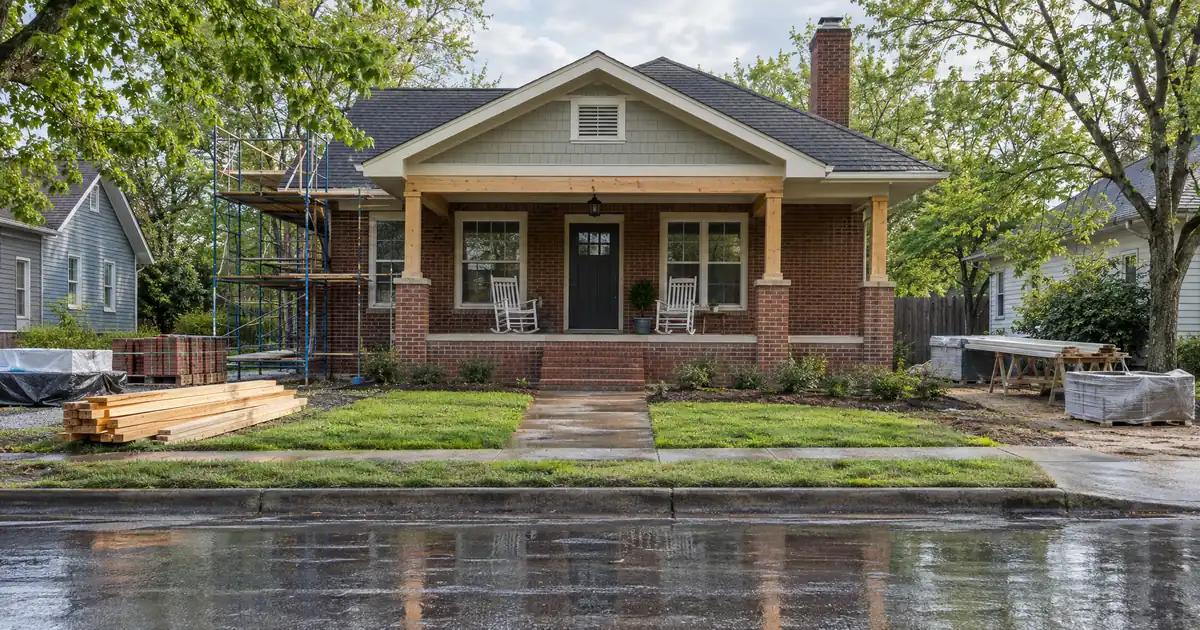
The Quick Read: It depends on whether the property’s condition or a seller’s deadline is the obstacle, because hard money fits a distressed or heavy-rehab purchase that a bank won’t touch, while a bank or DSCR loan fits a stable rental the investor plans to hold. Most rental investors end up using both in sequence: a short-term loan to buy and renovate, then long-term financing to pay it off.
- Hard money is underwritten mainly on the property, the plan, and the exit. Bank loans lean more on the borrower’s credit and documented income.
- Terms on the current program run 6-18 months, interest-only, so the loan must be repaid by a sale or refinance on a set date.
- Hard money costs more than a bank loan, but the premium can be worth paying when it wins a deal that bank financing would lose.
- The real risk is the exit. A low appraisal or thin rent coverage can leave part of the bridge loan unpaid.
- Leverage, credit, and terms vary by lender, property, and experience, and nothing here is a commitment to lend.
Hard Money vs. Bank Loan: What Actually Differs?
Hard money is asset-based and a bank loan is credit-based. The hard money lender asks what the property is worth, what the plan is, and how the loan gets repaid. A bank asks about the borrower’s income, credit history, and the property’s stability. Everything else follows from that split.
What this loan actually costs to carry.
Hard money is sized against the project and priced by time. Enter the deal and see how much the program will lend, the cash required at closing, the carry while you hold it, and what is left at the exit.
Leverage tiers on the current program: 85% with fewer than 2, 90% with 2 or more, 93% with 5 or more completed projects — every tier capped at 75% of after-repair value. Loan amounts up to $5,000,000, larger by exception; terms of 6 to 18 months, interest-only, no prepayment penalty. The rehab portion funds in draws against completed work, not at closing.
Program parameters shown update from Lendmire’s centralized guideline source. Rate, points, and months are editable assumptions, not quoted terms.
Cost cap sets the loan · positive spread
Illustrative estimate only — not a quote, Loan Estimate, approval, or commitment to lend. Rate, points, and months are editable assumptions. Hard money is business-purpose financing for real estate investors, not a consumer mortgage. Leverage on the current program tops out at 93% of project cost for investors with a documented track record, capped at 75% of after-repair value, with rehab funding up to 100% of the documented budget released in draws; actual terms vary by lender, borrower experience, property, and exit. Lendmire is a mortgage broker, not a lender.
| Factor | Hard money | Bank loan | DSCR loan |
|---|---|---|---|
| Main underwriting basis | Property, plan, exit | Borrower income and credit | Rent vs. full payment |
| Typical use | Buy, rehab, bridge | Stabilized hold | Stabilized rental hold |
| Term | 6-18 months | Long-term | Long-term, 30-year fixed spine |
| Payments | Interest-only | Amortizing | Amortizing; interest-only through select lenders |
| Property condition | Distressed is workable | Usually must be habitable | Usually leased and stable |
| Cost | Highest of the three | Lowest, usually | Between the two |
Treat the table as a map, not a rulebook. Some banks and credit unions offer their own short-term renovation loans, so the line between “bank” and “hard money” is not absolute. Pricing, fees, and appetite differ from lender to lender.
Across the wholesale network Lendmire places files with, the pattern is consistent. A property that is vacant, unfinished, or being repositioned goes to short-term capital. A property with a lease in place and a hold plan goes to long-term financing. Trouble starts when an investor puts a long-hold property on a short loan, or a half-finished property into a loan that expects a tenant.
When Does Hard Money Make Sense?
Hard money makes sense when the deal’s problem is condition, deadline, or both. If a bank can’t finance the property as-is, or the seller will not wait for a full bank file, short-term asset-based capital is often the only workable structure. These situations come up repeatedly:
- Heavy rehab. The property can’t be leased today, so rental coverage doesn’t exist yet. Hard money funds the purchase and releases rehab money in draws against completed work.
- Fix-and-flip. The exit is a sale, and a short term fits a short project.
- Bridge purchase. The investor needs to own the property now and will place long-term financing after stabilizing it.
- Bank-declined collateral. Distressed or unusual properties often fail a bank’s condition standards even when the numbers are strong.
- Deadline-driven purchases. Auctions and motivated sellers reward the buyer with the simpler file.
The cost premium can be rational. Lost deals carry a price too, and a loan that costs more per month but secures a below-market purchase may beat a cheaper loan that arrives after the seller moves on. Interest-only payments soften the monthly carry, and the program carries no prepayment penalty, so a short hold doesn’t incur an exit toll. Total cost still depends on fees plus how long the loan stays open, and a project that runs long can erase the savings.
When Is the Bank or DSCR Loan the Better Call?
Take the bank or DSCR route when the property is stable, leased, and meant to be held. In that case the short-term premium buys nothing. There is no rehab to fund and no deadline to meet, so the cheaper long-term structure wins.
The two long-term routes differ by borrower. A bank loan favors an investor with strong documented income and a small portfolio. A DSCR loan is reviewed primarily on property-level rental income covering the payment, subject to lender guidelines, so it suits self-employed investors, entity-owned portfolios, and anyone whose traditional personal-income documentation understates what the property earns. The complete DSCR loans guide walks through how that test works.
Two cautions apply. First, a passing coverage ratio is not the same as positive cash flow. DSCR compares rent to the full payment (principal, interest, taxes, insurance, and any HOA dues) and nothing else. Repairs, vacancy, management, utilities, and capex sit outside the number.
Second, hard money is the wrong tool when the deal only works at full after-repair value. If the margin vanishes at a slightly lower appraisal, skip the leverage and renegotiate the purchase price.
What Does a Hard Money Deal Look Like in Practice?
Hard money leverage is measured against project cost and capped against after-repair value. Fix-and-flip files on the current program run up to 93% of project cost for investors with 5+ completed projects, 90% of cost at 2+ projects, and 85% of cost with fewer than 2. Every tier is capped at 75% of after-repair value. These figures vary by lender, property, and experience.
Other structures on the program:
- Bridge purchases without rehab: up to 80% of purchase price.
- Cash-out and rate/term refinances: up to 65% of value.
- Rehab budgets: up to 100% of the budget funds in draws against completed work. That is a budget figure, not a purchase leverage figure.
- Loan size: up to $5,000,000, with larger loans by exception.
- Property type: non-owner-occupied residential, 1-4 units, plus ground-up construction up to 10 units. Commercial, land, and owner-occupied properties are not on the program.
- Credit: a 620 minimum score, with added conditions below 660. First-time investors qualify at the lower leverage tiers.
Run the numbers on how the two caps interact. Say an investor’s total project cost is 100 units and the lender offers the 90% tier. That tier only reaches its full amount if after-repair value is at least 1.2 times cost, because 90% of cost equals 75% of a value that size. If the appraised value is only 1.1 times cost, the 75% value cap binds and the loan lands at about 82.5% of cost. The investor funds the gap. The top 93% tier needs value near 1.24 times cost.
Here is the catch: no true 100% purchase program exists. When an investor hears about 100% financing, the real structure is usually a high share of project cost plus a rehab budget funded in draws. It does not cover the full purchase, closing costs, or reserves, and the top tier is reserved for experienced investors.
The Exit Is the Real Risk
Exit risk, not the interest-only carry, is what hurts hard money borrowers. The loan is a bridge, and a bridge that ends short of the far bank leaves the investor in the water. Build the plan backward from the maturity date before closing on the purchase.
Many investors refinance out of hard money into long-term DSCR investor loans once the property is stabilized, and Lendmire brokers that path. On that exit, two separate tests decide the outcome:
1. Appraised value. The new lender sizes the loan on its own appraisal, not the investor’s after-repair estimate. Leverage on a cash-out refinance is set by the new lender’s guidelines and is tied to that appraised value, not to the original hard-money project cost.
2. Rent coverage. Rent is tested against the full payment. The appraiser documents market rent on the 1007 form for single-family properties or the 1025 for 2-4 units. Coverage of 1.00 is where many select programs start, and stronger ratios open better pricing and leverage. A separate select-lender path takes coverage below 1.00 with leverage and terms adjusted. Final terms depend on lender guidelines, property type, leverage, and the borrower’s complete credit picture.
Seasoning matters as well. The common expectation is about 6 months, measured from the recorded title date. Finishing the rehab or signing a lease does not start that clock. A payoff-only refinance generally carries lighter seasoning and higher leverage than a cash-out, so the exit type changes the math.
The break-even test is simple: the appraised value must be at least (payoff plus exit costs) divided by the LTV cap. At a 75% cap, value must be about 1.33 times the payoff plus costs. Notice what that does to the earlier example. A bridge loan at 90% of cost and 75% of value leaves no cushion for exit costs on a 75% cash-out. The investor needs value above the estimate, a payoff-only structure, or cash to cover the difference. These specifics are subject to lender guidelines and a full review of property, leverage, and credit.
A 6-month term on a heavy rehab can also run out before the rehab, lease-up, seasoning, and appraisal all finish. That is why the program runs 6-18 months and why a sensible plan picks the longer term for bigger scopes. Lendmire’s piece Should an Investor Use a DSCR Loan Over Hard Money to Cash Out? covers that choice for a property already owned.
A Five-Question Scorecard
Answer these before choosing. The more “yes” answers to the first three and to the last, the more hard money fits. The more “yes” answers to the fourth, the more a bank or DSCR loan fits.
1. Does the property need work before anyone can lease it or a bank will lend on it?
2. Will a deadline cost you the deal if you wait for a standard file?
3. Is the purchase price low enough that the deal still works at a conservative appraisal?
4. Is the property stable, leased, and a hold for years?
5. Do you already have a documented exit, including seasoning and rent coverage, that works on paper?
Experience changes the answer, too. A first-time investor can qualify, but at the lower leverage tiers, so the cash needed is larger than the headline tiers suggest. If the answer to question 5 is “I’ll figure it out,” slow down. Without a named exit, the short term becomes a liability.
Should an investor try the bank first? Usually, a short conversation is worth it when the property is habitable and no deadline presses. A clear “no” from a bank turns hard money from a guess into a decision. When the property is not reviewable by a bank as-is, or the deadline is real, skip that step.
Edge Cases and Common Misconceptions
“Hard” refers to the asset. The name points to the hard collateral securing the loan. It does not mean the loan is hard to get. Lender quality varies, and a few operators treat borrowers poorly, so vetting the lender’s fees, draw process, and track record is the investor’s job.
Hard money is not private money. Private money can come from nearly anyone with capital, often on negotiated terms. Hard money comes from lenders that make asset-based loans as a business.
Credit still matters. It matters less than the property, but lenders still review it, and experience affects the leverage tier.
Hard money is not always the more expensive choice over time. It costs more per month, but on a short hold with interest-only payments and no prepayment penalty, total cost may stay modest. A slow rehab changes that.
Entity borrowing is common. Lending to an LLC is typical on these files, subject to lender program eligibility.
Tax treatment can depend on how the funds are used and how the property is held; investors should keep clear records and speak with a qualified tax professional before relying on any deduction.
Why the Underwriting Is Different
Hard money skips a formal debt-to-income test because it is a business-purpose product. The CFPB’s summary of the Truth in Lending Act lists credit extended primarily for a business purpose as exempt and treats credit to acquire or improve non-owner-occupied rental property as business-purpose credit. The agency’s ability-to-repay rulemaking says the same of investment-purpose loans, so the consumer income test does not govern them.
That is why a lender can focus on value and exit. It also means the investor, not a consumer rulebook, carries the job of stress-testing the deal.
Key Terms Defined
After-repair value (ARV): the estimated value of a property once planned renovations are complete.
Loan-to-cost (LTC): the loan amount as a share of total project cost, which differs from loan-to-value.
Draw: a release of rehab money after completed work is verified, so the investor often pays first and is reimbursed.
Balloon: the full remaining balance due at maturity, repaid by a sale or refinance.
Bridge loan: short-term financing that carries a property until a sale or long-term loan replaces it.
Seasoning: the time an owner must hold title before a lender will refinance on current value.
DSCR: monthly rent divided by the full monthly payment, including principal, interest, taxes, insurance, and HOA dues.
Frequently Asked Questions
Can a first-time investor get a hard money loan?
Yes, at the lower leverage tiers. With fewer than two completed projects, fix-and-flip financing runs up to 85% of project cost, still capped at 75% of after-repair value, and the minimum credit score is 620 with extra conditions below 660. Terms and leverage vary by lender, property, and experience.
Is a hard money loan the same as private money?
No. Private money can come from almost anyone with capital, usually on terms negotiated one-on-one. Hard money comes from lenders that underwrite loans against property value, plan, and exit as a standard product, so the structure is more predictable.
Is 100% hard money financing possible?
Not on a purchase. The highest tier reaches 93% of project cost for investors with 5+ completed projects, capped at 75% of after-repair value. Up to 100% of the rehab budget funds in draws against completed work, but that covers renovation only, not the full purchase or closing costs.
Will a hard money loan charge a prepayment penalty?
Typically no on this program, which suits a short hold. The more useful question is total cost, which depends on upfront fees and how long the loan stays open. Terms run 6-18 months, so a project that runs long raises the cost.
Can a hard money loan be refinanced into a DSCR loan?
Yes, and many investors plan it from day one. The long-term lender sizes the loan on its own appraisal and tests rent against the full payment. Seasoning of about 6 months from the recorded title date is the common expectation, and a cash-out tops out around 75% LTV, subject to lender guidelines.
Running the Numbers on Your Own Deal
If you are buying, rehabbing, or refinancing an investment property on a short timeline and want to see how the numbers work, Lendmire can help you compare hard money options based on the project, the exit plan, leverage, and your goals. Lendmire is a mortgage broker that arranges investor financing through select lenders in its wholesale network, across 41 markets, including Washington, D.C. Phone 828-256-2183 or request a quote. The deal that works at a conservative appraisal, with a documented exit, is the one worth financing.
About Lendmire
Lendmire, NMLS# 2371349, is a mortgage brokerage focused on investor financing, arranging DSCR loans in 40 states plus Washington, D.C. — 41 markets total. Qualification is based on the property’s income rather than personal income documentation, subject to lender guidelines, making it a fit for LLC-held rentals and scaling portfolios. Scotsman Guide named Lendmire a Top Mortgage Workplace in both 2025 and 2026.
Get Started
Ready to find the right loan for you?
In about 30 seconds you can review financing options available for your investment property. No commitment required.
Informational only. Not a Loan Estimate, approval, or commitment to lend. Program availability and eligibility are subject to lender guidelines, credit approval, property review, and underwriting.
References
1. CFPB – Truth in Lending Act summary
2. Federal Register – Ability-to-Repay and Qualified Mortgage Standards
This article is part of Lendmire’s hard money loan program — full qualification details, guidelines, and scenarios live on the program page.
Related reading: How a Lender Reads a Seller-Carried Note on a Hard Money Loan · Can an Investor Qualify for a Super Jumbo DSCR Loan With Lower Credit? · Hard Money Loan Requirements to Exit Seller Financing or Subject-to
Brandon Miller
Founder & CEO, Mortgage Loan Originator, Lendmire LLC
- Mortgage Loan Originator · NMLS# 1129696 · Verify on NMLS Consumer Access
- North Carolina Real Estate Broker · License# 343312 · Verify on NCREC
- North Carolina Insurance Producer · License# 19053198 · Property, Casualty, Life, Health · Verify on NAIC SBS
- Lendmire LLC · Firm NMLS# 2371349 · Verify firm licensure
Legal disclosures. Lendmire (NMLS# 2371349) is a state-licensed mortgage brokerage that arranges financing through wholesale lender relationships. Lendmire is not a direct lender, depository institution, or registered financial advisor. The discussion above is general informational content about real estate financing — it is not financial, legal, or tax advice, and readers should consult licensed professionals for guidance on their individual circumstances. Loan inquiries are subject to lender underwriting; this article does not represent a commitment to lend. Loan terms, rates, and qualification standards vary by borrower, property, and state, and are subject to change at any time. Equal Housing Opportunity. NMLS Consumer Access: nmlsconsumeraccess.org.