
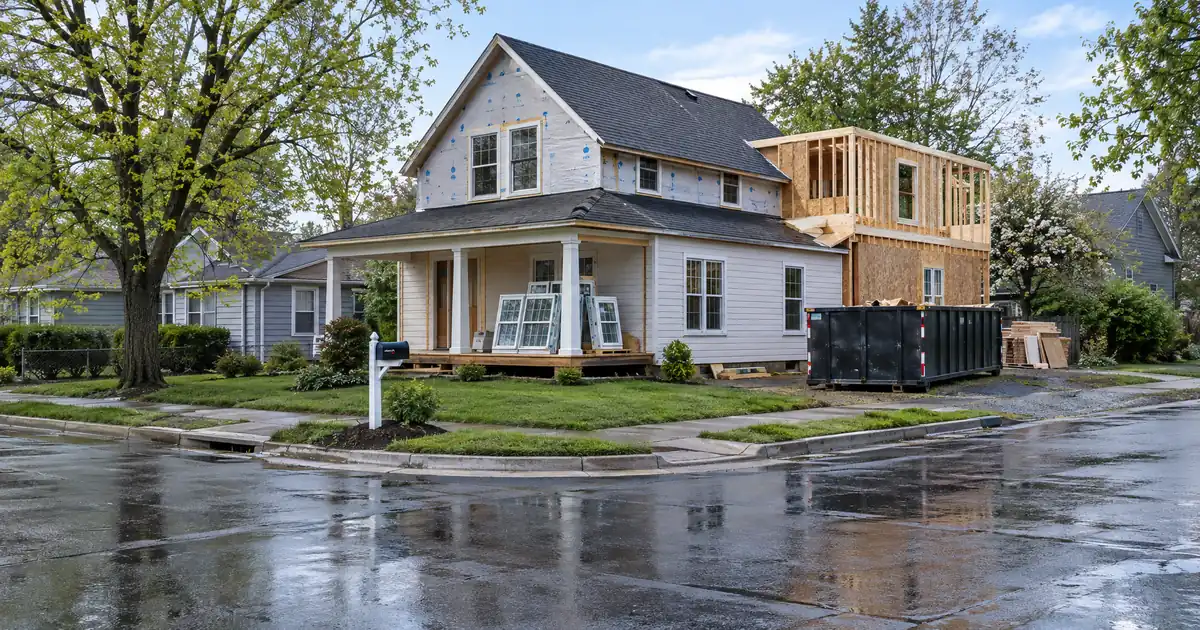
The Quick Read: A hard money lender usually does not put your insurance premium into a coverage ratio, because the loan is sized on the property, the plan, and the exit, so a higher premium rarely changes whether the bridge loan is reviewed. The premium still matters in two places. It must be paid and bound at closing, and it lands inside the monthly obligation on the rental refinance that repays the bridge. Terms vary by lender and program, so confirm them for your file.
- At closing: the policy must be active, paid, and name the lender, and a higher premium is a cash item, not a ratio input.
- At the exit: the DSCR refinance divides rent by a payment that includes the premium, so a bigger premium lowers the ratio.
- The size of the drop depends on insurance’s share of the total payment, not on the premium’s percentage increase.
- The permanent landlord quote is what the refinance uses, not the renovation-phase policy.
- A bridge can close fine and still fail the exit, so quote insurance before you pick the bridge.
Key Terms Defined
Hard money loan: a short-term, interest-only, asset-based loan used to buy, rehab, or bridge a property. It is underwritten on the property, the plan, and the exit.
DSCR (debt service coverage ratio): monthly rent divided by the monthly housing obligation. A ratio of 1.00 means rent equals that obligation.
PITIA: principal, interest, taxes, insurance, and association dues. It is the bottom half of the DSCR fraction.
Binder: a short-term proof that coverage is in force, issued before the full policy documents arrive.
Loss payee (or mortgagee): the lender named on the policy so it is paid first on a claim.
Builder’s risk: a policy for a property under construction or heavy rehab. It typically ends when work is finished or the property is occupied.
ARV (after-repair value): the estimated value of the property once the work is done. Hard money lenders cap leverage against it.
DP-3: a common landlord policy form, written on a dwelling-fire basis with a replacement-cost dwelling limit.
What this loan actually costs to carry.
Hard money is sized against the project and priced by time. Enter the deal and see how much the program will lend, the cash required at closing, the carry while you hold it, and what is left at the exit.
Leverage tiers on the current program: 85% with fewer than 2, 90% with 2 or more, 93% with 5 or more completed projects — every tier capped at 75% of after-repair value. Loan amounts up to $5,000,000, larger by exception; terms of 6 to 18 months, interest-only, no prepayment penalty. The rehab portion funds in draws against completed work, not at closing.
Program parameters shown update from Lendmire’s centralized guideline source. Rate, points, and months are editable assumptions, not quoted terms.
Cost cap sets the loan · positive spread
Illustrative estimate only — not a quote, Loan Estimate, approval, or commitment to lend. Rate, points, and months are editable assumptions. Hard money is business-purpose financing for real estate investors, not a consumer mortgage. Leverage on the current program tops out at 93% of project cost for investors with a documented track record, capped at 75% of after-repair value, with rehab funding up to 100% of the documented budget released in draws; actual terms vary by lender, borrower experience, property, and exit. Lendmire is a mortgage broker, not a lender.
Where Does the Premium Show Up in a Hard Money File?
It shows up as a closing condition and as a budget line, not as a qualifying ratio. Across the programs we place files with, the bridge loan is sized on cost, after-repair value, and your experience. Insurance has to be in force before the lender funds.
Typical hard money programs allow up to 6-18 months of interest-only payments. Fix-and-flip leverage is tiered by completed projects and measured against project cost, with a cap of 75% of ARV. All of this varies by lender, property, and experience. None of it includes an insurance test. The premium never enters the sizing formula the way it does on a rental loan.
What the lender does want is proof. Wexford Insurance lists the usual package:
- A certificate of insurance, and a policy copy or binder.
- Proof that coverage starts on or before closing.
- The lender named as mortgagee or loss payee.
- Coverage limits that meet the lender’s minimum.
On rehab or construction loans, builder’s risk is the common requirement. Coverage Criteria notes that construction lenders typically want coverage equal to total project value, with the lender named as loss payee and proof of active coverage before the first draw. If you let coverage lapse, the consequences are contractual. They include a default or lender-placed (force-placed) coverage at a higher cost.
So a higher premium on a bridge deal hits you first as cash at closing and as a carry cost during the hold. The lender is checking that the policy exists and is adequate. It is not checking whether you can afford the price of it.
How Does Underwriting Treat the Premium, Step by Step?
Underwriting treats it in two separate tests. The bridge loan tests the asset and the plan. The rental refinance later tests rent against a payment that includes the premium. A higher premium barely touches the first test and can reshape the second.
Here is the sequence on a typical file:
1. Bridge closing. You bind a hazard policy, plus builder’s risk if you are rehabbing. The lender is named as loss payee or additional insured. The premium is a closing cost, not a ratio input.
2. During the hold. The renovation-phase policy, whether builder’s risk or a vacancy form, is priced differently from the permanent landlord policy you will carry later.
3. Exit planning. While the rehab is still underway, get a real quote on a landlord policy for the finished, leased property. Landlord policies cost more than owner-occupant policies, so do not assume your own home’s premium is a guide.
4. DSCR underwriting. The underwriter takes the quote or binder, divides the annual premium by 12, and adds it to principal, interest, taxes, and dues. Flood coverage is added where required.
5. Rent. The rent used is the lease or the appraiser’s market rent, not the asking rent and not a hoped-for increase.
6. Outcome. The ratio is compared with the program floor and with the pricing and leverage tiers. A lower ratio can mean less leverage, more reserves, or a decline, depending on the program.
Rent does not rise because your premium did. The top of the fraction stays fixed while the bottom grows. That is the whole mechanical story.
The two tests side by side:
| Factor | Hard money loan | DSCR exit refinance |
|---|---|---|
| What it tests | Property, plan, exit | Rent versus full payment |
| Premium counted as | Closing condition, carry cost | Part of PITIA |
| Effect of higher premium | Mostly cash and budget | Lower coverage ratio |
| Premium figure used | Binder or policy at closing | Permanent landlord quote |
Which Premium Figure Counts at Each Stage?
The figure changes as the property changes, and the one that decides your exit is the last one. A premium from a vacant or renovation policy does not carry over to the rental loan. The permanent landlord quote does.
| Stage | Policy in play | What the lender counts |
|---|---|---|
| Contract | Estimate or quote | Your budget only |
| Bridge closing | Hazard or builder’s risk binder | Proof of paid coverage |
| Rehab and draws | Builder’s risk or vacancy form | Continuous coverage |
| Refinance underwriting | Landlord policy quote or binder | Premium divided by 12, inside PITIA |
The common stumble sits in the last row. Investors carry a cheap or convenient renovation-phase policy and assume the refinance lender will use it. The refinance lender tests the actual insurance on the finished property, so switch to a landlord policy before the refinance lender asks.
Reserves matter here too. Reserve targets scale with the payment, so a bigger premium can nudge the reserve requirement up. Reserves vary by lender, leverage, loan size, and transaction type.
Worked Example: What a Higher Premium Does to the Ratio
A higher premium lowers the ratio by the premium’s share of the whole payment, not by the premium’s own percentage increase. The formula is simple: new ratio equals old ratio divided by one plus the percentage increase in PITIA. Everything below is a modeled illustration, not market data.
Say insurance makes up a quarter of the monthly obligation, which is plausible in a high-hazard market. The premium doubles. That adds 25% to PITIA, so a starting ratio of 1.25 falls to about 1.00. A 25% premium increase in the same file adds only about 6% to PITIA. It takes a 1.25 ratio to roughly 1.18, not to 0.94.
Here is a reusable sensitivity grid. The first two columns are the assumptions. The last two show where the ratio lands from two starting points.
| Insurance share of PITIA / premium change | PITIA change | Start 1.25 | Start 1.15 |
|---|---|---|---|
| 10% share, premium up 50% | +5.0% | about 1.19 | about 1.10 |
| 10% share, premium up 100% | +10.0% | about 1.14 | about 1.05 |
| 25% share, premium up 50% | +12.5% | about 1.11 | about 1.02 |
| 25% share, premium up 100% | +25.0% | about 1.00 | about 0.92 |
Two lessons come out of the grid. A thin starting margin is fragile, and a heavy insurance share makes it more so. Low-hazard markets, where insurance is a small slice of the payment, absorb a premium jump much better.
The bottom-right cell lands below 1.00. Many select programs start at 1.00 as a floor. A separate select-lender path takes coverage below 1.00 with leverage and terms adjusted. These are different paths with different terms. Whether either applies depends on lender guidelines, credit, reserves, and property review.
One more point matters. Clearing 1.00 does not mean the property produces positive cash flow. DSCR compares rent to PITIA only. Repairs, vacancy, management, utilities, and capital expenses sit outside the calculation. A higher premium hurts the real budget even when the ratio holds. For a full walkthrough of how coverage works, see the complete DSCR loans guide.
What Variations Change the Premium and the File?
Several structural choices change the premium itself, and the policy form can change whether the lender accepts the policy at all. These are the variations we see most.
Lender value versus insurer value. A hard money lender measures the property by ARV or as-is value. An insurer measures what it would cost to rebuild, or the actual cash value after depreciation. The two numbers rarely match. A lender may reject a policy valued on actual cash value when it wants replacement cost. Coverage that falls short of the lender’s minimum can become a closing condition, with the fix usually being a higher limit and a higher premium.
Policy form. Landlord policies are typically DP-3 or dwelling-fire forms with a replacement-cost dwelling limit. Some cheaper alternative dwelling or fire policies are not all-perils, so check the program’s form requirements before you buy one for the sake of price.
Blanket policies. Some hard money programs accept a blanket policy that covers several properties, with proof the new property was added. That varies by lender, so ask before you assume it.
Deductibles and limits. A higher deductible lowers the premium, but lenders set a ceiling on how high it can go. Trade a lower premium for a deductible the program will not accept, and you have created a closing problem.
Condition of the building. Roof age and the market both move the premium, and older roofs can push a property toward a costlier placement.
Where Does the General Rule Break?
The general rule is that the premium is a small share of the payment. It breaks in a few predictable places.
High-hazard markets. The GAO found that national average homeowners premiums rose about 3% after inflation over the five-year period it studied. Rates in parts of some southern coastal, high-wind areas rose 25% or more. Moving from medium to high wildfire risk was associated with an 8% increase. That spread is why the same premium shock is a nuisance in one market and a deal-killer in another.
Vacant and renovation phases. Standard policies often exclude vacancy. A property that sits empty during rehab may need a vacancy endorsement or a builder’s risk form, and those cost differently from the policy you will hold once a tenant moves in. Premium changes again at completion.
Late shopping. An investor who waits until the refinance lender asks can end up in a costlier surplus-lines placement. The underwriter then counts that higher premium in PITIA. The cure is shopping early.
Formula framing. Some explainers treat insurance as an operating expense that shrinks the top of the ratio. Most 1-4 unit DSCR programs put it in the PITIA denominator instead. The two framings give different numbers, and the lender’s own definition controls.
Short-term rentals. Short-term rental files use different coverage floors and rent sources than long-term rentals. Rent is typically built from hosting history rather than a standard lease, and leverage runs lower than on a long-term rental. A higher premium is therefore tested against that program’s own rules. Confirm the specifics in the program guidelines.
Different lenders, different treatment. Some programs use the quote and some use the binder. Some set tiers that a small ratio change never crosses, and others reprice on a few hundredths. Across the network this is the biggest variable, and it is why a ratio that passes with one lender can fail with another.
What Does the Investor Decision Look Like?
The decision is to price insurance before you choose the bridge, then budget the premium into the exit test. A bridge that closes fine can still fail the DSCR exit. Fixing that after the fact costs more than fixing it before you buy.
Premium pressure is not hypothetical for landlords. A survey of 216 single-family investors, co-run by a private lender and reported by Fast Company, found that 84% said rising premiums had hurt their cash flow over the prior 12 months. It was a self-reported survey, so read it as direction, not measurement. Rental Housing Journal makes the arithmetic plain: every dollar added to the premium comes straight out of monthly cash flow.
When the quote comes back higher than your plan, you have several moves:
- Widen the rent margin. Better rent, a stronger unit mix, or a property with more rental income per dollar of payment all lift the numerator.
- Shrink the payoff. A smaller balance at the refinance lowers the payment, which helps offset the premium.
- Re-quote. Change carriers, adjust the deductible within the lender’s limit, or fix the roof item the insurer flagged.
- Change the property. In a high-hazard market, a different house or a different submarket may solve more than any tweak to the policy will.
Many investors refinance out of hard money into long-term DSCR financing once the property is stabilized, and Lendmire brokers that path. For how the flipper-side exits compare, see Lendmire’s piece How a DSCR Lender Counts Five Hard Money Exits From a Flipper.
A short checklist before you commit to a bridge:
- Get a landlord-policy quote for the finished property, not just the builder’s risk quote.
- Model the exit ratio with that premium, then stress it with a larger premium.
- Ask the bridge lender for its insurance minimums on limits, form, and deductible.
- Confirm which premium figure the refinance lender will use.
- Keep reserves in view, since they scale with the payment.
Run the Numbers Before You Pick the Bridge
If you are buying, rehabbing or refinancing an investment property on a short timeline and want to see how the numbers work, Lendmire can help you compare hard money options based on the project, the exit plan, leverage, and your goals. Programs are subject to lender guidelines, credit approval, and property review, and nothing here is a commitment to lend. The site’s illustrative calculator can give you a rough estimate before you talk to anyone.
Frequently Asked Questions
Does a renewal retest a closed loan?
Not usually. Once a hard money loan is closed, the lender mainly cares that coverage stays continuous and the lender stays named. A higher renewal premium raises your carry cost but does not typically retest the loan. It does show up again when you refinance into long-term financing.
Can a higher premium reduce the loan amount?
On the bridge loan, rarely, since sizing runs on cost and value. On a DSCR refinance, it can. A lower ratio can mean less leverage, more reserves, or a decline, depending on the program and the lender’s tiers.
Does the lender use my estimate or a quote?
A quote or binder. Estimates are for your own planning. The refinance underwriter wants the real figure from the permanent landlord policy on the finished property.
Is the premium escrowed on a hard money loan?
It varies by lender. Many hard money loans leave the premium as your responsibility, with proof of payment required at closing. On the DSCR refinance, the premium is counted in PITIA and is commonly handled through escrow, depending on the program.
Does vacancy coverage cost more?
Often it does. Standard policies frequently exclude vacancy, so a vacant or renovation property may need a different form or endorsement. Price that policy separately from the landlord policy you will carry once the property is leased.
For current guidelines and terms, see Lendmire’s DSCR loan programs page.
About Lendmire
A non-QM mortgage broker (NMLS# 2371349), Lendmire arranges DSCR financing for real estate investors in 41 markets — 40 states plus Washington, D.C. Because deals are underwritten primarily on property cash flow rather than personal income documentation, the structure suits self-employed buyers and entity-owned portfolios. Lendmire places loans through wholesale investor lenders; it is not a direct lender. Scotsman Guide named Lendmire a Top Mortgage Workplace in both 2025 and 2026.
Get Started
Ready to find the right loan for you?
In about 30 seconds you can review financing options available for your investment property. No commitment required.
Informational only. Not a Loan Estimate, approval, or commitment to lend. Program availability and eligibility are subject to lender guidelines, credit approval, property review, and underwriting.
References
1. Wexford Insurance: hard money lender insurance requirements
2. Coverage Criteria: builder’s risk insurance requirements
3. GAO
4. Fast Company: investor survey on rising insurance premiums
5. Rental Housing Journal: how insurance costs reshape rental cash flow
This article is part of Lendmire’s hard money loan program — full qualification details, guidelines, and scenarios live on the program page.
Related reading: How to Refinance a Hard Money Flip Into a DSCR Loan Early · Cash vs Gap Loan vs Hard Money Modification for a First Flip · Own Cash vs Gap Loan vs Hard Money Modification on a Rehab Overrun
Brandon Miller
Founder & CEO, Mortgage Loan Originator, Lendmire LLC
- Mortgage Loan Originator · NMLS# 1129696 · Verify on NMLS Consumer Access
- North Carolina Real Estate Broker · License# 343312 · Verify on NCREC
- North Carolina Insurance Producer · License# 19053198 · Property, Casualty, Life, Health · Verify on NAIC SBS
- Lendmire LLC · Firm NMLS# 2371349 · Verify firm licensure
Disclosures. The information presented in this article is general market commentary, not financial, legal, or tax advice. Lendmire is a mortgage brokerage (NMLS# 2371349) — not a direct lender or depository institution — and loan placement is subject to lender underwriting. Nothing in this content represents a commitment to lend. Loan terms, pricing, and program availability vary based on borrower qualifications, property characteristics, and state of subject property, and are subject to change at any time. Lendmire complies with Equal Housing Opportunity requirements. Consumer access: nmlsconsumeraccess.org.