
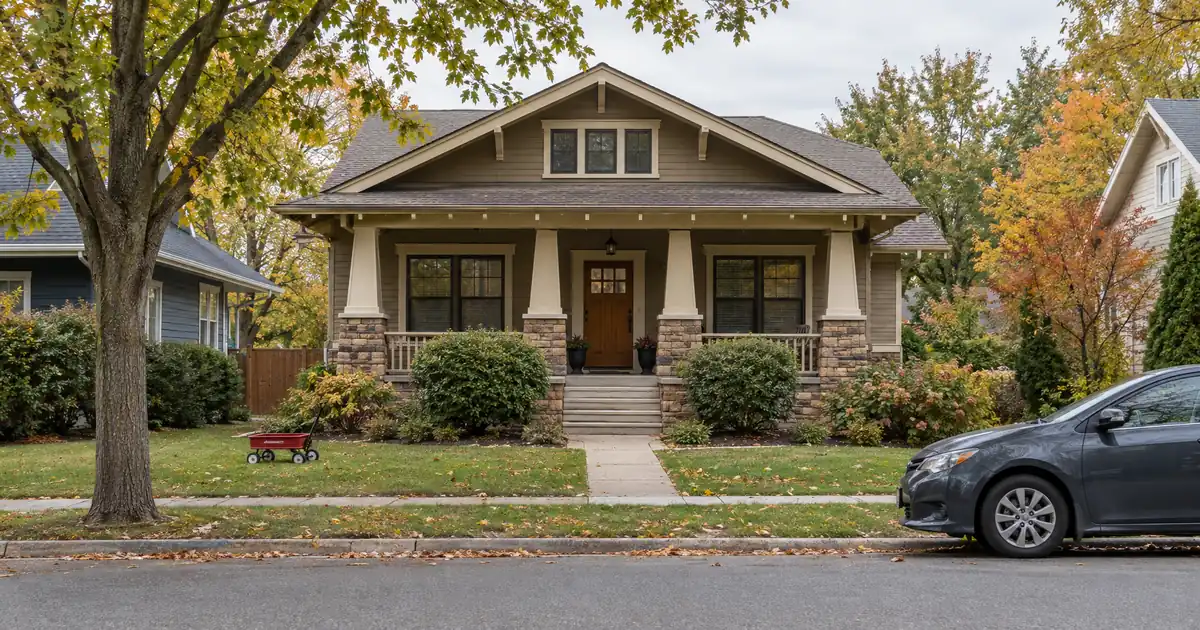
The Quick Read: You can open a HELOC on a new build once the home is finished, legally occupiable, recorded in your name, and showing enough verified equity under the lender’s combined loan-to-value limit, because lenders judge the collateral and the equity rather than how new the house is. The hard part is usually day-one equity, since a new build often appraises close to what you paid. Occupancy matters most, because the ceiling on an investment line is far lower than on a primary residence.
- Lenders want a finished home: a certificate of occupancy, closed permits, and a recorded deed.
- On Lendmire’s wholesale network, an investment-property line tops out at 70% combined loan-to-value (CLTV) with a 700 minimum credit profile.
- A primary-residence line reaches 90% CLTV only at a 720 or better credit profile, up to a $500,000 line.
- A rental you plan to hold long term often fits a DSCR cash-out refinance better than a revolving line.
What Does “After Completion” Change for a HELOC?
A finished home gives a lender something it can value and take a lien against. An unfinished one does not.
How large a line the equity supports.
An equity line is sized by combined loan-to-value, occupancy, and credit — not by rental coverage. Switch the occupancy or the credit band and the ceiling moves with it.
Investment-property lines require a 700 minimum credit score; second-home lines start at a 640 minimum and primary-residence lines at 600, and the combined-LTV ceiling steps down as the credit band drops on primary-residence and second-home lines and holds on investment-property lines; the line cap steps down on primary-residence lines and holds at every tier on investment-property and second-home lines.
A debt-to-income ratio above 45% requires 680+ credit. Profiles under 640 are limited to single-family homes. At least 75% of the approved line is drawn at closing. Ceilings, floors, and caps update from Lendmire’s centralized guideline source.
Line estimate
Illustrative estimate only — not a quote, Loan Estimate, approval, or commitment to lend. The rate is an editable assumption; equity-line pricing is variable through both the draw and repayment periods and never converts to fixed. Occupancy and credit drive the ceiling together: an investment property tops out at 70% combined LTV (minimum credit 700, line cap $500,000); a second home tops out at 90% combined LTV (minimum credit 640, line cap $500,000), with the ceiling stepping down as the credit band drops (the cap holds at every tier); a primary residence tops out at 90% combined LTV (minimum credit 600), and its $750,000 maximum line is available only at 75% combined LTV or below with a 700-or-better credit profile (720 on the longer-runway program) and a full appraisal. Lines above $500,000 require a full appraisal. Credit, debt-to-income, property type, and full underwriting review all affect the final line.
During construction, the collateral is incomplete, the occupancy is not legal yet, and a construction loan usually holds the first lien. Most lenders will not put a line on that. After completion, the home looks like any other house to the lender. It can be inspected, valued, insured, and occupied.
That means the real questions are about the file, not the age of the house. Is there a certificate of occupancy? Is the deed recorded? Who holds the first lien? What is the value, and how much equity does it leave after every lien?
Where the line will be secured is the first decision. A line can sit on the new build itself, or on a different property you already own, such as your primary home, with the proceeds used for the new build.
Are You Ready to Apply? A Completion Checklist
A new build is ready for a line application when four things are true. The home must be legally occupiable, the title must be recorded, the lien picture must be clean, and the value must be provable.
- Certificate of occupancy (CO). Lenders commonly ask for the CO, closed permits, and completed inspections before they order a valuation. A temporary or conditional CO is accepted by some programs and refused by others.
- Recorded deed. Some banks will not take an application until the deed or mortgage has been recorded, as Yahoo Finance reports in its look at how soon you can get a HELOC after buying. There is no universal waiting period, but individual lender policies differ.
- Lien position. If a construction loan or a first mortgage is still open, a second-position line may be limited by that lender. On Lendmire’s network, a standalone line can sit in first or second position. Many lenders want first position on an investment property, according to a BiggerPockets discussion of HELOCs on investment property.
- Title held correctly. The network’s line must be held by an individual borrower or a revocable living trust. An LLC, corporation, or land trust cannot hold title on this product. A new build already deeded to an LLC needs a vesting change first, or it belongs in a DSCR cash-out conversation instead.
Step by Step: How the Line Gets Opened
The process runs in six steps. Each one is a checkpoint that can stop a new-build file, so it helps to clear them in order.
1. Confirm occupancy. Decide whether the home is your primary residence, a second home, or an investment property. The ceiling, minimum credit, and maximum line all change with that choice.
2. Check combined leverage. Add the first mortgage balance to the line you want, then divide by the expected value. That result is your CLTV.
3. Pull your credit profile. The network uses a single-bureau score keyed to the primary wage earner. The report can be no more than 90 days old at closing, and rescores are not available.
4. Submit the application and property documents. Expect to provide the CO, a settlement statement or deed, proof of insurance on the finished home, and your income and asset documents.
5. Valuation. Lines at or below $500,000 ordinarily run an automated valuation, though a higher CLTV may require a secondary valuation. You may request a full appraisal, and every line above $500,000 requires one.
6. Final review and funding. The lender reviews the whole file against its guidelines. At least 75% of the line is drawn at closing, and the rest stays available for draws of at least $1,000 afterward.
Lendmire arranges these lines through select wholesale partners in its 16 full-service states and is never the lender. Every figure here is subject to lender guidelines and a full file review.
How a New-Build Valuation Differs From a Resale
New builds are harder to value than resales. Comparable sales are thinner, and builder pricing does not always match what the market pays.
McKissock, an appraiser education provider, explains that appraisers choose comparables carefully on new construction. Some lenders want at least one settled sale that did not involve the subject’s own builder. Nearby new developments often supply comps when the subject’s community has few closed sales.
Three practical points follow from that.
- Concessions get adjusted out. If the builder paid closing costs or bought down your financing, the appraiser adjusts the comparable sales to remove that effect. Your equity can look smaller than your contract price suggested.
- Upgrades rarely appraise dollar for dollar. Design-center upgrades and lot premiums may support a higher appraised value, depending on comps and underwriter review, but they are not credited at cost.
- Automated values can miss. A brand-new community may not have enough data for an automated valuation to be reliable. If the number looks low, requesting a full appraisal is allowed on any line.
Here is a simple example of why equity is the gate. Say a buyer closes on a builder-sold townhome with 20% down and the appraisal matches the contract price. The first mortgage already sits at 80% of value. That is above the 70% ceiling on an investment line, so there is no room for a second line until the value rises or the balance falls. Terms depend on the lender’s guidelines, the property type, the leverage, and a full review of the credit profile.
What the Network Allows by Occupancy
The ceiling depends on how you will use the home, so quoting one number for every new build would mislead. The table shows the main tiers on Lendmire’s wholesale network.
| Occupancy | Credit tier | Max CLTV | Max line |
|---|---|---|---|
| Primary residence | 720+ | 90% | $500,000 |
| Primary residence | 700+ | 75% | $750,000 |
| Second home | 720+ | 90% | $500,000 |
| Investment property | 700+ | 70% | $500,000 |
Lower credit tiers step down from there. On a primary residence, the 620 tier reaches 70% CLTV up to $400,000, and the minimum credit profile is 600. A second home starts at 640, and an investment property starts at 700.
Market-wide surveys paint a broader picture. NerdWallet reports that investment-property lines at some lenders reach 80% maximum loan-to-value, while many sit lower. On Lendmire’s network, the investment ceiling is 70% CLTV with a 700 minimum credit profile.
A few more parameters shape a new-build file.
- Line size. Lines run from $25,000 to $750,000, and anything above $500,000 is primary residence only. It requires a 700 or better credit profile (720 on the longer-runway structure, which is the 5-year draw option described below), caps at 75% CLTV, and needs a full appraisal.
- Structure. Primary and second-home lines come in two forms: a 3-year interest-only draw with a 17-year repayment, or a 5-year draw with a 25-year repayment. Investment lines use the 5-year draw and 25-year repayment only. Pricing floats during both periods and never converts to fixed.
- Debt-to-income. The ceiling is 50%, and 45% for credit profiles from 600 to 679. The line is qualified on the interest-only payment at the maximum draw.
- Property types. Single-family homes, 2-4 units, PUDs, townhomes, and condominiums, including non-warrantable ones, are eligible. The 2-4 unit type requires a 640 minimum on the 5-year draw structure, and modular homes are eligible only on that structure. Manufactured homes, co-ops, condotels, log homes, and commercial or mixed-use zoning are not offered.
In some of the 16 states, a property listed for sale, or listed within the past 60 days, is ineligible. That can catch a builder-held home that was still on the market shortly before your closing.
Where the General Rule Breaks
The usual path fails in a handful of predictable ways. Knowing them early saves an application.
A construction loan that has not converted. If the first lien is still an interim loan, a second-position line may be blocked. The clean sequence is completion, a CO, permanent financing, and only then a line.
Insurance that never transitioned. Builder’s-risk coverage protects a project under construction. A lender on a finished home generally wants a standard homeowner or landlord policy in force, so confirm the switch before applying.
An owner-occupied line that later becomes a rental. The CFPB explains how a HELOC works as an open-end line you can borrow against repeatedly. Lenders may restrict renting out a home secured by a primary-residence line. If you plan to rent the new build, apply under the investment-property terms from the start.
A value that comes in low. Lenders may freeze or reduce a line if the home’s value falls or the borrower’s finances worsen, which adds risk after funding.
A borrower with many properties. A borrower is limited to three lines, and anyone owning more than 15 financed properties is not eligible. Combined exposure caps at $2,000,000 on one wholesale program and $750,000 on the other.
A different label. Some banks call the product a line of credit rather than a HELOC, so ask each lender what it calls the product before assuming it does not exist.
HELOC or DSCR Takeout: Which Fits a Rental New Build?
A revolving line and a rental refinance do different jobs. A line gives you a second lien and flexible draws, while a rental refinance replaces the first mortgage and pulls equity at once.
For a pure rental, the DSCR route often fits better than a line. DSCR loans are designed for non-owner-occupied investment properties, and they are reviewed differently from a standard owner-occupied mortgage. The property qualifies primarily on rental income covering the payment, subject to lender guidelines. Lendmire’s complete DSCR loans guide covers how that works.
Across the wholesale network, DSCR cash-out refinances top out around 75% LTV, and about 6 months of seasoning is the common expectation. A CO is needed before a permanent DSCR loan on a new build. Coverage of 1.00 is where many select programs start, and a separate select-lender path takes coverage below 1.00 with leverage and terms adjusted. Clearing 1.00 does not mean the property is cash-flow positive, because repairs, vacancy, management, and capital costs sit outside the calculation. The exact numbers vary by lender and program and follow a full review of property, leverage, and credit.
Compare the two paths for an investor who wants cash from a new rental.
| Factor | Investment HELOC | DSCR cash-out |
|---|---|---|
| Lien | Standalone line, first or second | New first mortgage |
| Max leverage | 70% CLTV | Around 75% LTV |
| Held in an LLC | Not eligible | Subject to lender program eligibility |
| Credit floor | 700 | Often 660 or higher; 620 in parts of the network |
If you keep a strong first mortgage and need a small, flexible amount, the line may fit. If you plan to hold the property in an LLC, or you need to pull equity across a larger balance, the DSCR route is usually the stronger fit.
A line is also a poor fit if you need long-term fixed-style debt. As the draw period ends, repayment begins, and Lendmire’s article Can You Get a New HELOC After Your Draw Period Ended? shows what that transition looks like. A BiggerPockets investor discussion also frames a line as a short-term tool that needs an exit plan.
Key Terms Defined
- Combined loan-to-value (CLTV): the total of your first mortgage and the new line, divided by the home’s appraised value.
- Certificate of occupancy (CO): the local approval that says a finished building can legally be lived in.
- Draw period: the stretch when you can borrow and repay against the line, usually with interest-only payments.
- Lien position: the order in which lenders get paid if the home is sold; the first lien is paid ahead of the second.
- Automated valuation: a computer-generated estimate of value that stands in for a full appraisal on smaller lines.
- DSCR: the debt service coverage ratio, which is monthly rent divided by the full monthly housing payment.
Frequently Asked Questions
How soon after closing on a new build can I apply for a HELOC?
There is no fixed federal waiting period, and each lender sets its own rule. Some want the deed recorded first, and others add seasoning on a primary residence. On a new build, the practical waiting period is usually how long it takes to record the deed and build equity.
Does a certificate of occupancy guarantee approval?
No. The home can be legally occupied, but the lender still reviews value, credit, leverage, and the lien picture. A strong CO helps the file reach valuation, and the numbers decide the rest.
Can I use a HELOC on my current home to fund a new build?
Yes, in many cases the line stays secured by the home you already own, not the new one. That changes which occupancy rules and ceilings apply. Lendmire’s network can place a line on a primary residence at up to 90% CLTV at 720 or better, subject to lender guidelines.
Can I put the line on a new build held in an LLC?
Not on this product. LLCs, corporations, partnerships, and irrevocable, blind, or land trusts cannot hold title. You would need to move title to yourself or a revocable living trust, or look at a DSCR loan instead, subject to lender program eligibility.
What if my new build appraises below what I paid?
Then the line may shrink or fail the CLTV test. You can request a full appraisal, wait for the market to catch up, or pay down the first mortgage to improve the ratio.
Next Step
If you are considering a home equity line and want to see how the numbers work, Lendmire can help you compare HELOC options based on the property, the equity available, credit profile, combined leverage, and your goals. You can also request a quote at lendmire.com.
New-build communities tend to seat their first sales at builder pricing, so the equity that supports a second lien often arrives after the neighborhood builds its own resale history.
For current guidelines and terms, see Lendmire’s HELOC programs page.
About Lendmire
As a mortgage broker (NMLS# 2371349), Lendmire helps homeowners and real estate investors in its 16 full-service states open home equity lines of credit arranged through wholesale lenders. Lendmire is never the lender; line amounts, ceilings and terms are set by the lender under its guidelines. Scotsman Guide named Lendmire a Top Mortgage Workplace in both 2025 and 2026.
Get Started
Ready to find the right loan for you?
In about 30 seconds you can review financing options available for your home or investment property. No commitment required.
Informational only. Not a Loan Estimate, approval, or commitment to lend. Program availability and eligibility are subject to lender guidelines, credit approval, property review, and underwriting.
References
1. Yahoo Finance – How soon can you get a HELOC after purchase
2. BiggerPockets – HELOC on investment property
3. McKissock – Appraising new construction
4. NerdWallet – HELOC on investment property
6. BiggerPockets – Is it a good idea to buy investment property on HELOC
This article is part of Lendmire’s home equity line of credit program — full qualification details, guidelines, and scenarios live on the program page.
Related reading: Can a Rental HELOC Fund a Remodel in Stages Like a Construction Draw? · Tenants-in-Common vs. an LLC for Friends Buying a Rental on a DSCR Loan · How Much Equity a Lender Needs to Lift a Frozen HELOC
Brandon Miller
Founder & CEO, Mortgage Loan Originator, Lendmire LLC
- Mortgage Loan Originator · NMLS# 1129696 · Verify on NMLS Consumer Access
- North Carolina Real Estate Broker · License# 343312 · Verify on NCREC
- North Carolina Insurance Producer · License# 19053198 · Property, Casualty, Life, Health · Verify on NAIC SBS
- Lendmire LLC · Firm NMLS# 2371349 · Verify firm licensure
Disclosures. The information presented in this article is general market commentary, not financial, legal, or tax advice. Lendmire is a mortgage brokerage (NMLS# 2371349) — not a direct lender or depository institution — and loan placement is subject to lender underwriting. Nothing in this content represents a commitment to lend. Loan terms, pricing, and program availability vary based on borrower qualifications, property characteristics, and state of subject property, and are subject to change at any time. Lendmire complies with Equal Housing Opportunity requirements. Consumer access: nmlsconsumeraccess.org.