
Start With One To Four Units — The Quick Read: As of September 25, 2026, mortgage rates have climbed four straight weeks, and that alone is reason to pick your entry point with care. One-to-four-unit residential property gets you conventional financing, a lighter appraisal, and easier resale. Cross into five units and you’re in small commercial lending — a different, thinner, pricier capital market. My take: start small, get active, then decide where you want to go.
I’ve watched this exact fork trip up first-time investors for eighteen years in lending. It’s not a small distinction. It’s the difference between getting in the game and getting priced out of it before you’ve closed a single deal.
Market Snapshot
A quick read on the investor landscape — figures come from the cited sources below. Confirm current property-level numbers before underwriting.
| Metric | Detail |
|---|---|
| Home prices | $429,100 median |
| Employment | 643,000 jobs (NAR Existing-Home Sales page) |
What Changed This Month
Rates moved fast in September 2026, and the move matters more for a mom-and-pop buyer than for an institution with deep pockets and patient capital.
Freddie Mac’s survey put the 30-year fixed at 6.71% for the week of September 3, then 6.76% the following week, then a sharp jump to 6.95% the week of September 17, and 7.03% for the week of September 24 — four consecutive weekly increases totaling 32 basis points in a month, per Freddie Mac’s PMMS release. A year earlier, per that same Freddie Mac survey, the 30-year averaged 6.30% — so today’s level sits roughly 73 basis points higher year-over-year.
Existing-home sales fell 2% month over month in August to a seasonally adjusted pace of 3.98 million, even as inventory rose to 1.62 million units and months of supply climbed to 4.9 — the highest reading in over a decade, according to NAR’s existing-home sales data. NAR’s chief economist noted sales are still up 1.6% year-to-date, supported by wage growth of 3.1% in August and 643,000 net new jobs added since the start of the year.
On September 16, 2026, the Federal Reserve raised the federal funds rate a quarter point, describing an economy expanding at a solid pace with job gains keeping pace with the workforce. That hike lines up almost exactly with the sharpest weekly rate jump of the month.
Key Takeaways
- Freddie Mac’s 30-year average rose from 6.71% to 7.03% across four weeks in September 2026 — a 32-basis-point climb.
- Existing-home sales slipped to a 3.98 million pace in August, but inventory and supply both grew, giving buyers more room to negotiate.
- One-to-four-unit residential financing stays on the conventional appraisal track; five-plus units moves into commercial-style underwriting.
- Mortgage application volume fell as rates rose, with refinance activity down sharply from a year ago.
- The unit-count line matters more, not less, when rates and appraisal costs are both rising.
What I’m Seeing in the Pipeline
If you’re a mom-and-pop or first-time investor, one to four units is where you start. I say this to nearly every new client who calls asking whether they should “go bigger” on the first deal.
Here’s the pattern. Once you cross over four units, you’re in small or mid commercial financing. The capital gets harder to find. It’s priced higher. The appraisal costs jump — a lot — because you’re no longer getting a standard residential appraisal, you’re paying for commercial-style valuation work. And leverage drops, meaning you put more money down to get the deal done. We have lenders who’ll do five-to-ten-unit deals, and we can get those financed. But a first-time investor needs to walk in knowing all of that going in, not find it out at underwriting.
A twenty- or thirty-unit apartment complex can be a great asset — for the right investor, with the experience and the capital to back it. As a first deal? Probably not. You don’t have the track record yet, and honestly, you usually don’t have the down payment either. That’s not a knock. It’s just math.
One to four units gets you a more affordable appraisals, the most leverage, and the easiest resale. It gets you in the game, active, learning the mechanics with real money on the table instead of studying from the sidelines. Start there. Decide where you want to take it after.
Why the Four-Unit Line Exists
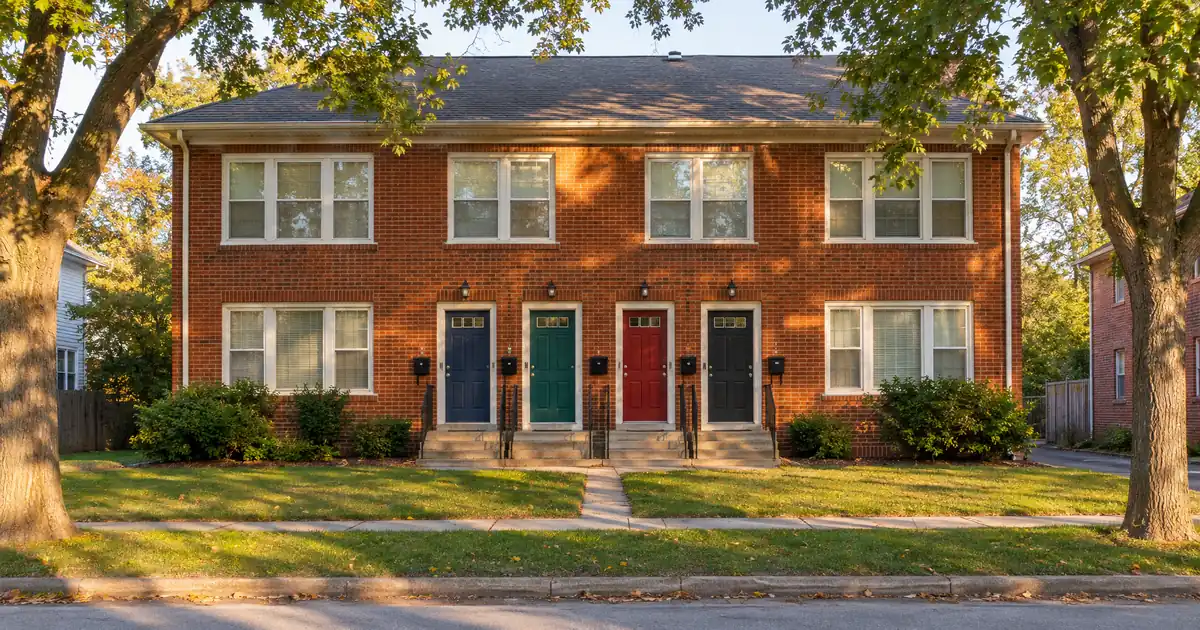
This isn’t an arbitrary industry quirk — it’s baked into how conventional financing classifies residential property. A property with two, three, or four units is still treated as residential for consumer mortgage purposes, even though it houses multiple tenants. The moment you add a fifth unit, the deal works to a different rulebook entirely, with a different appraisal standard and a different investor pool behind the capital.
That shift shows up starkly in the numbers on the institutional side. In 2025, 2,530 different lenders originated $381.8 billion in new mortgages for properties with five or more units — a 32% jump from 2024, but still well below the roughly $490 billion peak the multifamily market hit in 2021 before higher rates and valuation uncertainty sidelined a chunk of that capital. That’s a market that swings hard with rate cycles and lender appetite. One-to-four-unit residential lending doesn’t swing anywhere near as violently, because it’s underwritten against the same conventional infrastructure that prices a single-family home.
What This Means for Real Estate Investors
Rising rates raise the cost of every deal, but they raise the cost of a five-plus-unit deal faster — because you’re stacking a pricier appraisal and lower leverage on top of a higher rate at the same time. That combination punishes a thin-capital first-time buyer hardest.
Mortgage applications fell 4.1% for the week ending September 11, 2026, with the refinance index down 9% from the prior week and 65% lower than the same week a year earlier — a sign that borrowers are pulling back sharply as the cost of money climbs, according to the MBA’s weekly survey. The following week, the 30-year rate reportedly moved higher again, and applications fell once more. That’s not a market rewarding aggressive leverage right now. It’s a market rewarding the buyer who keeps the deal simple. Exact terms depend on the lender’s guidelines, property type, leverage, and a full review of the borrower’s file.
Meanwhile, the 10-year Treasury yield sits near 5.17%-5.20% as of September 25, 2026 — the highest level of this rate cycle, following a sell-off over the prior three sessions. Mortgage rates track the 10-year loosely but directionally, so a Treasury yield sitting at a cycle high tells you the mortgage-rate pressure isn’t likely to ease on its own in the next few weeks.
None of this changes the fundamental appeal of small multifamily. Duplexes, triplexes, and fourplexes still let you collect multiple rent checks under one roof, one insurance policy, one loan. What’s changed is the cost of getting in — and that cost gap between four units and five units is exactly what widens when rates rise and appraisal fees climb with it.
Is Bigger Actually Better Right Now?
No — not for a first deal, and arguably less so this month than most. The math that makes five-plus units attractive to an experienced investor (economies of scale, professional management, institutional exit buyers) requires capital reserves and underwriting sophistication that a first-timer typically hasn’t built yet.
I’ll put it plainly: the investor who tries to skip the one-to-four-unit step to chase a bigger cap-rate number on a twenty-unit building is usually underestimating two things — the size of the down payment a commercial lender will require, and how much slower that deal moves through underwriting compared with a straightforward residential file. Existing-home sales data shows inventory rising to 1.62 million units and months of supply climbing to 4.9 — per NAR — which tells me there’s more selection right now in the one-to-four-unit space than there’s been in years. That’s the market to work while you build a track record, not the moment to reach for a deal outside your depth.
My Take
Here’s my honest opinion: the four-unit line is the single most useful piece of structure a new investor can learn before they ever make an offer. It’s not a technicality. It determines your appraisal cost, your leverage, and how easily you’ll be able to sell the property later if your plans change.
I think the investors who do best over time are the ones who treat one-to-four units as a real strategy, not a placeholder. Buy one. Learn how the tenant mix behaves, how the maintenance calls land, how the numbers actually cash-flow once you’re past the pro forma. Then decide — calmly, with a track record behind you — whether to buy a second one-to-four-unit property or step up into five-plus-unit commercial territory. Either path is legitimate. What’s not smart is skipping the step where you learn the business on a deal sized to your experience and your capital.
DSCR loan programs exist specifically to make that first step easier, because they qualify primarily on the property’s rental income rather than requiring a deep personal income file — details on eligibility, subject to lender guidelines, live on the DSCR loan programs page. That structure fits the one-to-four-unit buyer well, especially a self-employed investor whose traditional personal-income documentation doesn’t tell the whole income story.
What I’d Do Now
If you’re weighing your first deal this fall, run the one-to-four-unit math before you look anywhere near a five-plus-unit listing. Get comfortable with what a conventional residential appraisal costs versus a commercial-style valuation — the gap is real, and it changes your total cash needed to close.
If you already own a smaller property and you’re thinking about moving up to five-plus units, treat that decision separately from your first deal. It’s a different lender pool, a different appraisal process, and a different leverage picture — not necessarily a worse deal, just a genuinely different one. If you’ve built equity in a one-to-four-unit property already and you’re weighing whether to pull cash out to fund that next step, where to start on a cash-out refinance is worth reading before you call a lender.
And if a deal ever gets denied because a property quietly crossed the four-unit line without anyone flagging it early, that’s a fixable underwriting problem, not a dead deal — but it’s much easier to fix before you’re under contract than after, as I’ve written about when a fix-and-flip loan gets denied over unit count.
If you’re weighing a purchase or a refinance this fall, Lendmire can walk you through how current programs fit your file — call 828-256-2183 or request a quote directly through our mortgage quote form.
For the end-to-end picture of how these loans work — qualification, structures, and the full process — see Lendmire’s complete DSCR loans guide.
Frequently Asked Questions
Is a fourplex still considered residential financing?
Yes. A property with two, three, or four units is treated as residential for conventional mortgage purposes, even though it has multiple tenants. The moment a fifth unit is added, the property moves into small commercial underwriting, subject to lender guidelines.
Why does the appraisal cost jump so much above four units?
Because the appraisal standard itself changes. A one-to-four-unit property uses a standard residential appraisal form. A five-plus-unit property requires a commercial-style valuation, which is a more involved process and costs meaningfully more, subject to program terms.
Should I skip small multifamily and go straight to a twenty-unit building?
Probably not for a first deal. Larger commercial properties can be excellent assets for experienced investors with the capital reserves to support them, but a first-time buyer typically lacks both the track record and the down payment a commercial lender expects, subject to lender guidelines.
Do DSCR loans work for one-to-four-unit properties?
Yes, they’re commonly used there. DSCR loan programs qualify primarily on a property’s rental income rather than a deep personal income file, which fits many first-time investors moving into a duplex, triplex, or fourplex, depending on program guidelines.
How does the current rate environment change this decision?
It raises the cost of leverage everywhere, but it hits five-plus-unit deals harder because lower leverage and higher appraisal costs stack on top of a higher rate at the same time. Freddie Mac’s survey put the 30-year fixed at 7.03% for the week of September 24, 2026, up 32 basis points over the prior month.
About Lendmire
Lendmire (NMLS# 2371349) is a non-QM mortgage brokerage arranging DSCR investor loans in 41 markets — 40 states plus Washington, D.C. — and consumer mortgage programs, including bank statement, HELOC and down payment assistance options, in 16 states through wholesale lenders. Lendmire is the broker, never the lender; every file is underwritten by the lender under its own guidelines. Scotsman Guide named Lendmire a Top Mortgage Workplace in both 2025 and 2026.
Get Started
Ready to find the right loan for you?
In about 30 seconds you can review financing options available for your home or investment property. No commitment required.
Informational only. Not a Loan Estimate, approval, or commitment to lend. Program availability and eligibility are subject to lender guidelines, credit approval, property review, and underwriting.
References
1. NAR Existing-Home Sales Data
2. Freddie Mac PMMS Release, September 24, 2026
3. Federal Reserve FOMC Statement, September 16, 2026
This article is part of Lendmire’s Mortgage News series — every loan program’s qualification details, guidelines, and scenarios live on the loan options page.
Related reading: Bundling Rentals Into One Loan: The Flexibility You Trade Away · The Spreadsheet That Is Fighting The Market This Fall · Brokers Cost More — And Other Mortgage Myths Worth Killing
Brandon Miller
Founder & CEO, Mortgage Loan Originator, Lendmire LLC
- Mortgage Loan Originator · NMLS# 1129696 · Verify on NMLS Consumer Access
- North Carolina Real Estate Broker · License# 343312 · Verify on NCREC
- North Carolina Insurance Producer · License# 19053198 · Property, Casualty, Life, Health · Verify on NAIC SBS
- Lendmire LLC · Firm NMLS# 2371349 · Verify firm licensure
Required disclosures. Lendmire (NMLS# 2371349) operates as a licensed mortgage broker, not a direct lender or depository. The discussion in this article is general in nature and should not be relied upon as financial, legal, or tax advice — every investment scenario is unique and should be reviewed by a qualified professional. Any loan inquiry is subject to lender underwriting, and this article is not a commitment to lend or a guarantee of approval. Mortgage rates, loan terms, and program guidelines vary by borrower, property, and state, and may change without notice. Equal Housing Opportunity. Verify licensure at NMLS Consumer Access.