
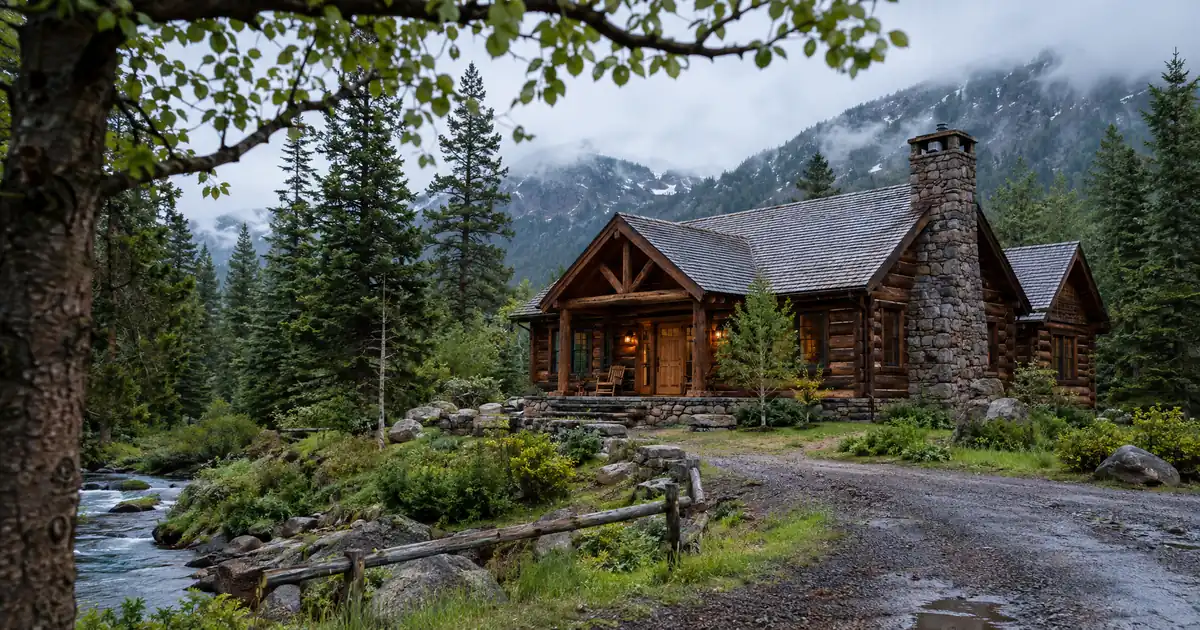
The Quick Read: A super jumbo DSCR loan is reviewed for the cabin on whether its rent covers the payment, a super jumbo bank statement loan is reviewed around whether your deposits do, and on rural collateral the acreage limits and reserves often decide the file before the product does. Reserves are a separate test from either income method. They are the liquid funds you keep after closing, and they apply on both paths.
- DSCR fits when the cabin earns rent you can document and you want a business-purpose loan.
- Bank statement fits when your deposits are strong, the cabin is partly personal use, or the rental history is thin.
- Through select wholesale programs, bank statement reserves run 3, 6 or 9 months by loan size, subject to full underwriting.
- Bank statement overlays at super jumbo size cap rural property at ten acres and exclude it above $3,000,000, through select wholesale programs.
- The rural appraisal gates both products, so check it before you pick a path.
The title of this piece mixes two ideas, so it helps to separate them. “Bank statement” describes how income is proven. “Reserves” describes how much cash you hold afterward. A borrower can need strong numbers on both.
Here is the honest answer on who each option is for. DSCR is for the investor whose cabin behaves like a business and whose rent can be documented. Bank statement is for the self-employed owner whose cash flow is stronger than the tax return shows. Neither product removes the rural problems of thin comparable sales, acreage limits and tight overlays at large loan sizes.
Side-by-Side
The table below puts the two paths next to each other on the same cabin. The DSCR column shows published industry norms, which vary by program. The bank statement column reflects guidelines from select wholesale programs in Lendmire’s network, subject to full underwriting. Pricing is left out on purpose, because it depends on the file.
| Factor | Super Jumbo DSCR (industry norms) | Super Jumbo Bank Statement |
|---|---|---|
| Reviewed on | Rent versus the housing payment | Deposits after an expense ratio |
| Core documents | Appraisal plus rent schedule or STR proof | 12 or 24 months of statements |
| Property use | Business-purpose investment | Primary, second home or investment |
| Vesting | Often an LLC, per program terms | Usually an individual borrower |
| Reserves | Liquid months of payment, varies | 3, 6 or 9 months by loan size |
| Seasonality | Trailing rent or STR analysis | Deposits averaged over the period |
| Rural | Acreage limits tighten with size | Ten acres max, none above $3M |
Two rows deserve more explanation. The first is property use, because it decides which product is even allowed. The second is the rural row, because it is where many cabin files stall.
How Reserves Work on Each Path
Reserves are measured in months of the full housing payment, meaning principal, interest, taxes, insurance and any association dues. Both products check them, and neither lets reserves stand in for the income test. Strong reserves will not rescue weak rent on a DSCR file or weak deposits on a bank statement file.
On the bank statement side, the ladder is specific. Through select wholesale programs, reserves typically run 3 months on loans to $500,000, 6 months to $1,500,000, and 9 months above that. Each additional financed property adds about 2 months, up to a 12-month maximum. First-time investors are typically asked for 12 months. These figures are subject to full underwriting and can change.
Above the super jumbo line, cash-out proceeds cannot satisfy reserves. That line sits above $3,500,000 on a primary residence and above $3,000,000 on a second home or investment property. Reserves need to come from your own liquid funds, not from the loan you are closing. Lendmire’s piece Super Jumbo DSCR vs Bank Statement Reserves on a $3M Purchase vs Cash-Out walks through that distinction.
DSCR reserve expectations are less uniform. Published industry norms generally ask for more months on investment properties, on very large loans and on borrowers with several financed properties. Programs differ widely, so treat any single published number as a starting point for a conversation, not a promise.
When Super Jumbo DSCR Is the Better Fit
DSCR is the better fit when the cabin has a documentable income stream and you want the loan judged on the property. It qualifies primarily on property-level rental income covering the payment, subject to lender guidelines. Your personal income and debt-to-income ratio take a back seat.
That matters most for an investor who already carries several financed properties. Each new loan on a debt-to-income basis crowds the next one. A DSCR file looks at the cabin’s own coverage, then at credit, assets, reserves and the borrower or entity.
For a cabin, the key question is how the rent gets proven. On a long-term lease, the appraiser supplies a market rent estimate. A one-unit property like a cabin uses a rent schedule, and Fannie Mae’s forms list names the single-family comparable rent schedule as Form 1007. Small multi-unit properties use Form 1025 instead.
Short-term rental income takes more work. Programs we see usually accept one or more of these supports:
- an appraiser’s short-term rental analysis,
- twelve months of property-management statements,
- twelve months of bank statements showing rental deposits,
- a third-party rental projection report on purchases.
Most programs credit the lower of the in-place lease and the market rent. A cabin with a thin rental history can miss the coverage test even when the owner’s finances are excellent. Short-term rental rules vary by city, county, HOA and property type, so confirm local rules before relying on projected rental income.
Coverage below 1.00 does not always end the conversation. Select lenders in the network offer programs below 1.00, though LTV and terms adjust to match. Expect lower leverage and a closer look at reserves on those files.
DSCR loans are designed for non-owner-occupied investment properties. Because they are business-purpose investor loans, they are reviewed differently from a standard owner-occupied mortgage. Coverage is typically discussed in qualitative terms, since the lender looks at whether the property’s rental income supports the debt rather than at the borrower’s personal income. The practical point is that the lender will want the purpose documented, so a cabin you use yourself for much of the year may not qualify as a pure investment.
DSCR loans commonly close in an LLC, subject to lender program eligibility. That helps investors who hold the cabin in an entity. It also means personal guarantees are common, so read the guarantee terms carefully.
The limits are real. DSCR depends on rent you can prove, so a brand-new cabin with no history leans on appraiser projections. At super jumbo size, programs commonly tighten rural and acreage eligibility. Confirm those rules for the specific program before you spend money on an appraisal.
When Super Jumbo Bank Statement Is the Better Fit
Bank statement is the better fit when your deposits tell a stronger story than the cabin’s rent does. It is reviewed on documented income under the applicable program, subject to lender guidelines. Founders, physicians, attorneys and other self-employed owners often show write-offs that shrink taxable income. HousingWire’s non-QM guide frames this the same way: self-employed borrowers with strong deposits but reduced taxable income typically start with bank statement loans.
The mechanics are straightforward. Qualifying income equals eligible deposits divided by the statement months, after an expense ratio on business accounts. Through select wholesale programs, the expense ratio typically scales with the size and type of the business: it is lowest for a service business with no employees and higher for businesses with more employees or any product business. An accountant-provided ratio is another option. A profit-and-loss method is also available, subject to program caps.
Business statements need at least 25% ownership. Transfers from your own business into your personal account count at 100%. Statements must be consecutive, and transaction histories do not substitute for them. Debt-to-income can run up to 50%.
Credit floors rise with size. The leverage ladder adds its own credit minimums as the loan grows.
Bank statement also fits when the cabin is not a pure rental. A one-unit second home qualifies for this path, as does a primary residence. The cabin’s rent is not the main qualifier, so a seasonal property with a thin rental history does not sink the file. Tax treatment can depend on how the funds are used and how the property is held; investors should keep clear records and speak with a qualified tax professional before relying on any deduction.
Leverage steps down as the loan grows. Take a second-home purchase between $2,500,000 and $3,000,000: the ladder tops out at 75% LTV with a 720 credit minimum. A cash-out in that same band tops out at 60% LTV. Investment property carries the same ceilings in that band, 75% on a purchase and 60% on a cash-out. These are ceilings through select wholesale programs, subject to full underwriting. The exact numbers vary by lender and program and follow a full review of property, leverage, and credit.
Asset-based paths exist for owners with large liquid balances. An asset allowance divides liquid assets by 36, 60 or 84 months and applies to primary and second homes only. An assets-only path needs liquid funds equal to the loan plus closing costs, with no debt-to-income test. Retirement accounts count at 70%, or 80% at age 59½ and older. Business funds, gifts and cryptocurrency do not count.
The trade-off is that bank statement files get screened closely. Declining deposits, overdrafts and unexplained transfers can all reduce qualifying income. HousingWire notes that lenders do not simply add up deposits, and the same is true of the programs we place files with.
For another view of the cash-out side, see Lendmire’s piece Super Jumbo DSCR vs Bank Statement Reserves on a Cash-Out Refinance.
Why Does the Rural Appraisal Matter More Than the Loan Type?
The appraisal gates both products, and rural collateral is harder to value. Mortgage insurer Enact’s rural appraisal training lists the usual problems: few comparable sales, large adjustments, limited inventory, and well, septic and road issues. It also notes that acreage maximums vary by lender.
McKissock, an appraiser-education provider, adds that rural markets have fewer transactions. Appraisers may have to search neighboring towns for comparables. They also deal with a mix of agricultural, recreational and mixed-use properties.
Excess land creates a second problem. Land beyond the residential site often adds less value than buyers expect, and some lenders exclude it from collateral. A lower appraised value shrinks the loan on either product. Price-per-acre math from a listing is a poor guide.
At super jumbo size, the bank statement overlays are the strictest. Above $3,000,000 on a primary residence, second home or investment property, rural property is excluded and acreage is capped at ten acres. Rural collateral is also not available above $3,000,000 on the broader program, and rural leverage tops out at 80% LTV on ten acres or less. Above $4,000,000, every file is reviewed case by case before submission. Anyone shopping a cabin near those sizes should run the property through eligibility first. Final terms depend on the lender’s guidelines, the property type, and the borrower’s complete credit picture.
DSCR programs at large balances generally run similar overlays, though the specifics differ by program. In practice, a cabin on a large parcel is more likely to fit the smaller-balance bands of either product. If the property falls outside rural eligibility, the options are a lower loan amount, a different property structure, or a different program.
DSCR vs. conventional financing
There are two common ways to finance an investment property, and they qualify you differently — here’s how investors weigh them.
Why investors choose it
- Qualifies on the property’s rental income — no personal tax returns, W-2s, or pay stubs needed to document income.
- No personal debt-to-income ceiling to clear, so existing mortgages and obligations don’t cap your borrowing the same way.
- Can be closed in an LLC, keeping the property inside a business entity.
- Built for scaling — not held to the limit on number of financed properties that conventional financing applies.
- Underwriting centers on the deal: generally qualifies when the rent covers the payment, a 1.00x coverage ratio being a common baseline (confirmed in underwriting).
- Designed specifically for investment property, including long-term and, where the program allows, short-term rentals.
Where it’s strong
- Often the lowest ongoing financing cost for a buyer who fully qualifies on personal income — a fit for a first property or a cost-first purchase.
Trade-offs for investors
- Requires full personal income documentation and must fit within a debt-to-income limit — salary, existing debts, and other mortgages all count.
- Typically held in your personal name rather than a business entity.
- Caps how many financed properties you can carry, which can become a ceiling as a portfolio grows.
- Evaluates you as a borrower as much as the property, which usually means more paperwork.
How investors usually choose: a first or single property often optimizes for the lowest financing cost; portfolio builders often optimize for leverage, vesting in an LLC, and scaling past conventional caps. The right answer depends on your goals, the property, and current guidelines — both paths run through select lenders in Lendmire’s wholesale network, with eligibility and terms confirmed in underwriting.
Key Terms Defined
DSCR: The debt service coverage ratio, found by dividing the property’s monthly rent by its full monthly housing payment. A ratio of 1.00 means rent equals the payment.
PITIA: Principal, interest, taxes, insurance and association dues, the full housing payment that reserves are counted against.
Eligible deposits: Business or personal deposits that count as income. Transfers between your own accounts and unexplained deposits generally do not count, except as noted for transfers from your own business.
Expense ratio: The share of business deposits treated as operating costs before the rest becomes qualifying income.
Which One Fits You?
Match the product to the strongest part of your file. If your rent is documented and your personal income is hard to prove, DSCR is the natural starting point. If your deposits are strong and the cabin is a second home or only lightly rented, bank statement is the natural starting point.
Some borrowers fit both. A self-employed investor with a well-documented short-term rental cabin could run the file either way. In that case, compare reserves, leverage and rural eligibility, since those usually separate the two. The broader picture is covered in Lendmire’s complete DSCR loans guide.
The choice between DSCR and bank statement financing is close to a toss-up in many files. DSCR tends to scale better across a multi-property portfolio, while bank statement tends to scale better for an owner whose income is the stronger asset. The cabin’s rural status can tip the choice either way, because it limits what both programs will do at larger sizes.
The Verdict
Neither product is better in the abstract. DSCR rewards a cabin that earns and can prove it. Bank statement rewards an owner whose cash flow carries the file, with a clear reserve ladder and leverage steps that come from the loan size.
Reserves are the shared constraint, and rural overlays are the shared risk. Whichever path you choose, the best preparation is the same: gather your statements or rent proof, confirm your liquid reserves, and check the property against rural and acreage limits before you order an appraisal. Programs change and every file is underwritten individually.
Frequently Asked Questions
Can I use cash-out proceeds to meet reserves on a cabin loan?
Not above the super jumbo line on bank statement programs. That line sits above $3,500,000 on a primary residence and above $3,000,000 on a second home or investment property, and cash-out proceeds cannot satisfy reserves there. Below that line the answer depends on the program. Reserves are expected to come from your own liquid assets.
Does my cabin count as rural to a lender?
It depends on the appraiser’s classification and the program’s own definitions. Acreage, location, outbuildings and the availability of comparable sales all play a part. On the bank statement programs described here, super jumbo files are capped at ten acres and rural collateral is not offered above $3,000,000, through select wholesale programs.
Can a part-time rental cabin use a bank statement loan?
Yes, as a one-unit second home or investment property, subject to full underwriting. The cabin’s rent is not the main qualifier, so seasonal income does not sink the file. Your deposits carry the qualification, and the appraisal and reserves still have to work.
Do I need an LLC for a DSCR loan on a cabin?
Not necessarily. DSCR loans often close in an LLC, subject to lender program eligibility, but individual ownership may also be available. Bank statement loans are usually underwritten to an individual borrower, and entity vesting depends on the program.
Is consumer bank statement lending available in my state?
Lendmire’s consumer mortgage lending is licensed in Alabama, California, Colorado, Florida, Georgia, Indiana, Michigan, Montana, New Mexico, North Carolina, Ohio, Pennsylvania, Tennessee, Texas, Virginia and Washington. DSCR investor availability is confirmed separately by file.
Next Step
If you are financing a high-balance rural property on business or personal bank statements, or on the cabin’s own rent, and want to see how the numbers work, Lendmire can help you compare super jumbo options based on your deposits, the property, credit profile, leverage, and your goals. Programs are placed through select wholesale lenders, subject to full underwriting, and nothing here is a commitment to lend.
For current guidelines and terms, see Lendmire’s super jumbo bank statement loan programs page.
Self-employed borrowers can compare both super jumbo programs on Lendmire’s self-employed mortgages page.
About Lendmire
Lendmire is a non-QM mortgage brokerage (NMLS# 2371349) arranging DSCR investor loans in 41 markets, including Washington, D.C., through wholesale and investor-lending channels. DSCR loans are evaluated by the lender on rental income rather than personal income, subject to lender guidelines — a fit for LLC-owned portfolios, self-employed investors, and operators scaling beyond conventional loan caps. Recognized as a Scotsman Guide Top Mortgage Workplace in 2025 and 2026.
Get Started
Ready to find the right loan for you?
In about 30 seconds you can review financing options available for your investment property. No commitment required.
Informational only. Not a Loan Estimate, approval, or commitment to lend. Program availability and eligibility are subject to lender guidelines, credit approval, property review, and underwriting.
References
1. Fannie Mae — Selling and Servicing Guide forms
2. HousingWire — Non-QM loans guide
3. Enact — Rural appraisal review training
4. McKissock — Appraising rural properties
This article is part of Lendmire’s super jumbo bank statement loan program — full qualification details, guidelines, and scenarios live on the program page.
Related reading: Super Jumbo Bank Statement Cash-Out After a Private Bank Decline · Super Jumbo Bank Statement Delayed Financing for a Private-Bank Client · How to Get a Super Jumbo Bank Statement Cash-Out as an Entertainer
Brandon Miller
Founder & CEO, Mortgage Loan Originator, Lendmire LLC
- Mortgage Loan Originator · NMLS# 1129696 · Verify on NMLS Consumer Access
- North Carolina Real Estate Broker · License# 343312 · Verify on NCREC
- North Carolina Insurance Producer · License# 19053198 · Property, Casualty, Life, Health · Verify on NAIC SBS
- Lendmire LLC · Firm NMLS# 2371349 · Verify firm licensure
Legal disclosures. Lendmire (NMLS# 2371349) is a state-licensed mortgage brokerage that arranges financing through wholesale lender relationships. Lendmire is not a direct lender, depository institution, or registered financial advisor. The discussion above is general informational content about real estate financing — it is not financial, legal, or tax advice, and readers should consult licensed professionals for guidance on their individual circumstances. Loan inquiries are subject to lender underwriting; this article does not represent a commitment to lend. Loan terms, rates, and qualification standards vary by borrower, property, and state, and are subject to change at any time. Equal Housing Opportunity. NMLS Consumer Access: nmlsconsumeraccess.org.