
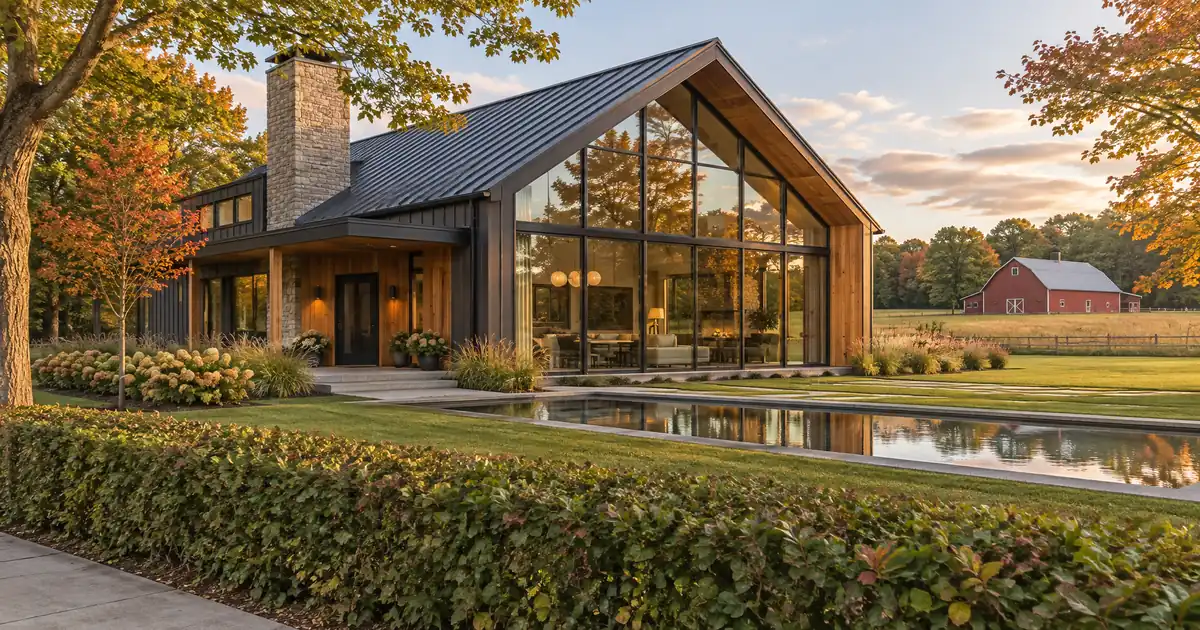
The Quick Read: Which providers will write a home equity line on land with animals, hay fields, or outbuildings depends on how the property is zoned, taxed, and used, not on how many acres you own. A hobby parcel zoned and taxed as residential can be reviewed like a single-family home through Lendmire’s wholesale network. Lendmire does not offer a line on a property with agricultural zoning. Lendmire is a mortgage broker, not a lender, so the useful question is which program fits your file, not which name tops a list.
- Equity and income do not change the outcome when the zoning is agricultural.
- Zoning, tax classification, and dwelling type are tested before credit, leverage, or income.
- Rental properties get the lowest ceiling of the three occupancy types, with a 700 minimum score and a $500,000 maximum line.
- Manufactured homes, log homes, and commercial or mixed-use property are not eligible.
- Thin rural comparable sales can shrink the line even when the property qualifies.
Why There Is No Honest Ranked List
A ranked list of providers would mislead you. Eligibility on farm-type property is set lender by lender, and each lender reads the same parcel differently. A list that ignores that gives a false picture.
How large a line the equity supports.
An equity line is sized by combined loan-to-value, occupancy, and credit — not by rental coverage. Switch the occupancy or the credit band and the ceiling moves with it.
Investment-property lines require a 700 minimum credit score; second-home lines start at a 640 minimum and primary-residence lines at 600, and the combined-LTV ceiling steps down as the credit band drops on primary-residence and second-home lines and holds on investment-property lines; the line cap steps down on primary-residence lines and holds at every tier on investment-property and second-home lines.
A debt-to-income ratio above 45% requires 680+ credit. Profiles under 640 are limited to single-family homes. At least 75% of the approved line is drawn at closing. Ceilings, floors, and caps update from Lendmire’s centralized guideline source.
Line estimate
Illustrative estimate only — not a quote, Loan Estimate, approval, or commitment to lend. The rate is an editable assumption; equity-line pricing is variable through both the draw and repayment periods and never converts to fixed. Occupancy and credit drive the ceiling together: an investment property tops out at 70% combined LTV (minimum credit 700, line cap $500,000); a second home tops out at 90% combined LTV (minimum credit 640, line cap $500,000), with the ceiling stepping down as the credit band drops (the cap holds at every tier); a primary residence tops out at 90% combined LTV (minimum credit 600), and its $750,000 maximum line is available only at 75% combined LTV or below with a 700-or-better credit profile (720 on the longer-runway program) and a full appraisal. Lines above $500,000 require a full appraisal. Credit, debt-to-income, property type, and full underwriting review all affect the final line.
So this article skips the ranking and shows how these files are actually reviewed. Lendmire works with a network of wholesale HELOC lenders and matches a property to the program that fits it. The best program for your situation depends on the property type, credit profile, leverage you need, and how the land is classified. The lenders that write a given parcel depend on those same facts.
Key Terms Defined
HELOC: A home equity line of credit, a revolving line you borrow against using the equity in a property.
CLTV: Combined loan-to-value, meaning all mortgage debt on the property, including the new line, divided by its appraised value.
Hobby farm: A property where land and animals are a lifestyle, not the main source of income. Lenders do not use one fixed definition.
Agricultural zoning: A local land-use designation that permits farming as the primary use. It is a disqualifier on these programs.
Tax classification: How the county assesses the land. A farm-use assessment can signal agricultural use even where zoning is residential.
Draw period: The stretch of the line when you can borrow and pay interest only, followed by a repayment period.
Valuation: The method a lender uses to set the property’s value, either an automated model or a full appraisal.
What Is a HELOC, and Why Does It Behave Differently on Land?
A HELOC is a revolving line secured by your property. The Consumer Financial Protection Bureau describes it as an open-end line of credit. You can borrow, repay, and borrow again during a draw period. The payment is usually variable, so it can change over time. The CFPB also warns that you can lose the home if you cannot repay.
Behind an existing mortgage, a HELOC sits in second position. On the network, a standalone line can also sit in first position.
Land complicates this because the lender has to value and resell the collateral if a file goes bad. A house on a lot has many comparable sales. A house on twenty acres with a barn and a pond may have very few. That is why farm and hobby-farm files get a closer look at the property before anyone looks at your credit.
What Top HELOC Providers on a Farm or Hobby Farm Property Actually Look At
Underwriting runs in a fixed order. Property comes first, and borrower strength comes later.
Step 1: The property-type screen. The underwriter asks whether the file reads as a residence with land or as a farm. The tests are zoning, tax classification, dwelling type, and whether the land produces income. Agricultural zoning stops the file. Strong income does not fix a property-type problem. Bank statements and tax returns answer only the income question.
Step 2: Dwelling type. Manufactured homes (single- and double-wide), log homes, and barndominiums are not offered in the network’s DSCR programs, and the equity-line programs exclude manufactured and log homes as well. Modular factory-built homes are eligible only on the longer-runway program, which pairs a 5-year interest-only draw with a 25-year repayment. Rural land attracts these building types, so check yours early.
Step 3: Valuation. Lines at or below $500,000 ordinarily run an automated valuation with no traditional appraisal. Rural parcels are the usual exception, because a model needs comparable sales it often cannot find. A full appraisal is required on every line above $500,000. You can also ask for one on any line.
Step 4: Sizing the line. The maximum line is the property value times the CLTV ceiling, minus what you already owe. The ceiling depends on occupancy, which the next section settles.
Step 5: The borrower. Credit score, debt-to-income, and housing history come next. Debt-to-income tops out at 50%, and a ratio above 45% requires a 680 minimum score. Qualification is based on the interest-only payment calculated on the maximum draw.
Step 6: Income documentation. Farm receipts can work against you. Heavy agricultural income can point toward agricultural use, which brings back the Step 1 problem. Many borrowers keep farm receipts in a separate account and document large deposits clearly.
Ceilings Depend on How You Occupy the Property
Occupancy is the first number to settle. The same barn-and-acreage parcel gets very different leverage as a primary home, a second home, or a rental.
| Occupancy | Max CLTV | Min credit | Max line |
|---|---|---|---|
| Investment property | 70% | 700 | $500,000 |
| Second home | 90% at 720+ | 640 | $500,000 |
| Primary residence | 90% at 720+ | 600 | $500,000 at 90% CLTV; $750,000 at 75% CLTV, 700+ (720 on the longer-runway program) |
The primary-residence tiers step down with credit. A 720 score reaches 90% CLTV up to $500,000. A 700 score reaches 85% up to $500,000. A 640 score reaches 80% up to $500,000. A 620 score reaches 70% up to $400,000. On a second home, a 700 score reaches 85% and a 640 score reaches 75%, both up to $500,000.
A line above $500,000 is available on primary residences only. It takes a 700 or better credit profile (720 on the longer-runway program), caps at 75% CLTV, and requires a full appraisal. Every figure is a typical guideline for select wholesale lenders, subject to full file review. None is a commitment to lend.
The investment ceiling is the one that surprises people. A 720 score does not lift it above 70% CLTV. If equity from a rural rental is the plan, build around that ceiling from the start.
Where Hobby Farms Land: A Decision Table
Most farm-type properties fit one of a few profiles. This table shows how the network’s programs typically read each one.
| Property profile | Typical reading | Next step |
|---|---|---|
| Residential zoning and tax class, a few animals, hay for personal use | Reviewed as a single-family home | Confirm valuation support |
| Residential zoning, farm-use tax assessment | Mixed signal; may read as agricultural use | Ask the lender before ordering an appraisal |
| Agricultural zoning | Not offered | Consider other financing routes |
| Manufactured or log home on the land | Not eligible | Different financing needed |
| Barndominium | Not offered in the DSCR programs | Confirm dwelling type with a broker first |
| Working farm with commercial crop or livestock sales | Generally outside residential equity lines | Explore agricultural lending |
The mismatch cases in the middle rows are the ones to watch. Zoning and tax classification do not always agree. A parcel zoned residential but taxed on a farm-use assessment can be read as agricultural use, even though the zoning looks clean.
Why “Farm” Is So Slippery
You may think your property is a farm because the government says it is. The USDA Economic Research Service counts any place that sold, or normally would have sold, at least $1,000 of agricultural products in a year. That is a statistical definition. It sweeps in properties no lender would treat as working farms.
The definition also carries little weight outside statistics. AgWeb reports that a USDA-ERS official said the threshold has far less force in commodity and insurance programs. Underwriting works the same way. Your self-description as a hobby farmer and a government statistic both matter less than what the lender sees in the zoning, the tax record, and the income.
A few animals and a hay field read differently from leased pasture or a commercial crop. A lender looks at the pattern of use, not the label you put on it.
Outbuildings, Guesthouses, and Mixed Occupancy
A second dwelling is different. If you live in one house and rent another on the same acreage, expect questions about which structure is the collateral and how each is used.
Farm stays, event income, and hunting leases should not be relied on to qualify. Count only what the lender can treat as ordinary residential or rental use. Revenue from the land can nudge the file toward an agricultural reading.
Title matters as well. On these programs, title must be held by the individual borrower or an inter vivos revocable living trust. LLCs, corporations, partnerships, and land trusts cannot hold title, which is the sharpest structural difference from a DSCR loan. A property already deeded to an LLC needs a vesting change first, or a DSCR cash-out refinance instead. Whether an LLC-titled hobby parcel qualifies for the DSCR route depends on program guidelines and the property type.
A Worked Example in Percentages
Consider a residential-zoned hobby parcel held as an investment property. The owner owes 55% of its value. At the 70% CLTV ceiling, the room is 15 points of the property’s value.
Now say the lender’s valuation comes back 10% below what the owner expected. Seventy percent of the lower value, minus the same debt, leaves roughly 8 points of the original value. A 10% valuation miss cut the available line nearly in half.
That is how thin rural comparable sales hurt. The loan math amplifies every valuation gap, so the line can be much smaller than expected even when the property is eligible. Lenders may also reduce a line if the home’s value falls later.
How the Line Works After Approval
Investment lines run one structure only: a 5-year interest-only draw, then a 25-year fully amortizing repayment. Primary residences and second homes can choose that structure or a 3-year draw with a 17-year repayment. Pricing floats across the draw and the repayment period on both programs.
At least 75% of the line must be drawn at closing. That surprises borrowers who want a standby line they do not touch. After closing, the minimum subsequent draw is typically $1,000. One state sets it higher.
Ceilings depend on occupancy and credit. Primary residences and second homes reach 90% CLTV only at a 720 or better credit profile, with a line of up to $500,000. A 700 score on either occupancy reaches 85% up to $500,000. Investment lines stop at 70% CLTV.
Credit and borrower limits apply too. A bankruptcy needs 4 years of seasoning from discharge or dismissal. A foreclosure-family event follows a longer seasoning path on investment files, and some programs decline that history on a primary residence outright. A borrower is limited to three lines and cannot own more than 15 financed properties. Availability is limited to Lendmire’s 16 full-service states, which is narrower than its 41-market DSCR footprint.
If Your Farm Property Is Declined
A decline on property type is not a verdict on you. You usually have four directions to consider.
- Reclassify, if it is truthful. If the land is residential in reality and only the tax record looks agricultural, a corrected classification may change the reading. Do not manufacture a story. The records must match the facts.
- Sell or refinance a different property. Equity in a conventional rental elsewhere in your portfolio may fit these programs better than the farm does.
- Use a DSCR cash-out refinance on a rental. A DSCR loan is reviewed primarily on property-level rental income covering the payment, subject to lender guidelines. Cash-out generally tops out around 75% LTV on standard rentals, with about 6 months of seasoning as the common expectation. The property itself must still be eligible. Check hobby-farm status before assuming it is. Read the complete DSCR loans guide for how that route works.
- Look at agricultural lending. True working farms generally belong with agricultural lenders, not residential equity programs.
Pre-Application Checklist
Before paying for an appraisal, gather this.
1. Zoning. Get the written zoning designation from the county.
2. Tax classification. Confirm whether the land carries a farm-use assessment.
3. Dwelling type. Confirm whether the house is site-built, modular, manufactured, log, or a barndominium.
4. Occupancy. Decide whether the property is a primary home, second home, or rental.
5. Debt. Total up the mortgage balance and liens against the property.
6. Credit. Pull your score. A report must be no more than 90 days old at closing.
7. Income records. Keep farm receipts apart from household deposits.
8. Vesting. Confirm title is in your name or a revocable living trust.
A broker can screen these before any fee is paid. That is the practical value of a network. One property gets compared against several lenders’ eligibility rules at once.
Frequently Asked Questions
Can I get a HELOC on a hobby farm?
Sometimes. A parcel zoned and taxed as residential may be reviewed as a single-family home. Agricultural zoning is not offered. A farm-use tax assessment, farm income, or a dwelling type like a barndominium can change the answer.
Does acreage disqualify a property?
Not by itself. Zoning and use matter more than acre count on this network, and no single acreage number decides eligibility. Individual lenders sometimes set their own cutoffs, which is one reason a broker shops several programs.
What is the maximum CLTV on a farm property?
It depends on occupancy. An investment property tops out at 70% CLTV with a 700 minimum score. Primary residences and second homes can reach 90% CLTV, but only at a 720 or better credit profile and up to $500,000. Every figure is a typical guideline subject to lender review.
Will farm income help me qualify?
Usually not. Heavy agricultural income can signal agricultural use, which is an eligibility problem. Qualification on these programs is based on the borrower’s credit, debt-to-income, and equity.
Can an LLC hold a farm property and still get a line?
Not on these equity-line programs. Title must be held by the individual or a revocable living trust. A DSCR cash-out may fit instead, subject to program eligibility and the property type.
Next Step
If you are considering a home equity line and want to see how the numbers work, Lendmire can help you compare HELOC options based on the property, the equity available, credit profile, combined leverage, and your goals.
Rural parcels reward the borrower who checks zoning and tax class before the appraisal, because those two records decide the file before anything else does.
About Lendmire
Lendmire (NMLS# 2371349) is a mortgage brokerage serving homeowners and real estate investors in its 16 full-service states. Home equity lines of credit are arranged through wholesale lending channels; Lendmire brokers the line and the lender underwrites each application under its occupancy-based guidelines. Scotsman Guide named Lendmire a Top Mortgage Workplace in both 2025 and 2026.
Get Started
Ready to find the right loan for you?
See your offer in seconds. No credit pull, no obligation.
Informational only. Not a Loan Estimate, approval, or commitment to lend. Program availability and eligibility are subject to lender guidelines, credit approval, property review, and underwriting.
References
1. Consumer Financial Protection Bureau
2. USDA Economic Research Service – Farm Structure and Contracting
3. AgWeb
This article is part of Lendmire’s HELOC & home equity loan program — full qualification details, guidelines, and scenarios live on the program page.
Related reading: Top Investment Property HELOC Providers When You Need the Fastest Approval · Top Investment Property HELOC Providers for LLC-Held Rentals · Top Investment Property HELOC Providers to Buy a Rental Property
Brandon Miller
Founder & CEO, Mortgage Loan Originator, Lendmire LLC
- Mortgage Loan Originator · NMLS# 1129696 · Verify on NMLS Consumer Access
- North Carolina Real Estate Broker · License# 343312 · Verify on NCREC
- North Carolina Insurance Producer · License# 19053198 · Property, Casualty, Life, Health · Verify on NAIC SBS
- Lendmire LLC · Firm NMLS# 2371349 · Verify firm licensure
Compliance and disclosures. Lendmire (NMLS# 2371349) is a licensed mortgage broker and is not a direct lender, depository institution, financial advisor, or tax professional. Content in this article is general market analysis and educational information — not financial, legal, or tax advice for any specific situation. Lendmire does not guarantee loan approval; every transaction is subject to underwriting by the funding lender. Mortgage pricing and loan program guidelines are subject to change at any time without notice and vary by borrower characteristics, property type, and state regulations. Lendmire complies with Equal Housing Opportunity. Licensure verification: NMLS Consumer Access.