
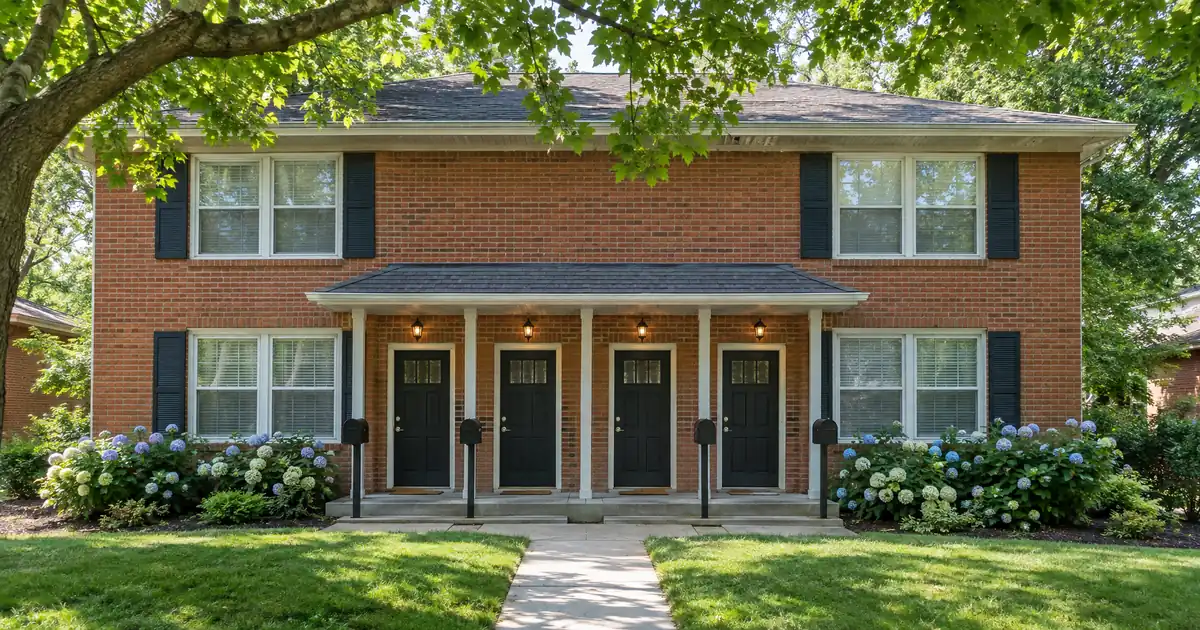
The Quick Read: On a fourplex you will live in, only a VA loan can truly start at no money down, while FHA always asks for a 3.5% minimum investment. VA fits eligible veterans and service members who have cash reserves and can document landlord readiness. FHA fits buyers with no military service, or buyers who want its flexible credit and ratio rules and can bring the minimum. Both programs require you to live in one of the four units, so neither one is an investor loan. Everything below is subject to lender guidelines and full file review, and nothing here is a commitment to lend.
Key takeaways
- “No money down” on a fourplex is a VA feature. FHA’s maximum financing is 96.5% of value.
- VA replaces monthly mortgage insurance with an upfront funding fee. FHA charges an upfront premium plus an annual one.
- Both loans count only part of the building’s rent toward qualifying, and each has its own test.
- VA can ask for more cash in reserve than its “no down payment” label suggests.
- If you qualify for both, the monthly cost and the cash left in your account after closing usually decide it.
FHA payment estimate
Starting assumptions reflect an example price and the FHA minimum investment. Replace them with your own figures.
Editable benchmark: 7.32% as of October 22, 2026 · Freddie Mac 30-year average via FRED®. A conventional market reference, not an FHA loan quote.
Illustrative starting assumptions: a $350,000 price, the FHA minimum investment as the down payment, a thirty-year term at the current Freddie Mac benchmark, and property taxes and insurance estimated at typical national rates. Every field is editable.
Illustrative estimate only — not a Loan Estimate, approval, quote, or commitment to lend. The rate field carries the weekly Freddie Mac thirty-year conventional benchmark, a market reference and not an FHA loan quote; your rate is set by the lender at lock. FHA mortgage insurance follows HUD’s published schedule for the term, leverage and loan size entered; taxes, insurance and dues are editable estimates; closing costs are not included; county loan limits are not checked here. Licensed in sixteen states for consumer mortgages. Lendmire is not affiliated with or acting on behalf of FHA, HUD, or the federal government.
Side-by-Side
The table shows how the two loans treat a four-unit home you will occupy. Every FHA figure comes from the wholesale programs Lendmire places FHA files with. VA items follow VA’s own published guidance.
| Factor | VA loan | FHA loan |
|---|---|---|
| Who can use it | Eligible veterans, service members, surviving spouses | Any qualifying owner-occupant |
| Units allowed | Up to 4 | 1 to 4 |
| Down payment | Often none, if it appraises | 3.5% minimum investment |
| Maximum financing | No down payment typical | 96.5% of value |
| Credit floor | Mostly set by the lender | 580 decision score |
| Mortgage cost | Upfront funding fee, no monthly premium | 1.75% upfront plus annual premium |
| Occupancy | Live in one unit | Principal residence |
| Rent in qualifying | Part of rent, plus reserves and landlord history | Self-sufficiency test on 3-4 units |
| Ratios | Ratios plus residual income | 31/43 base, up to 40/50 |
A few rows need explaining. They come up again below.
Can Each Loan Really Finance a Fourplex?
Yes. Both programs cover four units, and both require you to live in the building. VA’s purchase loan page says a VA-backed loan can buy a home of up to four units. The borrower has to meet VA and lender standards for credit and income, and has to live in the home being bought.
FHA works the same way on occupancy. The FHA loan is for one to four units that become your principal residence. A non-occupant co-borrower is allowed on FHA, which helps some families. The co-borrower does not remove the requirement that you live there.
Five or more units fall outside both programs’ single-family products. Those buildings are financed another way.
This is “house hacking”: you live in one unit and the other three help carry the building. It is still an owner-occupied purchase. A plan to rent all four units from day one does not fit either loan.
What “No Money Down” Actually Means
Only VA can start at zero. VA reports that nearly 90% of its loans are made with no down payment. That works because VA guarantees part of the lender’s loan.
Zero down still has conditions. The property has to appraise at or above the price, or the buyer may need to bring a small down payment, per VA’s Buyer’s Guide. Entitlement also matters. A borrower with full entitlement can usually buy without a down payment, but partial or remaining entitlement can bring county limits back into play. The same guide notes that loans made before 2020 above the county limit needed a down payment on the excess.
FHA never gets to zero. You put in at least 3.5% of the lesser of price or appraised value. Seller or interested-party contributions can reach 6% of the price. Those contributions can help with closing costs, but they do not replace the buyer’s minimum investment.
Cash to close is not the only cash question. VA’s handbook asks for reserves on a multi-unit purchase, covered below. “No money down” does not mean “no cash needed.”
How the Rent Counts on Each Loan
Neither program lets you count all the rent. A fourplex looks like four rent checks, but the underwriting haircuts them.
On VA, the lender follows Chapter 4 of the VA Lender’s Handbook for multi-unit rental income. In summary:
- The lender verifies cash reserves of at least six months of the full housing payment.
- The lender documents your experience managing rentals, or your plan to use a property manager.
- Rental income counts only if you have a reasonable likelihood of success as a landlord.
- For an existing building, the amount counted is 75% of the lease or rental agreement, unless more can be documented.
- For proposed construction, the amount counted is 75% of the appraiser’s opinion of fair monthly rent.
That handbook edition is older, and individual lenders can be stricter than VA. Treat the six-month reserve figure as a baseline and confirm it with your lender.
FHA takes a different route on three- and four-unit homes. The building must pass a self-sufficiency test. The appraiser estimates market rent, and a portion of that rent has to cover the full housing payment. The formula sits in HUD Handbook 4000.1. A fourplex with weak rents or heavy vacancy can fail the test even when your personal income is strong.
In practice, VA tests you as a landlord and FHA tests the building. A first-time landlord with thin savings may struggle on VA. A buyer with strong savings and a well-rented building may find VA easy. A strong borrower in a building with soft rents may find FHA harder.
When VA Is the Better Fit
VA wins when you are eligible and the cash you keep matters as much as the cash you bring. These are the common situations.
You have little cash and decent reserves. Zero down frees money for repairs, vacancy cushions and the reserve requirement. FHA would take at least 3.5% of the price from that same pile. These specifics are subject to lender guidelines and a full review of property, leverage, and credit.
Monthly cost is the priority. VA has no monthly mortgage insurance. CFPB explains that VA swaps it for a guarantee, so the buyer pays only an upfront funding fee. On a fourplex, a monthly premium on a large balance can add up over many years. The funding fee varies with your down payment and prior VA use, and it can be rolled into the loan. Rolling it in raises the balance and the long-term cost.
You want lower friction at closing. VA says its purchase loans often carry fewer closing costs, and the seller may be allowed to pay some. VA also has no prepayment penalty if you pay the loan off early.
You have landlord credibility. Prior rental management, or a plan to use a property manager, helps the file. A veteran who already owns a duplex fits well.
You expect to keep the building for years. Because FHA’s annual premium lasts for the term on a thirty-year loan above 90% LTV, VA’s lack of a monthly premium widens the gap the longer you hold. Terms depend on the lender’s guidelines, the property type, the leverage, and a full review of the credit profile.
The flip side matters. VA is limited to eligible borrowers. Being eligible does not make approval automatic, because the lender’s own credit and income standards apply too. Not every lender offers VA loans either, so your options can be narrower.
When FHA Is the Better Fit
FHA wins when VA is unavailable, or when the file has features VA lenders handle less comfortably. Consider these situations.
You have no military service. FHA has no service requirement. That settles most cases.
Your credit is modest. The wholesale programs Lendmire places FHA files with start at a 580 decision score for the 3.5% minimum. HUD has a lower tier with a larger required investment, but the network does not reach below 580. If your credit sits near that floor, FHA is built for it. Lenders on VA files often set their own higher floors.
You have a past credit event. HUD’s waiting periods are two years from a Chapter 7 discharge and three years from a foreclosure. Those are HUD rules, not a promise from any lender.
Your ratios are tight. The base pair is 31/43, housing to total. Documented compensating factors can reach 40/50 at the top tier, and the automated finding governs most files. That flexibility helps a borrower with real income and heavy debts.
You have a co-borrower who will not live there. FHA allows a non-occupant co-borrower. A relative’s income can strengthen the file, though the occupying borrower still has to live in one unit.
You have the cash for 3.5%. For a buyer with the money in hand, the minimum investment is manageable. The upfront premium of 1.75% of the base loan can be financed.
Here is the cost side. The annual premium runs between 0.15% and 0.75% of the balance, depending on term, loan amount and LTV. At or below 90% LTV, it ends after eleven years. Above 90% on a thirty-year loan, it lasts for the term. A fourplex bought near the 96.5% maximum sits in the lasting-premium zone. That is a real cost, and it is the main price of FHA’s flexibility. Later, an FHA Streamline can refinance an existing FHA loan with no appraisal and a limited credit review, although the premium continues. The exact numbers vary by lender and program and follow a full review of property, leverage, and credit.
County loan limits apply to FHA, and they change every year. Four-unit limits are higher than one-unit limits, which makes a fourplex purchase workable in many counties.
Key Terms Defined
Entitlement: The amount of guaranty VA gives a veteran, which sets how much a lender can lend with no down payment.
Self-sufficiency test: FHA’s check that the appraiser’s market rent on a three- or four-unit home covers the full housing payment.
Funding fee: VA’s one-time upfront charge that replaces monthly mortgage insurance.
Upfront premium: FHA’s one-time mortgage insurance charge, 1.75% of the base loan, which can be financed.
What a Practitioner Sees in These Files
Across the FHA and VA files Lendmire arranges through wholesale lenders, the usual surprise is not the down payment. It is the reserves, the appraisal and the rent. A buyer expects zero down on VA, then learns the lender wants several months of reserves on a multi-unit property. Another buyer picks FHA for its credit flexibility, then finds the appraiser’s market rent is lower than the seller’s rent roll.
Ask early what the appraiser is likely to assume for rents. Ask early how the lender will count reserves. Both questions affect which loan works far more than the advertised leverage does.
Choosing When You Qualify for Both
If you qualify for both, run the choice as a short checklist. No single answer fits every borrower.
| Your situation | Usually points to |
|---|---|
| Little cash, solid reserves | VA |
| Wants to avoid monthly premium | VA |
| Credit near the floor | FHA |
| Tight ratios, documented factors | FHA |
| First-time landlord, thin savings | FHA, or VA with a property manager plan |
| Holding the building many years | VA |
Two more checks help. If the appraisal could come in below price, VA may ask for a small down payment, while FHA already has a 3.5% buffer built in. If you may reuse VA entitlement for another home later, think about how a fourplex purchase uses it up. VA says the benefit can be reused if you sell or refinance a home bought with a VA-backed loan.
Conventional financing is a third path for buyers who qualify for neither or want to compare. It is outside this comparison.
Tax treatment can depend on your situation. Borrowers should speak with a qualified tax professional before relying on any deduction or credit.
A Balanced Verdict
VA is usually stronger on cash and monthly cost. FHA is usually stronger on credit and ratio flexibility. Neither is better in every case. A veteran with good credit, reserves and a well-rented building will probably find VA hard to beat. A buyer with a thinner credit profile, heavier debts or no service record often finds that FHA is the loan that gets the fourplex done.
The honest test is the full cash picture: what you bring to closing, what you hold in reserve, and what the loan costs each month. Compare those three numbers on both loans before you pick one.
Next Step
If you are buying a home and want to see whether an FHA loan fits your file, Lendmire can help you compare the options and what each one asks of the file. Lendmire is a mortgage broker, not a lender, so any outcome stays subject to lender guidelines and full file review. The team can be reached at 828-256-2183.
Frequently Asked Questions
Can I buy a fourplex with FHA and put nothing down?
No. FHA requires a 3.5% minimum investment on the lesser of price or appraised value, with maximum financing of 96.5%. Seller contributions can reach 6% of the price and may help with closing costs. They do not replace the minimum investment.
Do I have to live in the fourplex on a VA or FHA loan?
Yes. Both programs finance a home you will occupy. VA says you must live in the home you are buying. FHA treats it as your principal residence. A pure investment purchase does not fit either loan.
Does all the rent count toward qualifying?
No. On VA, the handbook counts 75% of the lease or rental agreement for an existing building, and it ties the rental income to reserves and landlord readiness. On FHA, a three- or four-unit home has to pass the self-sufficiency test based on the appraiser’s market rent. Lenders can apply stricter standards than the agencies.
Is a VA loan free of mortgage costs?
No. VA has no monthly mortgage insurance, but it charges an upfront funding fee. The fee can be rolled into the loan, which raises the balance and the overall cost. FHA charges an upfront premium of 1.75% plus an annual premium, so the structure differs even though neither loan is free.
Can I use VA again after buying a fourplex?
Sometimes. Partial or remaining entitlement can bring county limits back into play on the next purchase. A lender can review how much entitlement you would have left.
For your own numbers, request a scenario review with Lendmire.
About Lendmire
Lendmire (NMLS# 2371349) is a mortgage broker licensed for consumer lending in 16 states. Lendmire arranges FHA, VA, conventional and jumbo purchase and refinance loans through wholesale lenders; every file is underwritten by the lender under the applicable program guidelines. Scotsman Guide named Lendmire a Top Mortgage Workplace in both 2025 and 2026.
Get Started
Ready to find the right loan for you?
In about 30 seconds you can review financing options available for your home or investment property. No commitment required.
Informational only. Not a Loan Estimate, approval, or commitment to lend. Program availability and eligibility are subject to lender guidelines, credit approval, property review, and underwriting.
References
4. VA Lender’s Handbook, Chapter 4 – Credit Underwriting
6. CFPB – What is mortgage insurance
This article is part of Lendmire’s FHA loan program — full qualification details, guidelines, and scenarios live on the program page.
Related reading: FHA Cash-Out Payment History Requirements for an Existing FHA Loan · Can a Homeowner With an FHA Loan Do an FHA Cash-Out in Texas? · FHA Cash-Out Buyout Documentation for an Existing FHA Loan
Brandon Miller
Founder & CEO, Mortgage Loan Originator, Lendmire LLC
- Mortgage Loan Originator · NMLS# 1129696 · Verify on NMLS Consumer Access
- North Carolina Real Estate Broker · License# 343312 · Verify on NCREC
- North Carolina Insurance Producer · License# 19053198 · Property, Casualty, Life, Health · Verify on NAIC SBS
- Lendmire LLC · Firm NMLS# 2371349 · Verify firm licensure
Legal disclosures. Lendmire (NMLS# 2371349) is a state-licensed mortgage brokerage that arranges financing through wholesale lender relationships. Lendmire is not a direct lender, depository institution, or registered financial advisor. The discussion above is general informational content about real estate financing — it is not financial, legal, or tax advice, and readers should consult licensed professionals for guidance on their individual circumstances. Loan inquiries are subject to lender underwriting; this article does not represent a commitment to lend. Loan terms, rates, and qualification standards vary by borrower, property, and state, and are subject to change at any time. Equal Housing Opportunity. NMLS Consumer Access: nmlsconsumeraccess.org.