
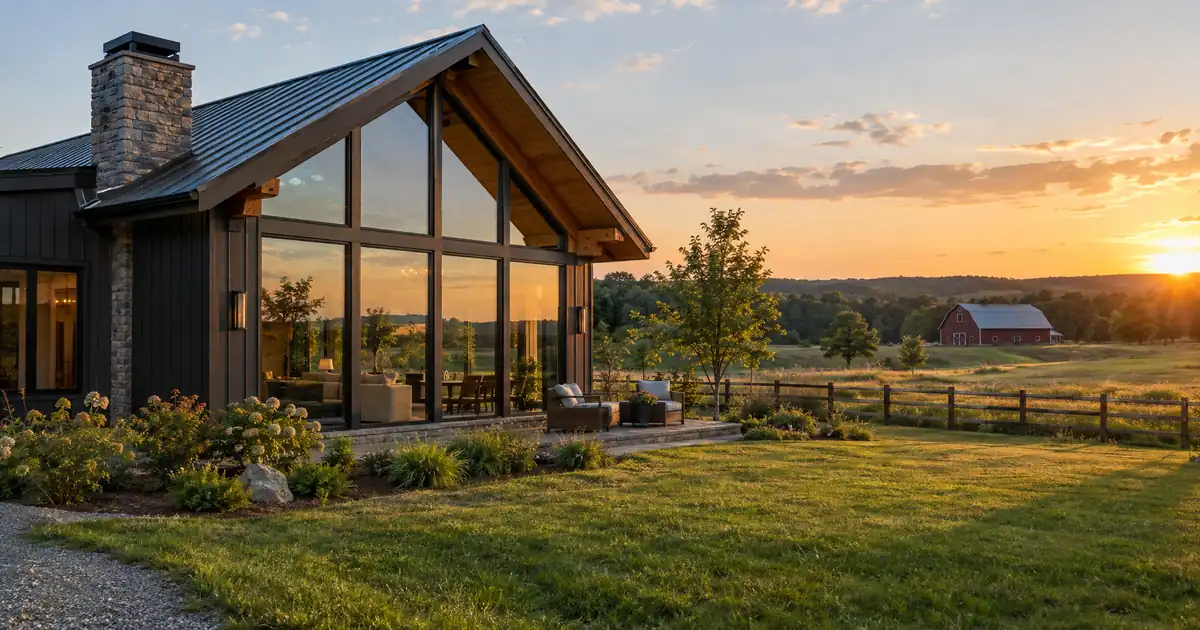
Rural Rental Properties And What A DSCR Loan Covers — The Quick Read: There is no single federal definition of “rural” that governs DSCR lending. Rural status gets decided property by property, through the appraisal report and each lender’s own overlays on population, acreage, and neighborhood build-out. What a DSCR loan actually covers on a rural rental depends on whether an appraiser can support a defensible rent number, whether the property’s use trips an agricultural exclusion, and whether the acreage and location fit a given program’s parameters.
That last part matters more than most investors expect going in. A rural property that sails through one lender’s underwriting can get a hard decline from another lender working the exact same file — not because of credit or cash flow, but because of how each program defines “rural” in the first place.
DSCR Calculator
Run the numbers in your market
Rate source: Freddie Mac 30-yr average via FRED® — Federal Reserve Bank of St. Louis · effective Sep 17, 2026
Prefilled with local estimates — enter your own rent or nightly figures, taxes, insurance, and HOA for a more accurate picture.
Program parameters update from Lendmire’s centralized guideline source. Taxes and insurance are editable estimates.
As of Sep 17, 2026 · General Freddie Mac market benchmark, not a Lendmire loan offer. Rent, nightly rate, occupancy, taxes, and insurance are editable estimates. Short-term rental figures are estimates only and vary significantly by season, property type, management approach, and local short-term-rental rules — confirm local regulations before relying on them. Qualifying income for short-term rentals varies by program — some use appraisal market rent, others use documented STR history or projections — and is confirmed in underwriting. Not a Loan Estimate, approval, or commitment to lend. Program availability and eligibility are subject to lender guidelines, credit approval, property review, and underwriting.
Key Terms Defined
DSCR (Debt Service Coverage Ratio): the monthly rent divided by the monthly housing payment (principal, interest, taxes, insurance, and any HOA dues) — a ratio at or above 1.00 means the rent covers the payment.
Form 1007: the standard rent-schedule appraisal form used on 1-unit investment properties, where the appraiser estimates market rent using comparable rentals in the area.
Form 1025: the equivalent rent-schedule form for 2-4 unit properties, sometimes called the Small Residential Income Property Appraisal Report.
Reconsideration of value (ROV): a formal request asking an appraiser to revisit a rent or value conclusion, supported by specific comp-level evidence — not a general argument that the number feels low.
No-ratio loan: a qualification path that doesn’t require the rent to hit a minimum coverage number at all, available through select wholesale programs at a reduced leverage, subject to underwriting.
Key Takeaways
- No government rural map — Census, USDA, or the federal consumer-finance regulator — controls DSCR eligibility. The appraisal and the individual lender’s overlays do.
- The core friction point in a rural DSCR file isn’t the borrower’s credit. It’s whether the appraiser can find enough comparable rentals to support a defensible rent number.
- Working farms, ranches, and true agricultural use fall outside DSCR programs entirely — that’s a near-universal lending convention, not a Lendmire-specific rule.
- Acreage caps and log-cabin-style construction are recognized gray zones where the same property can look different to two different underwriters.
- Short-term rentals and rent-controlled units compound rural comp problems instead of solving them.
Is There an Official Definition of “Rural” for DSCR Loans?
No. DSCR loans are business-purpose, non-QM products, so no statutory rural map applies to them the way one applies to a government program. Each lender in a wholesale network sets its own rural criteria, and the appraiser’s narrative language on the report is what actually triggers those overlays.
This creates a real problem for investors used to conventional or owner-occupied loans, where “rural” has one clear meaning. The U.S. Census Bureau defines rural areas as open country and small settlements. These have fewer than 2,000 housing units and fewer than 5,000 residents. This is just a statistical baseline. It gets redrawn after each census. It has nothing to do with whether a specific lender will fund a specific rental property. The USDA Economic Research Service uses a similar Census-based definition for its own work. Separately, USDA’s zero-down loan program uses a population cutoff. But that cutoff applies only to owner-occupied purchases, not investment properties. So it doesn’t matter here — that program excludes rental property outright.
The federal consumer-finance regulator’s rural definition is even narrower. Its Rural or Underserved Areas Tool gives creditors a safe harbor for specific exemptions in the federal truth-in-lending rulebook. These cover things like escrow requirements, balloon-payment qualified mortgage treatment, and certain appraisal rules. DSCR loans are business-purpose loans. They’re already exempt from most of these rules — but not because of rural status. They’re exempt because they aren’t consumer mortgages in the first place. None of these three government frameworks decides whether a rural rental passes DSCR underwriting. That decision comes from the appraisal report and the lender’s own overlay sheet.
How Does Underwriting Actually Treat a Rural Rental File?
The DSCR math itself never changes with geography — rent divided by the full monthly housing payment produces the same ratio whether the property sits in a subdivision or on a gravel road. What changes in a rural file is confidence in the rent number feeding that ratio, and that confidence problem runs through four steps.
Step one: the appraisal is the trigger point. Even though a DSCR loan sits outside agency guidelines, a 1-unit rural rental still gets a Form 1007 rent schedule, and a 2-4 unit property gets the Form 1025 equivalent. Non-QM underwriters didn’t invent a new methodology for documenting market rent — they reuse the same rent-schedule framework appraisers already know from conventional lending.
Step two: comparable rental data drives the rent conclusion, and rural markets often can’t supply enough of it. The standard approach compares the subject to at least three similar rental properties nearby. In a low-density market, three genuine, recent, arm’s-length comparable rentals within a reasonable distance may simply not exist. This is a recognized structural appraisal issue in low-population markets generally, not something specific to DSCR paper.
Step three: thin comps push the rent conclusion lower, which pushes the ratio lower. A property with genuinely strong local rental demand can still land a conservative appraised rent because the appraiser has less data to lean on. That lower rent number is what shows up in the numerator of the ratio calculation — the math doesn’t discriminate, but the input does.
Step four: a reconsideration of value is the formal remedy, with a real evidentiary bar. An investor pushing back on a rural rent conclusion needs comp-level evidence the appraiser missed — additional rental comparables, corrected property details, documented rent history — not a general reference to current listing prices or a claim that the market “feels” stronger.
Across the network of lenders Lendmire places files with, this is the single most common reason a rural DSCR file stalls: not credit, not reserves, but an appraiser who can’t defend a rent number with three solid comps. Getting ahead of that — pulling comparable rental data before ordering the appraisal, not after — is the single highest-leverage move on a rural file.
What Does a DSCR Loan Actually Cover on a Rural Rental?
Across select lenders in Lendmire’s wholesale network, rural is treated as workable on a residential rental up to five acres, with room up to twenty acres on loan sizes to $3,000,000 and ten acres above that on larger files. Working farms, ranches, agricultural income, and true vacation-cabin construction fall outside this coverage entirely — those are property-type exclusions, not rural overlays.
Property size and leverage move together on rural files the same way they do everywhere else in the program: loan amounts from $150,000 to $10,000,000 on the portfolio side of the ladder (Lendmire’s standard DSCR program runs to $3,000,000), with the strongest leverage — up to 80% on a purchase — available at credit 660-plus on loans up to $1,000,000. Above that, leverage steps down: 75% purchase and rate-term through $3,000,000 at 700-plus credit, dropping to 65% purchase from $3,000,000 to $4,000,000, and 60% on review from $4,000,000 to $10,000,000. Files above $4,000,000 are reviewed case by case before submission, purchase or rate-and-term only, no cash-out. Final terms depend on lender guidelines, property type, leverage, and the borrower’s complete credit picture.
Cash-out on rural collateral follows the same ceiling as any standard rental: 75% at or below $1,000,000, stepping down through the ladder to a $1,500,000 cap above 60% LTV, with no cash-out above $3,000,000 at all. Coverage of 1.00 or better earns full leverage; select programs in the network will consider 0.75 to 0.99 coverage on a rural file up to $2,000,000, though LTV and terms adjust accordingly, subject to underwriting. Reserves typically run six months of the full monthly payment on the subject property, twelve for a first-time investor, and two appraisals are required above $2,000,000 — a detail that matters on rural files specifically, since a second appraiser can sometimes surface comps the first one missed.
Investors weighing a jumbo rural purchase against a smaller in-town property should look at Lendmire’s jumbo DSCR loan closing timeline for rental property coverage for how loan size interacts with documentation depth on larger files.
Where Does the General Rule Break?
Four situations reliably produce different outcomes from different underwriters on the same rural property, and an investor who understands them going in avoids a lot of wasted appraisal fees.
Agricultural use is a categorical exclusion, not a rural variant. Working farms, ranches, orchards, and properties with income tied to crops, hay, or livestock sit outside DSCR programs entirely. The reasoning is structural: if a lender ever needed to foreclose and take over a working agricultural operation, it lacks the operational expertise to run it, and the pool of buyers with that expertise is far smaller than the pool of buyers for a standard residential rental. This isn’t a DSCR-specific overlay — it’s close to universal across non-QM lending, and even USDA’s own owner-occupied program excludes properties used primarily for agricultural or commercial enterprise.
Log cabins occupy a genuine gray zone. True vacation-cabin construction is generally excluded, but a single-family home built in “log style” — with standard HVAC, running water, septic, and comparable properties nearby — is typically treated as an eligible residential rental. The distinguishing factor is infrastructure and comparability, not the logs themselves.
Acreage caps create hard breaks at specific thresholds. Coverage in Lendmire’s network runs to five acres at standard terms, extends to twenty acres on loans up to $3,000,000, and steps to ten acres above that. Cross those lines and the file needs a different structure entirely, sometimes with excess land carved out of the appraisal.
DSCR vs. conventional financing
Two common ways to finance an investment property in this market. They qualify you differently — here’s how investors weigh them.
Why investors choose it
- Qualifies on the property’s rental income — no personal tax returns, W-2s, or pay stubs needed to document income.
- No personal debt-to-income ceiling to clear, so existing mortgages and obligations don’t cap your borrowing the same way.
- Can be closed in an LLC, keeping the property inside a business entity.
- Built for scaling — not held to the limit on number of financed properties that conventional financing applies.
- Underwriting centers on the deal: generally qualifies when the rent covers the payment, a 1.00x coverage ratio being a common baseline (confirmed in underwriting).
- Designed specifically for investment property, including long-term and, where the program allows, short-term rentals.
Where it’s strong
- Often the lowest ongoing financing cost for a buyer who fully qualifies on personal income — a fit for a first property or a cost-first purchase.
Trade-offs for investors
- Requires full personal income documentation and must fit within a debt-to-income limit — salary, existing debts, and other mortgages all count.
- Typically held in your personal name rather than a business entity.
- Caps how many financed properties you can carry, which can become a ceiling as a portfolio grows.
- Evaluates you as a borrower as much as the property, which usually means more paperwork.
How investors usually choose: a first or single property often optimizes for the lowest financing cost; portfolio builders often optimize for leverage, vesting in an LLC, and scaling past conventional caps. The right answer depends on your goals, the property, and current guidelines — both paths run through select lenders in Lendmire’s wholesale network, with eligibility and terms confirmed in underwriting.
Short-term rentals and rent-controlled units stack friction rather than solving it. A rural property with weak long-term rent comps might look better on paper as a short-term rental — but STR income can’t be captured on a standard rent-schedule form, so it introduces its own documentation path (twelve months of operating history on a refinance, or the appraisal’s short-term-rent analysis at 80% of gross rent on a purchase, for experienced investors with at least twelve months owning income property in the last thirty-six). Combining a rural, low-comp market with an STR strategy layers two separate appraisal friction points onto one file rather than canceling either one out. Municipal permission to operate short-term rentals is never assumed — it has to be documented for the specific property, since rules are set locally and change. Lendmire’s coverage on insurance requirements for short-term rental properties walks through the parallel documentation gap on the insurance side.
What Does the Investor Decision Actually Look Like?
In practice, “is this rural property DSCR-eligible” breaks into three separate questions, and each one can independently sink or save a deal — which is why screening happens before the offer, not after.
First: can an appraiser produce a defensible market-rent number at all? If three genuine comparable rentals don’t exist nearby, the file can stall regardless of the borrower’s credit profile or the property’s real cash-flow potential.
Second, check whether the property’s use classification triggers an agricultural or zoning exclusion. A financially sound rental with strong local tenants can still get declined. This happens if it has agricultural zoning, working outbuildings like barns or stables, or any income tied to farming rather than pure residential rent.
Third, check whether the property fits within the acreage and loan-size limits a given lender will actually underwrite. These limits are set by each lender, not by law. So the same rural property can be a clean approval with one program and a hard decline with another. Early screening — before writing an offer, before ordering the appraisal — is the single highest-leverage step you can take on a rural DSCR deal.
The macro backdrop supports taking rural DSCR deals seriously rather than treating them as a niche curiosity. Investor share of home sales oscillated between 15% and 20% before 2020, but in the second quarter of a recent year, Scotsman Guide reported that a full one-third of home sales went to investors — a growing pool of capital chasing DSCR paper, including rural product. More capital doesn’t eliminate the underlying comp-scarcity problem, though. That problem is physical, not a matter of lender appetite.
An investor with a marginal rural coverage ratio isn’t automatically out of options. Lendmire’s guide on when a weak rental can be offset by blended DSCR explains how looking at a whole portfolio can sometimes carry one weak file. For the full picture of how coverage ratio, leverage, and property eligibility fit together on any rental — rural or not — Lendmire’s complete DSCR loans guide is the place to start.
DSCR loans qualify mainly based on whether the property’s rental income covers the payment, subject to lender guidelines. This doesn’t mean skipping documentation altogether. Rural files still need the same rent-schedule support any investment property needs. The rural label just makes that support harder to produce. Tax treatment can depend on how loan proceeds are used and how the property is held. So investors should keep clear records and talk with a qualified tax professional before relying on any deduction.
If you’re evaluating a rural rental purchase or refinance and want to see how the coverage ratio, acreage, and leverage actually line up, Lendmire can help compare DSCR loan options based on the property’s income, the borrower’s credit profile, and the deal’s overall structure. Reach Lendmire at 828-256-2183 or request a quote directly to start the conversation before ordering an appraisal.
Frequently Asked Questions
Does a rural property automatically get a lower DSCR loan amount?
Not automatically — loan size is driven by the property’s value and the borrower’s leverage tier, not rural status by itself. Rural status affects the file through acreage caps (five acres at standard terms, extending to twenty or ten acres at larger sizes) and through comp-driven rent conclusions, which can indirectly compress the coverage ratio if the appraised rent comes in conservative.
Can I use a Form 1007 rent conclusion even if I have a signed lease at a higher rent?
Most programs anchor qualification to the appraiser’s independent market-rent conclusion rather than the actual lease amount, particularly when the two diverge. A signed lease is still useful documentation, but it typically doesn’t override a conservative appraised rent driven by thin comps in a rural market.
Is a hunting lease or farm income ever counted toward DSCR lender review?
No. Agricultural income, hunting-lease income, and similar non-residential-rental income streams sit outside the property income DSCR programs are built to measure. These programs are underwritten around residential rental income specifically.
What happens if my rural property doesn’t have three comparable rentals nearby?
The appraiser will typically expand the search radius or the timeframe, or apply adjustments for the properties that are available, which usually produces a more conservative rent conclusion. A formal reconsideration of value is the path to challenge that number, but it requires specific comp-level evidence the original appraiser missed — not a general market argument.
Can a short-term rental in a rural, low-comp market still qualify?
It can, through a separate documentation path built for STR income rather than the standard long-term rent schedule — either twelve months of operating history on a refinance or the appraisal’s short-term-rent analysis on a purchase, discounted to 80% of gross rent, generally reserved for investors with prior income-property experience. Municipal permission to operate has to be confirmed and documented for that specific property, since short-term rental rules can vary by city, county, HOA, and property type.
For current guidelines and terms, see Lendmire’s super jumbo DSCR loan programs page.
Self-employed borrowers can compare both super jumbo programs on Lendmire’s self-employed mortgages page.
About Lendmire
Lendmire, NMLS# 2371349, is a mortgage brokerage focused on investor financing, arranging DSCR loans in 39 states plus Washington, D.C. — 40 markets total. Qualification is based on the property’s income rather than personal income documentation, subject to lender guidelines, making it a fit for LLC-held rentals and scaling portfolios. Scotsman Guide named Lendmire a Top Mortgage Workplace in both 2025 and 2026.
Get Started
Ready to find the right loan for you?
In about 30 seconds you can review financing options available for your home or investment property. No commitment required.
Informational only. Not a Loan Estimate, approval, or commitment to lend. Program availability and eligibility are subject to lender guidelines, credit approval, property review, and underwriting.
References
1. U.S. Census Bureau — Urban and Rural
2. USDA Economic Research Service — What is Rural
3. Scotsman Guide — Investor-owned homes surge as brokers pivot to nonconforming loans
Brandon Miller
Founder & CEO, Mortgage Loan Originator, Lendmire LLC
- Mortgage Loan Originator · NMLS# 1129696 · Verify on NMLS Consumer Access
- North Carolina Real Estate Broker · License# 343312 · Verify on NCREC
- North Carolina Insurance Producer · License# 19053198 · Property, Casualty, Life, Health · Verify on NAIC SBS
- Lendmire LLC · Firm NMLS# 2371349 · Verify firm licensure
Compliance and disclosures. Lendmire (NMLS# 2371349) is a licensed mortgage broker and is not a direct lender, depository institution, financial advisor, or tax professional. Content in this article is general market analysis and educational information — not financial, legal, or tax advice for any specific situation. Lendmire does not guarantee loan approval; every transaction is subject to underwriting by the funding lender. Mortgage pricing and loan program guidelines are subject to change at any time without notice and vary by borrower characteristics, property type, and state regulations. Lendmire complies with Equal Housing Opportunity. Licensure verification: NMLS Consumer Access.


