
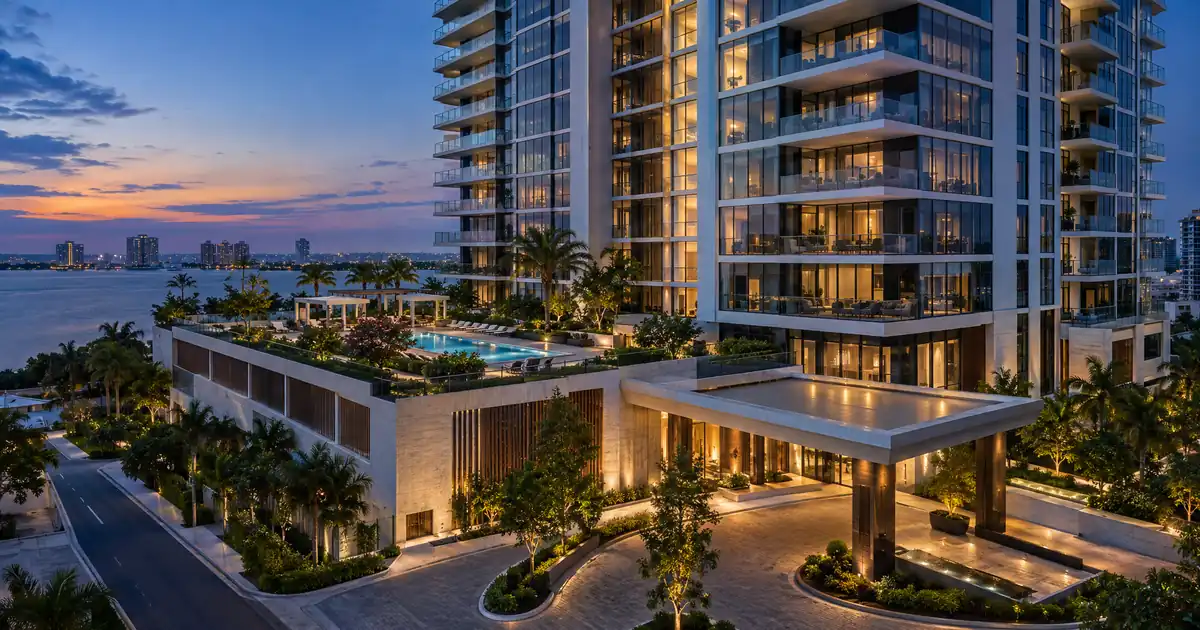
How To Get A Luxury Condo Approved On A Short-term Rental DSCR Loan — The Quick Read: The condo itself has to clear lender review before your income numbers even matter. Most luxury resort and beachfront condos get flagged as “non-warrantable” by conventional standards, but that label doesn’t stop DSCR financing — it’s the reason DSCR financing exists. The play is: confirm the building isn’t a condotel, document the rental income the right way, and size the loan against the leverage ladder for non-warrantable units. Get those three right and a high-end short-term rental condo is very reviewable.
The Setup: Why Luxury Condos Trip Up Conventional Lenders
Luxury vacation condos often run into trouble. Think of the beachfront tower, the ski-village building, or the downtown high-rise with a concierge desk. These buildings often fail conventional condo review before a buyer ever sees a rate sheet. Fannie Mae’s Selling Guide caps commercial and mixed-use space at 35% of a project. It also disqualifies buildings whose documents restrict owner occupancy or require rental pooling. Ironically, these are often the exact features that make a resort condo work well as a short-term rental (Fannie Mae Selling Guide – Ineligible Projects).
Short-Term Rental Calculator
Run the STR numbers in your market
Rate source: Freddie Mac 30-yr average via FRED® — Federal Reserve Bank of St. Louis · effective Sep 17, 2026
Prefilled with local estimates — enter your nightly rate, occupancy, taxes, and insurance for a more accurate picture.
Short-term rental income is documented with a 12-month history or a market data report. Program parameters update from Lendmire’s centralized guideline source.
As of Sep 17, 2026 · General Freddie Mac market benchmark, not a Lendmire loan offer. Nightly rate, occupancy, taxes, and insurance are editable estimates. Qualifying income for short-term rentals varies by program — some use appraisal market rent, others use documented STR history or projections — and is confirmed in underwriting. Not a Loan Estimate, approval, or commitment to lend. Program availability and eligibility are subject to lender guidelines, credit approval, property review, and underwriting.
This isn’t a rare problem. Fannie Mae’s own Condo Status Finder shows only 3.6% of tracked projects carry an “ineligible” status as of its most recent update, but the top reasons — insurance shortfalls, repair issues, condotel characteristics, and pending litigation — line up almost perfectly with the profile of a high-end resort building (Fannie Mae Condo Status Finder).
DSCR loans sidestep that whole review. They’re business-purpose loans, reviewed on the property’s rental income rather than a conforming checklist. Because they’re not sold to Fannie Mae or Freddie Mac, the 35% commercial cap and the rental-pool exclusion simply don’t apply. Across the wholesale network Lendmire works with, non-warrantable condos are a normal file — not an exception that needs a workaround.
Step One: Separate the Condotel Problem From Everything Else
A condotel is a different animal from a plain non-warrantable condo. No lender in the network treats them the same. Condotels are buildings licensed or operated like hotels, with front-desk rental services or nightly check-in. They sit in their own category. A unit can even get tagged as a condotel just for showing up prominently on booking platforms, even without formal hotel services.
Programs in the network still finance condotels, but the leverage and loan size shrink: purchase up to 75% and refinance up to 65%, capped at $1,500,000, with $250,000 in cash-in-hand typically required. A plain non-warrantable condo — one that’s ineligible for GSE purchase but doesn’t run hotel operations — gets better terms: up to 75% LTV and up to $1,500,000, subject to underwriting.
Before you go further, pull the condo declaration and check whether the building is licensed or marketed as a hotel. That single fact determines which leverage bucket you’re in.
Step Two: Get the Rental Income Documented the Right Way
Short-term rental income on a DSCR file gets qualified at a discount to gross bookings, never at face value. On most programs in the network, qualifying income comes from twelve months of documented operating history on a refinance, or the appraisal’s short-term-rent analysis on a purchase — and either way, it’s typically counted at around 80% of gross revenue, not the full nightly-rate math a listing page shows you.
This matters because the raw AirDNA or platform number and the underwritten number are routinely far apart. Two lenders can look at the identical listing and land on meaningfully different debt-service coverage ratios, purely from how conservatively they treat seasonality and haircut the top-line revenue. That’s normal — it’s why getting pre-underwritten by someone who’s actually run the numbers matters more than trusting a projection tool.
Short-term rental qualification on these programs is generally reserved for experienced investors. Typically, that means someone who’s owned income property within the past thirty-six months. It also isn’t available on the no-ratio path. So if you’re a first-time landlord buying your first luxury unit as a short-term rental, know this before you make an offer.
Step Three: Run the Coverage Math
A coverage ratio at or above 1.00 — meaning the documented rental income covers the full monthly housing payment, including principal, interest, taxes, insurance, and HOA dues — earns the strongest available leverage on a given loan size. Below that, coverage in the 0.75-to-0.99 range is a real path through select programs in the network, capped at $2,000,000, though leverage and terms adjust to compensate, subject to underwriting.
Say you’re eyeing a beachfront unit priced at $1.2 million. On most files in that $1M-to-$1.5M bracket, purchase leverage tops out around 75% for a borrower with strong credit, and cash-out on a refinance in that band runs lower still — capped near 70% for standard rental collateral, or 70% specifically when the collateral is a short-term rental, since any cash-out ceiling above 60% narrows for STR-classified units. If the documented income clears 1.00x comfortably, that unit sits in strong shape. If it lands closer to 0.85x, the file can still move — just at reduced leverage, and the underwriter will want to see reserves and credit compensate for the thinner cushion.
Short-term rental loans in the network stop at $2,000,000 regardless of how strong the coverage ratio runs — a $3 million penthouse with excellent booking history still needs a standard long-term-rent DSCR structure or a larger portfolio-level program to get financed above that ceiling.
Step Four: Check the Building’s Insurance Structure
Master policy gaps are one of the most common reasons a condo project gets flagged ineligible in the first place, and they matter twice on a luxury STR file — once for the building’s overall standing, and once for what you personally have to insure. Master policies typically run “bare walls,” “single entity,” or “all-in,” and each version leaves a different amount of the unit’s interior for the owner’s own HO-6 policy to cover (Policygenius).
The DSCR payment calculation folds insurance into the monthly obligation used for the coverage ratio. So an under-insured master policy, or a thin HO-6 rider, does more than create liability risk. It can also shift the debt-service number enough to change what leverage you qualify for. Pull the master policy declarations page before you finalize the loan amount you’re underwriting to.
Step Five: Confirm the Building and City Both Allow Short-Term Rentals
Lender approval and legal permission to operate are two entirely separate questions, and getting one right doesn’t guarantee the other. HOA rental restrictions run on a completely different track from city or county short-term rental ordinances — complying with one never satisfies the other. An HOA can prohibit short-term rentals outright in its governing documents even where the city fully permits them, and that restriction shows up often enough in resort-condo markets that it deserves a real look before you sign a contract.
Because short-term rental rules can vary by city, county, HOA, and property type, investors should confirm local rules before relying on projected rental income. This is diligence work you do yourself or through counsel — it isn’t something a DSCR underwriter checks for you, and it isn’t something the loan approval implies one way or the other.
Where Files Go Sideways
The most common breakdown isn’t the coverage ratio. It’s sequencing. Here’s what often happens: investors get excited about a strong AirDNA projection and put in an offer. Only then do they discover the building requires mandatory rental pooling. Some programs in the network treat this differently than a straightforward non-warrantable flag with no operational restrictions.
The second common miss: assuming the raw platform revenue number is the qualifying figure. It isn’t. Build your offer math around a haircut-adjusted number, not the listing page’s best month.
DSCR vs. conventional financing
Two common ways to finance an investment property in this market. They qualify you differently — here’s how investors weigh them.
Why investors choose it
- Qualifies on the property’s rental income — no personal tax returns, W-2s, or pay stubs needed to document income.
- No personal debt-to-income ceiling to clear, so existing mortgages and obligations don’t cap your borrowing the same way.
- Can be closed in an LLC, keeping the property inside a business entity.
- Built for scaling — not held to the limit on number of financed properties that conventional financing applies.
- Underwriting centers on the deal: generally qualifies when the rent covers the payment, a 1.00x coverage ratio being a common baseline (confirmed in underwriting).
- Designed specifically for investment property, including long-term and, where the program allows, short-term rentals.
Where it’s strong
- Often the lowest ongoing financing cost for a buyer who fully qualifies on personal income — a fit for a first property or a cost-first purchase.
Trade-offs for investors
- Requires full personal income documentation and must fit within a debt-to-income limit — salary, existing debts, and other mortgages all count.
- Typically held in your personal name rather than a business entity.
- Caps how many financed properties you can carry, which can become a ceiling as a portfolio grows.
- Evaluates you as a borrower as much as the property, which usually means more paperwork.
How investors usually choose: a first or single property often optimizes for the lowest financing cost; portfolio builders often optimize for leverage, vesting in an LLC, and scaling past conventional caps. The right answer depends on your goals, the property, and current guidelines — both paths run through select lenders in Lendmire’s wholesale network, with eligibility and terms confirmed in underwriting.
A third failure point is treating STR qualification as available on every loan size. It isn’t — the $2,000,000 ceiling on short-term rental files means a $2.5 million unit with excellent booking history needs a different structural approach, whether that’s a larger down payment to bring the loan size under the ceiling or qualifying the file on long-term market rent instead.
Who This Fits — and Who It Doesn’t
This option works well if you already have a rental history, or a credible short-term-rental appraisal analysis. You’ll also need decent liquidity for reserves. And the building can’t fall under a hard condotel exclusion. Most files require reserves of about six months of the full monthly housing payment, held on the subject property. If you’re a first-time investor, that requirement can climb to about twelve months. Plan for this before you go under contract.
It doesn’t fit someone buying their very first income property with STR income as the only qualifying source — the experience requirement rules that out on most programs. It also doesn’t fit a buyer counting on a loan amount above $2,000,000 to be qualified purely on short-term rental income; that scenario needs either a long-term-rent DSCR structure or a larger loan sized under a different program.
Entity vesting — buying in an LLC rather than personally — is welcome on these files without layering multiple entities together, which is common for investors holding several properties. Anyone weighing that structure for a specific unit should look at how vesting a luxury short-term rental in an LLC actually plays out before closing.
DSCR loans are for investment properties you won’t live in. Lenders review them differently than a standard owner-occupied mortgage. That’s because they’re business-purpose loans for investors. To qualify, the property’s rental income generally needs to cover the payment, subject to lender guidelines. Lenders don’t look at your traditional personal-income documents for this.
Anyone comparing a condotel classification against a plain non-warrantable condo before making an offer should read through the differences in condotel vs. condo on a luxury short-term rental — the leverage gap between the two categories is bigger than most buyers expect. And for the full mechanics of how DSCR underwriting works property by property, Lendmire’s complete DSCR loans guide walks through the coverage-ratio math in more depth.
Tax treatment can depend on how the funds are used and how the property is held; investors should keep clear records and speak with a qualified tax professional before relying on any deduction.
This article is educational only and not legal or tax advice. Investors should consult a qualified attorney or CPA about the rental restrictions, entity structure, and tax treatment that apply to their own property and situation.
Frequently Asked Questions
Does a non-warrantable condo automatically disqualify me from financing? No. Non-warrantable describes a building’s standing with Fannie Mae and Freddie Mac, not whether the unit can generate rental income. DSCR loans are built specifically for this category and don’t check against the conforming condo rules at all.
Can I qualify using an AirDNA projection alone? On most files in the network, purchase transactions use a documented short-term-rent analysis or projection at a discount to gross revenue, while refinances lean on twelve months of actual operating history. The raw projection number is a starting point, not the final qualifying figure.
What’s the loan size ceiling for a short-term rental condo? Short-term rental files in the network cap out at $2,000,000, regardless of how strong the booking history runs. Above that, the file typically needs to qualify on long-term market rent instead.
Does the HOA’s rental policy affect my loan approval? Not directly — a lender reviews the building’s warrantability and insurance structure, not its rental-pooling bylaws for legality purposes. But an HOA ban on short-term rentals can still eliminate your income source after closing, which is a diligence issue separate from the loan file.
How much does short-term rental income get discounted for qualification purposes? On most programs in the network, documented STR income is counted at around 80% of gross revenue rather than full nightly-rate totals, and only for investors with prior income-property experience.
For current guidelines and terms, see Lendmire’s super jumbo DSCR loan programs page.
Self-employed borrowers can compare both super jumbo programs on Lendmire’s self-employed mortgages page.
About Lendmire
Lendmire, NMLS# 2371349, is a mortgage brokerage focused on investor financing, arranging DSCR loans in 39 states plus Washington, D.C. — 40 markets total. Qualification is based on the property’s income rather than personal income documentation, subject to lender guidelines, making it a fit for LLC-held rentals and scaling portfolios. Scotsman Guide named Lendmire a Top Mortgage Workplace in both 2025 and 2026.
Investors focused on short-term rentals can review DSCR loans for Airbnb and short-term rentals.
Get Started
Ready to find the right loan for you?
In about 30 seconds you can review financing options available for your home or investment property. No commitment required.
Informational only. Not a Loan Estimate, approval, or commitment to lend. Program availability and eligibility are subject to lender guidelines, credit approval, property review, and underwriting.
References
1. Fannie Mae Selling Guide – Ineligible Projects (B4-2.1-03)
2. Fannie Mae Condo Status Finder
3. Policygenius – HO-6 Condo Insurance
Brandon Miller
Founder & CEO, Mortgage Loan Originator, Lendmire LLC
- Mortgage Loan Originator · NMLS# 1129696 · Verify on NMLS Consumer Access
- North Carolina Real Estate Broker · License# 343312 · Verify on NCREC
- North Carolina Insurance Producer · License# 19053198 · Property, Casualty, Life, Health · Verify on NAIC SBS
- Lendmire LLC · Firm NMLS# 2371349 · Verify firm licensure
Important disclosures. Lendmire (NMLS# 2371349) is a licensed mortgage brokerage. Lendmire is not a direct lender, depository institution, or financial advisor. All loan inquiries are subject to lender underwriting; this article does not constitute a commitment to lend. Rates, terms, and program guidelines are subject to change without notice and vary by borrower profile, property type, and state. Information in this article is general in nature and is not financial, legal, or tax advice. Equal Housing Opportunity. NMLS Consumer Access: nmlsconsumeraccess.org.


