
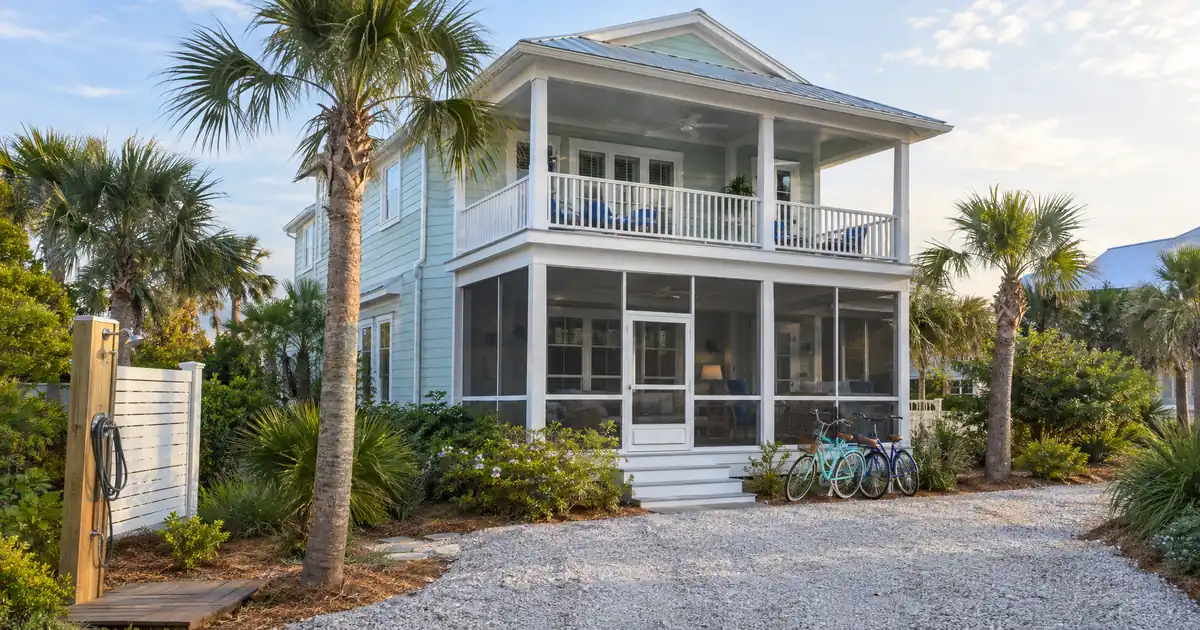
Use A Second-Home Loan On A Beach House — The Quick Read: No, not if the rent is what makes the numbers work. A second-home loan is built around personal use, not rental income, and the property can’t be run like a business. If your real plan is rental cash flow, a DSCR loan — a loan qualified on the property’s rental income instead of your traditional personal-income documentation — is the tool built for that job.
If you plan to live in the beach house part of the year and rent it out occasionally, a second-home loan can work. If your plan is to rent it most of the year and use it yourself now and then, that’s an investment property in every practical sense, and the loan should match that reality.
DSCR Calculator
Run the numbers in your market
Rate source: Freddie Mac 30-yr average via FRED® — Federal Reserve Bank of St. Louis · effective Sep 17, 2026
Prefilled with local estimates — enter your own rent or nightly figures, taxes, insurance, and HOA for a more accurate picture.
Program parameters update from Lendmire’s centralized guideline source. Taxes and insurance are editable estimates.
As of Sep 17, 2026 · General Freddie Mac market benchmark, not a Lendmire loan offer. Rent, nightly rate, occupancy, taxes, and insurance are editable estimates. Short-term rental figures are estimates only and vary significantly by season, property type, management approach, and local short-term-rental rules — confirm local regulations before relying on them. Qualifying income for short-term rentals varies by program — some use appraisal market rent, others use documented STR history or projections — and is confirmed in underwriting. Not a Loan Estimate, approval, or commitment to lend. Program availability and eligibility are subject to lender guidelines, credit approval, property review, and underwriting.
Key Terms Defined
Second-home loan: A mortgage for a property you personally use for part of the year, priced and underwritten around that personal-use intent — not around rental income.
DSCR loan: A business-purpose investment loan qualified primarily on the property’s rental income covering its payment, subject to lender guidelines, rather than your traditional personal-income documentation.
Occupancy fraud: Misstating how you actually intend to use a property — claiming personal use when the real plan is rental income — to get loan terms meant for owner-use properties.
Rental pool: An arrangement where a management company or developer controls bookings and often shares revenue across multiple owners’ units — the kind of setup a second-home loan explicitly prohibits.
LTV (loan-to-value): The loan amount as a percentage of the property’s value. Lower LTV means a bigger down payment relative to price.
PITIA: Principal, interest, taxes, insurance, and association dues — the full monthly obligation a lender measures rental income against.
What a Second-Home Loan Actually Requires
A second-home loan requires the property stay available primarily for your own use and enjoyment. Fannie Mae’s Selling Guide draws this line directly: rental income from a second home generally cannot be used to qualify the borrower for the loan. The property is defined by personal use, not by its ability to produce income.
That doesn’t mean zero renting is allowed. A summary of Freddie Mac’s parallel standard, via Homebuyer.com, notes the borrower can rent the property short-term, as long as it isn’t tied to a rental pool, a management company controlling occupancy, or revenue-sharing with a developer. Occasional renting is tolerated. A business model built on renting is not.
There’s also a practical property test. The home generally needs to be suitable for year-round occupancy, though seasonal properties — beach houses included — can get an appraisal exception if there’s comparable seasonal-limitation sales data to support it. That matters for a lot of coastal properties that sit half-empty in winter.
The Rule People Get Wrong
For years, many lenders and borrowers read the second-home rider as banning all rentals outright. It didn’t. The rider was clarified to confirm short-term renting was always permitted, provided the property stayed primarily for the owner’s personal use and wasn’t handed over to a management arrangement. The confusion came from cautious lenders reading the old language too strictly, not from an actual rule change.
So the myth “second homes can never be rented” is false. The more accurate rule: occasional, incidental rental activity is fine. Renting as the primary purpose, or handing bookings to a manager who controls the calendar, crosses into investment-property territory — regardless of how many nights you personally stay there.
Second-Home Loan vs. DSCR Loan
| Factor | Second-Home Loan | DSCR Loan |
|---|---|---|
| What drives lender review | Borrower’s personal use intent | The property’s rental income |
| Rental income counted | Generally not | Yes, it’s the core of qualification |
| Property manager control | Not allowed | Normal and expected |
| Traditional personal-income documentation | Typically reviewed | Usually not the focus |
| Best fit | Occasional personal use, light renting | Rental-dependent cash flow |
The DSCR path exists precisely for the buyer whose real plan is rental income. It qualifies the deal on the property’s cash flow rather than forcing a personal-use story that doesn’t match the actual plan. Lendmire’s complete DSCR loans guide walks through how that qualification actually works property by property.
Why Rental-Dependent Buyers Shouldn’t Force the Second-Home Box
If your underlying math requires the rent check to cover the payment, a second-home loan is the wrong structure from day one — because that income generally can’t be counted toward qualifying in the first place. Trying to make it work anyway usually means misrepresenting your actual plans on the application.
That’s not a paperwork technicality. The Federal Housing Finance Agency defines occupancy fraud as falsely stating your intent to live in a property to get better loan terms than an investment property would carry. Lenders have gotten sharper about catching it, and rental-heavy applications draw more scrutiny than they used to.
A DSCR loan sidesteps that tightrope entirely. There’s no personal-use rider to violate, no one-year clock, and no conflict if you want a property manager running bookings — that’s the normal operating model these loans are built to finance.
How DSCR Financing Actually Handles a Rental Beach House
Across the wholesale network Lendmire places files through, coverage of 1.00 or better on documented rent typically earns the strongest available leverage — up to 80% on purchases from $150,000 to $1,000,000, stepping down to 75% between $1,000,000 and $3,000,000, and tightening further above that on larger balances, always subject to underwriting. Credit typically starts around 660, moving to 700 once loan size crosses $3,000,000.
Short-term rental income is treated differently than a standard lease. Most programs in the network look at twelve months of documented operating history on a refinance, or the appraisal’s short-term-rent analysis on a purchase, and apply a discount to gross rent rather than counting every dollar projected. That haircut protects against seasonal swings — a real factor for a beach property with a summer-heavy booking calendar.
Coverage below 1.00 isn’t automatically dead, either. Select programs in the network will still consider files in that range, and no-ratio options exist for stronger borrower profiles, but leverage and terms adjust downward to offset the added risk, subject to underwriting. None of this replaces a lender’s actual review — it’s a starting map, not a promise.
One thing that trips up a lot of beach-property buyers: local rules on short-term rentals can vary by city, county, HOA, and property type, so it’s worth confirming what’s actually allowed before leaning on projected nightly income to qualify. A property that can’t legally operate as a short-term rental can’t count that income on a DSCR file, no matter how strong the projected numbers look on paper.
Files on seasonal coastal properties tend to run tighter reserve requirements than a standard long-term rental would, simply because the income has more swing to it month to month — that’s a pattern seen across the network, not a rule specific to any one lender.
Using Second-Home Financing to Bridge Into Ownership
Some buyers genuinely want personal use first and rental income second — a family beach house they’ll eventually rent more heavily once the kids are grown, for instance. A second-home loan fits that intent honestly, and buyers sometimes lean on gift funds for a second-home down payment or business funds held in reserve to get there. The key is matching the loan to the actual plan, not the plan you think sounds better on an application.
If that plan shifts later — say, personal use fades and the rental side takes over — refinancing into a DSCR structure is usually the cleaner move rather than continuing under a second-home loan the property no longer fits.
Tax treatment can depend on how the property is used and how many days count as personal versus rental use; investors should keep clear records and talk with a qualified tax professional before relying on any deduction.
Frequently Asked Questions
Can I rent my beach house occasionally and still keep a second-home loan?
Yes, occasional short-term renting is generally fine as long as the property stays primarily available for your own use and no management company or rental pool controls the calendar. The line gets crossed when renting becomes the main purpose of ownership rather than an occasional side activity.
What happens if I get approved as a second home but rent it out full-time?
That mismatch between stated intent and actual use is what regulators define as occupancy fraud, and lenders are watching for it more closely on investment-heavy applications. It’s a compliance issue, not just a matter of getting a slightly different rate.
Does a DSCR loan require personal income documentation?
No — DSCR lender review runs primarily on the property’s rental income covering the payment, subject to lender guidelines, rather than personal income documentation like traditional income documentation or pay stubs. Credit and reserves still matter, but the income test is about the asset, not the borrower’s paycheck.
Can short-term rental income qualify a beach house on a DSCR loan?
Often yes, using documented operating history or an appraisal’s short-term-rent analysis at a discount to gross income, subject to lender guidelines and local rental rules. Local restrictions on short-term rentals can vary by city, county, and HOA, so confirming what’s legally allowed at the property matters before counting on that income.
Is a beach house automatically an investment property for financing purposes?
Not automatically — it depends on how you actually intend to use it, not just its location. A beach house used mostly for personal enjoyment with light rental activity can still fit a second-home loan; one purchased mainly to generate rental income fits the DSCR path better.
If your beach house plan runs on rental cash flow, Lendmire can help you compare DSCR loan options based on the property’s income, your credit profile, available leverage, and your goals as an investor.
For current guidelines and terms, see Lendmire’s super jumbo DSCR loan programs page.
Self-employed borrowers can compare both super jumbo programs on Lendmire’s self-employed mortgages page.
About Lendmire
Lendmire, NMLS# 2371349, is a mortgage brokerage focused on investor financing, arranging DSCR loans in 39 states plus Washington, D.C. — 40 markets total. Qualification is based on the property’s income rather than personal income documentation, subject to lender guidelines, making it a fit for LLC-held rentals and scaling portfolios. Scotsman Guide named Lendmire a Top Mortgage Workplace in both 2025 and 2026.
Get Started
Ready to find the right loan for you?
In about 30 seconds you can review financing options available for your home or investment property. No commitment required.
Informational only. Not a Loan Estimate, approval, or commitment to lend. Program availability and eligibility are subject to lender guidelines, credit approval, property review, and underwriting.
References
1. Fannie Mae Selling Guide – Occupancy Types (B2-1.1-01)
2. Freddie Mac Second Home Requirements, via Homebuyer.com
Brandon Miller
Founder & CEO, Mortgage Loan Originator, Lendmire LLC
- Mortgage Loan Originator · NMLS# 1129696 · Verify on NMLS Consumer Access
- North Carolina Real Estate Broker · License# 343312 · Verify on NCREC
- North Carolina Insurance Producer · License# 19053198 · Property, Casualty, Life, Health · Verify on NAIC SBS
- Lendmire LLC · Firm NMLS# 2371349 · Verify firm licensure
Required disclosures. Lendmire (NMLS# 2371349) operates as a licensed mortgage broker, not a direct lender or depository. The discussion in this article is general in nature and should not be relied upon as financial, legal, or tax advice — every investment scenario is unique and should be reviewed by a qualified professional. Any loan inquiry is subject to lender underwriting, and this article is not a commitment to lend or a guarantee of approval. Mortgage rates, loan terms, and program guidelines vary by borrower, property, and state, and may change without notice. Equal Housing Opportunity. Verify licensure at NMLS Consumer Access.


