
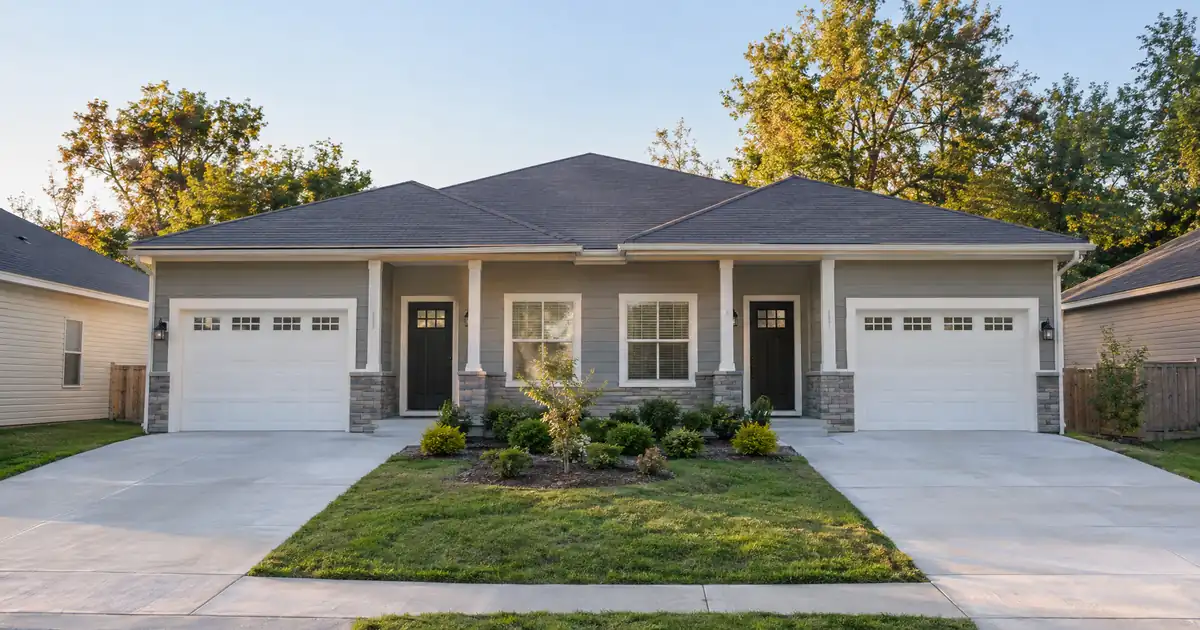
Does A Duplex Match Single-Family Leverage In A DSCR Portfolio Loan — The Quick Read: Mostly, yes — up to a point, then no. Across most wholesale programs, a 2-4 unit property sits on the same leverage grid as a single-family rental through the smaller loan sizes. Once the loan crosses into larger balances, leverage steps down by property size and unit count together, not by unit count alone. The coverage ratio itself — rent against payment — usually isn’t any harder to clear on a duplex. Often it’s easier, because two rent checks cover one mortgage payment instead of one.
Here’s the direct answer, in one breath: a duplex, triplex, or fourplex qualifies under the same DSCR framework as a single-family rental, uses a different appraisal form to document rent, and generally sits on the identical leverage ladder through the first loan tier — with the same step-downs applying to both property types as the loan amount grows.
DSCR Calculator
Run the numbers in your market
Rate source: Freddie Mac 30-yr average via FRED® — Federal Reserve Bank of St. Louis · effective Sep 17, 2026
Prefilled with local estimates — enter your own rent or nightly figures, taxes, insurance, and HOA for a more accurate picture.
Program parameters update from Lendmire’s centralized guideline source. Taxes and insurance are editable estimates.
As of Sep 17, 2026 · General Freddie Mac market benchmark, not a Lendmire loan offer. Rent, nightly rate, occupancy, taxes, and insurance are editable estimates. Short-term rental figures are estimates only and vary significantly by season, property type, management approach, and local short-term-rental rules — confirm local regulations before relying on them. Qualifying income for short-term rentals varies by program — some use appraisal market rent, others use documented STR history or projections — and is confirmed in underwriting. Not a Loan Estimate, approval, or commitment to lend. Program availability and eligibility are subject to lender guidelines, credit approval, property review, and underwriting.
What Actually Changes Between a Duplex and a Single-Family Rental
The math doesn’t get harder. The paperwork does.
A single-family rental gets appraised on Fannie Mae’s Form 1007, a simple one-unit rent schedule. A duplex, triplex, or fourplex gets appraised on Fannie Mae Form 1025, the Small Residential Income Property Appraisal Report — sometimes called Freddie Mac Form 72. That form breaks rent out unit by unit, then rolls the whole building up into one income figure. It’s the same underlying job — proving what the property rents for — just built for a building with more than one door.
That’s the whole structural difference in most files. Once the appraiser produces a total rent figure for the building, the lender treats it exactly like a single-family rent schedule: total rent goes in the numerator, total payment goes in the denominator, and out comes a coverage ratio.
The unit-count line that actually matters isn’t duplex versus single-family. It’s four units versus five. Cross into five units or more and the file typically leaves residential DSCR underwriting entirely, moving into commercial-style analysis built on operating statements rather than a rent schedule. A fourplex stays inside the world this article covers. A five-unit building doesn’t.
Does Leverage Actually Match? The Loan-Size Answer
Leverage matches through the entry tier and then steps down by loan size, not by property type. On files up to $1,000,000, Lendmire’s wholesale network typically places purchase and rate-and-term financing at up to 80% loan-to-value for both single-family and 2-4 unit collateral, with a credit floor around 660 — subject to lender guidelines. That ceiling holds for both property types at that size.
Cash-out on that same tier typically tops out around 75% for standard rental collateral (a 70% ceiling applies specifically to short-term-rental collateral in this same range) — again, without a separate haircut for unit count.
Where it changes is loan size, and it changes for everyone. Move into the $1,000,000 to $1,500,000 tier and purchase or rate-and-term leverage typically steps down to around 75%, cash-out to around 70%, with credit expectations rising toward 700. From $1,500,000 to $3,000,000, purchase and rate-and-term still typically run near 75%, but cash-out compresses further, closer to 60%, with credit floors around 720. Above $3,000,000, leverage steps down again — purchase and rate-and-term closer to 65%, no cash-out at all — and above $4,000,000, every request in Lendmire’s network gets reviewed case by case before submission, purchase or rate-and-term only, capped near 60%, never a flat “up to” number.
None of that ladder treats a duplex worse than a single-family house at the same loan size. It’s the dollar amount doing the work, not the unit count.
| Loan Size | Purchase / Rate-Term LTV | Cash-Out LTV | Credit Floor |
|---|---|---|---|
| $150K–$1M | Up to 80% | Up to 75% (70% on STR) | 660+ |
| $1M–$1.5M | Up to 75% | Up to 70% | 700+ |
| $1.5M–$3M | Up to 75% | Up to 60% | 720+ |
| $3M–$4M | Up to 65% | None | 700+ |
| $4M–$10M | Up to 60% (on review) | None | 700+ |
Read that table against unit count and property type disappears as a variable. It’s the loan amount that moves the needle.
Where the Rent Math Actually Favors the Duplex
A duplex often clears the coverage ratio more easily than a comparable single-family rental at the same price point, because two rent checks are offsetting one payment instead of one. If a single-family rental sits at breakeven coverage, a duplex with the same total rent and payment often has more cushion — because a vacancy in one unit still leaves the other unit’s income partially offsetting the mortgage.
That’s not a marketing line — it’s how the appraisal form is built. Form 1025 produces a per-unit rent breakdown and then aggregates it into one total figure, and that aggregation is what smooths out single-unit vacancy risk. A one-unit rental with a vacant tenant has zero rental income that month. A two-unit property with one vacant unit still has half its expected rent showing up.
Vacancy at closing doesn’t kill a duplex file, either. If a unit sits empty when the loan closes, underwriting substitutes the appraiser’s market-rent opinion for that unit and still aggregates it with the occupied unit’s actual or leased rent — the same treatment a single-family file gets when a house is between tenants.
This is also where coverage below 1.00 becomes a live option rather than a dead end. Sub-1.00 coverage is available through select lenders in Lendmire’s wholesale network, with leverage and terms adjusting accordingly, subject to underwriting — that’s true for both single-family and 2-4 unit collateral, and multi-tenant income is often what pushes a marginal file back above the line rather than needing that path at all.
The Coverage Ratio Isn’t the Bottleneck — Documentation Is
Where a duplex file actually gets more complicated is proving the rent, not clearing the ratio. Two or four leases instead of one, potential unit-mix differences, and an appraisal form that takes longer to complete all add friction to the file — even when the underlying math is favorable.
Reserve requirements don’t discriminate by unit count either. Most files in Lendmire’s network need around six months of PITIA held in reserve on the subject property — twelve months for a first-time investor — regardless of whether that property is a single house or a fourplex. Loans above $2,000,000 typically require two appraisals rather than one, again independent of unit count.
Short-term rental duplexes carry their own wrinkle. A long-term rental duplex qualifies off a signed lease or the appraiser’s market rent. A short-term rental duplex qualifies off documented operating history — typically twelve months of platform income on a refinance, or the appraisal’s short-term rental analysis on a purchase, generally discounted against gross receipts. That’s a different documentation path entirely, and short-term rental rules can vary by city, county, HOA, and property type, so investors should confirm local rules before relying on projected rental income.
Investors weighing a fourplex against a jumbo-balance single-family file might also want a closer look at how the ladder behaves at higher price points — Lendmire’s luxury duplex leverage guide walks through that comparison in more depth.
Key Terms Defined
DSCR (debt-service coverage ratio): the property’s monthly rental income divided by its full monthly payment — principal, interest, taxes, insurance, and any HOA dues. A ratio of 1.00 means rent exactly covers the payment.
LTV (loan-to-value): the loan amount expressed as a percentage of the property’s appraised value or purchase price, whichever is lower. Lower LTV means a bigger down payment.
DSCR vs. conventional financing
Two common ways to finance an investment property in this market. They qualify you differently — here’s how investors weigh them.
Why investors choose it
- Qualifies on the property’s rental income — no personal tax returns, W-2s, or pay stubs needed to document income.
- No personal debt-to-income ceiling to clear, so existing mortgages and obligations don’t cap your borrowing the same way.
- Can be closed in an LLC, keeping the property inside a business entity.
- Built for scaling — not held to the limit on number of financed properties that conventional financing applies.
- Underwriting centers on the deal: generally qualifies when the rent covers the payment, a 1.00x coverage ratio being a common baseline (confirmed in underwriting).
- Designed specifically for investment property, including long-term and, where the program allows, short-term rentals.
Where it’s strong
- Often the lowest ongoing financing cost for a buyer who fully qualifies on personal income — a fit for a first property or a cost-first purchase.
Trade-offs for investors
- Requires full personal income documentation and must fit within a debt-to-income limit — salary, existing debts, and other mortgages all count.
- Typically held in your personal name rather than a business entity.
- Caps how many financed properties you can carry, which can become a ceiling as a portfolio grows.
- Evaluates you as a borrower as much as the property, which usually means more paperwork.
How investors usually choose: a first or single property often optimizes for the lowest financing cost; portfolio builders often optimize for leverage, vesting in an LLC, and scaling past conventional caps. The right answer depends on your goals, the property, and current guidelines — both paths run through select lenders in Lendmire’s wholesale network, with eligibility and terms confirmed in underwriting.
Form 1025 (Small Residential Income Property Appraisal Report): the appraisal document used for 2-4 unit properties, breaking rent out per unit before rolling it into one total figure for the building.
No-ratio loan: a program path where the lender doesn’t require a minimum coverage number at all, generally paired with lower leverage and stricter credit and reserve standards.
Business-purpose loan: a loan made for an investment property rather than a home the borrower lives in. DSCR loans are designed for non-owner-occupied investment properties, and because they are business-purpose loans, they get reviewed differently than a standard owner-occupied mortgage.
A Quick Way to Check the Numbers
Investors curious how a specific duplex or fourplex pencils out against a comparable single-family purchase can walk through the mechanics in Lendmire’s complete DSCR loans guide, which covers how the ratio gets calculated and how leverage scales with loan size.
Tax treatment can depend on how the funds are used and how the property is held; investors should keep clear records and speak with a qualified tax professional before relying on any deduction.
The non-QM segment this loan type belongs to has been growing fast enough that more lenders are actively building out 2-4 unit programs every year. Scotsman Guide reports 2024-vintage non-QM loans closing at an average 75% loan-to-value with a 776 average credit score — context for how tight underwriting has gotten industry-wide even as volume climbs. Investor purchase activity backs up why this matters: real estate investors bought over 34% of all single-family homes sold in the third quarter of 2025, the highest share in five years, per market tracking Q4 2025 Investor Pulse Report — and individual, small-portfolio investors, not large institutional operators, are driving most of that activity.
Frequently Asked Questions
Does a fourplex qualify the same way a duplex does?
Yes, generally. Both fall inside the 2-4 unit bracket, both get appraised on Form 1025, and both typically sit on the same leverage ladder at a given loan size. The line that matters is five units, not the difference between two and four.
Is it harder to hit a 1.00 DSCR on a duplex than a single-family house?
Usually the opposite. Multiple rent streams often make the ratio easier to clear, since one vacant unit still leaves partial rent offsetting the payment — a single-family rental with a vacant tenant has no offsetting income at all.
Can I get 80% leverage on a duplex above $1,000,000?
Not typically. The 80% ceiling generally applies to loans up to $1,000,000 regardless of unit count. Above that, leverage steps down by loan size for single-family and 2-4 unit properties alike.
Does a vacant unit disqualify a duplex from DSCR financing?
No. Underwriting typically substitutes the appraiser’s market-rent opinion for a vacant unit and still aggregates that figure with the occupied unit’s rent, the same way a single vacant single-family rental gets treated.
What happens if I add a fifth unit to a fourplex?
The file generally leaves residential DSCR underwriting and moves into commercial-style analysis based on operating statements rather than a simple rent schedule. That’s a full underwriting change, not a minor adjustment to the leverage table.
If you are buying or refinancing a rental property and want to see how the numbers work, Lendmire can help you compare DSCR loan options based on the property income, credit profile, leverage, and investor goals — reach the team at 828-256-2183 or request a quote directly.
For current guidelines and terms, see Lendmire’s super jumbo DSCR loan programs page.
Self-employed borrowers can compare both super jumbo programs on Lendmire’s self-employed mortgages page.
About Lendmire
Lendmire is a DSCR-focused mortgage brokerage, NMLS# 2371349, placing investor loans across 40 markets, including Washington, D.C. DSCR eligibility is generally reviewed by the lender around a property’s rental income rather than personal income documentation, which fits LLC-held rentals, self-employed investors, and portfolios scaling past conventional financed-property limits. Scotsman Guide named Lendmire a Top Mortgage Workplace in both 2025 and 2026.
Get Started
Ready to find the right loan for you?
In about 30 seconds you can review financing options available for your home or investment property. No commitment required.
Informational only. Not a Loan Estimate, approval, or commitment to lend. Program availability and eligibility are subject to lender guidelines, credit approval, property review, and underwriting.
References
1. Fannie Mae Form 1025 (official form PDF)
2. Scotsman Guide — “Which groups are driving non-QM lending?”
Brandon Miller
Founder & CEO, Mortgage Loan Originator, Lendmire LLC
- Mortgage Loan Originator · NMLS# 1129696 · Verify on NMLS Consumer Access
- North Carolina Real Estate Broker · License# 343312 · Verify on NCREC
- North Carolina Insurance Producer · License# 19053198 · Property, Casualty, Life, Health · Verify on NAIC SBS
- Lendmire LLC · Firm NMLS# 2371349 · Verify firm licensure
Important disclosures. Lendmire (NMLS# 2371349) is a licensed mortgage brokerage. Lendmire is not a direct lender, depository institution, or financial advisor. All loan inquiries are subject to lender underwriting; this article does not constitute a commitment to lend. Rates, terms, and program guidelines are subject to change without notice and vary by borrower profile, property type, and state. Information in this article is general in nature and is not financial, legal, or tax advice. Equal Housing Opportunity. NMLS Consumer Access: nmlsconsumeraccess.org.


