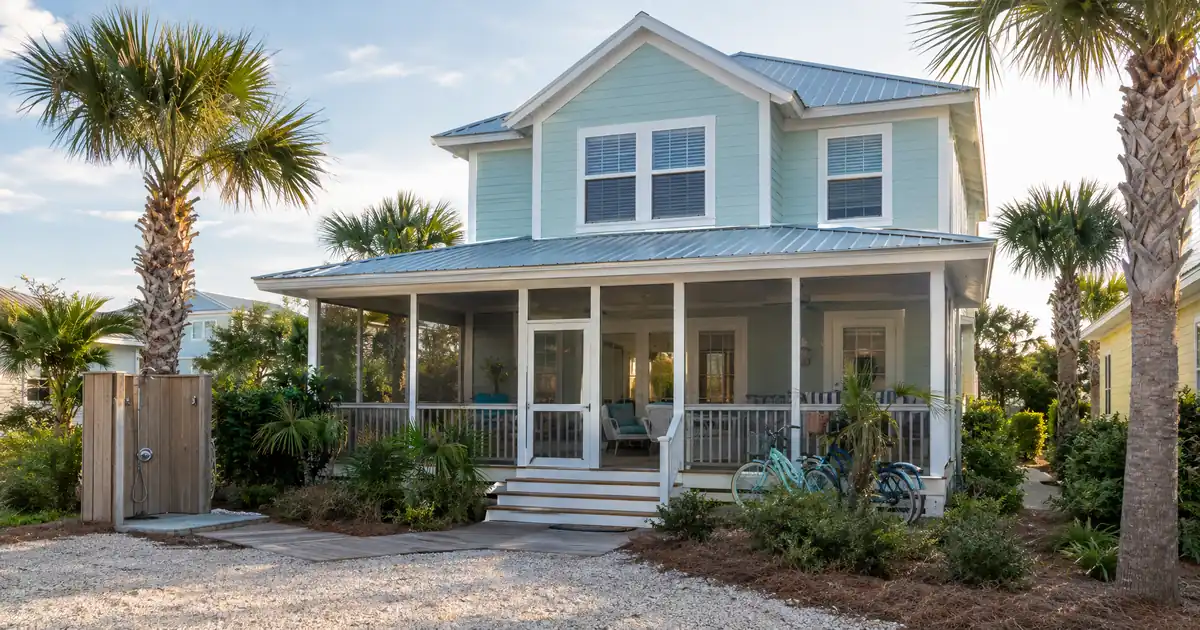
Furnished Vs Unfurnished Short-term Rental For A Business Owner’s Purchase — The Quick Read: Furnished nightly rentals qualify differently than unfurnished long-term leases — the appraisal form changes, the income documentation changes, and the insurance policy changes. Neither option is “better” on paper. The right choice depends on your local demand, your appetite for turnover work, and how a lender’s income-qualification math treats the property you’re buying. This article walks through both paths so you can pick the one that fits your file, not just your Pinterest board.
Most business owners buying a rental property assume the furnished-vs-unfurnished decision is a design question. It isn’t. It’s a documentation question first, an insurance question second, and a design question a distant third. The property gets sorted onto one of two lending paths well before anyone talks about throw pillows.
Short-Term Rental Calculator
Run the STR numbers in your market
Rate source: Freddie Mac 30-yr average via FRED® — Federal Reserve Bank of St. Louis · effective Sep 17, 2026
Prefilled with local estimates — enter your nightly rate, occupancy, taxes, and insurance for a more accurate picture.
Short-term rental income is documented with a 12-month history or a market data report. Program parameters update from Lendmire’s centralized guideline source.
As of Sep 17, 2026 · General Freddie Mac market benchmark, not a Lendmire loan offer. Nightly rate, occupancy, taxes, and insurance are editable estimates. Qualifying income for short-term rentals varies by program — some use appraisal market rent, others use documented STR history or projections — and is confirmed in underwriting. Not a Loan Estimate, approval, or commitment to lend. Program availability and eligibility are subject to lender guidelines, credit approval, property review, and underwriting.
The Two Paths, Side by Side
Unfurnished long-term rentals and furnished short-term rentals get qualified through different appraisal tools, different income sources, and different insurance products — even when the two properties sit on the same street.
| Factor | Unfurnished (Long-Term Lease) | Furnished (Short-Term Rental) |
|---|---|---|
| Review basis | Signed lease or appraiser’s market rent | Platform history or short-term rent analysis |
| Appraisal form | Form 1007 rent schedule (SFR) | Form 1007 short-term rent analysis, discounted |
| Income used | Lower of lease or appraised market rent | 80% of gross short-term income, subject to underwriting |
| Investor experience needed | None specific to leasing history | Track record owning income property typically required |
| Insurance product | Landlord policy (building, contents, loss of rent) | Commercial short-term rental policy with liability that follows guests |
| Entity vesting | LLC or approved business structure, subject to program eligibility | Same — furnishing status doesn’t change this |
| Loan amount ceiling in Lendmire’s network | Up to $10,000,000 on the portfolio investor program | Up to $2,000,000 |
That last row matters more than people expect. A business owner chasing a large-balance acquisition — a fourplex portfolio, a mid-size multifamily rollup — runs into a hard ceiling the moment the strategy shifts to nightly rentals. Long-term leased properties can scale into the millions through select wholesale programs Lendmire arranges; short-term rental files, in this same network, stop at $2,000,000 regardless of how strong the operating history looks.
Key Terms Defined
DSCR (debt-service coverage ratio): a measure of whether the property’s rental income covers its full monthly obligation — a ratio of 1.00 means the rent exactly covers the payment, above 1.00 means there’s cushion.
Form 1007: the standard appraisal form used to document a property’s market rent for long-term-lease qualification, built around a twelve-month lease model rather than nightly pricing.
Business-purpose loan: financing for a non-owner-occupied investment property rather than a home you live in — DSCR loans are designed for non-owner-occupied investment properties, and because they’re business-purpose investor loans, they’re reviewed differently from a standard owner-occupied mortgage.
Operating history: the trailing period of actual platform income (Airbnb, VRBO, or similar) a lender reviews to establish what a short-term rental has actually earned, as opposed to a projection.
No-ratio loan: a qualification path where the lender doesn’t require a minimum coverage ratio at all — available through select programs in Lendmire’s wholesale network to $2,000,000, with LTV and terms adjusted accordingly and subject to underwriting.
When Unfurnished Is the Better Fit
Unfurnished long-term rentals fit business owners who want scale, simplicity, and a documentation path a lender can process against a single number. If you’re buying multiple doors, buying above $2,000,000, or you don’t want to manage turnover, this is your lane.
The appraisal mechanics favor simplicity here. A licensed appraiser pulls comparable rents and produces one figure via the Form 1007 rent schedule, and underwriting typically applies the lower of that figure or the signed lease amount. That’s it — one number drives the whole qualification. There’s no platform data to collect, no trailing twelve months of nightly bookings to compile, no seasonal swing to explain to an underwriter.
Leverage tends to run stronger here too, mostly because the loan-amount ceiling is much higher. Through Lendmire’s wholesale network, standard rentals at coverage of 1.00 or better can reach 80% LTV on purchases up to $1,000,000, with the ladder stepping down to 75% between $1,000,000 and $3,000,000 before tightening further above that. Investors buying larger multifamily or portfolio deals — the kind that stretch into the millions — have a runway here that short-term rental financing simply doesn’t offer in the same network. Final terms depend on lender guidelines, property type, leverage, and the borrower’s complete credit picture.
Unfurnished properties also sidestep the insurance complication entirely. A standard landlord policy assumes a tenant-occupied property with no owner-supplied furnishings. That’s exactly the structure most long-term-lease properties are built around — building, contents, loss of rent, and liability, without the commercial-use question that a furnished nightly rental raises.
If your goal is buying and holding cash-flowing property with minimal operational overhead — you have a day job running your actual business — unfurnished is usually the lower-friction path. You sign a tenant, you collect rent, the file underwrites against one appraised number.
When Furnished Is the Better Fit
Furnished short-term rentals work well for business owners who target a specific, proven nightly-rental market. This is a location where the operating income clearly beats what a twelve-month lease would bring in. You also need to be ready to document that income the way lenders actually want it documented.
The qualification path is more involved, but it’s not more restrictive if you’ve got the track record. In Lendmire’s network, short-term rental files qualify using twelve months of operating history on a refinance, or the appraisal’s short-term rent analysis on a purchase, applied at 80% of gross income. That discount matters — a strong nightly-rate projection doesn’t get taken at face value; the appraiser and the lender both build in a buffer, and appraisers generally don’t force short-term-rental income through the standard rent-schedule grid because that form was never built for nightly comps in the first place.
There’s an experience bar here too. Most programs in this space, Lendmire’s included, reserve short-term rental qualification for investors with some track record — typically twelve months owning income property within the last thirty-six months. First-time landlords buying their debut property as a furnished nightly rental usually need to start with the unfurnished path and build a file history first.
The insurance side is where furnished properties genuinely diverge, and it’s not a minor line item. A standard landlord policy assumes the unit holds none of the owner’s own personal property. That’s a direct conflict when your whole business model is “come stay in our furnished condo.” Furnished short-term rentals need a commercial policy built for nightly guest turnover — one that carries liability coverage following guests off the premises. A business pursuits exclusion buried in a standard landlord or homeowners policy can void liability coverage entirely, if an insurer decides the nightly-rental activity counts as a business. This is a documented gap, not a theoretical one. It’s worth getting right before closing, not after a claim.
Leverage on the furnished side tops out lower than the standard rental ladder. This reflects the smaller $2,000,000 ceiling and the added income variability that lenders price into the file. Coverage below 1.00 is a real path through select programs to that $2,000,000 ceiling, with LTV and terms adjusted accordingly and subject to underwriting. But it’s not the no-ratio path — short-term rentals don’t qualify through no-ratio programs in this network.
Municipal permission is the piece business owners most often skip and shouldn’t. Short-term rental rules can vary by city, county, HOA, and property type, so confirming what’s actually allowed at the specific address — not just “in the area” — belongs at the top of your due diligence list, before you ever get to furnishings or financing.
Why the Appraisal Treats Furniture as a Non-Event
Whichever path you take, the furniture itself carries almost no weight in the appraised value. Real estate appraisers value real property — land and structure — and generally leave personal property out of the conclusion entirely. Most appraisers lump common furniture as having little or no contributory value and caveat it out of the report rather than attempt to price it.
This matters at the contract-price level. If you’re buying a turnkey furnished property where furnishings add real dollars to the asking price, expect the appraised value to reflect the real estate alone — furniture, fixtures, and equipment are typically treated as personal property and documented on a separate bill of sale a lender won’t touch. Budget for that gap between contract price and loan-eligible collateral value. It’s routine, not a red flag, but it surprises first-time furnished-property buyers almost every time.
A Practical Way to Think Through the Decision
Run this mentally before you write an offer. Is the property in a market with demonstrated nightly-rental demand, or is the “Airbnb potential” mostly a hunch? Do you already own income property, or would this be your first rental? Is the purchase price under the $2,000,000 short-term rental ceiling, or does the deal size push you toward the standard rental ladder regardless of your rental strategy? And are you prepared to carry — and pay for — a commercial short-term rental insurance policy, not a landlord policy with an add-on rider?
Lendmire places files through its wholesale network, and the strongest short-term rental applications tend to come from investors who already own a similar property that generates documented income elsewhere. That operating history does the heavy lifting in underwriting. The appraisal’s short-term rent analysis then just confirms the data, rather than being the only proof. Weaker files show up when an investor projects nightly income for a market they’ve never operated in, with no track record to back up the number. These files often get reduced leverage, or lenders steer them toward the standard long-term-lease path instead.
A property that’s marketed and leased on a standard annual basis gets the unfurnished-style documentation treatment, no matter whether it happens to be furnished. How a property is actually rented drives the appraisal path — not whether there’s a couch in the living room. This trips up business owners who furnish a unit “just in case” but plan to lease it long-term. Furnishing alone doesn’t move a file onto the short-term rental path, and it doesn’t need to.
For a deeper look at how DSCR lender review actually works property by property, Lendmire’s complete DSCR loans guide walks through the qualification mechanics in more depth than fits here. If you’re weighing whether to self-manage a furnished unit or bring in a co-host, Lendmire’s piece on managed vs. co-hosted short-term rentals is a useful next read before you commit to the operational side.
The Balanced Verdict
Neither path is the “smarter” investment. They’re different tools for different deal profiles. Unfurnished wins on scale, simplicity, and loan-amount ceiling. Furnished wins where local nightly demand genuinely outperforms a twelve-month lease, and where you’re ready to carry the extra operating and insurance overhead. The honest test isn’t which one sounds more exciting. It’s which one your specific property, your specific market, and your specific track record can actually support at the lender’s desk.
Tax treatment can depend on how the funds are used and how the property is held; investors should keep clear records and speak with a qualified tax professional before relying on any deduction.
Frequently Asked Questions
Does furnishing a rental automatically change how I report the income on my taxes? No. The controlling factors are average guest stay length and whether you provide hotel-like services, not whether the unit has furniture. A furnished property leased on a standard annual basis is treated like any other long-term rental for documentation purposes.
Can I get a larger loan on a furnished short-term rental than an unfurnished one? Generally no — in Lendmire’s wholesale network, short-term rental files are capped at $2,000,000, while the standard long-term rental ladder can reach considerably higher for qualified investors, subject to underwriting.
Will a strong Airbnb income projection get me more leverage than the appraisal supports? Not automatically. Underwriting typically applies a conservative treatment to short-term income — 80% of gross in Lendmire’s network — rather than taking a platform projection at face value, and the appraisal’s own analysis still factors into the number.
Do I need to be an experienced landlord to buy a furnished short-term rental with financing? Usually, yes. Most programs, including those in Lendmire’s network, reserve short-term rental qualification for investors with some track record — typically twelve months owning income property within the last thirty-six months.
Does my landlord insurance policy just need an add-on to cover short-term guests? Not reliably. Landlord policies are built around long-term tenancy and can carry exclusions that eliminate liability coverage if an insurer decides nightly rentals constitute a business activity — a dedicated commercial short-term rental policy is the safer structure.
If you’re weighing a furnished or unfurnished purchase and want to see how the numbers actually work, Lendmire can help you compare DSCR loan options. These are based on the property’s income, your credit profile, available leverage, and your broader investment goals.
Investors focused on short-term rentals can review DSCR loans for Airbnb and short-term rentals.
For current guidelines and terms, see Lendmire’s super jumbo DSCR loan programs page.
Self-employed borrowers can compare both super jumbo programs on Lendmire’s self-employed mortgages page.
About Lendmire
Lendmire — NMLS# 2371349 — is a mortgage brokerage specializing in DSCR investor loans, helping arrange financing across 40 markets, including Washington, D.C., through wholesale and investor-lending channels. The model centers on property-level rental income reviewed by the lender rather than W-2 documentation, subject to lender guidelines, suiting entity-owned and multi-property investors. Lendmire holds Scotsman Guide Top Mortgage Workplace recognition for 2025 and 2026.
Lendmire’s Top Mortgage Workplace recognition is documented by Scotsman Guide 2025 Top Mortgage Workplace and Scotsman Guide 2026 Top Mortgage Workplace.
Get Started
Ready to find the right loan for you?
In about 30 seconds you can review financing options available for your home or investment property. No commitment required.
Informational only. Not a Loan Estimate, approval, or commitment to lend. Program availability and eligibility are subject to lender guidelines, credit approval, property review, and underwriting.
References
2. BiggerPockets — The Fine Print Between Landlord and STR Insurance Policies
4. AppraisersForum — Comparable Adjustments for Furnished Homes
5. Beycome Real Estate Glossary — FF&E
Brandon Miller
Founder & CEO, Mortgage Loan Originator, Lendmire LLC
- Mortgage Loan Originator · NMLS# 1129696 · Verify on NMLS Consumer Access
- North Carolina Real Estate Broker · License# 343312 · Verify on NCREC
- North Carolina Insurance Producer · License# 19053198 · Property, Casualty, Life, Health · Verify on NAIC SBS
- Lendmire LLC · Firm NMLS# 2371349 · Verify firm licensure
Compliance and disclosures. Lendmire (NMLS# 2371349) is a licensed mortgage broker and is not a direct lender, depository institution, financial advisor, or tax professional. Content in this article is general market analysis and educational information — not financial, legal, or tax advice for any specific situation. Lendmire does not guarantee loan approval; every transaction is subject to underwriting by the funding lender. Mortgage pricing and loan program guidelines are subject to change at any time without notice and vary by borrower characteristics, property type, and state regulations. Lendmire complies with Equal Housing Opportunity. Licensure verification: NMLS Consumer Access.