
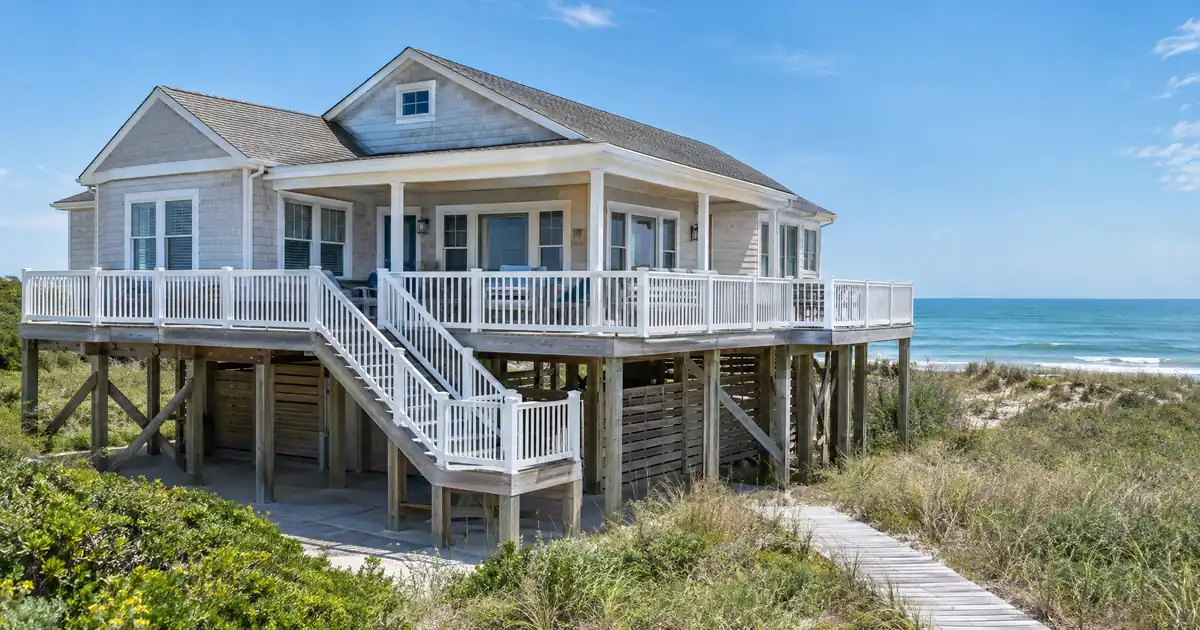
DSCR Loan Criteria For A Practice Owner Buying A Vacation Rental — The Quick Read: A practice owner qualifies for a DSCR loan on the vacation rental’s projected income, not on traditional personal-income documentation that a busy dental or medical practice tends to shrink. The property has to be non-owner-occupied, credit typically needs to clear 660, and short-term rental income is counted at a discount to gross, not by multiplying nightly rate by thirty days. The catch that trips up most practice owners: any personal use of the property, even a few weeks a year, can knock the whole file out of DSCR eligibility.
Practice owners are some of the best-suited borrowers for this product, and also some of the easiest to disqualify by accident. Here’s the full mechanics, start to finish.
Short-Term Rental Calculator
Run the STR numbers in your market
Rate source: Freddie Mac 30-yr average via FRED® — Federal Reserve Bank of St. Louis · effective Sep 17, 2026
Prefilled with local estimates — enter your nightly rate, occupancy, taxes, and insurance for a more accurate picture.
Short-term rental income is documented with a 12-month history or a market data report. Program parameters update from Lendmire’s centralized guideline source.
As of Sep 17, 2026 · General Freddie Mac market benchmark, not a Lendmire loan offer. Nightly rate, occupancy, taxes, and insurance are editable estimates. Qualifying income for short-term rentals varies by program — some use appraisal market rent, others use documented STR history or projections — and is confirmed in underwriting. Not a Loan Estimate, approval, or commitment to lend. Program availability and eligibility are subject to lender guidelines, credit approval, property review, and underwriting.
Why A Practice Owner Runs Into Trouble With Conventional Underwriting
Your practice’s tax return is built to minimize taxable income — that’s the whole point of a good accountant. The problem is that a conventional lender reads that same return to calculate your debt-to-income ratio, and a low taxable-income number looks like a low-earning borrower even when your actual cash flow is strong.
DSCR lending skips that step. Underwriting looks at whether the property’s rent covers its own payment, not whether your Schedule C supports a mortgage. That’s the core mechanic, and it’s exactly why self-employed professionals gravitate toward this loan type more than salaried buyers do.
Key Terms Defined
DSCR (Debt Service Coverage Ratio): the property’s monthly rental income divided by its full monthly housing payment — principal, interest, taxes, insurance, and HOA dues if any. A ratio of 1.00 means the rent exactly covers the payment.
Business-purpose loan: a loan made for investment or income-producing use rather than personal housing — this is the legal category DSCR loans fall into, and it’s what lets underwriting skip personal income documents.
Non-owner-occupied: the borrower does not live in the property as a residence. This is a hard requirement for DSCR eligibility, and it’s checked closely on vacation rental files specifically.
No-ratio loan: a DSCR structure where the lender doesn’t require a minimum coverage number at all, usually in exchange for lower leverage and stronger credit.
Interest-only period: a stretch of the loan term — often up to 120 months on these programs — where the payment covers interest only, no principal, which lowers the payment and can raise the coverage ratio.
How Underwriting Actually Treats The File, Step By Step
Step 1 — the appraiser sets a baseline rent figure. For a straight long-term rental, appraisers use standardized comparable-rent forms to land on a market rent number. For a vacation rental meant for short-term guests, that baseline number is treated as context, not the final answer — appraisal guidance is explicit that nightly rate times thirty days isn’t how monthly income should be estimated, because it ignores vacancy, platform fees, and seasonality.
Step 2 — short-term rental income gets documented and discounted. Across the wholesale network Lendmire works with, short-term rental files qualify at 80% of gross income, and the source of that income depends on whether it’s a purchase or a refinance. On a refinance, twelve months of actual operating history does the job. On a purchase with no history yet, the appraisal’s short-term rent analysis stands in. Either way, the borrower generally needs to show they’ve owned income-producing property for twelve of the last thirty-six months — this isn’t a first-time-investor program.
Step 3 — the occupancy question gets settled before anything else moves forward. This is the step practice owners underestimate. DSCR loans are business-purpose products, and business-purpose classification depends on the property being non-owner-occupied. Every DSCR file across the network requires an occupancy certification — the borrower confirms they won’t use the property as a residence or vacation home themselves. Get this wrong, and the whole structure falls apart, regardless of entity or intent.
Step 4 — credit, coverage, and reserves get weighed together. These three move as a set. A softer coverage number can sometimes be offset by stronger reserves or higher credit; a thinner credit file might need more cash in reserve. Nothing on a DSCR file is evaluated in isolation, subject to lender guidelines on the specific program.
Step 5 — entity vesting and the personal guaranty. Practice owners already comfortable running their business through a PLLC or PC often want the same structure on the vacation rental — and that’s fine. Entity vesting is welcome without layered entity structures. What doesn’t change: a personal guaranty from the controlling individual is standard practice across essentially every DSCR file in the network, regardless of whether title sits in an LLC. The entity shields you from property-level liability claims — it doesn’t shield you from the loan itself.
What The Numbers Actually Look Like
Loan sizes across this program run from $150,000 to $10,000,000, though the standard DSCR ladder tops out at $3,000,000 and a separate ladder carries qualified investors above that on a case-by-case basis. Short-term rental files and no-ratio files are capped lower, at $2,000,000.
Leverage steps down as the loan gets bigger. On most files up to $1,000,000, purchase and rate-and-term leverage can reach 80%, with credit typically at 660 or better. Move into the $1,000,000 to $3,000,000 range and leverage on most files settles around 75% for purchase and rate-and-term, with credit expectations rising to 700 or better as size increases. Above $3,000,000, leverage typically steps down further — around 65% in the $3,000,000-to-$4,000,000 band, and around 60% from $4,000,000 up to $10,000,000 — with every file above $4,000,000 reviewed case by case before submission, purchase or rate-and-term only, no cash-out.
Cash-out works differently, and the ceiling depends on collateral type: standard rentals can reach a 75% cash-out ceiling at smaller loan sizes, stepping down to 70% and then 60% as size grows, while short-term-rental collateral tops out lower, around a 70% cash-out ceiling, and cash-out disappears entirely above $3,000,000. Every figure here varies by lender and program — guidelines, property type, leverage, and credit profile all apply.
Coverage of 1.00 or higher earns full leverage on the ladder above. Coverage between roughly 0.75 and 0.99 is a real path through select programs in the network, up to $2,000,000 — but leverage and terms adjust downward when coverage runs below 1.00, subject to underwriting. No-ratio qualification also exists through a handful of lenders in the network, up to $2,000,000, generally for borrowers with a seven-year clean housing history and no late payments on their mortgage in the past twenty-four months — no minimum coverage ratio is published for that path, and it’s reserved for stronger credit and reserve profiles.
Reserve requirements typically run six months of the property’s full payment (interest-only-based, if the loan carries an interest-only structure), rising to twelve months for first-time investors. Above $2,000,000, two separate appraisals are typically required instead of one.
The Structures And Variations Available
Not every practice owner needs the same shape of loan. A few common variations show up across files like this:
- Interest-only structure. Up to 120 months of interest-only payments, available up to 75% leverage on 30- and 40-year terms, requiring coverage of roughly 0.75 or better. This lowers the monthly payment relative to a fully amortizing loan, which can push a borderline coverage ratio comfortably above 1.00.
- No-ratio path. For a practice owner with strong credit and a long clean housing history but a vacation rental that hasn’t built a rental track record yet, no-ratio qualification through select programs skips the coverage test entirely — at reduced leverage, up to $2,000,000.
- Cash-out refinance into a second vacation rental. A practice owner who already owns one seasoned rental can pull equity to fund the down payment on a second, subject to the collateral-type cash-out ceilings above.
- Condotel and rural exceptions. Vacation rentals often sit in condo-hotel buildings or on larger rural lots. Non-warrantable condos qualify up to 75% and $1,500,000; condotels qualify up to 75% on purchase (65% on refinance) with a $1,500,000 cap and $250,000 minimum cash-in-hand; rural properties on five acres or less can reach 75%, with larger acreage capped by loan size.
For the fuller mechanics of how these pieces fit together across property types, Lendmire’s complete DSCR loans guide walks through the program end to end.
Where The General Rule Breaks: Named Edge Cases
Personal use, even limited, disqualifies the structure. This is the single biggest trap. A practice owner who wants to rent the property most of the year but stay there for a couple of weeks personally is not looking at a DSCR-eligible scenario — they’re looking at a different product entirely, like second-home or bank-statement financing.
Rental pools can force reclassification regardless of personal days used. If a management company or timeshare-style arrangement controls who occupies the unit and when, the file tends to move toward investment classification no matter how few nights the owner actually stays there. The flip side matters too: a condotel where the owner independently controls their own unit’s availability can often still qualify, while one requiring mandatory participation in a rental pool typically can’t, because the investor doesn’t fully control the collateral.
Tax rules and lending rules are two separate tests, not one. The IRS applies its own 14-15 day personal-use threshold for vacation-home tax treatment — IRS Topic No. 415 states that renting a dwelling for fewer than 15 days means the rental income isn’t reported and rental expenses aren’t deducted. Personal-use day counting for the broader deduction-limitation rules gets more detail from the University of Illinois Tax School. Neither of these determines whether your DSCR lender treats the property as business-purpose. Passing the IRS’s vacation-home test for a given tax year says nothing about satisfying a lender’s occupancy certification — they’re separate tests run by separate parties for separate reasons.
DSCR vs. conventional financing
Two common ways to finance an investment property in this market. They qualify you differently — here’s how investors weigh them.
Why investors choose it
- Qualifies on the property’s rental income — no personal tax returns, W-2s, or pay stubs needed to document income.
- No personal debt-to-income ceiling to clear, so existing mortgages and obligations don’t cap your borrowing the same way.
- Can be closed in an LLC, keeping the property inside a business entity.
- Built for scaling — not held to the limit on number of financed properties that conventional financing applies.
- Underwriting centers on the deal: generally qualifies when the rent covers the payment, a 1.00x coverage ratio being a common baseline (confirmed in underwriting).
- Designed specifically for investment property, including long-term and, where the program allows, short-term rentals.
Where it’s strong
- Often the lowest ongoing financing cost for a buyer who fully qualifies on personal income — a fit for a first property or a cost-first purchase.
Trade-offs for investors
- Requires full personal income documentation and must fit within a debt-to-income limit — salary, existing debts, and other mortgages all count.
- Typically held in your personal name rather than a business entity.
- Caps how many financed properties you can carry, which can become a ceiling as a portfolio grows.
- Evaluates you as a borrower as much as the property, which usually means more paperwork.
How investors usually choose: a first or single property often optimizes for the lowest financing cost; portfolio builders often optimize for leverage, vesting in an LLC, and scaling past conventional caps. The right answer depends on your goals, the property, and current guidelines — both paths run through select lenders in Lendmire’s wholesale network, with eligibility and terms confirmed in underwriting.
Business-purpose classification itself is a legal category, not a label you choose. DSCR loans are designed for non-owner-occupied investment properties. Because they are business-purpose investor loans, they’re reviewed differently from a standard owner-occupied mortgage — a distinction the CFPB’s coverage rule for RESPA cross-references directly. An LLC name on title or an “investment” label on a lease doesn’t override actual occupancy facts.
Owner-occupied 2-4 unit properties sit outside this entirely. If a practice owner is eyeing a small multi-unit vacation property they intend to partly occupy themselves, that’s a different, stricter test than a straightforward single-family rental purchase — and generally not a fit for this program.
The Practice-Owner Decision In Practice
Across files like these, the practice owners who move smoothly are the ones who decide upfront — before writing an offer — whether they truly want a pure rental or a part-personal-use property. The ones who stumble are almost always trying to have both: full DSCR terms and personal vacation weeks. That combination doesn’t exist as a DSCR structure, and finding that out mid-underwriting means restructuring the file, which costs the deal momentum.
A practice owner comfortable running their business through an entity should expect the vacation rental’s entity structure to work the same way — liability separation on the asset, personal guaranty on the loan. That’s consistent, not a surprise, once you know it going in.
The strongest DSCR files from this borrower type tend to bring documented reserves beyond the six-month minimum. This especially matters for a first vacation rental purchase, where twelve months of reserves applies. Solid reserves paired with a clean credit profile give underwriting room to work with. This helps even when a vacation rental’s seasonal income runs a little thinner in its first year of documented history.
For practice owners weighing the paperwork side of a purchase like this, Lendmire’s guide on vacation rental DSCR loan paperwork breaks down what documentation actually gets requested.
Tax treatment can depend on how the funds are used and how the property is held; investors should keep clear records and speak with a qualified tax professional before relying on any deduction.
Frequently Asked Questions
Can I use a DSCR loan if I plan to stay at the vacation rental sometimes?
Not through a standard DSCR structure. Every DSCR file across the network requires an occupancy certification confirming the borrower won’t personally use the property as a residence or vacation home. Even limited personal use can move the file into a different product category, like second-home or bank-statement financing.
Does my practice’s LLC or PC structure help my DSCR application?
It can support entity vesting, which many practice owners already use elsewhere in their business. It doesn’t remove the personal guaranty requirement — that stays with the controlling individual regardless of how title is held, subject to lender guidelines.
How is short-term rental income calculated if the property has no rental history yet?
On a purchase with no operating history, underwriting typically relies on the appraisal’s short-term rent analysis rather than nightly-rate math, counted at a discount to gross income. On a refinance, twelve months of actual operating history is used instead, subject to program guidelines.
What credit score do I need as a practice owner buying a vacation rental?
Most programs in the network look for a 660 floor at smaller loan sizes, with that expectation rising as high as 700 or better once the loan climbs past $3,000,000. Exact thresholds vary by program, reserves, and coverage ratio.
Can I close a DSCR loan on a vacation rental with coverage under 1.00?
Select programs in the network allow coverage in the 0.75-to-0.99 range up to $2,000,000, though leverage and terms adjust downward at that level, subject to underwriting. No-ratio qualification is also available through a handful of lenders in the network for stronger credit files, up to the same loan size.
Are you not sure if a vacation rental purchase fits a DSCR loan or a different program? Lendmire can help you compare options. The team looks at the property’s projected income, your credit profile, and available leverage. Call 828-256-2183 or request a quote.
For current guidelines and terms, see Lendmire’s super jumbo DSCR loan programs page.
Self-employed borrowers can compare both super jumbo programs on Lendmire’s self-employed mortgages page.
About Lendmire
As a DSCR and non-QM mortgage broker, Lendmire — NMLS# 2371349 — connects investors with wholesale lending channels across 40 markets, including Washington, D.C. The property’s rental income, not the borrower’s tax returns, is central to lender review, which works for self-employed operators and portfolios beyond four financed properties. Scotsman Guide named Lendmire a Top Mortgage Workplace in both 2025 and 2026.
Investors focused on short-term rentals can review DSCR loans for Airbnb and short-term rentals.
Get Started
Ready to find the right loan for you?
In about 30 seconds you can review financing options available for your home or investment property. No commitment required.
Informational only. Not a Loan Estimate, approval, or commitment to lend. Program availability and eligibility are subject to lender guidelines, credit approval, property review, and underwriting.
References
1. IRS Topic No. 415, Renting Residential and Vacation Property
2. University of Illinois Tax School, “Tax Rules for Rentals and Vacation Homes”
3. CFPB Regulation X, §1024.5 (Coverage of RESPA)
This article is part of Lendmire’s super jumbo DSCR loan program — full qualification details, guidelines, and scenarios live on the program page.
Related reading: DSCR Loan Criteria For A Loan-out Corporation Owner On A Vacation Rental · Short-term Rental DSCR Loan Criteria For Business Owner Buyers · Vacation Rental DSCR Loan Paperwork For A Practice Owner With K-1 Income
Brandon Miller
Founder & CEO, Mortgage Loan Originator, Lendmire LLC
- Mortgage Loan Originator · NMLS# 1129696 · Verify on NMLS Consumer Access
- North Carolina Real Estate Broker · License# 343312 · Verify on NCREC
- North Carolina Insurance Producer · License# 19053198 · Property, Casualty, Life, Health · Verify on NAIC SBS
- Lendmire LLC · Firm NMLS# 2371349 · Verify firm licensure
Compliance and disclosures. Lendmire (NMLS# 2371349) is a licensed mortgage broker and is not a direct lender, depository institution, financial advisor, or tax professional. Content in this article is general market analysis and educational information — not financial, legal, or tax advice for any specific situation. Lendmire does not guarantee loan approval; every transaction is subject to underwriting by the funding lender. Mortgage pricing and loan program guidelines are subject to change at any time without notice and vary by borrower characteristics, property type, and state regulations. Lendmire complies with Equal Housing Opportunity. Licensure verification: NMLS Consumer Access.