
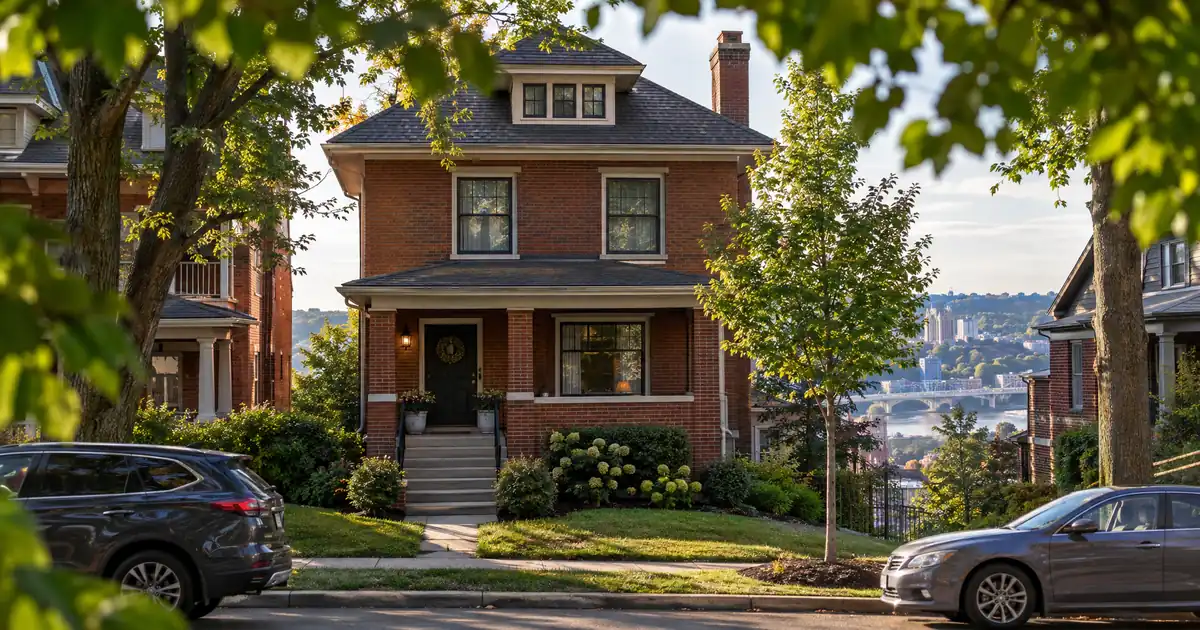
Picture an investor holding a West Price Hill duplex bought at $150,000 a few years back, now appraising near the neighborhood’s listing median. The unit rents were reset at renewal, the roof and boiler are documented, and the loan balance has barely moved. That owner has equity on paper and a second deal waiting. The open question is how much of the equity a lender will actually let out, and what the file needs to show for it.
Cincinnati, Ohio rental property investors can tap DSCR programs that Lendmire (NMLS# 2371349) arranges, available across 41 markets, including Washington, D.C. Lendmire is a DSCR-focused mortgage broker. It places the file with lenders that review eligibility and approve.
DSCR Cash-Out Calculator
Run the cash-out numbers in Cincinnati, OH
Rate source: Freddie Mac 30-yr average via FRED® — Federal Reserve Bank of St. Louis · effective Sep 24, 2026
Prefilled with starting assumptions — enter your property’s value, balance, taxes, and insurance for a more accurate picture.
Program parameters update from Lendmire’s centralized guideline source. Taxes and insurance are editable estimates.
As of Sep 24, 2026 · General Freddie Mac market benchmark, not a Lendmire loan offer. Property value, balance, taxes, and insurance are editable estimates. Maximum loan-to-value varies by lender, program, property type, and seasoning. Not a Loan Estimate, approval, or commitment to lend. Program availability and eligibility are subject to lender guidelines, credit approval, property review, and underwriting.
TL;DR: A cash-out refinance on a Cincinnati, Ohio rental is underwritten primarily on the property’s rent measured against its full monthly obligation. It fits owners of older small multifamily or workforce houses whose citywide typical value of $238,714 still leaves room under the 75% ceiling.
- Price Hill duplexes carry the strongest modeled coverage in the city because the basis is low.
- Higher-priced east-side houses model well below 1.00x on cash-out sizing.
- Seasoning runs about 6 months from title recording, with about 6 months of reserves.
- Greater Cincinnati multifamily vacancy hit 9.3%, concentrated in new Class A stock. Terms vary by lender guidelines, property type, leverage, credit profile, and full file review.
Cincinnati Market Snapshot
A quick read on the Cincinnati investor landscape — figures come from the cited sources below. Confirm current property-level numbers before underwriting.
| Metric | Detail |
|---|---|
| University enrollment | 53,682 total (University of Cincinnati News) |
| Employment | 19,500+ employees (Cincinnati Children’s) |
Price Hill: Low Basis, Stacked Rents
West Price Hill is the strongest coverage story in Cincinnati for a cash-out. Homes.com shows a median home price of $189,900 and six multi-family listings spanning $170,000 to $435,000. One duplex on that page showed unit rents of $975 and $1,120. That is a single listing, not a rent survey, so treat it as an illustration rather than a benchmark.
Run the numbers on it as a modeled case. Assume $2,095 in combined rent, a value near $190,000 and a 75% cash-out loan. Rent divided by full monthly obligation, with taxes and insurance included, lands roughly in the 1.5x range. That is a wide cushion over the 1.00x benchmark most standard programs are built around. Qualification still depends on lender guidelines, credit and property review.
The tenant base in the Price Hills leans on workforce demand. RentCafe puts East and West Price Hill averages around $1,011 to $1,021, and Westwood at $1,040. Those figures come from 50+ unit buildings, so small-building rents can sit above or below them. Low rents against a low basis is the trade. Low rents also mean thin room if a unit sits vacant a month or two. Model the file with one unit dark and see whether the number holds.
Northside sits a notch higher at $1,335 on the same RentCafe series. It offers the same style of product with somewhat stronger rents, though this research found no reliable price data for it. Treat any Northside claim as qualitative until comps say otherwise.
Walnut Hills and Bond Hill: Does the Extra Unit Earn Its Keep?
Multi-unit coverage does not win automatically. Bond Hill shows why. Its median home price was $215,000, while multi-family listings ran $285,000 to $425,000, roughly $70,000 to $210,000 above the typical home. Each added unit must cover the debt attached to it. If a fourplex appraises well but two units are under-rented, the coverage ratio can come out worse than the single-family next door.
Walnut Hills is the other revitalization play. It sits near the medical district and averages $1,673. Directionally, it offers more rent per dollar of basis than the east side. It also carries wider variance from block to block.
Demand here traces to institutions rather than headlines. Cincinnati Children’s employs over 19,500 people and is the largest employer in Southwest Ohio. TriHealth adds almost 14,000 team members. The University of Cincinnati reported a record fall headcount of 53,682, including 9,534 online students. That enrollment includes Blue Ash and Clermont campuses, so not all of it lands in Clifton rental stock.
Corryville averages $2,249 and CUF $1,766, and both sit beside the campus and hospital cluster. Those are apartment-building averages. Owners of small buildings there should pull actual lease comps, since the appraiser will.
Skip the Oakley Refi (Unless Sub-1.00 Suits You)
Higher-priced neighborhoods rarely produce coverage on a cash-out. Oakley ($1,688), Hyde Park ($1,682) and Mt. Adams ($2,350) are appreciation markets, and the sizing math shows it.
Take a modeled $450,000 house in an Oakley-type submarket and rent it at $1,800, the citywide house median from Zumper. At 75% LTV with taxes and insurance included, coverage comes out near 0.6x. Not close. Exact terms depend on the lender’s guidelines, property type, leverage, and a full review of the borrower’s file.
Sub-1.00 files exist. A lender could review a sub-1.00 program, an interest-only structure, or a lower-leverage request with more cash retained. Each usually brings tighter pricing, more reserves or reduced proceeds, and outcomes depend on lender guidelines, credit approval and property review. For most owners in these neighborhoods, the better move is to hold the asset and tap equity from a cash-flow property elsewhere.
The property-manager screen is simple. Northpoint’s rule of thumb treats a rent-to-price ratio of 0.7% or better as workable for cash flow, and anything below 0.5% as an appreciation bet. It is a manager’s heuristic, not a lender threshold. The Oakley case sits near 0.4%. The citywide house median of $1,800 against Zillow’s typical value of $238,714 works out to roughly 0.75%, modeled coverage in the low-1.1x range including taxes and insurance. That is the sweet spot for a standard-value house.
Frequency of Equity: The Seasoning Clock and the 75% Ceiling
The seasoning clock starts at title recording, not at closing-table signing dates or contract dates. Programs generally look for about 6 months of ownership before a cash-out, though details vary by lender. Buy in one month, and the calendar decides your earliest refinance window. Anything the lender treats as a recent purchase or a value-add project changes what the appraisal supports.
The ceiling is 75% LTV on a cash-out, a hard cap that sits below the purchase limit. Equity available depends on rent used for lender review, full monthly obligation, reserves and that ceiling. It is not a guaranteed cash figure. Every figure here varies by lender and program — guidelines, property type, leverage, and credit profile all apply.
Where does value come from? Not the headline. Three benchmarks disagree in this market. Zillow’s typical city value is $238,714, up 3.6%. Redfin’s median sale price was $285,000 in November, up 8.7%, per Redfin. The REALTOR Alliance reported a January median sold price of $300,000, up 10.0%, but across five counties. Those measure different things. Size the loan off the appraiser’s local comps, not a city headline.
Comps can also run thin. Redfin’s March data showed a median of 51 days to sell, the longest among Ohio’s three large metros. Dated or overpriced properties get thin comps. If an appraisal comes in light, the 75% math shrinks with it.
What the File Looks Like
DSCR files in markets like this one typically look like small-balance duplexes and triplexes held in LLCs. They come in with mixed lease histories: one unit on a fresh lease, one on month-to-month. The friction rarely sits in the coverage number itself. It sits in the documentation around it, meaning leases that don’t match the appraiser’s rent schedule, deferred maintenance that surfaces at inspection, and reserves held in the wrong account. Files that clear cleanly usually line up rent schedule, lease copies and proof of reserves before the appraisal is ordered.
The operations checklist is short but strict:
- Lease copies for every unit, with an appraiser rent schedule that reconciles to them.
- Reserves of about 6 months of full monthly obligation, or about 9 months on balances above $1,500,000.
- A credit profile at or above the 620 floor, with better tiers at 660, 680 and 700 opening more room.
- Title held in an individual name or an LLC, subject to lender program eligibility.
- Recorded ownership past the seasoning window.
Loan sizes go up to $3,000,000 on standard programs, and smaller balances route through select lenders in the network. Most Price Hill duplexes fall in that smaller-balance lane. Investors comparing paths can read conventional vs DSCR on investor loans.
Is 9.3% Vacancy a Warning?
Not for older stock. Greater Cincinnati multifamily vacancy reached 9.3% after four straight quarterly increases, following roughly 14,000 unit completions over five years. That is the highest since 2005. It is a real number and a legitimate underwriting concern.
The pressure is uneven. Institutional Property Advisors reports Class A vacancy above 4% and roughly 3% for lower-tier assets, with new supply concentrated in Northeast and Southeast submarkets. The two figures likely come from different datasets, so don’t blend them. The read-through is that older Class B and C duplexes face less lease-up competition than new suburban towers do.
The forward view helps modestly. MMG projects apartment completions falling roughly 43% year over year, and expects Cincinnati to lead major Ohio metros in rent growth, with effective rents up 2.1% against 1.5% nationally. That is a forecast, not a guarantee. It does mean a refinance appraisal in the next 12 to 24 months should meet a steadier rent story than the last few years produced.
Where the Proceeds Go
The whole point of a cash-out is the next deal. Proceeds from a Price Hill duplex can fund a down payment on another small building, so equity moves from one low-basis property into two. The equity recycle pathway covers the mechanics. Investors can request a rental-income loan quote or call 828-256-2183 to walk through a specific file. Ohio DSCR financing sits on the state hub for the wider program map.
Two cautions. Stacking cash-outs on thin coverage compresses the cushion on every property in the portfolio. And demand here rests on institutional employment. The city has a 4.6% unemployment rate and roughly 310,000 to 315,000 residents per the Census Bureau and ACS-based data, with a regional workforce of 1.3 million per REDI Cincinnati. Employment is diversified across healthcare, consumer goods, finance and logistics, which supports tenant continuity. Investors should still verify current local rental rules, taxes and insurance with qualified local professionals.
Frequently Asked Questions
How soon can a Price Hill duplex owner pull equity out?
Programs generally look for about 6 months of ownership, measured from title recording. Owners who bought recently should check the recording date rather than the contract date. The lender’s seasoning rules and the appraisal support then decide what is available.
DSCR vs. conventional financing
Two common ways to finance an investment property in Cincinnati, OH. They qualify you differently — here’s how investors weigh them.
Why investors choose it
- Qualifies on the property’s rental income — no personal tax returns, W-2s, or pay stubs needed to document income.
- No personal debt-to-income ceiling to clear, so existing mortgages and obligations don’t cap your borrowing the same way.
- Can be closed in an LLC, keeping the property inside a business entity.
- Built for scaling — not held to the limit on number of financed properties that conventional financing applies.
- Underwriting centers on the deal: generally qualifies when the rent covers the payment, a 1.00x coverage ratio being a common baseline (confirmed in underwriting).
- Designed specifically for investment property, including long-term and, where the program allows, short-term rentals.
Where it’s strong
- Often the lowest ongoing financing cost for a buyer who fully qualifies on personal income — a fit for a first property or a cost-first purchase.
Trade-offs for investors
- Requires full personal income documentation and must fit within a debt-to-income limit — salary, existing debts, and other mortgages all count.
- Typically held in your personal name rather than a business entity.
- Caps how many financed properties you can carry, which can become a ceiling as a portfolio grows.
- Evaluates you as a borrower as much as the property, which usually means more paperwork.
How investors usually choose: a first or single property often optimizes for the lowest financing cost; portfolio builders often optimize for leverage, vesting in an LLC, and scaling past conventional caps. The right answer depends on your goals, the property, and current guidelines — both paths run through select lenders in Lendmire’s wholesale network, with eligibility and terms confirmed in underwriting.
Does the 75% ceiling apply to Cincinnati multi-units the same way?
Yes. Cash-out refinances are capped at 75% LTV regardless of unit count, and appraised value is what counts. A fourplex in Bond Hill that appraises light will produce less than its listing price implies. Final terms depend on lender guidelines, property type, leverage, and the borrower’s complete credit picture.
Why do some Cincinnati neighborhoods model below 1.00x?
Rent does not scale with price. Oakley-type houses carry a much higher basis against rents near the citywide house median of $1,800, so coverage falls well under the 1.00x benchmark. Sub-1.00 programs, interest-only structures or lower leverage may be reviewed, subject to lender guidelines.
Which rent source should an appraiser file be built on?
Lease comps on similar small buildings, not RentCafe averages, which come from 50+ unit buildings. Zumper’s $1,400 median, Doorstead’s $1,543 metro median and RentCafe’s $1,482 average disagree because their methods differ. A rent schedule tied to actual leases is the safest support.
Does the 9.3% multifamily vacancy hurt a cash-out on an older duplex?
It matters less for older stock. The oversupply sits mostly in newer Class A and suburban submarkets, and lower-tier vacancy was cited near 3% by a separate dataset. Still, expect the appraiser to apply a vacancy assumption to the rent schedule.
The Number to Carry Forward
Cincinnati’s median house rent of $1,800 sits about 40% above the $1,288 apartment median, and that gap is what a well-chosen small building can capture.
For current guidelines and terms, see Lendmire’s DSCR loan programs page.
About Lendmire
Lendmire (NMLS# 2371349) is a mortgage brokerage built around DSCR investor lending, with programs available in 41 markets, including Washington, D.C. DSCR lenders commonly evaluate rental-income coverage instead of personal income paperwork, a practical fit for LLC-owned and multi-property investors. Terms vary by lender, property, leverage and program. The firm was named a 2026 Scotsman Guide Top Mortgage Workplace and was recognized by Scotsman Guide in 2025.
Get Started
Ready to find the right loan for you?
In about 30 seconds you can review financing options available for your investment property. No commitment required.
Informational only. Not a Loan Estimate, approval, or commitment to lend. Program availability and eligibility are subject to lender guidelines, credit approval, property review, and underwriting.
References
1. Zillow Home Values, Cincinnati
2. Cushman & Wakefield MarketBeat
3. University of Cincinnati enrollment release
4. Cincinnati Children’s employer release
5. Homes.com
7. Homes.com — Bond Hill Neighborhood Multi Family Homes for Sale
8. TriHealth
10. northpointam.com — Cincinnati Best Neighborhoods Invest
11. Redfin
12. REALTOR Alliance
13. Institutional Property Advisors
14. MMG Real Estate Advisors forecast
15. U.S. Census Bureau QuickFacts, Cincinnati
16. REDI Cincinnati
17. a 2026 Scotsman Guide Top Mortgage Workplace
18. recognized by Scotsman Guide in 2025
This article is part of Lendmire’s investment property cash-out refinance program — full qualification details, guidelines, and scenarios live on the program page.
Related reading: DSCR Cash Out Refinance Cincinnati Ohio · DSCR Cash Out Refinance Fairfield Ohio · DSCR Cash Out Refinance Zanesville Ohio
Guides: Investment Property Cash-Out Refinance in Cincinnati, OH · Investment Property Cash-Out Refinance in Ohio
Brandon Miller
Founder & CEO, Mortgage Loan Originator, Lendmire LLC
- Mortgage Loan Originator · NMLS# 1129696 · Verify on NMLS Consumer Access
- North Carolina Real Estate Broker · License# 343312 · Verify on NCREC
- North Carolina Insurance Producer · License# 19053198 · Property, Casualty, Life, Health · Verify on NAIC SBS
- Lendmire LLC · Firm NMLS# 2371349 · Verify firm licensure
Compliance and disclosures. Lendmire (NMLS# 2371349) is a licensed mortgage broker and is not a direct lender, depository institution, financial advisor, or tax professional. Content in this article is general market analysis and educational information — not financial, legal, or tax advice for any specific situation. Lendmire does not guarantee loan approval; every transaction is subject to underwriting by the funding lender. Mortgage pricing and loan program guidelines are subject to change at any time without notice and vary by borrower characteristics, property type, and state regulations. Lendmire complies with Equal Housing Opportunity. Licensure verification: NMLS Consumer Access.