
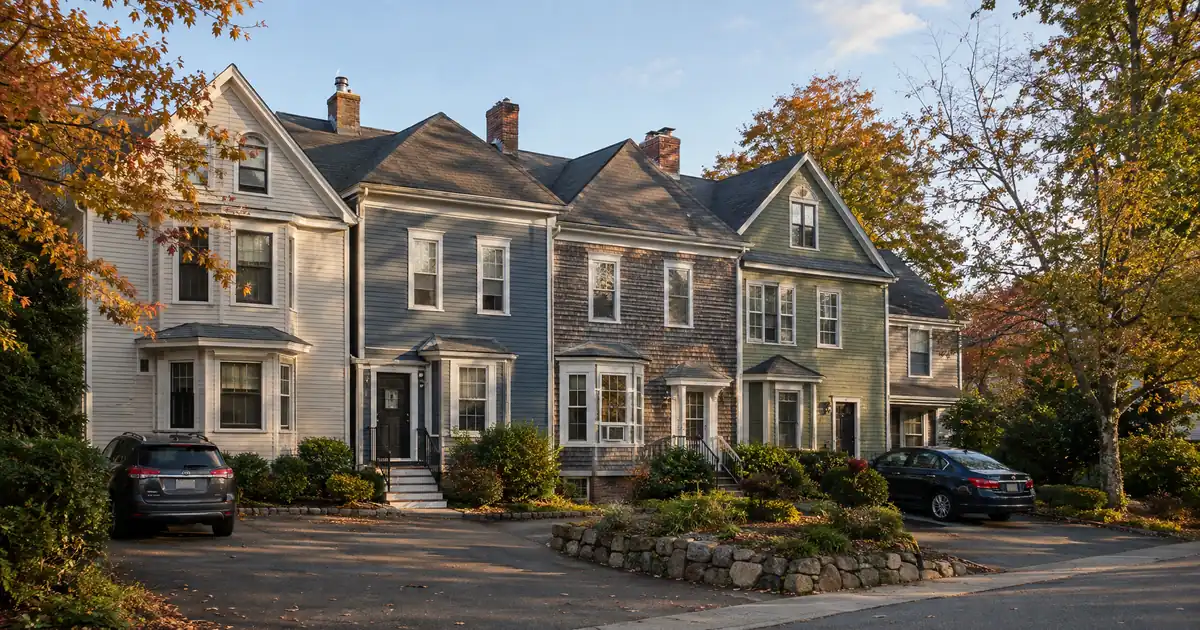
Picture an investor holding a South Medford two-family purchased at $1,095,000. The building is stabilized, both units are leased, and a second property is on the radar. The real question isn’t whether a cash-out refinance exists. It’s whether the rent still covers the new loan once taxes and insurance stack on top of principal and interest.
TL;DR: A DSCR cash-out refinance in Medford, Massachusetts fits the investor who already owns a multi-unit or transit-adjacent rental with real equity and enough rent to clear the full monthly obligation. The file is underwritten primarily on the property’s rental income measured against that obligation, with proceeds capped by a 75 percent LTV ceiling.
DSCR Cash-Out Calculator
Run the cash-out numbers in Medford, MA
Rate source: Freddie Mac 30-yr average via FRED® — Federal Reserve Bank of St. Louis · effective Sep 24, 2026
Prefilled with starting assumptions — enter your property’s value, balance, taxes, and insurance for a more accurate picture.
Program parameters update from Lendmire’s centralized guideline source. Taxes and insurance are editable estimates.
As of Sep 24, 2026 · General Freddie Mac market benchmark, not a Lendmire loan offer. Property value, balance, taxes, and insurance are editable estimates. Maximum loan-to-value varies by lender, program, property type, and seasoning. Not a Loan Estimate, approval, or commitment to lend. Program availability and eligibility are subject to lender guidelines, credit approval, property review, and underwriting.
- South Medford multi-family listings run $1,095,000 to $1,459,000, so stacked units drive coverage.
- Citywide values are nearly flat, with Zillow at $855,081, up 1.8 percent. Underwrite value-add, not lift.
- Modeled two-family coverage lands below 1.00x at full leverage and above it at lower LTV.
- Seasoning runs about six months from title recording, with reserves around six months of PITIA.
Lendmire (NMLS# 2371349) is a DSCR-focused mortgage broker. Through Lendmire’s DSCR program footprint — 41 markets, including Washington, D.C. — lenders may review qualifying rental income subject to program guidelines for Medford, Massachusetts investors. Its primer on DSCR loans covers the basics. This piece stays on equity extraction: what a Medford owner can pull, and what the rent has to do to support it.
Medford Market Snapshot
A quick read on the Medford investor landscape — figures come from the cited sources below. Confirm current property-level numbers before underwriting.
| Metric | Detail |
|---|---|
| Home prices | 7 sales (Redfin Lawrence Estates) |
| Typical rents | $3,000–$5,000 rents (Homes.com Medford Hillside) |
| Employment | 13,000 employees (Tufts Medicine physician page) |
Where the Coverage Math Lands
Multi-unit properties in Medford can clear the coverage test with moderate leverage, while single-family rentals mostly can’t at full leverage. Prices are high relative to rent here. That makes the LTV you choose as important as the property you own.
Run the numbers on a two-family valued near $1,100,000. These are modeled assumptions, not sourced market facts. Assume two 2-bedroom units at about $3,200 each. That sits between the RentHop 2-bedroom median of $3,050 and the Rentometer 2-bedroom average of $3,232. Divide that rent by a full PITIA, meaning principal, interest, taxes, and insurance. At the 75 percent ceiling, coverage comes out around 0.9x. Drop the refinance to roughly 60 percent LTV and it moves to about 1.1x.
Below 1.00x isn’t a dead end, but it isn’t a clean pass either. A lender may review a sub-1.00 program, an interest-only structure, or lower leverage, subject to lender guidelines, credit approval, and property review. Most standard programs use 1.00x as the baseline because rent covers the payment at that level. Going below it typically means more cash in, stronger credit, or different pricing.
Now the single-family comparison. A house near the South Medford median of $903,000 renting at the higher 3-bedroom average of $3,855 models below 0.7x at 75 percent LTV including taxes and insurance. Not close.
A Downtown Medford condo is the interesting middle case. Redfin shows a $636,000 median sale price on only six sales, so it’s directional at best. Against a 2-bedroom rent near $3,232, the modeled coverage at 75 percent falls in the low 0.8s before HOA dues. At 60 percent it reaches roughly 1.0x. The stronger play might be the condo for cleaner entry math, though multi-unit income stacking gives a sturdier cushion if the building is already in hand.
Why Multi-Unit Wins Here
Two- and three-family stock is the natural DSCR refinance asset in Medford. Point2Homes reports 40 percent of rental units were built in 1939 or earlier, which points to older triple-deckers and Foursquare-style multi-families. Stacking units lifts gross rent-to-price by roughly two points over a single-family at the same value. That gap often decides whether the number clears 1.00x.
Medford Hillside is the most interesting pocket. It sits at the Green Line terminus, and its housing is dense early-20th-century multifamily that Homes.com describes as leased partly to Tufts-affiliated tenants and rail commuters. Its marketing copy cites rents of $3,000 to $5,000 a month but doesn’t say whether that’s per unit, so treat it as a prompt to pull real comps. Four multi-family listings ran from $1,149,000 to $1,999,900.
Here’s the catch. Multi-family is the thinnest, most contested segment in the city. The Marrocco Group puts the median list near $1.2 million, with an average of eight offers per listing. Only 24 multi-family homes were listed citywide. Thin comps mean appraisals can swing, and that limits how much cash-out you can count on.
Don’t Underwrite Appreciation
Medford values have plateaued, so a cash-out built on expected market lift during the seasoning window is a bad bet. BMN Boston reports a median list price of $833,000, down about 0.1 percent year over year, with 3.2 months of supply. It calls that equilibrium. The equity you extract will mostly reflect your purchase price and any value you added, not the market.
Neighborhood numbers diverge, and the samples are small. South Medford’s median ($903,000) is up 9.1 percent. North Medford’s ($669,000) is down 8.1 percent. Lawrence Estates shows $1.2 million, up 18.2 percent, on seven sales. Appreciation-led pockets help if the appraisal lands high. North Medford argues for conservative LTV assumptions. This one’s a genuine toss-up for anyone holding across those lines, so stress-test the value downward before committing.
The Mechanics: Seasoning, LTV, and Reserves
The cash-out path has four main levers: LTV, seasoning, reserves, and coverage. Typical guidance puts the cash-out ceiling at 75 percent LTV, with about six months of ownership measured from title recording. The baseline coverage is 1.00x. The minimum credit score is 620, with better tiers at 660, 680, and 700, and reserves are about six months of PITIA. That rises to about nine months above $1,500,000. Standard programs typically run up to $3,000,000, subject to lender guidelines.
Equity available is not a guaranteed cash figure. It depends on rent used for lender review, PITIA, reserves, and the LTV ceiling together. Because Medford multi-family sits near the $1 million mark, reserves matter more than investors expect. LLC-titled properties are reviewed subject to lender program eligibility. For the step-by-step, see the cash-out refinance walkthrough and Lendmire’s refi programs.
On files from markets structurally like this one, where price-to-rent is tight and comps are thin, the friction usually isn’t credit. It’s the appraisal and the insurance quote. The cleanest files from a documentation standpoint arrive with executed leases, entity documents, title, and property details ready for lender review. Borrowers who run coverage at a lower LTV first tend to avoid late surprises.
| Factor | DSCR cash-out | Conventional cash-out |
|---|---|---|
| Qualifying basis | Property rent vs PITIA | Personal income and DTI |
| LLC title | Often workable, per program | Usually personal name |
| Portfolio scaling | Built for it | Financed-property limits |
| Best fit | Entity-held multi-unit | One or two personal rentals |
The comparison page details the flip point. For a high-W-2 owner with one rental in personal name, conventional can carry a lower cost. DSCR earns its place when the portfolio or the traditional personal-income documentation complicate the picture.
Who’s Renting: Tufts, Tufts Medicine, and the Green Line
Medford’s tenant base rests on universities, hospitals, and a rail connection to Boston. Tufts University enrolled 13,599 students per Data USA, though that figure is university-wide. Tufts Medicine lists 2,144 employees across its MelroseWakefield and Lawrence Memorial campuses. Per RentCafe, 46 percent of households rent, and average rent sits at $3,201.
Medford is a commuter-professional market rather than a job center. Data USA shows residents concentrated in professional and technical services (6,772), health care (5,189), and education (4,604). Then there’s the Green Line Extension terminus at Medford/Tufts, projected to carry more than 45,000 trips a day across the branch. Rent demand here is tied to rail access and institutional employment, which suits long-term leases. The Orange Line node at Wellington adds a second commuter corridor, though it skews toward newer mid-rise buildings.
What Does the Cash Go Into?
The refinance thesis depends on the destination of the proceeds. Pulling equity to buy another multi-unit near a rail station makes the argument straightforward, as long as that next deal clears coverage on its own. Redeploying into a market where the math doesn’t pencil at current pricing is a different decision. Medford itself shows why: a next purchase here can carry thinner coverage than the building you’re refinancing.
For a rough profile, the best-fit investor holds an entity-owned two- or three-family in South Medford or the Hillside with enough equity and reserves to lower LTV if coverage needs help. A single-family owner chasing maximum proceeds may find 0.7x coverage is a signal to reconsider the plan, not the loan. Run your own comps, then see how the DSCR math pencils or call Lendmire at 828-256-2183. Program details are subject to change, and Massachusetts investors should verify local rules, taxes, and insurance with qualified professionals.
Frequently Asked Questions
How do you qualify for a DSCR cash-out refinance in Medford?
Qualification centers on the property’s rent against its full monthly obligation, typically with a 1.00x baseline. Lenders generally also review credit (620 minimum, better tiers at 660, 680, and 700), about six months of seasoning, and reserves near six months of PITIA. In Medford’s high-price market, coverage often depends on keeping LTV below the 75 percent ceiling. Final eligibility varies by borrower, property, and loan scenario.
What are the requirements for a cash-out refinance on an investment property in Medford, Massachusetts?
Expect a 75 percent LTV ceiling, about six months of ownership from title recording, and reserves scaled to the loan size. Leases, title, insurance, and entity documents (if LLC-held) should be ready for review. Loan amounts generally run up to $3,000,000 on standard programs. Program guidelines and approvals rest with the lender.
Should a Medford investor count on appreciation to fund the cash-out?
No. Citywide values are close to flat, with Zillow showing 1.8 percent growth and BMN Boston showing about 0.1 percent decline in list prices. Submarkets diverge, with South Medford up and North Medford down, but the samples are small. Underwrite the extraction on purchase price and improvements instead.
DSCR vs. conventional financing
Two common ways to finance an investment property in Medford, MA. They qualify you differently — here’s how investors weigh them.
Why investors choose it
- Qualifies on the property’s rental income — no personal tax returns, W-2s, or pay stubs needed to document income.
- No personal debt-to-income ceiling to clear, so existing mortgages and obligations don’t cap your borrowing the same way.
- Can be closed in an LLC, keeping the property inside a business entity.
- Built for scaling — not held to the limit on number of financed properties that conventional financing applies.
- Underwriting centers on the deal: generally qualifies when the rent covers the payment, a 1.00x coverage ratio being a common baseline (confirmed in underwriting).
- Designed specifically for investment property, including long-term and, where the program allows, short-term rentals.
Where it’s strong
- Often the lowest ongoing financing cost for a buyer who fully qualifies on personal income — a fit for a first property or a cost-first purchase.
Trade-offs for investors
- Requires full personal income documentation and must fit within a debt-to-income limit — salary, existing debts, and other mortgages all count.
- Typically held in your personal name rather than a business entity.
- Caps how many financed properties you can carry, which can become a ceiling as a portfolio grows.
- Evaluates you as a borrower as much as the property, which usually means more paperwork.
How investors usually choose: a first or single property often optimizes for the lowest financing cost; portfolio builders often optimize for leverage, vesting in an LLC, and scaling past conventional caps. The right answer depends on your goals, the property, and current guidelines — both paths run through select lenders in Lendmire’s wholesale network, with eligibility and terms confirmed in underwriting.
Is a Medford two-family better than a single-family for coverage?
Usually, yes. Stacked units lift gross rent-to-price by roughly two points over a single-family at similar value. A modeled two-family at lower LTV can approach or clear 1.00x, while a single-family near the South Medford median models well below it. The exact result depends on actual rents, taxes, insurance, and appraised value.
Can a self-employed investor buying in Medford be reviewed for DSCR financing?
Yes, in many cases. Lendmire arranges DSCR investor loans, and eligibility is generally reviewed around the property’s rental income rather than personal income documentation. That fits self-employed owners whose traditional personal-income documentation understates their cash flow. Approval remains subject to lender guidelines.
The Real Choice
Most Medford owners considering a cash-out face a binary. Option one is to take the full 75 percent ceiling and maximize proceeds, accepting coverage near or below 1.00x on a two-family. That may call for a sub-1.00 structure, stronger credit, or more reserves. Option two is to hold LTV near 60 percent, keep coverage above the baseline, and accept a smaller check. In a city where values have plateaued despite the Green Line while rents have only crept, the question is whether you want more capital now or a sturdier building.
For current guidelines and terms, see Lendmire’s DSCR loan programs page.
About Lendmire
Lendmire is a DSCR-focused mortgage brokerage, NMLS# 2371349, placing investor loans across 41 markets, including Washington, D.C. A lender generally reviews DSCR eligibility around a property’s rental income rather than personal income documentation, which fits LLC-held rentals, self-employed investors, and portfolios scaling past conventional financed-property limits. The firm was named a 2026 Scotsman Guide Top Mortgage Workplace after being recognized by Scotsman Guide in 2025. Borrowers can also find state-specific details on Massachusetts DSCR investor loans.
Get Started
Ready to find the right loan for you?
In about 30 seconds you can review financing options available for your investment property. No commitment required.
Informational only. Not a Loan Estimate, approval, or commitment to lend. Program availability and eligibility are subject to lender guidelines, credit approval, property review, and underwriting.
References
1. Homes.com — South Medford Neighborhood Multi Family Homes for Sale
2. Zillow at $855,081, up 1.8 percent
4. Homes.com
5. Tufts Medicine physician page
6. RentHop 2-bedroom median of $3,050
7. Rentometer 2-bedroom average of $3,232
8. $903,000
9. Redfin — Downtown Medford Housing Market
10. Point2Homes
11. Marrocco Group
12. BMN Boston, Medford Housing Market
13. $669,000
14. Data USA, Tufts University
18. Tufts Now, Green Line Expansion
19. a 2026 Scotsman Guide Top Mortgage Workplace
20. recognized by Scotsman Guide in 2025
This article is part of Lendmire’s investment property cash-out refinance program — full qualification details, guidelines, and scenarios live on the program page.
Related reading: Luxury Rental DSCR Loans In New Jersey · Jersey Shore Vacation Rental Loans: DSCR Financing In Ocean City, Cape May And Long Beach Island · DSCR Cash-out Refinance In New Jersey: Pulling Equity From A Rental
Guides: Investment Property Cash-Out Refinance in Medford, MA · Investment Property Cash-Out Refinance in Massachusetts
Brandon Miller
Founder & CEO, Mortgage Loan Originator, Lendmire LLC
- Mortgage Loan Originator · NMLS# 1129696 · Verify on NMLS Consumer Access
- North Carolina Real Estate Broker · License# 343312 · Verify on NCREC
- North Carolina Insurance Producer · License# 19053198 · Property, Casualty, Life, Health · Verify on NAIC SBS
- Lendmire LLC · Firm NMLS# 2371349 · Verify firm licensure
Disclosures. The information presented in this article is general market commentary, not financial, legal, or tax advice. Lendmire is a mortgage brokerage (NMLS# 2371349) — not a direct lender or depository institution — and loan placement is subject to lender underwriting. Nothing in this content represents a commitment to lend. Loan terms, pricing, and program availability vary based on borrower qualifications, property characteristics, and state of subject property, and are subject to change at any time. Lendmire complies with Equal Housing Opportunity requirements. Consumer access: nmlsconsumeraccess.org.