
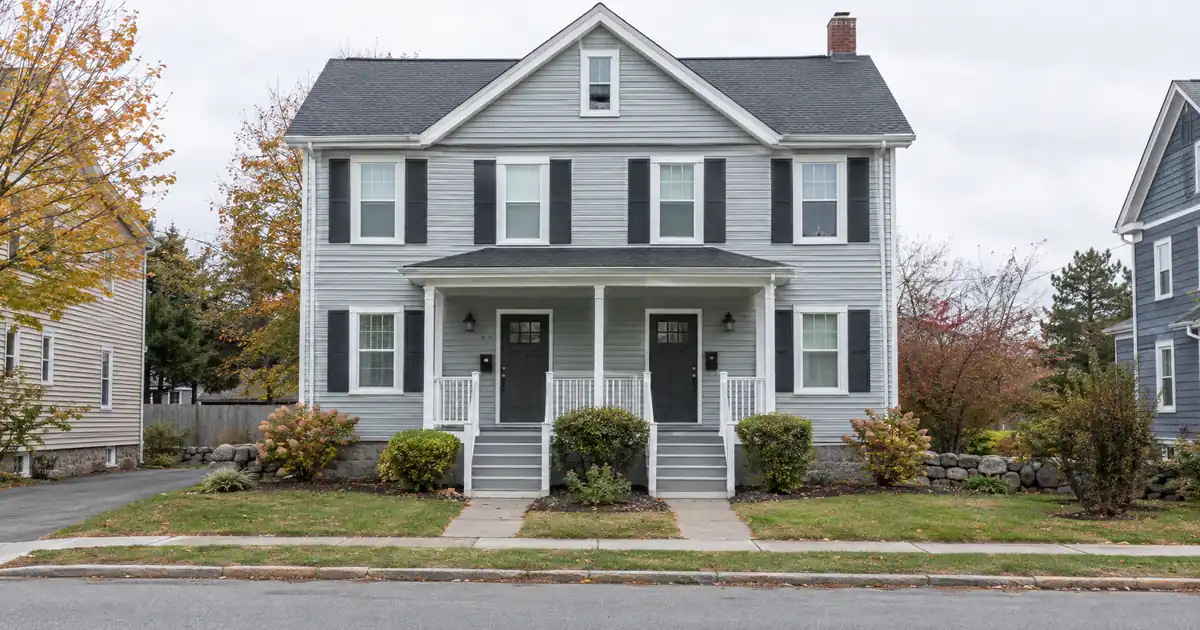
Whittenton is where Taunton’s small-landlord model shows up in the numbers. RentCafe reports that 88% of Whittenton rentals sit in small-scale complexes of fewer than 50 units, with average rent near $2,092. Condos in the neighborhood have median prices of $285,000 for one-bedrooms and $325,000 for two-bedrooms, per Homes.com. That is the profile of an owner who bought a two- or three-family years ago, built equity, and now wants it working somewhere else. This article covers that exit: how a DSCR cash-out refinance works on Taunton stock, which property types carry it, and where files stall.
DSCR Cash-Out Calculator
Run the cash-out numbers in Taunton, MA
Rate source: Freddie Mac 30-yr average via FRED® — Federal Reserve Bank of St. Louis · effective Oct 1, 2026
Prefilled with starting assumptions — enter your property’s value, balance, taxes, and insurance for a more accurate picture.
Program parameters update from Lendmire’s centralized guideline source. Taxes and insurance are editable estimates.
As of Oct 1, 2026 · General Freddie Mac market benchmark, not a Lendmire loan offer. Property value, balance, taxes, and insurance are editable estimates. Maximum loan-to-value varies by lender, program, property type, and seasoning. Not a Loan Estimate, approval, or commitment to lend. Program availability and eligibility are subject to lender guidelines, credit approval, property review, and underwriting.
The Quick Read:
A DSCR cash-out refinance in Taunton, Massachusetts is underwritten primarily on the property’s rental income measured against its full monthly obligation, with proceeds typically capped by a 75% loan-to-value ceiling and tied to roughly six months of ownership seasoning, subject to lender guidelines.
- Pre-war buildings make up a large share of Taunton rental units, per Point2Homes, which favors stacked two- and three-families.
- A single-family rental runs thin on coverage when its rent is set against a purchase price near the top of the local range, per Homes.com.
- Myles Standish Industrial Park lists a sizable employee base, per Taunton Development Corporation.
- East Taunton now has commuter rail, but any appraisal uplift from it is unproven, so don’t underwrite a value increase based on the new station.
Taunton Market Snapshot
A quick read on the Taunton investor landscape — figures come from the cited sources below. Confirm current property-level numbers before underwriting.
| Metric | Detail |
|---|---|
| Typical rents | $2,092 average (RentCafe Whittenton) |
| Cap rates | 7% going-in cap (Redfin City Center) |
| Employment | 7,400 employees (Taunton Development) |
| Vacancy | 3% (Business View Magazine, mayor) |
Where the Equity Sits in Taunton
The equity sits in older multi-unit buildings in the core neighborhoods. Point2Homes puts 47% of Taunton’s rental units (4,272) in pre-war stock, which means two-deckers, three-deckers, and converted Victorians. Point2Homes flags its own data as possibly not current, so treat that as directional.
RentCafe adds that 89% of Taunton rentals are in small complexes under 50 units, and 2-bedroom floorplans are about 52% of rentals. The tenant pool wants small-scale, two-bedroom space. A duplex or triplex is exactly that product.
Renters are a real share of the city. RentCafe’s market page counts 8,854 renter-occupied households (37%) against 15,017 owner-occupied (63%). RentCafe’s rent averages cover buildings with 50 or more units, so don’t read them as small-landlord rents. The tenure split still tells you the rental base is substantial.
On price, the sources disagree, which is normal. Resideline reports 355 closed sales with a median closing price of $499,900. This article uses that as the working citywide figure. Zillow’s home value index sits higher at $528,720, up 3.7% over the past year, reflecting a different methodology. For a cash-out, that appreciation is the part that matters. It is modest, steady, and not the kind of run that lets an investor assume a big appraisal jump.
Here is how the submarkets line up, using Homes.com medians. They are an aggregator and directional only.
- City Center. Prices sit near the middle of the core neighborhoods. Walkable downtown around Taunton Green, with the oldest stock. Multi-unit stacking is most likely here.
- Whittenton. Offers a more affordable entry point, with condo values on the lower end. Rent-to-price is the strongest of the core neighborhoods on a directional read.
- East Taunton. Single-family values sit in the middle to upper range, close to the Route 24/140 interchange and Myles Standish.
- Westville. This is the higher-priced tier, and it leans toward appreciation over cash flow.
Weir Village and Oakland also show up on Compass multi-family pages. There is no sourced price or rent data for them, so this article won’t invent any. The inference is that the older core neighborhoods hold most of the pre-war stock. Verify it with comps.
The Math: Why Stacked Units Carry the Refinance
Stacked units carry the refinance because income multiplies while the basis grows only modestly. A single-family house earns one rent against one price. A two- or three-family earns two or three rents against one lot and one loan.
Homes.com puts median single-family rent at $2,200, townhouses at $2,925, and condos at $2,175, with a citywide price-to-rent ratio of 17.2. Against a median single-family price near $500,000, that single-family number is thin.
Rentometer lists all-property-type rents of $1,724 for a one-bedroom, $2,166 for a two-bedroom, and $2,726 for a three-bedroom. Redfin showed seven multi-family listings at a median list price of $675,000, a point-in-time snapshot.
Run the numbers on the modeled inputs below. The rents and prices are assumptions built from those sources, not a market statistic. Coverage reads are rent divided by full PITIA at a 75% LTV, including taxes and insurance, rounded down. Exact terms depend on the lender’s guidelines, property type, leverage, and a full review of the borrower’s file.
| Property type | Modeled price | Modeled gross rent | Coverage read |
|---|---|---|---|
| Single-family | about $500K | about $2,200 | Below 0.75x |
| Two-family | about $675K | about $4,300 | Near 1.0x |
| Three-family | about $750K | about $6,500 | Roughly 1.3x |
Read it plainly. The single-family is a hold, not a cash-out candidate. The two-family sits right at the 1.00x benchmark that most standard programs are built around. That is workable on some files, tight on others. The three-family has real cushion. Below 1.00x, a lender may still review the file under different structures such as interest-only or a sub-1.00 program, but that usually means lower leverage or more cash in, and it is subject to lender guidelines and credit approval.
The DSCR is monthly rent divided by the full monthly obligation: principal, interest, taxes, insurance, and any HOA dues. The guide “What Is a DSCR Loan” walks through the mechanics.
DSCR files in markets like this one typically look like a pre-war multi-family with a long-tenured owner, a mix of legacy and market-rate leases, and an appraisal that comes in light on rent if the leases are below market. The strongest files show up with a rent roll that matches the lease copies, a unit count that matches the appraiser’s description, and a clear title chain. When the lease evidence is clean, the appraiser’s rent schedule usually carries the coverage number. When it isn’t, the number gets argued.
One thought out loud: the two-family is the genuine toss-up. The coverage is borderline, but the seasoning clock may already have run and the basis may be well below current value. An owner with a low basis could cash out at 75% of today’s value and still clear the benchmark. A recent buyer at a full price could not.
Seasoning, LTV, and What the Proceeds Are
The ceiling on a cash-out refinance is 75% of appraised value. That cap is firm, and it is not the 80% figure that applies to purchases. Seasoning typically runs about six months of ownership, measured from title recording. The settlement statement documents the recording date. Files that assume the seasoning requirement away get kicked back.
The proceeds are not a fixed number. Available equity depends on rent used for lender review, the full monthly obligation, reserves, and the 75% ceiling. A building with strong value but thin rents can hit the coverage floor before it hits the LTV cap. That is common on Taunton single-family stock and on the higher-priced Westville tier.
Other typical guidance, subject to program terms:
- Minimum coverage of 1.00x on rent used for lender review against PITIA.
- Credit tiers starting at a 620 floor, with better terms usually available at 660, 680, and 700.
- Reserves of about six months of PITIA.
- Loan amounts up to $3,000,000 on standard programs, with smaller balances routed through select lenders in the network.
Manufactured homes, log homes, and barndominiums fall outside these programs entirely.
Appreciation versus cash flow is the tension in this city. Westville and East Taunton lean toward appreciation. City Center and Whittenton lean toward coverage. A cash-out on a high-basis, low-rent house produces proceeds but little coverage cushion. A cash-out on a stacked pre-war building produces both. The refi options cover the rate-and-term and cash-out structures in more depth.
What happens to the proceeds is the point. They become the down payment on the next building, or reserves for a rehab. Take the owner of a Whittenton three-family who pulls capital to buy a second small multi-family nearby. The refinance only works if the seasoning, coverage, and reserves all hold on the first property, so the first file has to be clean.
For owners ready to test their numbers, see how the DSCR math pencils on a specific property. Lendmire is a broker, so lenders in the wholesale network do the review and approval.
Who Pays the Rent: The Industrial Park Base
The rent is paid by a workforce, not a campus. Taunton Development Corporation describes Myles Standish as a 1,029-acre industrial campus with 100 companies and about 7,400 employees. A Business View Magazine interview with the mayor puts the figure above 8,000, with named tenants including General Dynamics, Martignetti Companies, and Waters Corporation. Use the TDC count as the cleaner citation.
Liberty & Union Industrial Park adds 14 companies and 762 employees at the Route 24/140 interchange. That is a lot of weekday jobs for a city of roughly 60,433 residents, per Census Bureau QuickFacts. No comparison to other cities is made here, but it is a deep base for the size.
Data USA lists the largest resident industries as Health Care and Social Assistance (5,543 people), Retail Trade (4,442), and Construction (2,921). The average commute is 29.3 minutes. Employment grew 1.4% to about 31.1k. Median household income is $79,283, per Massachusetts Demographics.
Morton Hospital is part of the picture. Brown University Health lists it as a 144-bed acute care community hospital, and it joined that system after Steward Health Care’s bankruptcy. Bed counts differ across sources, so cite the hospital’s own page. A stable health system is a durable source of tenants for workforce rentals nearby. Student demand is minor: Bristol Community College’s Taunton center is downtown, but enrollment isn’t published and this isn’t a college-town rental market.
This workforce tenant base is why lease terms in Taunton tend to read as ordinary long-term residential leases. That matters to a lender reviewing a rent roll.
East Taunton and the Commuter Rail (Skip the Appraisal Assumption)
East Taunton is now a Boston-commuter submarket, and that changes demand more than it changes value. Commuter rail service began at East Taunton station as part of South Coast Rail. The station has 363 parking spaces next to the Route 24/140 interchange. A City of Taunton announcement lists a $12.25 full fare to Boston, and weekday direct service runs about every 70 minutes per Mass.gov.
For a cash-out, here’s the catch. The rail effect on values is not yet proven, and comps may be thin. An appraiser will work from closed sales, not from a station opening. Treat any uplift as a bonus, never as the basis for the loan amount. A borrower who sizes a refinance on projected appreciation gets disappointed at the appraisal.
What Derails Taunton Files
Four things derail Taunton files, and none of them are exotic.
Rent source gaps. Aggregators disagree sharply. Zillow Rentals shows an average of $2,100, up $70 year over year, with the rental market labeled cool. RentCafe shows $2,042 citywide, and another listing site shows far lower. No reliable city vacancy rate was found, so nobody should quote one. Underwrite on actual comps and the appraiser’s rent schedule, not one website’s average.
Unit-count mismatches. Pre-war buildings get renovated, combined, and split. When the listing, the tax record, and the appraisal describe different unit counts, the file stalls. Reconcile the count before submission.
Mixed-use downtown assets. A Redfin City Center listing states a going-in cap rate of 7% on a portfolio of apartments and commercial space. That is a listing broker’s claim, not a market cap rate. Properties with commercial components may fall outside standard residential DSCR programs, so confirm eligibility early.
Seasoning and title documentation. Missing recording dates, a settlement statement that doesn’t reconcile, or a recent transfer into an LLC can reset the conversation. Entity documents should be complete, and LLC-titled loans are subject to lender program eligibility.
The cleanest file has complete leases, entity documents, a clear title chain, a unit count that matches across every document, and reserves documented. That gives the lender fewer preventable gaps to review, though it never guarantees approval.
For the broader trade-off against bank financing, compare DSCR loans with conventional financing. Massachusetts investors can also review Massachusetts DSCR investor loans for the state-level picture. Verify current local rental rules, taxes, and insurance with qualified local professionals before committing.
DSCR vs. conventional financing
There are two common ways to finance an investment property in Taunton, MA, and they qualify you differently — here’s how investors weigh them.
Why investors choose it
- Qualifies on the property’s rental income — no personal tax returns, W-2s, or pay stubs needed to document income.
- No personal debt-to-income ceiling to clear, so existing mortgages and obligations don’t cap your borrowing the same way.
- Can be closed in an LLC, keeping the property inside a business entity.
- Built for scaling — not held to the limit on number of financed properties that conventional financing applies.
- Underwriting centers on the deal: generally qualifies when the rent covers the payment, a 1.00x coverage ratio being a common baseline (confirmed in underwriting).
- Designed specifically for investment property, including long-term and, where the program allows, short-term rentals.
Where it’s strong
- Often the lowest ongoing financing cost for a buyer who fully qualifies on personal income — a fit for a first property or a cost-first purchase.
Trade-offs for investors
- Requires full personal income documentation and must fit within a debt-to-income limit — salary, existing debts, and other mortgages all count.
- Typically held in your personal name rather than a business entity.
- Caps how many financed properties you can carry, which can become a ceiling as a portfolio grows.
- Evaluates you as a borrower as much as the property, which usually means more paperwork.
How investors usually choose: a first or single property often optimizes for the lowest financing cost; portfolio builders often optimize for leverage, vesting in an LLC, and scaling past conventional caps. The right answer depends on your goals, the property, and current guidelines — both paths run through select lenders in Lendmire’s wholesale network, with eligibility and terms confirmed in underwriting.
For current guidelines and terms, see Lendmire’s DSCR loan programs page.
Frequently Asked Questions
Which Taunton property types support the largest cash-out balance?
Two- and three-family houses do, because rents stack against one basis and one loan. The pre-war stock in City Center and Whittenton is the likeliest fit. Single-family houses near $500,000 earning about $2,200 usually run too thin on coverage to support much.
How long do I need to own a Taunton property before a cash-out?
Typically about six months, measured from title recording and documented by the settlement statement. Program terms vary by lender, so confirm the seasoning requirement before applying for the cash-out.
Can I count on the East Taunton commuter rail to lift my appraisal?
No. The station is new, comps are thin, and any value effect is unproven. Size the loan on current comps and the appraiser’s rent schedule, not on projected appreciation.
Does a Taunton two-family clear the 1.00x coverage benchmark?
It can land near it on modeled rents, including taxes and insurance, so it is borderline. A three-family usually has more cushion. Eligibility depends on lender guidelines, credit, reserves, and the appraisal.
Where does the tenant demand come from?
Mostly from workforce and family renters tied to the industrial parks, health care, and retail. Myles Standish alone lists about 7,400 employees, and health care is the largest resident industry.
Bottom Line Against Providence
Providence sits about 18 miles west and pulls the same commuters, but for a cash-out right now the math favors Taunton owners holding stacked pre-war units bought on a lower basis, while single-family owners here are better off holding than refinancing.
About Lendmire
As a DSCR and non-QM mortgage broker, Lendmire (NMLS# 2371349) connects investors with wholesale lending channels across 41 markets, including Washington, D.C. Lenders look primarily at the property’s rental income rather than the borrower’s traditional personal-income documentation, which suits self-employed operators and portfolios past four financed properties. The brokerage is a 2026 Scotsman Guide Top Workplace and was recognized by Scotsman Guide in 2025. Investors can reach the team at 828-256-2183.
Get Started
Ready to find the right loan for you?
In about 30 seconds you can review financing options available for your investment property. No commitment required.
Informational only. Not a Loan Estimate, approval, or commitment to lend. Program availability and eligibility are subject to lender guidelines, credit approval, property review, and underwriting.
References
1. RentCafe
2. Homes.com
3. Point2Homes
4. Homes.com
5. Taunton Development Corporation
6. Redfin
8. RentCafe
10. Resideline
12. Compass
13. Rentometer
14. Redfin
15. Liberty & Union Industrial Park
17. Data USA
18. Massachusetts Demographics
20. Bristol Community College’s Taunton center
21. South Coast Rail
22. City of Taunton announcement
23. Mass.gov
24. Zillow Rentals
25. a 2026 Scotsman Guide Top Workplace
26. recognized by Scotsman Guide in 2025
This article is part of Lendmire’s investment property cash-out refinance program — full qualification details, guidelines, and scenarios live on the program page.
Related reading: Luxury Rental DSCR Loans In New Jersey · Jersey Shore Vacation Rental Loans: DSCR Financing In Ocean City, Cape May And Long Beach Island · DSCR Cash-out Refinance In New Jersey: Pulling Equity From A Rental
Guides: Investment Property Cash-Out Refinance in Taunton, MA · Investment Property Cash-Out Refinance in Massachusetts
Brandon Miller
Founder & CEO, Mortgage Loan Originator, Lendmire LLC
- Mortgage Loan Originator · NMLS# 1129696 · Verify on NMLS Consumer Access
- North Carolina Real Estate Broker · License# 343312 · Verify on NCREC
- North Carolina Insurance Producer · License# 19053198 · Property, Casualty, Life, Health · Verify on NAIC SBS
- Lendmire LLC · Firm NMLS# 2371349 · Verify firm licensure
Important disclosures. Lendmire (NMLS# 2371349) is a licensed mortgage brokerage. Lendmire is not a direct lender, depository institution, or financial advisor. All loan inquiries are subject to lender underwriting; this article does not constitute a commitment to lend. Rates, terms, and program guidelines are subject to change without notice and vary by borrower profile, property type, and state. Information in this article is general in nature and is not financial, legal, or tax advice. Equal Housing Opportunity. NMLS Consumer Access: nmlsconsumeraccess.org.