
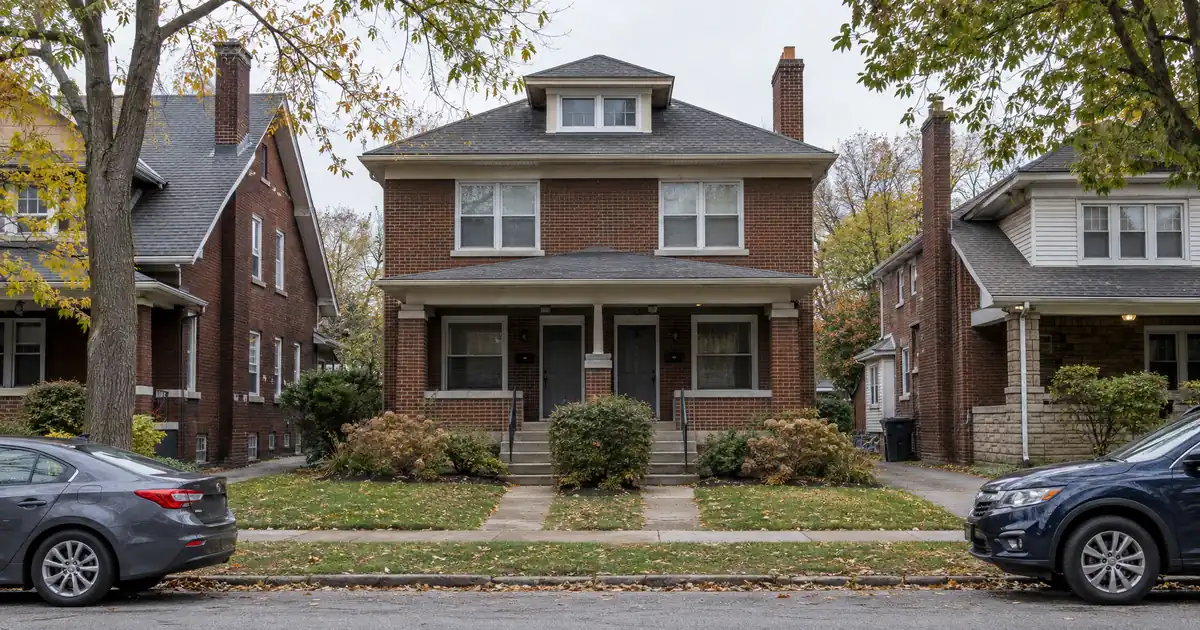
The objection comes first: single-family rent doesn’t carry a cash-out in Cleveland Heights. The city’s average home value index reads $214,166 per Zillow, while average rent is $1,363 per RentCafe. That is a thin ratio. A lender running full PITIA against a typical house rent will see coverage struggle, and the 75% LTV ceiling leaves little room after payoff. Every figure here varies by lender and program — guidelines, property type, leverage, and credit profile all apply.
The objection is partly right. It’s also the wrong lens for this housing stock. Cleveland Heights is a first-ring streetcar suburb with a large block of duplexes, converted homes, and small apartment buildings. Two-unit rent against one property value is where the cash-out math works. This article covers that math, the seasoning clock, and the paperwork that stalls these files. Purchase mechanics are a separate topic.
DSCR Cash-Out Calculator
Run the cash-out numbers in Cleveland Heights, OH
Rate source: Freddie Mac 30-yr average via FRED® — Federal Reserve Bank of St. Louis · effective Sep 24, 2026
Prefilled with starting assumptions — enter your property’s value, balance, taxes, and insurance for a more accurate picture.
Program parameters update from Lendmire’s centralized guideline source. Taxes and insurance are editable estimates.
As of Sep 24, 2026 · General Freddie Mac market benchmark, not a Lendmire loan offer. Property value, balance, taxes, and insurance are editable estimates. Maximum loan-to-value varies by lender, program, property type, and seasoning. Not a Loan Estimate, approval, or commitment to lend. Program availability and eligibility are subject to lender guidelines, credit approval, property review, and underwriting.
The Quick Read: A DSCR cash-out refinance in Cleveland Heights, Ohio is underwritten primarily on the property’s rental income measured against its full monthly obligation, so the file runs from seasoning proof and lease documentation through appraisal, title, and reserves review, with proceeds capped by a 75% LTV ceiling, subject to lender guidelines.
- Average rent is $1,363 against a $214,166 value index (RentCafe, Zillow).
- Duplex listings show roughly $1,250 per unit, so two-unit buildings carry coverage better than houses.
- Cash-out typically needs about 6 months of ownership, measured from title recording.
- 55% of rentals fall between $1,001 and $1,500. Underwrite inside that band.
- Cedar-Fairmount, Cedar-Lee, and Coventry sit minutes from University Circle’s hospital cluster.
Cleveland Heights Market Snapshot
A quick read on the Cleveland Heights investor landscape — figures come from the cited sources below. Confirm current property-level numbers before underwriting.
| Metric | Detail |
|---|---|
| Home prices | $256K median (Redfin) |
| University enrollment | 12,475 total (College Tuition Compare) |
| Employment | 28,000 physicians and employees (CWRU) |
Why the Single-Family Median Fights You
The single-family median is a coverage problem, not a demand problem. Redfin puts the recent median sale price at $256K, up 6.7% year over year, per its Cleveland Heights market page. Zillow’s smoothed index is up only 0.7%. Redfin’s price per square foot is $130, down 8.7%.
Read those together. The median gain looks like a mix shift toward larger homes, not a market lifting every appraisal. Underwrite the cash-out at flat values. Don’t build the proceeds on 6-7% appreciation.
The other side of the tension is comp depth. Homes sold in 27 days versus 33 a year earlier, and 205 sold in August against 200 the year before, per the same Redfin page. That’s a workable comp pool for an appraiser, which matters more on a refinance than headline appreciation.
The 1.00 DSCR benchmark is common across standard programs because rent covers the payment at that level. Some lenders look at lower ratios, but that usually means more cash in, lower leverage, or different pricing. Eligibility depends on lender guidelines, credit, reserves, and property review.
Duplexes Change the Math
Two-unit buildings are the best-fit collateral for a cash-out here. Listing copy in the market shows in-place or asking rents of about $1,250 per unit on two-bedroom duplexes, per Showcase Home Group. Two units at that level gross roughly 1.8 times the citywide average rent for a whole home. That is a rent comparison, not a coverage ratio. The price paid still decides whether coverage clears 1.00 once taxes and insurance are in.
The stock supports it. NeighborhoodScout shows 10.80% of units in duplexes, converted homes, or small buildings, alongside 61.82% single-family detached. Its data is older, so treat the mix as directional. Buildings with five or more units, about 22.86% of stock, sit outside standard 1-4 unit DSCR products.
The value-add angle is legacy rent. Some listings describe long-tenured month-to-month tenants paying $1,045 and $950 per LocalRealEstateOnline. Run the numbers on that as a modeled assumption: two units at those legacy rents total $1,995. Marked to $1,250 each after renovation, they total $2,500, about 25% more income. If the market supports the higher rents, that lifts the number a lender reviews on the refinance.
Two cautions. These are agent-copy rents, not comps, so pair any target with actual sale prices before you plan proceeds. And lenders generally underwrite to signed leases or market rent, so month-to-month tenants at $950 don’t get credited at $1,250 without paper.
Seasoning and the 75% Ceiling
Cash-out eligibility starts with about 6 months of ownership, measured from title recording. The settlement statement is the evidence. Files that assume the clock started at contract or at rehab completion get kicked back.
The ceiling is 75% LTV on cash-out, against 80% on purchase. Don’t blur those. Equity available depends on rent used for lender review, PITIA, reserves of about 6 months, and the LTV cap. It isn’t a guaranteed cash figure. Standard programs run up to $3,000,000, and smaller balances route through select lenders in the network. Final terms depend on lender guidelines, property type, leverage, and the borrower’s complete credit picture.
Consider an owner whose current payoff sits well below the 75% cash-out cap on appraised value. That leaves a margin of value before closing costs and reserves. If the owner assumed meaningful appreciation and the appraisal lands flat, the proceeds shrink or vanish. Underwriting to flat value is the safer habit here, given the Redfin per-square-foot decline.
The investor refinance breakdown covers refinance types. The cash-out refinance walkthrough covers the mechanics in more depth.
Where Rents Sit by Submarket
Neighborhood rent data here is listing-based and inconsistent across platforms. The figures below are directional snapshots, not underwriting numbers. No verified neighborhood sale prices exist in the research, so each profile stays qualitative on price.
Cedar-Fairmount is the closest submarket to University Circle. Rent.com lists a one-bedroom average of $1,296. The City calls the adjacent Top of the Hill site “the gateway between the Heights and University Circle” on its Development Projects page. The apartments going up there are new competing supply. They also show developers see the demand.
Cedar-Lee lists a one-bedroom near $1,050, though Redfin’s figure is lower, so the platforms disagree. The larger issue is supply. The City’s Cedar Lee Meadowbrook page describes a $66 million project with 206 market-rate apartments. It was announced some time ago, so check current status before assuming units are open. New Class-A units can pull rents down on older stock nearby.
Coventry Village lists a one-bedroom near $975. Older buildings mean maintenance-heavy assets, and appraisers notice condition. Budget for that in any renovation-then-refinance plan.
Noble-Nela is the most affordable corridor, with a one-bedroom average of $925. It’s workforce-rent territory. Without sale-price data, describe it as a rent-to-value candidate, not a proven one.
Severance and Mayfield Road sits near Severance Town Center. One-bedrooms average about $962.
Underwrite inside the band where demand actually is. RentCafe reports 55% of rentals between $1,001 and $1,500, and 42% of households renting, 8,084 in all. Assuming rents above $1,500 for a standard unit is where modeled coverage falls apart. Zumper reports rents up 11% over the last year per its rent research page. That’s one listing-based source, so don’t build a refinance on it.
The Demand Behind the Rent
Tenant demand here is an employment story. Per Data USA, the top resident employment sectors are health care and social assistance (4,688 people), educational services (3,614), and professional, scientific, and technical services (2,413). That counts where residents live, not where jobs sit.
The jobs are next door. The City’s location page names Case Western Reserve University, Cleveland Clinic, University Hospitals, and the Cleveland Museum of Art as neighbors. Case Western enrolled 12,475 students in the latest academic year per College Tuition Compare. University Hospitals reports 28,000 physicians and employees per a CWRU affiliate page. MetroHealth, the only major hospital inside city limits, announced a $42 million three-story addition at its Severance Circle campus.
Working DSCR brokers see a recurring pattern in older streetcar-suburb markets like this one. Single-family coverage looks fine on rent-to-income logic, then falls short on the price-to-rent math. Two-to-four-unit files tend to clear because the rent stacks on one property value. The files that stall usually stall on the lease evidence for the legacy units, not on the ratio.
What Stalls These Files (and What Doesn’t)
Most delays are documentation, not credit. Watch these:
1. Lease evidence on each unit. Month-to-month tenants need written proof of the rent. A handshake lease at $950 will be credited at what the paper shows.
2. Rent-roll clarity. List every unit, its rent, and its lease status on one page. Don’t leave a top-floor unit’s income blank.
3. Appraisal access and reconsideration. With price per square foot down 8.7% on Redfin’s page, expect comps to be debated. A reconsideration packet with recent in-neighborhood sales and condition adjustments is a routine step, not an emergency.
4. Title and seasoning proof. The recording date decides the clock. Clear any title issues before the file goes in.
5. Reserves documentation. Plan on about 6 months of PITIA in verified funds. Stale statements get a file re-papered.
DSCR vs. conventional financing
Two common ways to finance an investment property in Cleveland Heights, OH. They qualify you differently — here’s how investors weigh them.
Why investors choose it
- Qualifies on the property’s rental income — no personal tax returns, W-2s, or pay stubs needed to document income.
- No personal debt-to-income ceiling to clear, so existing mortgages and obligations don’t cap your borrowing the same way.
- Can be closed in an LLC, keeping the property inside a business entity.
- Built for scaling — not held to the limit on number of financed properties that conventional financing applies.
- Underwriting centers on the deal: generally qualifies when the rent covers the payment, a 1.00x coverage ratio being a common baseline (confirmed in underwriting).
- Designed specifically for investment property, including long-term and, where the program allows, short-term rentals.
Where it’s strong
- Often the lowest ongoing financing cost for a buyer who fully qualifies on personal income — a fit for a first property or a cost-first purchase.
Trade-offs for investors
- Requires full personal income documentation and must fit within a debt-to-income limit — salary, existing debts, and other mortgages all count.
- Typically held in your personal name rather than a business entity.
- Caps how many financed properties you can carry, which can become a ceiling as a portfolio grows.
- Evaluates you as a borrower as much as the property, which usually means more paperwork.
How investors usually choose: a first or single property often optimizes for the lowest financing cost; portfolio builders often optimize for leverage, vesting in an LLC, and scaling past conventional caps. The right answer depends on your goals, the property, and current guidelines — both paths run through select lenders in Lendmire’s wholesale network, with eligibility and terms confirmed in underwriting.
6. Entity documents. If the property sits in an LLC, operating agreement and formation papers must match the title, subject to lender program eligibility.
One line on local rules: verify current rental rules, taxes, and insurance with qualified local professionals before underwriting.
What Happens to the Proceeds?
Cash-out proceeds are capital for the next file. In a market where a single-family median struggles to cover, most investors point proceeds at another two-to-four-unit building or at renovation of a legacy-rent unit. The second choice raises rent on a property already in the portfolio. Cleveland Heights files sit within the Ohio DSCR investor loans program set.
Honest toss-up: an investor could pull the maximum now and redeploy, or hold leverage lower and let flat values recover. With Zillow’s index near flat, the second path is the more conservative one.
To price a scenario, get a rental-income loan quote or call Lendmire at 828-256-2183.
What a Local Appraiser Would Say
Cleveland Heights values follow the pre-war two-family and the block around it. A duplex a few minutes from the hospital campuses will hold its tenant base through most swings, while a house priced near the median will keep asking too much of a single rent check.
Frequently Asked Questions
How do you qualify for a DSCR cash-out refinance in Cleveland Heights?
Qualification centers on the property’s rent against its full PITIA, typically at a 1.00 benchmark, with a credit floor of 620 and higher tiers at 660, 680, and 700. Ownership of about 6 months from title recording is the usual seasoning point. Reserves of about 6 months PITIA are typical. Final eligibility depends on lender guidelines, credit approval, and property review.
What are the requirements for an investment property loan refinance in Cleveland Heights, Ohio?
Expect an appraisal, lease or market-rent documentation for every unit, proof of the recording date, reserves statements, and entity papers if an LLC holds title. Cash-out leverage tops out at 75% LTV, and standard programs run up to $3,000,000. Manufactured homes, log homes, and barndominiums fall outside these programs. These specifics are subject to lender guidelines and a full review of property, leverage, and credit.
Does the 6.7% price gain mean I can count on appreciation for proceeds?
No. Redfin’s median sale price rose 6.7%, but its price per square foot fell 8.7% and Zillow’s index is up 0.7%. That pattern suggests a mix shift toward larger homes. Underwrite proceeds at flat value, and treat any appraisal gain as a bonus.
Do below-market legacy rents hurt a cash-out?
They can, because lenders generally credit documented lease rent or market rent supported by the appraisal. Month-to-month units at $950 or $1,045 need written evidence. Renovating and re-leasing at market before the refinance lifts the income a lender reviews.
Can Lendmire help structure DSCR financing for small multifamily investment properties in Cleveland Heights?
For current guidelines and terms, see Lendmire’s DSCR loan programs page.
About Lendmire
Lendmire, NMLS# 2371349, is a DSCR and non-QM mortgage broker that places investor loans through wholesale lenders in 41 markets, including Washington, D.C. Program review centers on the property’s rental income rather than the borrower’s traditional personal-income documentation, which suits self-employed operators and portfolios beyond four financed properties. The firm was named a 2025 Scotsman Guide Top Mortgage Workplace and a top-ranked workplace in 2026, documented in the 2026 industry recognition release.
Get Started
Ready to find the right loan for you?
In about 30 seconds you can review financing options available for your investment property. No commitment required.
Informational only. Not a Loan Estimate, approval, or commitment to lend. Program availability and eligibility are subject to lender guidelines, credit approval, property review, and underwriting.
References
1. Zillow, Cleveland Heights home values
2. RentCafe, Cleveland Heights average rent
3. Redfin, Cleveland Heights housing market
4. College Tuition Compare, Case Western Reserve University enrollment
9. Rent.com
10. City of Cleveland Heights, Development Projects
11. City of Cleveland Heights, Cedar Lee Meadowbrook
12. Zumper — Rent Research Cleveland Heights OH
13. Data USA, Cleveland Heights
14. a 2025 Scotsman Guide Top Mortgage Workplace
15. Scotsman Guide — Top Workplaces 2026
16. EIN Presswire — Lendmire Recognized as a 2026 Top Workplace by Scotsman Guide
This article is part of Lendmire’s investment property cash-out refinance program — full qualification details, guidelines, and scenarios live on the program page.
Related reading: Luxury Rental DSCR Loans In New Jersey · Jersey Shore Vacation Rental Loans: DSCR Financing In Ocean City, Cape May And Long Beach Island · DSCR Cash-out Refinance In New Jersey: Pulling Equity From A Rental
Guides: Investment Property Cash-Out Refinance in Cleveland, OH · Investment Property Cash-Out Refinance in Ohio
Brandon Miller
Founder & CEO, Mortgage Loan Originator, Lendmire LLC
- Mortgage Loan Originator · NMLS# 1129696 · Verify on NMLS Consumer Access
- North Carolina Real Estate Broker · License# 343312 · Verify on NCREC
- North Carolina Insurance Producer · License# 19053198 · Property, Casualty, Life, Health · Verify on NAIC SBS
- Lendmire LLC · Firm NMLS# 2371349 · Verify firm licensure
Legal disclosures. Lendmire (NMLS# 2371349) is a state-licensed mortgage brokerage that arranges financing through wholesale lender relationships. Lendmire is not a direct lender, depository institution, or registered financial advisor. The discussion above is general informational content about real estate financing — it is not financial, legal, or tax advice, and readers should consult licensed professionals for guidance on their individual circumstances. Loan inquiries are subject to lender underwriting; this article does not represent a commitment to lend. Loan terms, rates, and qualification standards vary by borrower, property, and state, and are subject to change at any time. Equal Housing Opportunity. NMLS Consumer Access: nmlsconsumeraccess.org.