
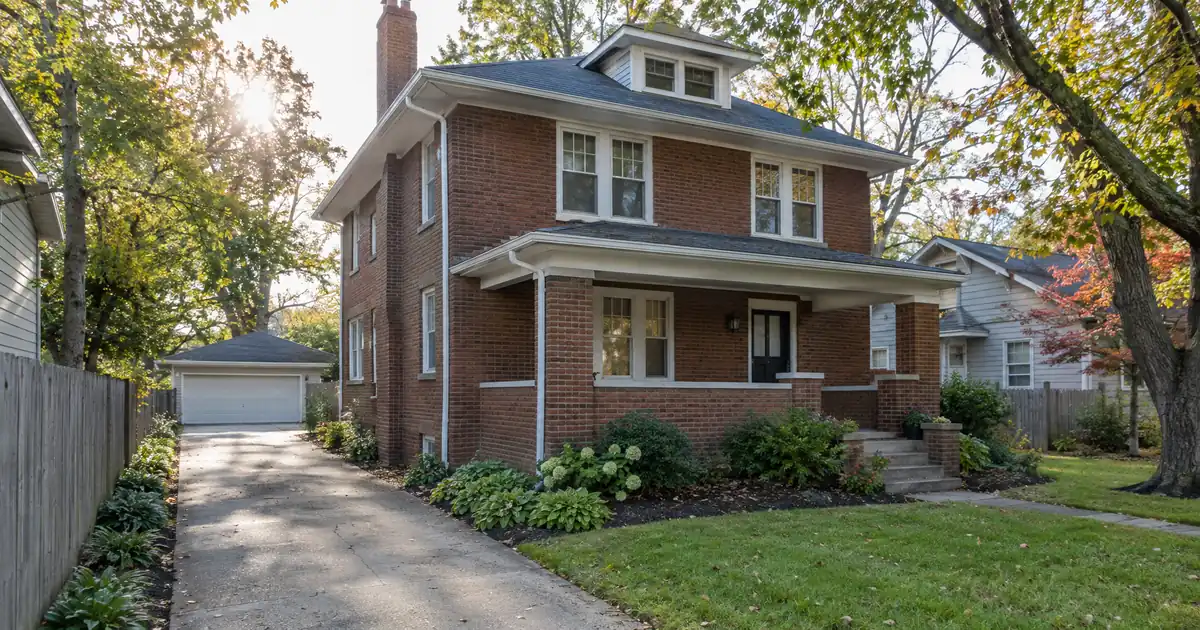
The appraisal comes back light. The comps are thin, the downtown block you own sold for less than the one next door did a year ago, and the six-month title clock you were counting on ran out weeks before the appraiser walked through. That is the friction point for most investors trying to pull equity out of a small Ohio rental, and Lancaster has all three problems at once. The way through is to size the loan off conservative value data, know which properties carry the coverage ratio, and line up the file before it goes to a lender.
DSCR Cash-Out Calculator
Run the cash-out numbers in Lancaster, OH
Rate source: Freddie Mac 30-yr average via FRED® — Federal Reserve Bank of St. Louis · effective Sep 24, 2026
Prefilled with starting assumptions — enter your property’s value, balance, taxes, and insurance for a more accurate picture.
Program parameters update from Lendmire’s centralized guideline source. Taxes and insurance are editable estimates.
As of Sep 24, 2026 · General Freddie Mac market benchmark, not a Lendmire loan offer. Property value, balance, taxes, and insurance are editable estimates. Maximum loan-to-value varies by lender, program, property type, and seasoning. Not a Loan Estimate, approval, or commitment to lend. Program availability and eligibility are subject to lender guidelines, credit approval, property review, and underwriting.
Key Takeaways:
A cash-out refinance on an investment property in Lancaster, Ohio is a DSCR-underwritten loan that replaces existing debt on a property you already own, sized off appraised value and the rent measured against its full monthly obligation, with proceeds returned as investable capital subject to lender guidelines.
- Citywide median sits near $232K, up just 0.7 percent per Redfin. Plan without appreciation help.
- Downtown median is $225K, down 7.3 percent per Redfin. It is a cash-flow play.
- Modeled single-family coverage at 75 percent LTV lands near 1.05 including taxes and insurance. Duplexes model higher.
- Multifamily inventory is thin, so appraisal comps for 2-4 unit properties are scarce.
Lendmire (NMLS# 2371349) places DSCR investor financing for Lancaster, Ohio through non-QM wholesale channels that cover 41 markets, including Washington, D.C. Cash-out files here are mostly small: single-family rentals and older duplexes owned by local investors who want to redeploy equity. The rest of this piece covers what those files look like, where the numbers hold, and where they don’t. For state-level context, see Lendmire’s Ohio DSCR platform.
Lancaster Market Snapshot
A quick read on the Lancaster investor landscape — figures come from the cited sources below. Confirm current property-level numbers before underwriting.
| Metric | Detail |
|---|---|
| Home prices | $250,000 median (Homes.com multi-family listings) |
| Employment | 2,200 employees (Fairfield 33 Development) |
What Will the Appraiser Actually See?
The appraiser will see a flat market with conflicting price signals. Redfin’s citywide figures show median sale prices moving only slightly year over year, while price per square foot has climbed noticeably. Prices are flat while per-foot values climb, which usually means smaller, cheaper homes are trading.
Other sources disagree, and it matters which one you anchor to. Resideline tracked a $220,000 median closing price across 383 closings over a six-month window, according to its Lancaster market report. Homes.com listed a $250,000 median. Zillow’s $280,902 is a value index, not a sale median, so it sits well above both. These use different methods and windows, so they shouldn’t be compared directly.
The practical read: size the cash-out off the lower, closed-sale data. A lender’s appraisal will do the same. An investor who assumes $250K and gets a $225K appraisal has just lost the equity they planned to pull. Since the six-month seasoning clock runs from title recording, not from when the purchase felt done, check the recording date before you order anything.
The 75 Percent Ceiling and the Six-Month Clock
Cash-out refinances on investment property cap at 75 percent LTV in these programs, and seasoning is about six months of ownership measured from title recording. Both are guideline figures that vary by borrower, property, and lender. How the cash-out works is covered separately, but a few parameters shape Lancaster deals specifically.
- Coverage. The 1.00x benchmark is standard because rent covers the full monthly obligation at that level. Some lenders review lower ratios, usually with lower leverage, more reserves, or different pricing.
- Credit and reserves. Credit tiers start at a 620 floor and step through 660, 680, and 700. Reserves run about six months of full housing payment.
- Loan size. Standard programs go up to $3,000,000. Most Lancaster files sit far below that, and smaller balances route through select lenders in the network.
Equity available is never a guaranteed cash figure. It depends on rent used for lender review, the full payment including taxes and insurance, reserves, and that 75 percent ceiling. Borrowers who need a refresher on the ratio itself can read the DSCR fundamentals. All review details remain subject to lender overlays, credit approval, and property review.
Where the Coverage Math Holds
Older two-unit stock near downtown carries the ratio better than single-family rentals in Lancaster. Rents run about $1,499 to $1,600 for a three-bedroom, and the citywide median price makes single-family coverage thin at high leverage. Duplexes split one price across two rents.
Start with the rent evidence. RentHop shows three-bedroom rentals at $1,600, up from $1,508, though the sample is small. RentCafe reports a $1,499 three-bedroom average and a $1,233 overall average, but only counts buildings with 50 or more units. Redfin’s rental data shows an average near $1,100. Treat $1,500 as the working three-bedroom figure and underwrite from actual leases.
Run the numbers on a modeled single-family rental at the $232K median with $1,600 in monthly rent. At 75 percent LTV, full PITIA including taxes and insurance puts coverage around 1.05. Drop to $1,499 in rent and the number slides just under 1.00. That is a sub-1.00 file on long-term rent alone, and the options a lender would review are lower leverage, a sub-1.00 program, or an interest-only structure. Qualification would still depend on lender guidelines, credit, and property review. Pulling back to about 65 percent LTV moves the modeled ratio to roughly 1.15.
Now a duplex. Assume a $225K purchase price, in line with the downtown median, and $1,900 in combined monthly rent (a modeled assumption, not a sourced figure). At 75 percent LTV including taxes and insurance, coverage models near 1.25. Underwrite from real leases or a rent survey, not listing copy. Duplexes marketed as post-rehab often carry an agent’s projected rent that may never appear in a signed lease.
Downtown and the Historic District
Downtown is the cash-flow-led submarket. The $225K median is down 7.3 percent, and price per square foot is $120, down about 9 percent, per the Redfin neighborhood data above. Value is soft, which is why leverage should be conservative. Demand is tied to the Main Street district, county government, and hospital staff. The Historic Lancaster District next door holds the city’s largest concentration of pre-1900 stock, per the City of Lancaster. Exterior changes there go through the Historic Lancaster Commission, so investors planning renovation should confirm requirements with local professionals before buying, not after.
Small multifamily is not a niche here. Tenants, appraisers, and lenders already understand the format.
South Ewing Street and the Medical Corridor
Hospital-adjacent housing draws steady tenants. Adena Fairfield Medical Center, formerly Fairfield Medical Center, is a 222-bed acute care hospital and, per the Fairfield 33 Development Alliance, the largest employer in the county at 2,200 employees. The corridor around North and South Ewing Street sits inside that demand pool. No reliable neighborhood-level rent source exists for it, so underwrite conservatively.
There is one complication: new supply is arriving nearby, which brings the next section.
Watch the New Supply
Lancaster is building fast, and small landlords compete with it. Per 10TV, construction has started on 616 single-family homes, 843 market-rate apartments, and 645 affordable apartments. That is a roughly $300 million pipeline.
Emerald Place on South Ewing Street is the nearest concern for small-property rents. LDG Development plans 216 apartments at 40 to 70 percent of area median income, with projected rents of $732 to $1,723. Any small landlord near that node prices against a brand-new comparable.
The counterweight is demand. The state committed $1 million in infrastructure funding for 361 workforce housing units, per the Ohio Governor’s office, and the Building Industry Association estimates the county needs 843 to 947 units a year, per 10TV. Vacancy figures are the weak spot. Published city and county numbers disagree by several points, so underwrite with the higher one and expect the lender to apply its own vacancy factor.
Who Pays the Rent?
Lancaster’s tenant base rests on employment, not on any single sector. The 2024 ACS puts population at 41,249, with median household income of $59,133 and a median age of 37.4. About 43 percent of households rent, per RentCafe’s Census-based figures. The Census Bureau’s QuickFacts page carries the official series.
The county backs that up. Per Columbus Region, Fairfield County has 165,176 residents, more than 4,300 businesses, and ranked as the fourth-fastest-growing county in Ohio over a ten-year span. Fairfield 33 counts over 130 manufacturers, and the hospital is the largest employer. Anchor Hocking employs about 800, making it the city’s largest manufacturer, according to Business View Magazine. Ohio University Lancaster adds 2,457 students by headcount, or 842 full-time equivalents.
The city also sits about 28 miles from Columbus at the meeting of US 33 and US 22, which gives it a commuter angle. That lets an investor argue Lancaster carries Columbus-adjacent demand at Lancaster prices. It’s a reasonable argument, though no source in the research quantifies commuter tenants.
Working DSCR brokers see a recurring pattern in small industrial-and-healthcare markets like this one: the file that clears cleanly is the one where the investor commissioned the rent evidence before the appraisal, not after. Coverage that pencils on an asking-rent assumption tends to slip under 1.00 once a lender uses lease or survey rent. The cleanest files arrive with complete leases, entity documents, title, and property details ready for review.
Skip the Appreciation Story
Assume Lancaster gives you nothing on price. Prices are flat to slightly soft, downtown is falling, and closed-sale medians sit below listing medians. The equity you can pull is the equity you already have, sized off conservative value. That changes the strategy in three ways.
First, cash-out works best on properties bought well below the median, where 75 percent of a $225K appraisal still leaves meaningful proceeds. Second, thin multifamily inventory means appraisal risk is higher than for single-family. Homes.com showed only five active multifamily listings, priced from $165,000 to $369,900, spending about 24 days on the market. Comps for a cash-out appraisal will be scarce. Third, proceeds are best treated as capital for the next deal, not spending money.
DSCR vs. conventional financing
Two common ways to finance an investment property in Lancaster, OH. They qualify you differently — here’s how investors weigh them.
Why investors choose it
- Qualifies on the property’s rental income — no personal tax returns, W-2s, or pay stubs needed to document income.
- No personal debt-to-income ceiling to clear, so existing mortgages and obligations don’t cap your borrowing the same way.
- Can be closed in an LLC, keeping the property inside a business entity.
- Built for scaling — not held to the limit on number of financed properties that conventional financing applies.
- Underwriting centers on the deal: generally qualifies when the rent covers the payment, a 1.00x coverage ratio being a common baseline (confirmed in underwriting).
- Designed specifically for investment property, including long-term and, where the program allows, short-term rentals.
Where it’s strong
- Often the lowest ongoing financing cost for a buyer who fully qualifies on personal income — a fit for a first property or a cost-first purchase.
Trade-offs for investors
- Requires full personal income documentation and must fit within a debt-to-income limit — salary, existing debts, and other mortgages all count.
- Typically held in your personal name rather than a business entity.
- Caps how many financed properties you can carry, which can become a ceiling as a portfolio grows.
- Evaluates you as a borrower as much as the property, which usually means more paperwork.
How investors usually choose: a first or single property often optimizes for the lowest financing cost; portfolio builders often optimize for leverage, vesting in an LLC, and scaling past conventional caps. The right answer depends on your goals, the property, and current guidelines — both paths run through select lenders in Lendmire’s wholesale network, with eligibility and terms confirmed in underwriting.
Consider the stronger recycling play. Buying a second small property at a discount often beats cashing out a third. The cash-on-cash on a cheap duplex can run well ahead of a median-priced single-family house, though exit liquidity is thinner. Investors comparing structures can look at DSCR versus conventional, and the broader refinance pathway for investor properties covers rate-and-term alternatives. Investors who want a coverage check before ordering an appraisal can review my scenario or call 828-256-2183. Verify current local rental rules, taxes, and insurance with qualified local professionals.
Frequently Asked Questions
How do you qualify for a DSCR loan in Lancaster, Ohio?
Qualification centers on the property’s rent versus its full monthly obligation, with a 1.00 ratio as the common benchmark. Credit tiers start at a 620 floor, and reserves run about six months of housing payment. Lancaster’s three-bedroom rents cluster around $1,500 to $1,600, so coverage on median-priced homes is close to the line at full leverage. Final eligibility depends on lender guidelines, credit approval, and property review.
What are the requirements for a cash-out refinance on an investment property in Lancaster, Ohio?
Expect about six months of ownership from title recording, a 75 percent LTV ceiling, and a qualifying DSCR of at least 1.00 on most programs. Because appraisals can come in near the lower closed-sale figures, plan proceeds from conservative value. Entity-held properties may qualify, subject to lender program eligibility.
Do Lancaster’s thin multifamily comps hurt a cash-out appraisal?
They can, because with only about five active multifamily listings, appraisers often reach for older or distant sales, and downtown values have been slipping. An investor gains by documenting actual leases and, where possible, recent nearby closings before the appraisal is ordered. The stronger file also has clear unit legality in older or historic-district stock.
Can Lendmire help structure DSCR financing for small multifamily investment properties in Lancaster?
Yes. Lendmire arranges DSCR investor loans through wholesale lenders. Loans are underwritten primarily on property cash flow, which suits 2-4 unit rentals held by an entity or self-employed owner.
Should investors expect price appreciation to increase available equity in Lancaster?
Not reliably. The citywide median is up under 1 percent, and downtown is down 7.3 percent. Plan cash-out proceeds on conservative value, and treat any gain as upside rather than the thesis.
What the Next Stretch Looks Like
Over the next 6 to 24 months, the pipeline is the variable to watch. If most of the 843 market-rate and 645 affordable apartments deliver on schedule, small landlords near Ewing Street will price against new product, and rent growth on older stock will likely flatten. Investors on cheap, well-located duplexes near downtown and the hospital should hold up better than those who paid the median. The county’s growth and its hospital and manufacturing payroll suggest demand won’t be the problem. Appraised value, not tenants, is the constraint to plan around in Lancaster.
For current guidelines and terms, see Lendmire’s DSCR loan programs page.
About Lendmire
A non-QM mortgage broker (NMLS# 2371349), Lendmire arranges DSCR financing for real estate investors in 41 markets, covering 40 states plus Washington, D.C. Since deals are underwritten primarily on property cash flow rather than personal income documentation, the structure suits self-employed buyers and entity-owned portfolios. Lendmire places loans through wholesale investor lenders and is not a direct lender. The firm has been recognized by Scotsman Guide as a 2026 Top Workplace and was named a 2025 Scotsman Guide Top Mortgage Workplace.
Get Started
Ready to find the right loan for you?
In about 30 seconds you can review financing options available for your investment property. No commitment required.
Informational only. Not a Loan Estimate, approval, or commitment to lend. Program availability and eligibility are subject to lender guidelines, credit approval, property review, and underwriting.
References
1. Redfin: Lancaster housing market
3. Homes.com
4. Fairfield 33 Development Alliance
6. RentHop
7. RentCafe
10. 10tv.com — Construction Underway for 300 Million Worth of New Housing Lancaster
11. LDG Development: Emerald Place
12. Columbus Region: Fairfield County profile
14. Ohio University regional enrollment
16. a 2025 Scotsman Guide Top Mortgage Workplace
This article is part of Lendmire’s investment property cash-out refinance program — full qualification details, guidelines, and scenarios live on the program page.
Related reading: DSCR Cash Out Refinance in Lancaster, Texas: The 2026 DSCR Guide to Inland Port Equity · Cash Out Refinance Investment Property in Lancaster, Texas: The 2026 DSCR Guide to Inland Port · DSCR Cash Out Refinance in Lorain, Ohio: The 2026 DSCR Financing Guide to Broadway Corridor
Guides: Investment Property Cash-Out Refinance in Ohio
Brandon Miller
Founder & CEO, Mortgage Loan Originator, Lendmire LLC
- Mortgage Loan Originator · NMLS# 1129696 · Verify on NMLS Consumer Access
- North Carolina Real Estate Broker · License# 343312 · Verify on NCREC
- North Carolina Insurance Producer · License# 19053198 · Property, Casualty, Life, Health · Verify on NAIC SBS
- Lendmire LLC · Firm NMLS# 2371349 · Verify firm licensure
Required disclosures. Lendmire (NMLS# 2371349) operates as a licensed mortgage broker, not a direct lender or depository. The discussion in this article is general in nature and should not be relied upon as financial, legal, or tax advice — every investment scenario is unique and should be reviewed by a qualified professional. Any loan inquiry is subject to lender underwriting, and this article is not a commitment to lend or a guarantee of approval. Mortgage rates, loan terms, and program guidelines vary by borrower, property, and state, and may change without notice. Equal Housing Opportunity. Verify licensure at NMLS Consumer Access.