
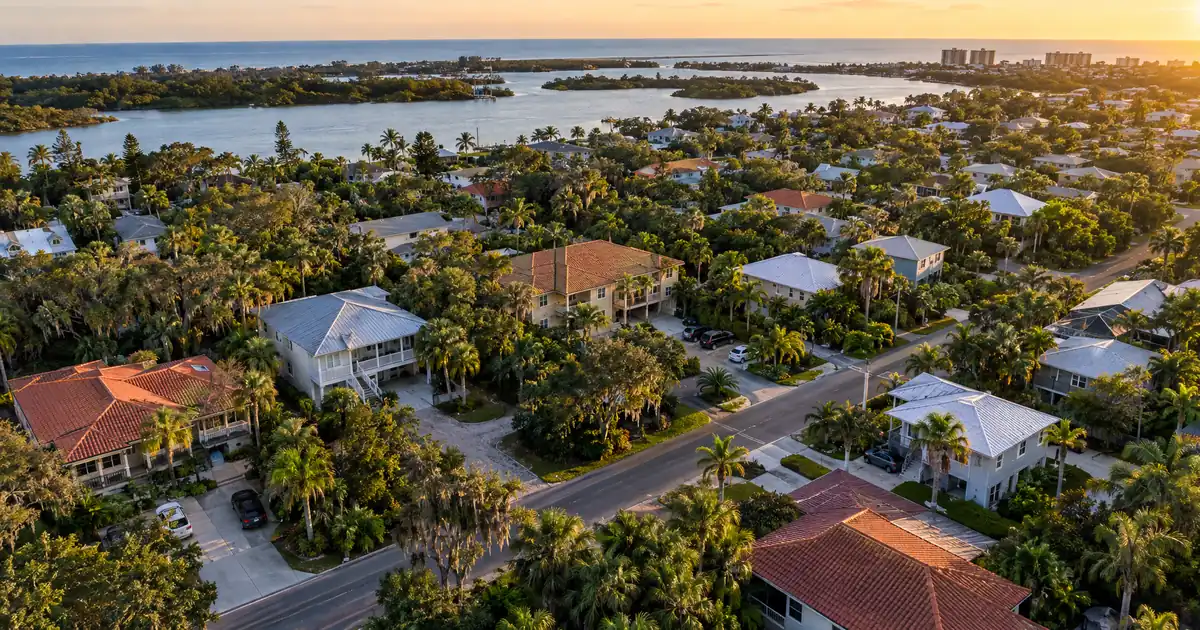
A rental in Siesta Isles hits the DSCR math like this. A canal-front single-family home appraises near the island’s $850,000 median sale price and carries a modeled $5,500 monthly rent on a twelve-month lease. The owner asks for the full 75 percent cash-out. With taxes and insurance counted in the monthly obligation, coverage lands right around 1.0x, which is borderline. Now put the same rent on a modeled $1.2 million value and coverage slides toward 0.7x. The rent didn’t change. The loan did. On Siesta Key that is the whole cash-out question, and the sections below work through it one step at a time. (Both rent and value here are modeled inputs, not cited market comps.)
The Quick Read: A DSCR cash-out refinance on Siesta Key, Florida is underwritten primarily on the property’s rental income measured against its full monthly obligation, so the file has to show a leasable rent, about six months of title seasoning, an appraisal that holds up on thin island comps and reserves behind a 75 percent loan-to-value cap.
DSCR Cash-Out Calculator
Run the cash-out numbers in Siesta Key, FL
Rate source: Freddie Mac 30-yr average via FRED® — Federal Reserve Bank of St. Louis · effective Sep 24, 2026
Prefilled with starting assumptions — enter your property’s value, balance, taxes, and insurance for a more accurate picture.
Program parameters update from Lendmire’s centralized guideline source. Taxes and insurance are editable estimates.
As of Sep 24, 2026 · General Freddie Mac market benchmark, not a Lendmire loan offer. Property value, balance, taxes, and insurance are editable estimates. Maximum loan-to-value varies by lender, program, property type, and seasoning. Not a Loan Estimate, approval, or commitment to lend. Program availability and eligibility are subject to lender guidelines, credit approval, property review, and underwriting.
- Median sale price sits near $850,000, with 92 days on market versus 36 a year earlier, per LocalLifeHomes.
- Condo median rent runs about $4,500 a month against a $5,000 all-property median.
- Condo supply sits above eight months, so condo appraisals lean on soft comps, per Team Renick.
- Single-family at island prices usually needs a lower loan-to-value than the cap to approach 1.00x.
- Duplex and small multi-unit stock lets stacked rents carry one price, per Zillow’s duplex listings.
Siesta Key Market Snapshot
A quick read on the Siesta Key investor landscape — figures come from the cited sources below. Confirm current property-level numbers before underwriting.
| Metric | Detail |
|---|---|
| Home prices | $825,673 average home value (Zillow Home Value Index) |
| University enrollment | 732-852 students (varies by year cited) (New College of Florida – Campus) |
| Population | 5,454 population (2020) (Wikipedia – Siesta Key, Florida) |
| Employment | 6,000+ staff (Glassdoor – Sarasota Memorial) |
How the Cash-Out Loan Gets Sized
The loan is capped by two tests, and the tighter one sets the proceeds. Test one is 75 percent of appraised value, the ceiling on a DSCR cash-out. Test two is the loan amount the rent can carry against a 1.00x benchmark. On Siesta Key the second test usually binds first, which surprises owners who only looked at equity.
The coverage ratio is monthly rent divided by the full monthly obligation: principal, interest, taxes, insurance and any HOA dues. A 1.00x baseline is common because rent covers the payment at that level. Some lenders look at lower-ratio files, but those usually need stronger compensating factors, lower leverage or more reserves, and everything stays subject to lender guidelines, credit review and property review. Lendmire’s primer on DSCR loans covers the basics if the ratio is new.
Here is the sequence on a typical cash-out file:
1. Confirm seasoning. Lenders in the network typically look for about six months of ownership, measured from title recording and documented by the settlement statement. A recent purchase with no recorded date is the first thing that gets kicked back.
2. Get the value. The appraiser picks comps, and on this island that choice moves the answer a lot. More on that below.
3. Test the rent. A signed twelve-month lease or an appraiser’s rent schedule sets the numerator. Seasonal pricing doesn’t translate cleanly into a lender’s rent figure.
4. Run the loan-to-value cap. Take 75 percent of the appraised value, subtract the existing payoff, and what remains is the ceiling on proceeds. It is a ceiling, not a promise.
5. Check the ratio at that loan size. If coverage falls under the benchmark, the loan amount comes down until the file clears or the structure changes.
Here is the appraisal sensitivity in percentages, no dollars needed. Say an owner’s payoff equals 55 percent of the appraised value. That leaves 20 points of room under the 75 percent cap. If the appraisal comes in 10 percent lower, the same payoff becomes about 61 percent of value, and the room shrinks to roughly 14 points. A 10 percent value miss cuts the proceeds room by about 30 percent. Thin comps turn that from a corner case into a planning assumption.
Where Island Values Stand
Siesta Key values are soft and noisy at the same time. LocalLifeHomes, drawing on Redfin data, puts the median sale price at $850,000, down 10.5 percent year over year, with a price per square foot of $611. Zillow’s index shows a different number, an average home value of $825,673, down 5.4 percent. The gap comes from methodology: one counts closed sales, the other models values across the whole housing stock. This article uses the $850,000 sale-price median as its reference point.
The market behind those numbers has loosened. Average days on market ran 92 versus 36 a year earlier, and active listings were up roughly 50 percent. Homes sell about 6 to 7 percent below list. A cash-out borrower should read that as pressure on the appraisal, not just on a future sale.
The island is also small. It is a census-designated place of 5,454 residents across roughly 2.3 square miles, so a handful of sales can swing a monthly median. One 30-day window shows a $1,425,000 median and another micro-market pull sits at $1.2 million over three months. Don’t anchor on any single print.
Working DSCR brokers see a recurring pattern in thin, luxury-heavy barrier-island markets. Owners assume the value from a listing site or a neighbor’s asking price, and the appraisal arrives with two or three comps that tell a different story. The files that recover are the ones with a reconsideration packet ready: recent in-neighborhood closings, condition and waterfront adjustments, and a clear list of what the first comps missed.
The Rent Side Is the Weak Side
Siesta Key is an appreciation market that borrows against equity. It is not a cash-flow market. Mashvisor’s island figures show a $1,999,500 median list price, average monthly rental income of $4,566 and an average cash-on-cash return of just 1.00 percent. That puts rent-to-price well under 0.3 percent.
Rent data is thin and noisy too. Zumper’s all-property median is $5,000 a month, down 13 percent over the year. The condo median on Homes.com is $4,500. Much of what gets advertised on the island is seasonal or vacation product, so a clean twelve-month rent index is hard to find. Don’t treat a peak-season monthly quote as a stabilized rent. A lender wants a lease or an appraiser’s rent schedule, and a seasonal ledger that swings across the year makes a poor substitute.
That doesn’t kill cash-out lending here. It changes the target. Owners with large equity can still clear 1.00x, but only by taking a smaller loan than the cap allows. Pulling 60 percent of value instead of 75 percent can be the difference between a file that clears and one that doesn’t.
Siesta Isles and the South End
Canal-front single-family in Siesta Isles is the most natural cash-out candidate. Siesta Isles has deep-water canals, private docks and Gulf access, and the product is a single-family home on a single lease. That is the cleanest rent evidence you can hand a lender. The catch is price. At an appraised value near the island median, a $5,500 rent lands borderline at full leverage. At higher values it falls under 1.00 quickly.
The South End, Turtle Beach and Sanderling, is quieter and more residential than the Village. It suits long-hold owners with documented leases and lower leverage targets. Pull less, keep the ratio clean, and treat the cash-out as a measured draw rather than an equity sweep.
Honestly, it’s a toss-up between asking for the maximum and asking for a clearing number. The maximum is nicer on paper, but a file that needs a sub-1.00 exception adds friction a smaller loan avoids. Run both before ordering the appraisal.
The Condo Corridor
Central Siesta Key, Crescent Beach and the so-called condo corridor, is where the rent-to-price math looks best. Condo rents are lower in absolute terms, with a $4,500 median, but purchase prices per square foot run lower too. Condo inventory is deep: Team Renick reports more than eight months of supply on the island, and a county-wide report puts condos at 6.3 months of supply against 4.1 months for detached homes. That favors buyers on entry price. It also means appraisers see plenty of competing listings, which can cap value on a cash-out.
The condo file has its own friction points. The HOA questionnaire has to be complete. The condo certification has to show the building is eligible. Any special assessments or litigation in the building can stop the file cold. Order the questionnaire early. A missing line item can stall a clean file for reasons that have nothing to do with the borrower.
The North End around the Village and the luxury enclave of Bay Isle and Shell Beach sit at the top of the price range. Those are premium properties with the weakest coverage ratios. They can work as equity-pull candidates only at low loan-to-value targets.
Small Multi-Unit: Where the Coverage Stacks
Multi-unit is the one product where rent can plausibly catch up to price on this island. Zillow lists 22 duplex, triplex and multi-family properties, ranging from a one-bedroom unit near $575,000 and a three-bedroom, three-bath duplex near $830,000 to a six-unit building near $3,990,000. Compass shows six-bedroom multi-unit buildings between $3,075,000 and $3,500,000. A beachside eight-unit property, four units on the ground level and four above, shares a courtyard pool and eight parking spaces per Homes.com.
Run the numbers on a modeled duplex. Say the property appraises near $830,000 and each side leases for a modeled $3,500. Against a 75 percent cash-out with taxes and insurance counted in, coverage lands around 1.2x or better. Those rents are illustrative, not sourced. The point is mechanical. Two rents against one price, one tax bill and one insurance policy do what a single $5,500 rent cannot.
Size matters at the top end. Standard programs run up to $3,000,000 on the loan amount, and balances above $1,500,000 move toward about nine months of reserves instead of six. A large building brings both lines into play.
Seasoning, Appraisal and the Paperwork That Stalls Files
The failure modes on Siesta Key cash-out files are predictable.
Seasoning gaps. The roughly six-month clock starts at title recording, not contract date or closing date. Files that assume the clock away get returned. The settlement statement is the evidence.
Appraisal variance. Wide spreads between listings and closed sales mean the first value may not be the last. Appraisal reconsideration is a routine step here, not an emergency move.
Reserves documentation. Reserves run about six months of the full monthly obligation, and more on larger balances. Statements need to show the funds belong to the borrower or the entity, with large deposits explained.
DSCR vs. conventional financing
There are two common ways to finance an investment property in Siesta Key, FL, and they qualify you differently — here’s how investors weigh them.
Why investors choose it
- Qualifies on the property’s rental income — no personal tax returns, W-2s, or pay stubs needed to document income.
- No personal debt-to-income ceiling to clear, so existing mortgages and obligations don’t cap your borrowing the same way.
- Can be closed in an LLC, keeping the property inside a business entity.
- Built for scaling — not held to the limit on number of financed properties that conventional financing applies.
- Underwriting centers on the deal: generally qualifies when the rent covers the payment, a 1.00x coverage ratio being a common baseline (confirmed in underwriting).
- Designed specifically for investment property, including long-term and, where the program allows, short-term rentals.
Where it’s strong
- Often the lowest ongoing financing cost for a buyer who fully qualifies on personal income — a fit for a first property or a cost-first purchase.
Trade-offs for investors
- Requires full personal income documentation and must fit within a debt-to-income limit — salary, existing debts, and other mortgages all count.
- Typically held in your personal name rather than a business entity.
- Caps how many financed properties you can carry, which can become a ceiling as a portfolio grows.
- Evaluates you as a borrower as much as the property, which usually means more paperwork.
How investors usually choose: a first or single property often optimizes for the lowest financing cost; portfolio builders often optimize for leverage, vesting in an LLC, and scaling past conventional caps. The right answer depends on your goals, the property, and current guidelines — both paths run through select lenders in Lendmire’s wholesale network, with eligibility and terms confirmed in underwriting.
Entity paperwork. If the property is titled in an LLC, the operating agreement, EIN letter and good-standing certificate should be ready, subject to lender program eligibility.
Lease evidence. A signed lease, a rent roll for multi-unit and proof of deposit make the numerator defensible.
Credit. Programs commonly run credit tiers at 620, 660, 680 and 700, with 620 as the floor. Higher scores generally support better leverage options, subject to lender guidelines.
Verify current local rental rules, taxes and insurance with qualified local professionals before underwriting. Those items sit outside the loan itself but shape the monthly obligation in the denominator.
What’s the Catch on Sub-1.00 Files?
The catch is that a sub-1.00 file is a different conversation, not a failed one. If rent doesn’t clear 1.00x at the requested loan size, a few structures may be worth a look: a lower loan-to-value, a sub-1.00 program that carries tighter terms, an interest-only structure to reduce the monthly obligation or a larger reserve position. A lender reviews each, and none is a given. Qualification stays subject to lender guidelines, credit approval and property review.
The tradeoff runs both ways. Lower leverage means less cash out, but it also means a cleaner file and a more durable hold. For owners who plan to redeploy the proceeds rather than spend them, that tradeoff usually favors the smaller loan. The program-to-program comparison shows how the underwriting logic differs from conventional loans if you’re weighing both.
Where the Proceeds Go
The cash-out is a funding source, not an end in itself. On this island the typical redeployment looks to the mainland, about six miles away by the Siesta Drive and Stickney Point bridges, where employment-based rental demand is deeper. Sarasota Memorial operates an 839-bed regional medical center and employs more than 6,000 staff. New College of Florida reports 852 undergraduates and Ringling College of Art and Design enrolls 1,663 students. Mainland neighborhoods like Gillespie Park and South Gate fit the small multi-unit approach better than the island does, since stacking rents is the way to get past thin single-unit ratios.
The sequence runs from island equity to a mainland multi-unit and, once that has seasoned, into the next investor refinance. The guide “The Refi Options” walks through how the repeat cycle fits together. Lendmire’s Florida DSCR loan programs cover the state-level program details, and the brokerage can show how the math pencils on a specific file.
The Order of Operations
Gather the lease, entity documents and reserve statements first. Confirm the recording date. Run the ratio at two loan sizes. Then order the appraisal. Siesta Key owners who sequence it that way come out ahead of those who start with the appraisal and hope.
Frequently Asked Questions
How do you qualify for a DSCR cash-out refinance in Siesta Key?
The property’s rent has to cover its full monthly obligation, with 1.00x as the common baseline. The file also needs about six months of title seasoning, a credit score at or above the 620 floor, and reserves of about six months. Because Siesta Key rents sit low against its prices, most owners clear the ratio by taking a smaller loan than the 75 percent cap allows. Qualification stays subject to lender guidelines.
What are the requirements for an investment property cash-out loan in Siesta Key, Florida?
Expect a recorded ownership history that meets seasoning, a signed lease or appraiser rent schedule, entity documents if the property sits in an LLC, and reserves documentation. Condo files add an HOA questionnaire and certification. Loan amounts run up to $3,000,000 on standard programs, and reserves climb on balances above $1,500,000. Manufactured homes, log homes and barndominiums fall outside these programs.
Do condos or single-family homes cash out better on Siesta Key?
Condos tend to show the better rent-to-price relationship, given a $4,500 median rent and lower entry prices, but deep inventory can weigh on appraised value. Single-family homes carry higher values and weaker coverage at full leverage, which makes them more appreciation-led. The better choice depends on which side of that tradeoff a given property sits on.
How much equity can a Siesta Key owner actually pull out?
The ceiling is 75 percent of appraised value minus the existing payoff, then cut back to whatever loan size clears the coverage ratio. On an island where rent runs low against value, the second limit often decides it. The proceeds are never a guaranteed figure until the appraisal, rent and reserves are reviewed.
For current guidelines and terms, see Lendmire’s DSCR loan programs page.
About Lendmire
Lendmire (NMLS# 2371349) is a non-QM mortgage broker serving investors in 41 markets including Washington, D.C. It helps structure DSCR scenarios commonly evaluated around a property’s rental income rather than personal income paperwork, subject to lender guidelines. Lendmire places loans through wholesale investor lenders and is not a direct lender. It was named a 2026 Scotsman Guide Top Workplace and was recognized by Scotsman Guide in 2025 as well. Call 828-256-2183 to talk through a Siesta Key file.
Get Started
Ready to find the right loan for you?
In about 30 seconds you can review financing options available for your investment property. No commitment required.
Informational only. Not a Loan Estimate, approval, or commitment to lend. Program availability and eligibility are subject to lender guidelines, credit approval, property review, and underwriting.
References
1. LocalLifeHomes Siesta Key Market Report
2. Homes.com Condos for Rent, Siesta Key
3. Zumper Rent Research, Siesta Key
4. Team Renick Siesta Key Home Value Trends
5. Zillow Duplex Listings, Siesta Key
6. Zillow Home Value Index, Siesta Key
7. New College of Florida – Campus
8. Wikipedia – Siesta Key, Florida
9. glassdoor.com — Working at Sarasota Memorial Hospital
10. Mashvisor Siesta Key Investment Property
11. Compass shows
12. Homes.com
13. a 2026 Scotsman Guide Top Workplace
14. recognized by Scotsman Guide in 2025
This article is part of Lendmire’s investment property cash-out refinance program — full qualification details, guidelines, and scenarios live on the program page.
Related reading: Cash-Out Refinance for an Investment Property in Siesta Key, Florida · Luxury Rental DSCR Loans In Siesta Key: What The Rent Must Cover · DSCR Cash Out Refinance in Sunny Isles Beach, Florida: The 2026 DSCR Guide to Collins Avenue
Guides: Investment Property Cash-Out Refinance in Siesta Key, FL · Investment Property Cash-Out Refinance in Florida
Brandon Miller
Founder & CEO, Mortgage Loan Originator, Lendmire LLC
- Mortgage Loan Originator · NMLS# 1129696 · Verify on NMLS Consumer Access
- North Carolina Real Estate Broker · License# 343312 · Verify on NCREC
- North Carolina Insurance Producer · License# 19053198 · Property, Casualty, Life, Health · Verify on NAIC SBS
- Lendmire LLC · Firm NMLS# 2371349 · Verify firm licensure
Compliance and disclosures. Lendmire (NMLS# 2371349) is a licensed mortgage broker and is not a direct lender, depository institution, financial advisor, or tax professional. Content in this article is general market analysis and educational information — not financial, legal, or tax advice for any specific situation. Lendmire does not guarantee loan approval; every transaction is subject to underwriting by the funding lender. Mortgage pricing and loan program guidelines are subject to change at any time without notice and vary by borrower characteristics, property type, and state regulations. Lendmire complies with Equal Housing Opportunity. Licensure verification: NMLS Consumer Access.