
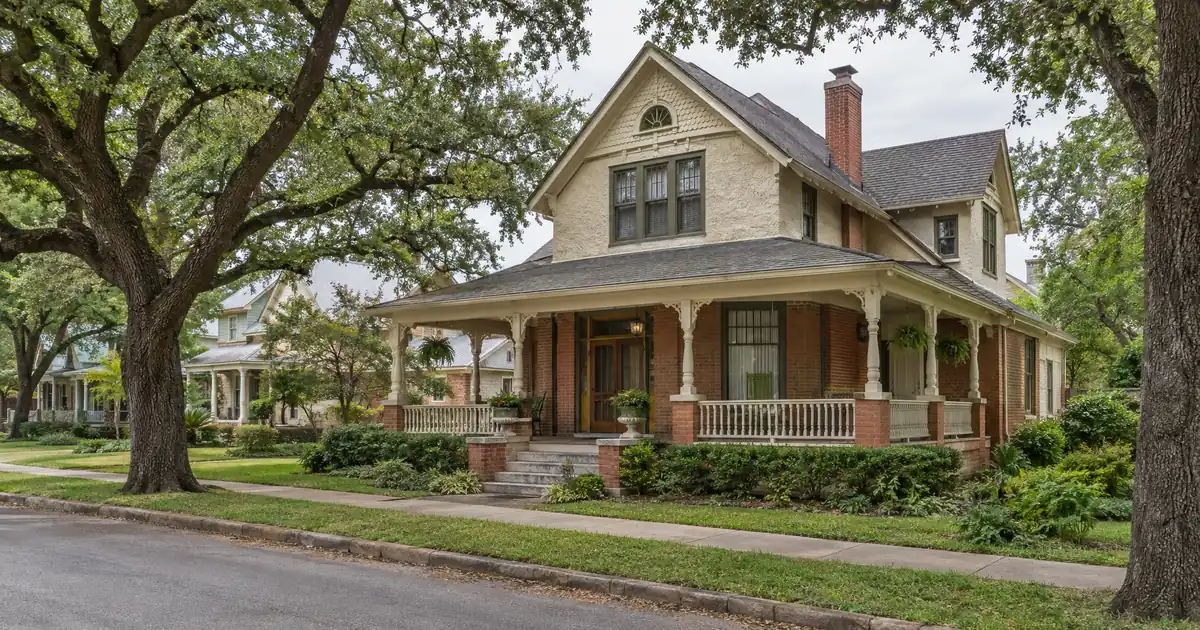
Blanco Gardens sits about a mile east of downtown, near the Blanco River, and it is where the San Marcos equity question gets honest fast. NeighborhoodScout lists average rent there at $1,550, with most homes renter-occupied. The stock is a 1970s-to-1990s mix of single-family houses and small apartment complexes. Affordable entry, steady renter demand, and no appreciation cushion. That last piece decides how much cash a refinance can pull out.
At a Glance: A DSCR cash-out refinance in San Marcos, Texas fits investors who already own a seasoned rental and can document in-place leases, because the loan is underwritten primarily on the property’s rental income measured against its full monthly obligation, with equity capped by appraised value in a market where the median sale price has slipped 7.7 percent year over year.
DSCR Cash-Out Calculator
Run the cash-out numbers in San Marcos, TX
Rate source: Freddie Mac 30-yr average via FRED® — Federal Reserve Bank of St. Louis · effective Sep 24, 2026
Prefilled with starting assumptions — enter your property’s value, balance, taxes, and insurance for a more accurate picture.
Program parameters update from Lendmire’s centralized guideline source. Taxes and insurance are editable estimates.
As of Sep 24, 2026 · General Freddie Mac market benchmark, not a Lendmire loan offer. Property value, balance, taxes, and insurance are editable estimates. Maximum loan-to-value varies by lender, program, property type, and seasoning. Not a Loan Estimate, approval, or commitment to lend. Program availability and eligibility are subject to lender guidelines, credit approval, property review, and underwriting.
- Cash-out tops out at 75 percent LTV, with ownership seasoned about six months from title recording.
- Median sale price sits near $314K, so appraisals may come in flat.
- Renters make up about 69 percent of households, per RentCafe.
- Multi-unit stock near campus is scarce and priced at a premium.
- Coverage is driven by rent softness, not by LTV alone.
Lendmire (NMLS# 2371349) places DSCR investor loans on San Marcos, Texas properties through wholesale lending channels reaching 41 markets, including D.C. This article covers the extraction side only: what the appraisal does to your equity, what the coverage math looks like, and what to track before you pull cash out.
San Marcos Market Snapshot
A quick read on the San Marcos investor landscape — figures come from the cited sources below. Confirm current property-level numbers before underwriting.
| Metric | Detail |
|---|---|
| Home prices | $495K median (Redfin San Marcos Multi-Family) |
| Typical rents | $5,600 gross rents (Homes.com Multi-Family) |
| University enrollment | 47,513 students (Texas State University Newsroom) |
| Employment | 700+ employees (PracticeLink) |
| Vacancy | 10.9% (NeighborhoodScout) |
What the Appraisal Does to Your Equity Here
San Marcos has no appreciation cushion right now, so cash-out proceeds depend on the purchase basis, not price growth. Redfin’s recent sales data shows the three-month median sale price down year over year, with price per square foot falling even faster. A cash-out sized off appraised value inherits all of that.
Zillow’s home value index shows a similar drift, and a local broker’s monthly report found roughly 7.6 months of supply. That is a buyer’s market. Appraisers pull from closed sales, and closed sales are trending down.
The practical read: an investor who bought in the last year or two should assume the appraisal lands flat or lower. Equity extraction works best on properties bought below market or improved since purchase. Buy-and-hold owners with a long basis have the most room. Recent buyers at peak pricing may find the 75 percent LTV ceiling leaves little or nothing to pull.
One source, an investor-focused broker, frames San Marcos as a cash-flow market rather than an appreciation market. That’s a fair description. Underwrite the refinance on what the rent supports, not on what the neighborhood might be worth later.
The Coverage Math (It Cuts Both Ways)
On single-family product at the median price, coverage is the binding constraint, not LTV. Most standard programs use 1.00 as the baseline: rent used for lender review divided by full monthly obligation, meaning principal, interest, taxes, insurance, and any association dues. The guide “What Is a DSCR Loan” covers the mechanics. Texas taxes and insurance are heavy line items, and they belong in the number.
Run the numbers on a hypothetical. Say you own a three-bedroom house worth about $314K on appraisal, and you use a modeled rent of $1,851, the Rentometer all-property-type figure for a three-bedroom. At 75 percent LTV, coverage including taxes and insurance lands below 1.00, somewhere around 0.85. Those are modeled assumptions, not a quote.
Below 1.00 doesn’t end the conversation. It changes the structure. Options a lender may review include a sub-1.00 program, an interest-only structure, or a lower LTV that trims the loan against the same rent. Each comes with tradeoffs in pricing, leverage, or cash out, and all of it is subject to lender guidelines, credit approval, and property review.
The multi-unit case looks different. Redfin’s multi-family listings show 13 properties at a median list price of $495K. One Western San Marcos fourplex of two-bedroom units near Texas State is listed as fully occupied at $4,150 in gross monthly rent. A modeled example at that price and 75 percent LTV, including taxes and insurance, lands around 1.2x. The listing rents are claims, not verified leases, and a duplex or fourplex appraised below list changes the picture. But four leases on one loan means one vacancy doesn’t zero out income. Coverage clears with more cushion than on a single house.
Which Submarkets Pencil for a Refinance
Blanco Gardens is the affordability play. Renters occupy most homes, and tenants are a mix of student and workforce households. NeighborhoodScout also reports a 10.9 percent vacancy rate there. Treat that as a single vendor figure, not an authoritative count, but it’s a reason to lean on signed leases and payment history instead of a market-rent assumption.
The Downtown and Texas State core, including Hughson Heights, carries the deepest tenant pool. LRG Realty puts entry near $250K for downtown, an agent’s approximate range. Investor sources call multi-unit product near campus overpriced relative to what it earns. Owners with a low basis here have the most equity to pull. New buyers at campus premiums have the least.
Eastern San Marcos is the low-price pocket. Redfin’s neighborhood page shows a median near $260K, but sales volume is very thin: three homes sold in one recent month. Thin comps make appraisals unpredictable, and cash-out sizing there is less certain than the entry price suggests.
Victory Gardens, a little over a mile south of downtown along I-35, is an older workforce area. Sunset Acres and the I-35 south corridor sit near the outlets and the Amazon, CFAN, and H-E-B distribution employers. A map of the market’s major employers lists all three, along with Texas State, as San Marcos-area employers. I found no neighborhood-level price series for either, so keep those files anchored to leases.
Skip two areas. Kissing Tree is age-restricted and mostly owner-occupied. Hunter’s Hill and River Road price near $600K, which makes for a low-yield DSCR profile.
Property Type: Where the Refi Math Holds
Two- to four-unit product and workforce three-bedroom houses are the realistic DSCR fits. Three-bedroom rents cluster around $1,800 to $2,000 across sources, and the three-bedroom band has held up better than two-bedrooms. RentHop shows three-bedrooms up 2.34 percent year over year while two-bedrooms fell 11.22 percent. Point2Homes puts two-bedrooms at 38 percent of rentals, the largest share, so the two-bedroom pool is deep but soft.
The rent sources disagree, and that matters for the appraisal. Apartment List shows a median of $1,061, down 7.8 percent year over year, and calls San Marcos the most affordable city in the Austin metro. RentCafe shows $1,601 for apartment buildings with 50 or more units, which isn’t a proxy for houses or duplexes. Zillow labels the rental market “cool.” A rent used for lender review comes from an appraiser’s rent schedule and the lease, not from a portal average. Sellers’ claims and last year’s peak won’t survive that review.
Tenant Demand Behind the Numbers
Rental demand rests on Texas State and a mixed employer base. The university’s newsroom reports 47,513 students, a 7 percent increase over the prior record. That count includes online and Round Rock students. A regional college reports 4,003 at Round Rock and 6,121 fully online, so the San Marcos campus count is lower. Don’t underwrite 47,513 local renters.
Growth is still real. The University Star reports the move to the Pac-12 and the push toward R1 status, and Hillviews reports an enrollment goal of 50,000. The City of San Marcos puts its population estimate at 91,082, a figure that includes university housing and rent-by-the-bedroom complexes. Census-based estimates run lower, so state which one you’re using.
Rents aren’t tracking enrollment, though. New apartment construction has added competition, and bed-by-bed student complexes compete for the same tenants at the low end. Enrollment supports demand. It doesn’t guarantee rent growth.
What Trips Up Cash-Out Files in a Soft Market
In markets like this one, the cleaner files tend to have the appraisal and the rent evidence lined up before submission. The common friction point is a gap between the rent on the lease and the market rent on the appraiser’s schedule, especially where student-adjacent stock carries semester-cycle turnover. Files with full lease copies, a rent roll showing payment history, and a clear ownership timeline tend to give lenders fewer preventable questions. Files that assume the seasoning requirement away, or that price the cash-out off a purchase-era value, are the ones that come back.
Here’s the documentation that does the work:
1. Seasoning proof. About six months of ownership, measured from title recording. The settlement statement documents it. Clearing title on a recent purchase before applying avoids surprises.
2. Lease and rent evidence. In-place leases, or a rent roll for multi-unit properties, plus proof of collected rent where available.
3. Entity documents. If the property sits in an LLC, operating agreement and articles, subject to lender program eligibility.
4. Reserves documentation. Typically about six months of the full monthly obligation, higher on larger balances. Statements need to show the cash is seasoned in the account.
5. Insurance and tax evidence. A current quote or declarations page, so the coverage number uses real figures instead of last year’s.
Most programs look at credit in tiers, with 620 as the typical floor. Standard programs commonly reach balances up to $3,000,000, and smaller balances route through select lenders in the network. The cash-out qualification details and rate-and-term and cash-out refi details lay out the mechanics. Review details are subject to lender overlays, and equity available is never a guaranteed cash figure.
Where the Proceeds Go (and Where They Shouldn’t)
The typical play is taking equity from a seasoned San Marcos property and redeploying it into a second asset. The thin-margin risk is using proceeds to buy more of the same soft-rent product. A duplex or fourplex with several leases behind one loan absorbs a vacancy better than another single-family house at the median price. Texas State demand supports multi-unit, but campus-adjacent multis carry a premium, so the purchase basis matters more than the address.
There’s also a case for holding off. With sales down and rents soft, a lower LTV on a refi may preserve coverage and leave room if the appraisal comes back light. Extracting less against a stronger coverage number is a legitimate structure. Owners who can document personal income instead may also want to weigh conventional financing against a DSCR loan on investor properties.
The stronger play might be waiting on one submarket while pulling equity in another. Owners in Blanco Gardens with in-place leases and a low basis are better placed than recent buyers in campus-adjacent product. This one is a toss-up depending on your basis, not the neighborhood name.
DSCR vs. conventional financing
Two common ways to finance an investment property in San Marcos, TX. They qualify you differently — here’s how investors weigh them.
Why investors choose it
- Qualifies on the property’s rental income — no personal tax returns, W-2s, or pay stubs needed to document income.
- No personal debt-to-income ceiling to clear, so existing mortgages and obligations don’t cap your borrowing the same way.
- Can be closed in an LLC, keeping the property inside a business entity.
- Built for scaling — not held to the limit on number of financed properties that conventional financing applies.
- Underwriting centers on the deal: generally qualifies when the rent covers the payment, a 1.00x coverage ratio being a common baseline (confirmed in underwriting).
- Designed specifically for investment property, including long-term and, where the program allows, short-term rentals.
Where it’s strong
- Often the lowest ongoing financing cost for a buyer who fully qualifies on personal income — a fit for a first property or a cost-first purchase.
Trade-offs for investors
- Requires full personal income documentation and must fit within a debt-to-income limit — salary, existing debts, and other mortgages all count.
- Typically held in your personal name rather than a business entity.
- Caps how many financed properties you can carry, which can become a ceiling as a portfolio grows.
- Evaluates you as a borrower as much as the property, which usually means more paperwork.
How investors usually choose: a first or single property often optimizes for the lowest financing cost; portfolio builders often optimize for leverage, vesting in an LLC, and scaling past conventional caps. The right answer depends on your goals, the property, and current guidelines — both paths run through select lenders in Lendmire’s wholesale network, with eligibility and terms confirmed in underwriting.
Verify current local rental rules, property taxes, and insurance costs with qualified local professionals before you commit. Some newer master-planned areas may carry MUD or PID assessments.
Frequently Asked Questions
How do you qualify for a DSCR cash-out refinance in San Marcos?
Qualification centers on the property’s rent against its full monthly obligation, typically with 1.00 as the baseline. Most files also need a credit score at or above a 620 floor, about six months of seasoning from title recording, and roughly six months of reserves. LTV caps at 75 percent on cash-out. Eligibility depends on lender guidelines, credit approval, and property review, so treat these as typical ranges.
What are the requirements for an investment property loan in San Marcos, Texas?
Expect an appraisal with a rent schedule, lease or rent-roll evidence, entity documents if an LLC holds title (subject to lender program eligibility), and reserves documentation. Standard programs commonly cover balances up to $3,000,000. Manufactured homes, log homes, and barndominiums fall outside these programs. Terms vary by borrower, property, and loan scenario.
Will a soft San Marcos appraisal shrink my cash-out?
It can. Cash-out sizes off appraised value, and the median sale price is down 7.7 percent year over year. A property bought below market or improved since purchase has the best chance of holding equity. A recent buyer at full price may see little room under the 75 percent ceiling. A lower LTV is one way to keep coverage workable.
Does Texas State enrollment growth raise my rents?
Not directly. Enrollment hit a record, but Apartment List shows median rent down 7.8 percent year over year, and new apartment supply is competing for the same tenants. Enrollment supports demand and vacancy stability, especially near campus. Underwrite the lease in hand, not projected growth.
What documents matter most for a San Marcos DSCR cash-out review?
Seasoning proof, current leases or a rent roll, reserves statements, and entity documents lead the list. Lendmire arranges DSCR investor loans, with cash-out capped at 75 percent LTV. Clean documentation gives the lender fewer gaps to review, but it doesn’t guarantee approval.
For current guidelines and terms, see Lendmire’s DSCR loan programs page.
What to Track Next Quarter
Three indicators tell you whether San Marcos equity is firming or eroding:
- Redfin’s median sale price and price per square foot. A turn from year-over-year declines is the first sign appraisals stop shrinking.
- Apartment List’s median rent trend. Flat to positive would loosen the coverage constraint on single-family refis.
- Texas State’s campus-versus-online enrollment split. San Marcos-based growth is what lifts renter demand, not the headline total.
Owners holding low-basis rentals near the Texas State core and in Blanco Gardens are best positioned if those three numbers stabilize, and the rest of the market will follow the same signals.
About Lendmire
Lendmire (NMLS# 2371349) is a mortgage brokerage built around DSCR investor lending, with programs available in 41 markets, including Washington, D.C. DSCR lenders commonly evaluate rental-income coverage instead of personal income paperwork, which suits LLC-owned and multi-property investors. Terms vary by lender, property, leverage, and program. The brokerage is a 2026 Scotsman Guide Top Mortgage Workplace and a top-ranked workplace in 2025. Investors can review Lendmire’s Texas DSCR platform or call 828-256-2183.
Get Started
Ready to find the right loan for you?
In about 30 seconds you can review financing options available for your investment property. No commitment required.
Informational only. Not a Loan Estimate, approval, or commitment to lend. Program availability and eligibility are subject to lender guidelines, credit approval, property review, and underwriting.
References
2. Redfin — San Marcos Housing Market
3. RentCafe
4. Redfin’s multi-family listings
6. news.txst.edu — University Statements Fall Record Enrollment
7. PracticeLink
8. neuhausre.com — San Marcos Real Estate Market Update March 2026
9. victorsteffen.com — Texas Real Estate Investment Property San Marcos
10. Rentometer
11. LRG Realty
12. Redfin’s neighborhood page
13. Point2Homes
14. Apartment List
16. Hillviews
18. a 2026 Scotsman Guide Top Mortgage Workplace
19. Scotsman Guide — Top Workplaces 2025
This article is part of Lendmire’s investment property cash-out refinance program — full qualification details, guidelines, and scenarios live on the program page.
Related reading: DSCR Loans in New Braunfels / San Marcos, Texas: Investor Financing for Gruene, Comal River, Downtown San Marcos & Real Estate Investors · DSCR Cash Out Refinance Colleyville Texas: How Investors Access Equity Without Income Docs · DSCR Cash Out Refinance San Angelo Texas
Guides: Investment Property Cash-Out Refinance in San Marcos, TX · Investment Property Cash-Out Refinance in Texas
Brandon Miller
Founder & CEO, Mortgage Loan Originator, Lendmire LLC
- Mortgage Loan Originator · NMLS# 1129696 · Verify on NMLS Consumer Access
- North Carolina Real Estate Broker · License# 343312 · Verify on NCREC
- North Carolina Insurance Producer · License# 19053198 · Property, Casualty, Life, Health · Verify on NAIC SBS
- Lendmire LLC · Firm NMLS# 2371349 · Verify firm licensure
Disclosures. The information presented in this article is general market commentary, not financial, legal, or tax advice. Lendmire is a mortgage brokerage (NMLS# 2371349) — not a direct lender or depository institution — and loan placement is subject to lender underwriting. Nothing in this content represents a commitment to lend. Loan terms, pricing, and program availability vary based on borrower qualifications, property characteristics, and state of subject property, and are subject to change at any time. Lendmire complies with Equal Housing Opportunity requirements. Consumer access: nmlsconsumeraccess.org.