
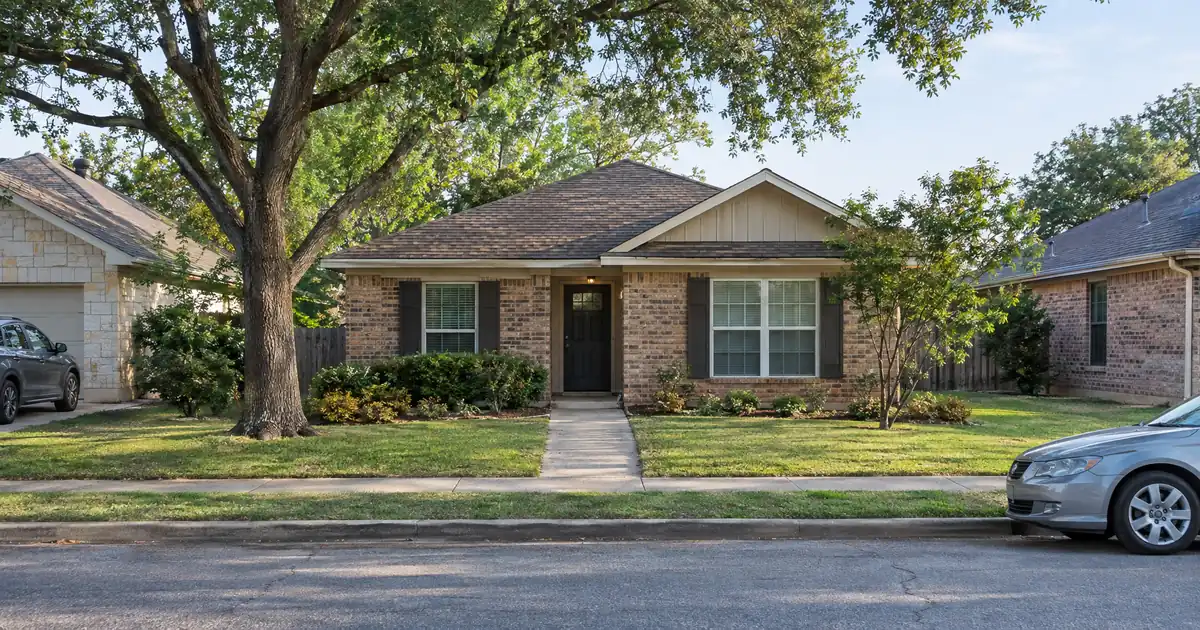
Most investors read Gainesville as a market where equity builds itself, and that’s the mistake. Zillow shows home values up just 0.1% over the past year, while Redfin shows homes averaging 119 days on market versus 88 a year earlier. Anyone planning a cash-out on the assumption that the appraisal will do the heavy lifting is planning around the wrong variable. In this town, the equity you can extract comes from what you paid, what you fixed, and what the rent supports.
The Quick Read: A DSCR cash-out refinance in Gainesville, Texas fits the investor who already owns an entry-priced workforce rental and wants capital for the next deal. It is underwritten primarily on the property’s rental income measured against its full monthly obligation, not on personal income documentation, subject to lender guidelines.
DSCR Cash-Out Calculator
Run the cash-out numbers in Gainesville, TX
Rate source: Freddie Mac 30-yr average via FRED® — Federal Reserve Bank of St. Louis · effective Sep 24, 2026
Prefilled with starting assumptions — enter your property’s value, balance, taxes, and insurance for a more accurate picture.
Program parameters update from Lendmire’s centralized guideline source. Taxes and insurance are editable estimates.
As of Sep 24, 2026 · General Freddie Mac market benchmark, not a Lendmire loan offer. Property value, balance, taxes, and insurance are editable estimates. Maximum loan-to-value varies by lender, program, property type, and seasoning. Not a Loan Estimate, approval, or commitment to lend. Program availability and eligibility are subject to lender guidelines, credit approval, property review, and underwriting.
- The cash-out ceiling is 75% LTV, with roughly six months of seasoning from title recording.
- Redfin‘s median sale price is $260K, but Zillow‘s value index reads $202,669.
- Coverage clears best on homes valued near or under $200K, and thins out near the median.
- New apartment supply is the main risk to older small-investor rentals. These specifics are subject to lender guidelines and a full review of property, leverage, and credit.
Lendmire (NMLS# 2371349) is a DSCR-focused mortgage broker, and it helps arrange DSCR financing for Gainesville, Texas investors through wholesale and investor-lending channels across 41 markets, including Washington, D.C. For the broader statewide picture, see Texas DSCR financing. This piece stays on the equity-extraction side of the ledger: what a Gainesville owner can pull out, what limits it, and where the proceeds should go.
Appreciation Is the Wrong Thesis Here
Gainesville is a cash-flow-led market, and any cash-out plan should be built on that premise. Redfin puts the median sale price at $260K, up 3.9% year over year. Median price per square foot is $147, down 7.8%, and only 46 homes sold in May versus 53 the year before. Those numbers describe a thin, slowing market, not a rising one. County-level Redfin data showed Cooke County prices down 4.0% year over year at last check.
The pricing sources also disagree, and the gap matters more for a refinance than a purchase. Redfin measures actual sale prices. Zillow’s $202,669 is a value index. Other portals publish figures that run well above both. The appraiser is the one who breaks the tie, and with 46 monthly sales the comp pool is small. A single distressed sale or one new-construction closing can drag a valuation around.
The practical read: don’t underwrite a cash-out on expected price growth. Underwrite on the value the appraiser can support today and the rent a tenant is paying today. If the equity is there because you bought below market or renovated, the refinance works. If you’re waiting for the market to hand you equity, wait longer.
What the 75% Cap Does in a Sub-$260K Market
Cash-out refinances on DSCR programs top out at 75% LTV. The purchase-side 80% figure doesn’t carry over, and that gap is the first thing to internalize. On a home appraising near Gainesville’s entry price band, a 25% equity cushion has to remain after the refinance, which trims proceeds more than most owners expect. Equity available depends on rent used for lender review, PITIA, reserves, and that 75% ceiling. It is not a guaranteed cash figure. Terms vary by lender guidelines, property type, leverage, credit profile, and full file review.
The other gates are typical of the program family, subject to lender guidelines and borrower profile:
- Seasoning: about six months of ownership, measured from title recording.
- Coverage: a 1.00 minimum DSCR is the standard benchmark, meaning rent used for lender review against full PITIA.
- Credit: tiers run from 620 up through 660, 680, and 700, with 620 as the floor. Better scores generally buy better leverage and pricing.
- Reserves: roughly six months of PITIA, with about nine months above $1,500,000.
- Loan size: standard programs run up to $3,000,000, and smaller balances route through select lenders in the network. That matters here, because many Gainesville balances will be small.
Property type is a screen worth a sentence, since rural Cooke County has plenty of unconventional stock. Manufactured homes, log homes, and barndominiums fall outside these DSCR programs. If the asset is one of those, this isn’t the product. Investors should also verify current local rental rules, taxes, and insurance with qualified local professionals before committing to a structure. Those items vary by property and sit outside the financing itself.
Run the Numbers Before the Appraiser Does
The coverage math in Gainesville is thinner than the cheap sticker prices suggest. The figures below are modeled assumptions, not sourced market data. They use a standard 30-year fully amortizing structure at 75% LTV, with taxes and insurance folded into full PITIA at Texas averages. Rents come from the research: Zillow Rental Manager shows a median house rent of $1,500 (a dated figure, so treat it as approximate). RentalSource puts county averages at $1,240 for a two-bedroom and $1,684 for a three-bedroom. Exact terms depend on the lender’s guidelines, property type, leverage, and a full review of the borrower’s file.
| Scenario | Appraised value | Modeled rent | Coverage incl. Taxes/insurance |
|---|---|---|---|
| Entry-priced SFR | ~$200K | $1,500 | About 1.1x |
| Median-priced SFR | $260K | $1,500 | Mid-0.8s |
| Median-priced SFR, top rent | $260K | $1,850 | Right around 1.0x |
| Median-list duplex | $450K | Two 2-bd at county avg | Low-0.8s |
Read the table honestly. The entry-priced home clears the benchmark with modest cushion. At the $260K median, a typical Gainesville house rent doesn’t cover full PITIA at 75% LTV. Only the stronger-rent three-bedroom gets to the line. The duplex row is the surprise: Redfin shows seven Cooke County multifamily listings with a $450K median list price, and two average two-bedrooms don’t carry that price. Multi-unit only beats single-family here if you find one priced well under that median. Check listings individually. Every figure here varies by lender and program — guidelines, property type, leverage, and credit profile all apply.
When a scenario lands below 1.00, the file isn’t necessarily dead, but it gets harder. A lender may review a sub-1.00 program, an interest-only structure, or reduced leverage with stronger credit and reserves. Each of those changes the return model, and eligibility depends on lender guidelines, credit approval, and property review.
DSCR files in markets like this one typically look like small-balance, older-stock houses where the rent is credible but the appraisal is the swing factor. The stronger files show a signed lease at or near market rent, an owner who bought or renovated below current value, and reserves that clear the requirement without stress. The weaker ones lean on an appraisal that’s hoped for rather than supported. Brokers who work these files usually get a current rent comp and a realistic value opinion in hand before ordering anything.
Where the Equity Sits (and Where It Doesn’t)
Neighborhood-level price data doesn’t exist for Gainesville in any reliable form. What follows is qualitative, anchored to named places and city-wide figures.
Downtown and the Historic District
Downtown has the strongest case for owners who bought right. The area around the courthouse square has brick-paved streets and older homes, and the Gainesville EDC describes a historic home district with houses built in the late 1800s to early 1900s. Older, smaller homes are the dominant rental product across Gainesville, and asking rents near the core have run roughly $1,095 to $1,995 by unit size per Zillow listings. Tenants are local workers and service-sector renters.
The caution is that old stock invites renovation surprises, and a cash-out only works if the appraisal reflects the work. Owners who renovated with permits and documentation are in far better shape than owners who did cosmetic patches. The equity story here is manufactured by the owner, not delivered by the market.
North Grand Avenue and the Safran Corridor
This corridor is where manufacturing demand meets new supply, and that pairing cuts both ways. Safran Seats has its U.S. headquarters in Gainesville and employs hundreds at its North Grand Avenue facility per the Cooke County Record. The tenant pool is steady: manufacturing and aerospace workers. But the 222-unit NorthPark Apartments sits on the same corridor and is now leasing. A single-family rental within reach of North Grand is competing with a brand-new apartment building for the same worker.
The Hwy 82 and I-35 Corridor
Gainesville has the busiest stretch of Highway 82 in Texas, according to the city manager as reported by KXII, and I-35 is mid-rebuild. TxDOT’s phases are estimated at $210M, $280M, and $187M per Texas Contractor. Rental stock along the corridor is mostly apartments and older houses. Traffic and construction help commercial demand and highway-service employment. They don’t automatically help a rental house’s rent, and construction disruption can hurt occupancy on properties right along the frontage.
East Side, Liberty Pointe, and the Rest
The east side, including Rock Creek Apartments off East Highway 82, is best treated as a multifamily-supply zone, not a single-family rental play. Liberty Pointe, a master-planned community off Helena Street, adds new-construction single-family supply aimed at workforce households. New builds appraise cleanly but usually carry higher basis, and higher basis is exactly what thins DSCR coverage.
Near North Central Texas College, demand comes from students, staff, and dual-credit families. NCTC is a commuter campus, not a dorm-heavy student market. It draws on Cooke, Denton, and Montague counties.
Skip Lake Kiowa for this purpose. It’s a gated lake community that runs second-home and retiree, not workforce rental. Vintage Square and Black Hill Farm skew owner-occupied and family, with no pricing found. Neither belongs in a workforce-rental cash-out thesis.
The 976-Unit Question
New apartment supply is the single biggest risk to a Gainesville cash-out, and it deserves a straight answer. The Cooke County Record reports NorthPark’s 222 units received certificates of occupancy and are now leasing, while the 754-unit Rock Creek Apartments broke ground and was on track to deliver soon after. That is roughly 976 new apartment units in a city of about 18,800 people, per World Population Review. The same reporting counts 1,600+ units in the broader pipeline over a two-to-three-year window. KXII noted a planned development of 946 housing units.
Lease-up concessions from that volume can pressure rents on older small-investor rentals. Not every property, and not on a fixed schedule, but the direction is clear. One aggregator lists a 1% Gainesville rental vacancy rate. That’s a low-grade statistic that likely predates the new supply, so use it as directional only.
Here’s the counter-argument. The EDC describes a plan to add 1,500 new homes tied to 2,500 new jobs around Gateway Industrial Park improvements. If the jobs show up on schedule, absorption could be healthier than the raw unit count suggests. It’s a genuine toss-up, and the honest response is to underwrite at today’s rent with no assumed growth. If the rent comp supports the number without help, the cash-out survives a soft lease-up.
Who’s Actually Renting?
Gainesville’s tenant base is anchored by manufacturing, healthcare, education, and the casino across the Red River. The EDC says 22% of the Cooke County workforce is in manufacturing. Safran Seats, Dura-Line, and Circuit Breaker Sales appear among employers, and no headcounts were published for them. Red River Pet Food is putting a $1.8 million facility in Gateway Industrial Park.
Healthcare adds a second layer. North Texas Medical Center is a 60-bed acute care hospital operated by Community Hospital Corporation and owned by the Gainesville Hospital District. Nurses, techs, and clinic staff are a steady pool. Education adds a third: NCTC enrolled 8,106 students in the most recent year, 2,153 full-time and 5,953 part-time, though that is multi-campus enrollment, not Gainesville alone. WinStar World Casino sits just across the Oklahoma line, and Rock Creek’s developer cited a location roughly 13 miles from it.
The tenants who matter are service-wage and shift-work households. They fit two- and three-bedroom homes at moderate rents, and HUD Fair Market Rent for Cooke County runs $1,192 for a two-bedroom and $1,523 for a three-bedroom per an aggregator citing HUD. Underwrite to the rent band that pool can carry, not to the top listing you saw.
Turning Proceeds Into the Next Deal
The reason to pull equity is to redeploy it, and Gainesville’s price structure tells you where. Entry-priced homes under roughly $200K are where coverage works. A modest cash-out from a well-seasoned rental can fund the reserves and down payment on another one, and the next deal should be sized for coverage, not for headline appeal.
A few practical rules for the sequence:
DSCR vs. conventional financing
Two common ways to finance an investment property in Gainesville, TX. They qualify you differently — here’s how investors weigh them.
Why investors choose it
- Qualifies on the property’s rental income — no personal tax returns, W-2s, or pay stubs needed to document income.
- No personal debt-to-income ceiling to clear, so existing mortgages and obligations don’t cap your borrowing the same way.
- Can be closed in an LLC, keeping the property inside a business entity.
- Built for scaling — not held to the limit on number of financed properties that conventional financing applies.
- Underwriting centers on the deal: generally qualifies when the rent covers the payment, a 1.00x coverage ratio being a common baseline (confirmed in underwriting).
- Designed specifically for investment property, including long-term and, where the program allows, short-term rentals.
Where it’s strong
- Often the lowest ongoing financing cost for a buyer who fully qualifies on personal income — a fit for a first property or a cost-first purchase.
Trade-offs for investors
- Requires full personal income documentation and must fit within a debt-to-income limit — salary, existing debts, and other mortgages all count.
- Typically held in your personal name rather than a business entity.
- Caps how many financed properties you can carry, which can become a ceiling as a portfolio grows.
- Evaluates you as a borrower as much as the property, which usually means more paperwork.
How investors usually choose: a first or single property often optimizes for the lowest financing cost; portfolio builders often optimize for leverage, vesting in an LLC, and scaling past conventional caps. The right answer depends on your goals, the property, and current guidelines — both paths run through select lenders in Lendmire’s wholesale network, with eligibility and terms confirmed in underwriting.
- Treat the six-month seasoning clock as a planning tool. Start the rent comp and value read before the date arrives.
- Keep the next property in the band where the math cleared, not the band the median suggests.
- Hold reserves for both properties. Two loans with thin coverage and thin reserves is how a single vacancy becomes a problem.
While other non-QM platforms add state-specific overlays that shrink usable LTV, the brokerage side of the equation is straightforward here: the 75% ceiling is the ceiling, and the task is to size the file so nothing further erodes it. Investors who want the mechanics can read the guide “What Is a DSCR Loan”, the wider refinance side, and Lendmire’s DSCR cash-out refinance overview. The comparison with conventional financing matters most for owners near financed-property limits. To size a specific file, run the numbers with Lendmire or call 828-256-2183.
Frequently Asked Questions
Can I do a DSCR cash-out on a Gainesville rental I bought recently?
Generally yes, once you’ve held it for about six months from title recording. Seasoning is measured from recording, not from contract or closing conversations. Eligibility still depends on the appraisal, the rent used for lender review, and lender guidelines.
Will the appraisal in Gainesville support a high cash-out?
Don’t count on it. Redfin’s median sale price and Zillow’s value index differ by tens of thousands of dollars, and monthly sales volume is small. Proceeds are limited by the 75% LTV ceiling and by what the appraiser can support with a thin comp pool. Plan on conservative value. Final terms depend on lender guidelines, property type, leverage, and the borrower’s complete credit picture.
Does the new apartment construction hurt my ability to refinance?
It doesn’t change the program rules, but it can change the number. If lease-up concessions pull nearby rents down, rent used for program review falls and coverage can slip below 1.00. A current rent comp before you order the appraisal shows where you stand.
Is a duplex better than a house for cash-out in Gainesville?
Not by default. On county-level figures, the median multifamily listing doesn’t beat single-family on gross rent against price. A duplex priced well below that median can work. One at the median generally won’t.
Can I refinance a small-balance Gainesville loan through this program?
Often yes, though smaller balances route through select lenders in the network. Standard programs go up to $3,000,000, but Gainesville balances will usually sit far below that. Qualification remains subject to lender guidelines, credit, and property review.
The Next 24 Months
Gainesville’s next two years will likely sort owners into two groups. Owners who bought below market and hold well-documented, market-rent leases should be able to refinance cleanly, because their equity is real and their coverage clears without help. Owners who bought near the $260K median at modest rents will find 75% LTV coverage tight, especially while roughly 976 new apartment units finish leasing up. If the EDC’s 1,500-home, 2,500-job plan materializes and the I-35 rebuild keeps moving, absorption should improve and rents on older houses could stabilize by the back half of that window. Until the jobs show up, the safer call is that Gainesville rewards the investor who extracts equity in modest amounts, holds reserves, and buys the next property in the sub-$200K band.
For current guidelines and terms, see Lendmire’s DSCR loan programs page.
About Lendmire
Lendmire, NMLS# 2371349, is a DSCR and non-QM mortgage brokerage with investor loan programs in 41 markets, including Washington, D.C. Lenders commonly review DSCR eligibility around property-level rent rather than personal income documentation, subject to lender guidelines. The brokerage helps arrange financing for LLC-owned portfolios beyond conventional financed-property limits, depending on program guidelines. It is recognized as a 2026 Scotsman Guide Top Workplace and a top-ranked workplace in 2025 in the Top Mortgage Workplace program.
Get Started
Ready to find the right loan for you?
In about 30 seconds you can review financing options available for your investment property. No commitment required.
Informational only. Not a Loan Estimate, approval, or commitment to lend. Program availability and eligibility are subject to lender guidelines, credit approval, property review, and underwriting.
References
1. Zillow Home Values, Gainesville TX
2. Redfin, Gainesville TX Housing Market
3. Redfin data
5. RentalSource
6. Redfin
8. Cooke County Record, Gainesville housing development boom
10. Texas Contractor
11. World Population Review, Gainesville
12. Gainesville EDC, Major Employers
13. Community Hospital Corporation, North Texas Medical Center
14. UnivStats, North Central Texas College enrollment
15. a 2026 Scotsman Guide Top Workplace
16. Scotsman Guide — Top Workplaces 2025
This article is part of Lendmire’s investment property cash-out refinance program — full qualification details, guidelines, and scenarios live on the program page.
Related reading: Cash Out Refinance Investment Property in Gainesville, Texas: Equity in a Supply Wave · DSCR Cash Out Refinance in Gainesville, Florida: Pulling Equity From the UF Rental Core · DSCR Cash Out Refinance in Pflugerville, Texas: Pulling Equity From a Cash-Flow-Led Suburb
Guides: Investment Property Cash-Out Refinance in Texas
Brandon Miller
Founder & CEO, Mortgage Loan Originator, Lendmire LLC
- Mortgage Loan Originator · NMLS# 1129696 · Verify on NMLS Consumer Access
- North Carolina Real Estate Broker · License# 343312 · Verify on NCREC
- North Carolina Insurance Producer · License# 19053198 · Property, Casualty, Life, Health · Verify on NAIC SBS
- Lendmire LLC · Firm NMLS# 2371349 · Verify firm licensure
Required disclosures. Lendmire (NMLS# 2371349) operates as a licensed mortgage broker, not a direct lender or depository. The discussion in this article is general in nature and should not be relied upon as financial, legal, or tax advice — every investment scenario is unique and should be reviewed by a qualified professional. Any loan inquiry is subject to lender underwriting, and this article is not a commitment to lend or a guarantee of approval. Mortgage rates, loan terms, and program guidelines vary by borrower, property, and state, and may change without notice. Equal Housing Opportunity. Verify licensure at NMLS Consumer Access.