
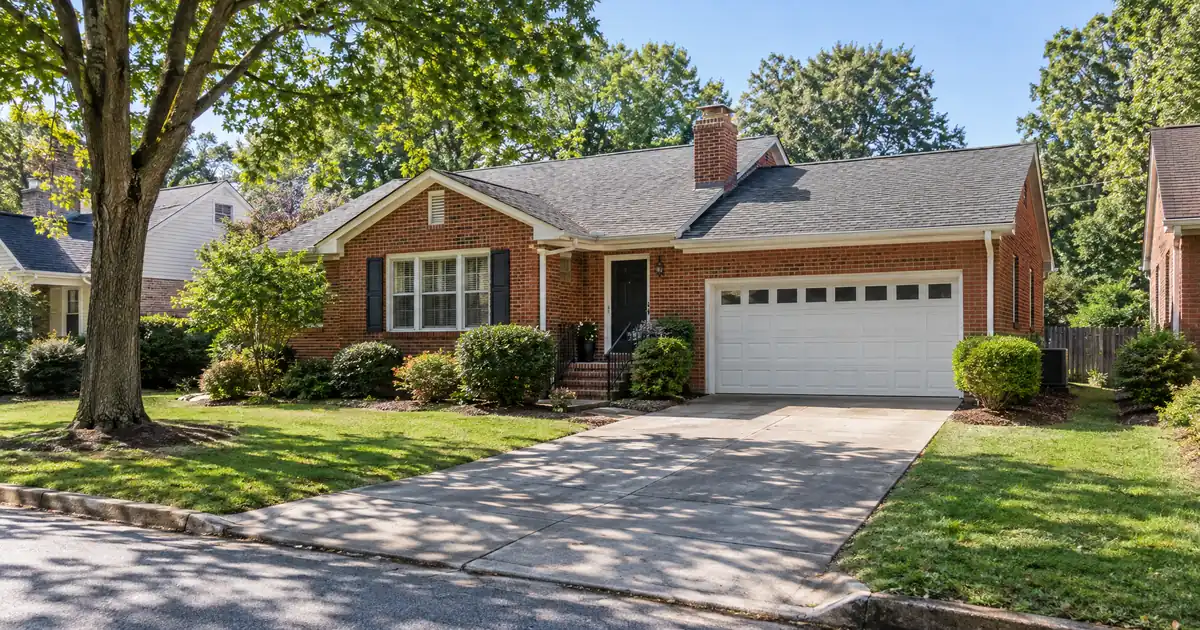
Picture two investors holding the same appraised value in Winston-Salem. One owns a three-bedroom house renting near the $1,695 median house rent that Zumper reports. The other owns a West End-style duplex where two leases stack to about $2,100, the combined rent on one live Redfin listing. Both want to pull equity out through a DSCR cash out refinance in Winston Salem, North Carolina. On the math, the duplex owner is the one who gets cleaner coverage at high leverage. The house owner can still get there, but usually by borrowing less.
The Short Version: A DSCR cash-out refinance in Winston Salem, North Carolina is underwritten primarily on the property’s rental income measured against its full monthly obligation, so the rent has to carry taxes, insurance and debt service before any equity is released, subject to lender guidelines.
DSCR Cash-Out Calculator
Run the cash-out numbers in Winston Salem, NC
Rate source: Freddie Mac 30-yr average via FRED® — Federal Reserve Bank of St. Louis · effective Sep 24, 2026
Prefilled with starting assumptions — enter your property’s value, balance, taxes, and insurance for a more accurate picture.
Program parameters update from Lendmire’s centralized guideline source. Taxes and insurance are editable estimates.
As of Sep 24, 2026 · General Freddie Mac market benchmark, not a Lendmire loan offer. Property value, balance, taxes, and insurance are editable estimates. Maximum loan-to-value varies by lender, program, property type, and seasoning. Not a Loan Estimate, approval, or commitment to lend. Program availability and eligibility are subject to lender guidelines, credit approval, property review, and underwriting.
- Cash-out tops out at 75 percent LTV, after roughly six months of ownership from title recording.
- The median sold price is $322,900 per Movoto, but other sources run lower. Size proceeds conservatively.
- Duplexes near the hospital corridor stack rent better than single-family at high leverage.
- Homes averaged 64 days on market versus 48 a year earlier, so appraisals deserve caution.
Lendmire (NMLS# 2371349) helps arrange DSCR financing for Winston Salem, North Carolina investors as part of a broader non-QM footprint reaching 41 markets, including D.C. It is a mortgage broker, not a lender. Wholesale lenders review each file, and the broker’s job is to structure it cleanly and place it. This article assumes the purchase is done. The question is how much equity the property can release, what the rent supports, and where the proceeds go next.
Winston Salem Market Snapshot
A quick read on the Winston Salem investor landscape — figures come from the cited sources below. Confirm current property-level numbers before underwriting.
| Metric | Detail |
|---|---|
| University enrollment | 9,633 total (Wake Forest University) |
| Employment | 19,220+ employees (Atrium Health Wake Forest) |
| Vacancy | 7.4% vs 7.7% national (Greater Winston-Salem, Inc.) |
What the Appraisal Actually Sets
The appraisal sets the proceeds, not the headline median. Winston-Salem’s medians disagree by tens of thousands of dollars depending on source, so sizing cash-out on the most flattering figure is the classic way to build a plan on paper equity.
Movoto reports a median sold price of $322,900, with 1,635 homes sold versus 1,276 a year earlier (Movoto). Redfin shows a lower $280,500 median from an earlier month, up 8.1 percent year over year, with price per square foot at $162. That is a different methodology and a different window, not a contradiction. This article uses the Movoto figure as its reference median and treats the Redfin number as the conservative floor.
The same Movoto data shows days on market stretching from 48 to 64. Prices are still climbing, but the market is loosening. For a cash-out borrower, that argues for a conservative value assumption. Say you bought a rental a year ago and expect the appraisal to land at the city median. If it comes in at the lower end of the range, the 75 percent ceiling produces a materially smaller proceeds figure. Plan for the lower one. If the higher number shows up, that’s a bonus.
Two other program points matter here. Most files need about six months of ownership measured from title recording, and reserves typically run around six months of PITIA, on most files and subject to lender guidelines. Neither is exotic. Both trip up investors who forget the clock starts at recording, not at contract.
Ardmore and the Hospital Corridor
Ardmore is the strongest cash-out submarket in the city for an investor who wants tenant depth over sheer yield. It sits adjacent to downtown and between the city’s two major hospitals, per Atwell Ford, and it is the city’s largest historic district with over 4,000 homes, mostly bungalows, Colonial Revival and Foursquare houses.
The tenant story is employment. Atrium Health Wake Forest Baptist is the county’s largest employer at 18,570 people in an earlier employer roundup, with Novant Health at 11,010, according to 6AM City. The Atrium flagship is an 885-bed tertiary-care hospital with more than 2,700 physicians per its company profile. A local property manager describes Ardmore demand as fueled by medical and tech professionals plus Wake Forest students and faculty. Data USA backs the sector mix: 22,037 residents work in health care and social assistance, 13,406 in manufacturing and 11,852 in educational services.
Rent momentum points the same direction. Zumper shows Ardmore average rent up 6.76 percent year over year, while citywide rents are roughly flat. A Redfin snapshot from an earlier period lists an Ardmore median rent of $1,347, but treat that as dated context.
Here’s the catch. The research turned up no reliable Ardmore median sale price. Rent growth is real, but the equity side of the cash-out equation, the appraisal, has to be earned with actual comps. A neighborhood with strong rent trends and no price data is a reason to order the appraisal early in the planning process, not a reason to assume the number.
West End and the Small-Duplex Math
West End is where the stacked-lease argument gets concrete. Redfin’s earlier snapshot lists West End at a $995 median rent, and Zumper places it among the more affordable pockets. Low per-unit rent looks like a weakness until you count doors.
The West End duplex example combines a 2BR/1BA upper unit at $1,200 with a 1BR/1BA lower unit at $900, or $2,100 together. A separate duplex listing from Greenhaven Realty shows units leased at $1,000 and $950, about $1,950 combined. Both are single listings, so they work as anecdotal comps and not market averages. Still, two leases on one asset routinely beat one lease at the median house rent.
The historic core also carries small-footprint product. Live listings in West Salem show a duplex built as two independent 1BR/1BA units, each with its own kitchen and laundry, per Redfin’s Forsyth County multifamily page. Those listings carry no rent figures, so the investor still has to supply comps.
Running the Coverage Numbers
Run the numbers on a modeled $300,000 appraised value. These are modeled assumptions, not sourced market data. The rents come from the sources above, and coverage is rent divided by full PITIA including taxes and insurance:
| Modeled scenario | LTV | Coverage incl. Taxes and insurance |
|---|---|---|
| Single-family at $1,695 rent | 75 percent | Mid-0.9s |
| Single-family at $1,695 rent | 65 percent | About 1.05 |
| Duplex at $2,100 combined | 75 percent | About 1.15 |
| Duplex at $1,950 combined | 75 percent | About 1.05 |
The pattern matters more than the decimals. At full 75 percent leverage, a median-rent house lands under the 1.00 benchmark. The same appraised value in a duplex clears it with some cushion. Pull the house down to roughly 65 percent LTV and it crosses 1.00 as well.
Most standard DSCR programs are built around a 1.00 benchmark because rent covers the obligation at that level. Some lenders review lower ratios, but usually with lower leverage, stronger credit, more reserves or different pricing, and eligibility depends on lender guidelines, credit profile and property review.
What’s the Catch on a Sub-1.00 House?
The house below 1.00 isn’t dead, but it forces a choice. A sub-1.00 program, an interest-only structure or a lower LTV could each be reviewed by a lender. None is guaranteed, and each carries a cost in proceeds, pricing or credit requirements.
The question worth asking first is whether the sub-1.00 route should be used at all. If the property has a real appreciation story, say an Ardmore bungalow where rents are climbing, accepting thinner coverage can be defensible. If the investor is stretching because the rent doesn’t support the balance, the cleaner answer is to take less cash out. Honestly, the lower-leverage refinance on the house often beats the aggressive one. You keep the coverage and the loan stays refinanceable, and you give up some proceeds. Whether that trade is worth it depends on what the cash does next.
Credit is the other lever. Typical tiers run 620, 660, 680 and 700, with 620 as the floor, and better credit generally supports better leverage and terms, subject to program guidelines. Balances up to $3,000,000 fit standard programs. Smaller balances route through select lenders in the network.
Where the Proceeds Go
Proceeds only make sense if the next asset pencils better than the one being refinanced. That’s the whole test. A cash-out that funds a second Ardmore-area duplex, where coverage clears with room to spare, is a straightforward equity-recycling story. A cash-out that funds a purchase in a market where the rent-to-debt ratio doesn’t work is a different decision, and one worth stress-testing before committing.
Rents give a rough gauge. Dividing Zumper’s $1,695 house median by Movoto’s $322,900 median price gives about 0.52 percent a month on a gross basis, and about 0.60 percent against Redfin’s lower median. That is my own illustrative arithmetic, before taxes, insurance and reserves, not a published figure. What it says is that single-family in this city is a slim-margin coverage play. Small multifamily is where the ratio widens, which is the reason a Winston-Salem investor pulling cash from a single-family rental often reinvests into two-to-four unit product.
Room-by-room rentals deserve a caution. One late-1800s house near downtown is listed as rented by the room, but the upside is seller-projected. A lender accepts what is in place, so underwrite to the current lease figure only and confirm the lender accepts by-the-room leases at all.
Ownership structure matters for these files. Investors holding through an LLC can often refinance in the entity’s name, subject to lender program eligibility. The cleanest file from a documentation standpoint has complete leases, entity docs, title and property details ready for lender review. In markets like this one, where rents sit in a narrow band and the appraisal spread is wide, the friction point is usually value, not paperwork. Files stall when the borrower’s number and the appraiser’s number disagree by a wide margin. Lenders and brokers see this pattern over and over in mid-priced Southeastern markets.
Investors who want the mechanics can read the cash-out refinance details and compare them against the investment property refinance options. For a first-time look at “What Is a DSCR Loan”, the cash-out refinance page covers the fundamentals without local detail. And if a W-2 borrower with one rental is weighing this against a bank loan, the guide “Where DSCR and Conventional Diverge” explains that the choice against conventional financing depends on entity structure and portfolio count more than on any single deal.
Supply Is the Risk to Watch
New apartment supply is the honest downside. The Greater Winston-Salem chamber reported 1,320 units delivered over a one-year span, with vacancy at 7.4 percent, still below the national 7.7 percent. That is older data and covers large complexes, not small landlords, but big-building concessions compete with small-landlord rents.
The forward-looking piece is thinner. A broker blog says a proposed pipeline includes 588 market-rate units, a 336-unit townhome rental project and a 252-unit apartment project near Salem Lake. It is not yet approved, and first units would not arrive for a couple of years at least. Treat it as a watch item, not a certainty. But if you’re planning to refinance a rental near that corridor, run vacancy conservatively, and the older, supply-constrained neighborhoods closer to the core look safer.
The renter base itself is steady. RentCafe counts 59,554 renter-occupied households, about 35 percent of the city, against 65 percent owner-occupied. Its average apartment rent of $1,288 is up 0.46 percent, though that dataset covers 50-plus-unit buildings only and is not a single-family comp. Zumper shows a 1 percent citywide decline. Flat rents mean the coverage story has to come from choosing the right property type and leverage, not from waiting for rent growth to fix a thin file.
Universities and the Innovation Quarter
Two demand anchors sit close to the historic core. Wake Forest University reports 9,633 total enrolled students, 5,595 of them undergraduates, and US News reports 22 percent live off campus. The Wake Forest Innovation Quarter covers about 200 acres and is projected to reach up to 5 million square feet of lab, office and mixed-use space. Downtown’s median rent in the earlier Redfin snapshot was $950, likely apartment-driven, so the Innovation Quarter is a demand signal for nearby small multifamily, not a rent comp.
Investors should verify current local rental rules, taxes and insurance with qualified local professionals. Beyond that, the financing question stays simple: does the rent carry the full obligation at the leverage chosen?
For investors who want a state-level view across markets, Lendmire maintains a page on DSCR loan options for North Carolina investors. When a specific file is ready, they can request a quote or call 828-256-2183.
DSCR vs. conventional financing
Two common ways to finance an investment property in Winston Salem, NC. They qualify you differently — here’s how investors weigh them.
Why investors choose it
- Qualifies on the property’s rental income — no personal tax returns, W-2s, or pay stubs needed to document income.
- No personal debt-to-income ceiling to clear, so existing mortgages and obligations don’t cap your borrowing the same way.
- Can be closed in an LLC, keeping the property inside a business entity.
- Built for scaling — not held to the limit on number of financed properties that conventional financing applies.
- Underwriting centers on the deal: generally qualifies when the rent covers the payment, a 1.00x coverage ratio being a common baseline (confirmed in underwriting).
- Designed specifically for investment property, including long-term and, where the program allows, short-term rentals.
Where it’s strong
- Often the lowest ongoing financing cost for a buyer who fully qualifies on personal income — a fit for a first property or a cost-first purchase.
Trade-offs for investors
- Requires full personal income documentation and must fit within a debt-to-income limit — salary, existing debts, and other mortgages all count.
- Typically held in your personal name rather than a business entity.
- Caps how many financed properties you can carry, which can become a ceiling as a portfolio grows.
- Evaluates you as a borrower as much as the property, which usually means more paperwork.
How investors usually choose: a first or single property often optimizes for the lowest financing cost; portfolio builders often optimize for leverage, vesting in an LLC, and scaling past conventional caps. The right answer depends on your goals, the property, and current guidelines — both paths run through select lenders in Lendmire’s wholesale network, with eligibility and terms confirmed in underwriting.
Frequently Asked Questions
How much equity can I pull from a Winston-Salem rental?
Up to 75 percent of the appraised value, minus the existing balance, and only if the rent covers the new loan’s full PITIA at the 1.00 benchmark or better. Reserves of roughly six months also apply. Given the spread between the Movoto and Redfin medians, size the plan on a conservative appraisal.
Does a duplex in West End or Ardmore cash-flow better than a house?
On modeled numbers, usually yes at high leverage. Two leases near $2,100 combined outpace a single median-rent house, and the duplex clears 1.00 at 75 percent LTV where the house typically does not. The catch is that the duplex rents come from single listings, so confirm them with actual comps.
Does the hospital corridor make Ardmore safer than other neighborhoods?
It makes tenant demand deeper, not the equity guaranteed. Atrium Health Wake Forest Baptist and Novant Health together employ tens of thousands, and Ardmore sits between their campuses. But no reliable Ardmore sale-price median turned up, so the appraisal still has to prove the value.
Can I refinance a property I bought less than six months ago?
Generally not for cash-out. Programs typically look for about six months of ownership measured from title recording. Investors who hold for less time sometimes explore alternatives, though those usually cost proceeds, and qualification is subject to lender guidelines.
Should new apartment supply change my leverage choice?
It should change your vacancy assumption more than your loan type. Large-complex deliveries have pushed multifamily vacancy to 7.4 percent citywide, and proposed projects near Salem Lake could add more. A lower LTV leaves room to absorb a slow lease-up.
Winston-Salem Against Greensboro
Greensboro is the more logistics-driven neighbor, and its rents run higher on lender-marketing comparisons. Right now the math still favors Winston-Salem for the investor recycling equity, because a hospital-anchored historic core full of small duplexes gives a stack-the-leases strategy that a logistics-and-warehouse tenant base simply doesn’t offer.
About Lendmire
Lendmire, NMLS# 2371349, is a mortgage brokerage specializing in DSCR investor loans. It helps arrange financing across 41 markets, including Washington, D.C., through wholesale and investor-lending channels. The model centers on property-level rental income reviewed by the lender rather than W-2 documentation, subject to lender guidelines, which suits entity-owned and multi-property investors. Lendmire is recognized as a 2026 Scotsman Guide Top Mortgage Workplace and a 2025 Scotsman Guide Top Mortgage Workplace. More detail is available through Lendmire’s industry announcements.
Get Started
Ready to find the right loan for you?
In about 30 seconds you can review financing options available for your investment property. No commitment required.
Informational only. Not a Loan Estimate, approval, or commitment to lend. Program availability and eligibility are subject to lender guidelines, credit approval, property review, and underwriting.
References
1. Zumper
2. Redfin — Ardmore New Listings
3. Movoto
6. Greater Winston-Salem chamber
7. Redfin
8. Atwell Ford
9. 6AM City
10. LinkedIn — Atrium Health Wake Forest Baptist
11. winstonsalempropertymanagement.com — Neighborhoods and Regions Served Ardmore Property Management
12. Data USA
13. Zumper
14. Redfin
16. Redfin’s Forsyth County multifamily page
17. homesintriadnc.com — Forsyth 611 New Homes Winston Salem Kernersville 2026
18. RentCafe
19. Wake Forest Innovation Quarter
20. a 2026 Scotsman Guide Top Mortgage Workplace
21. a 2025 Scotsman Guide Top Mortgage Workplace
This article is part of Lendmire’s investment property cash-out refinance program — full qualification details, guidelines, and scenarios live on the program page.
Related reading: DSCR Loans in Greensboro / Winston-Salem, North Carolina: Investor Financing for Fisher Park, Ardmore, and College Hill — Piedmont Triad Cash Flow, University Rental Demand, and Affordable Southeast Growth · Cash Out Refinance Investment Property Salem Massachusetts · DSCR Cash Out Refinance in Apex, North Carolina: The 2026 DSCR Financing Guide to Downtown Apex
Guides: Investment Property Cash-Out Refinance in North Carolina
Brandon Miller
Founder & CEO, Mortgage Loan Originator, Lendmire LLC
- Mortgage Loan Originator · NMLS# 1129696 · Verify on NMLS Consumer Access
- North Carolina Real Estate Broker · License# 343312 · Verify on NCREC
- North Carolina Insurance Producer · License# 19053198 · Property, Casualty, Life, Health · Verify on NAIC SBS
- Lendmire LLC · Firm NMLS# 2371349 · Verify firm licensure
Disclosure information. Lendmire is a state-licensed mortgage brokerage under NMLS# 2371349. Lendmire is not a depository institution, direct lender, or financial advisor — all loans referenced are placed through wholesale lender partners and are subject to each lender's underwriting standards. This article is provided for general informational purposes and is not a commitment to lend, nor does it constitute financial, legal, or tax advice. Loan programs, terms, rates, and qualification standards change without notice and depend on borrower profile, property type, and the state in which the subject property is located. Equal Housing Opportunity provider. NMLS Consumer Access: nmlsconsumeraccess.org.