
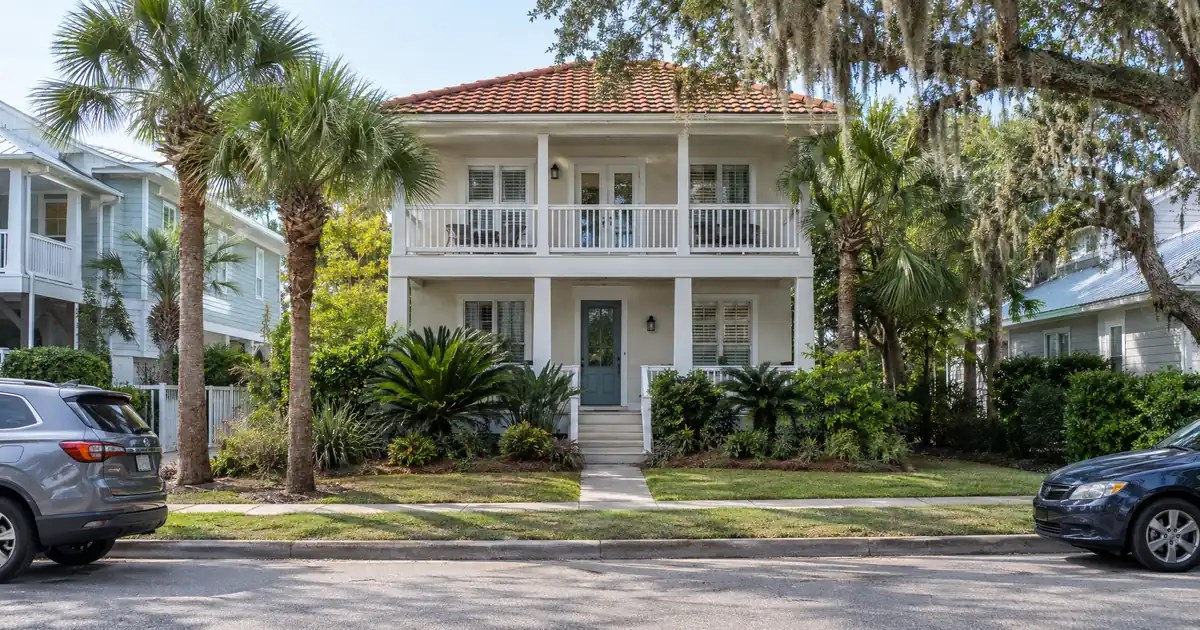
Can an investor actually pull cash out of a Panama City Beach rental, or does the math fall apart before the file even reaches a lender’s desk? It depends entirely on which submarket the property sits in and whether the rent roll is tourist-driven or a 12-month lease. Beach-strip condos financed as short-term rentals face a 20% rent haircut on top of a reduced 70% LTV ceiling, while inland Bay County multi-unit product built on stable workforce rent often clears coverage with room to spare.
The Quick Read: A Panama City Beach cash-out file is underwritten primarily on the property’s documented rental income measured against its full monthly payment obligation, with cash-out leverage capped at the standard 75% LTV (70% on short-term-rental files) — Florida carries no statewide overlay (Redfin). Final terms depend on lender guidelines, property type, leverage, and the borrower’s complete credit picture.
DSCR Cash-Out Calculator
Run the cash-out numbers in Panama City Beach, FL
Rate source: Freddie Mac 30-yr average via FRED® — Federal Reserve Bank of St. Louis · effective Sep 17, 2026
Prefilled with starting assumptions — enter your property’s value, balance, taxes, and insurance for a more accurate picture.
Program parameters update from Lendmire’s centralized guideline source. Taxes and insurance are editable estimates.
As of Sep 17, 2026 · General Freddie Mac market benchmark, not a Lendmire loan offer. Property value, balance, taxes, and insurance are editable estimates. Maximum loan-to-value varies by lender, program, property type, and seasoning. Not a Loan Estimate, approval, or commitment to lend. Program availability and eligibility are subject to lender guidelines, credit approval, property review, and underwriting.
- Florida cash-out refinances cap at 75% LTV — the standard ceiling, with no lender geographic overlay.
- Beach-zone STR files apply a 20% haircut to gross rents before calculating coverage.
- Inland Panama City multi-family carries a $339K median listing price versus far higher beach-corridor pricing.
- Six months of seasoning from title recording is generally required before cash-out proceeds are considered.
- Cove Pointe area rents run around $2,451/month against a $427,262 median price — tight but workable long-term coverage.
Panama City Beach Market Snapshot
A quick read on the Panama City Beach investor landscape — figures come from the cited sources below. Confirm current property-level numbers before underwriting.
| Metric | Detail |
|---|---|
| Home prices | $384K median (Redfin) |
| Typical rents | $1,671 avg (RentCafe) |
| University enrollment | 12,600+ students (Gulf Coast State College) |
| Population | 18,971 population (Census Reporter) |
| Employment | 1,100 employees (Bay County Chamber of Commerce) |
The Strongest Cash-Out Play Isn’t at the Beach
The best coverage math in this market sits inland, not on Front Beach Road. Panama City proper shows a multi-family median listing price of $339,000 against apartment rents averaging $1,529, with two-bedroom units running around $1,507 and three-bedroom units near $1,903 (Redfin Panama City multi-family data). That combination — lower per-door acquisition cost paired with non-seasonal workforce rent — is what makes duplex and triplex stacking the cleanest cash-out candidate in Bay County.
Run the numbers on a duplex acquired near that median price, with two 2-bedroom units renting near $1,507 each for combined monthly rent of roughly $3,014. Using a modeled 30-year payment at a qualitatively elevated rate environment, plus Florida-typical property tax and insurance carrying costs factored in qualitatively, the full monthly obligation lands well below that combined rent figure. Divide the rent by that obligation and coverage comes out comfortably above a 1.00 floor that some programs use as a minimum threshold, subject to lender guidelines and property review. A file with that kind of coverage cushion tends to move through underwriting with fewer conditions.
Proximity matters here too. Callaway, the Bay County submarket closest to Tyndall’s back gate, shows average rent across all bedroom counts of $1,800 — 11% below the national average — while listings in the area are explicitly marketed to commuters working at Tyndall Air Force Base and Naval Support Activity Panama City (Zillow Rental Manager Callaway). NSA Panama City hosts the Naval Surface Warfare Center, the Center for Explosive Ordnance Disposal & Diving, and a Coast Guard station — a second federal anchor separate from Tyndall that most PCB investor content overlooks entirely (Naval Support Activity Panama City). Two military installations generating a durable, dual-base tenant pool is a demand driver that doesn’t rise and fall with tourist season.
Cove Pointe: Better Rent, Tighter Math
Not every inland submarket clears coverage as easily. In Cove Pointe, the bayfront neighborhood just off downtown Panama City, the median real estate price runs $427,262 with average rent around $2,451 (NeighborhoodScout). That’s a stronger rent figure in absolute terms than Callaway, but the price basis is higher too. Modeling a full monthly obligation on that price — 30-year principal and interest plus Florida-typical tax and insurance load — lands somewhere near $2,550 to $2,600, which puts the rent-to-payment ratio just under 1.00x on straight long-term lease income alone.
That’s not a disqualifying number, but it’s a scenario where a sub-1.00 program, an interest-only restructure, or additional reserves become part of the conversation rather than an afterthought. Investors sitting on equity in a Cove Pointe-type property should expect the lender to look harder at the file, and the primer on how DSCR loans work is a useful starting point before assuming a straightforward approval.
Here’s the tension worth naming directly: Cove Pointe and similar bayfront pockets deliver stronger appreciation potential than Callaway’s workforce rentals, but Callaway’s cash-flow coverage is the more reliable DSCR story today. An investor optimizing for refinance-ready coverage ratios might prefer the duller, cheaper submarket. An investor optimizing for long-term equity growth might tolerate the tighter number at Cove Pointe. Both are legitimate strategies — they just point at different neighborhoods.
What the Beach Strip Actually Looks Like on a Cash-Out File
Skip the assumption that beachfront PCB product behaves like a normal long-term rental. It doesn’t. Entire-home listings make up 99.1% of the roughly 10,141 active short-term rentals in Panama City Beach, with condos the dominant property type at 71.8% and houses at 26.9% (AirROI). That means most beach-corridor comps a lender will see are vacation-rate data, not 12-month leases.
For a property financed as an STR, gross rents get reduced 20% before the coverage ratio gets calculated — a meaningful haircut, but PCB’s peak-season performance often absorbs it. AirDNA reports average occupancy near 57%, an average daily rate around $341, and average monthly revenue near $36,419 across the market (AirDNA) — figures that are proprietary estimates and should be read directionally, but they illustrate why many beach vacation rentals still clear 1.00x even after the reduction.
The trade-off shows up in real listings. A duplex a block from the beach in zip code 32408 recently sold with long-term rents totaling a combined $33,000 a year, a fraction of what the same unit could plausibly generate on the short-term market (Redfin zip 32408 sold listings). That price-to-income gap is the entire decision an owner has to make before requesting a cash-out quote: lease it long-term and underwrite it on the standard DSCR program, or structure it as STR-DSCR and accept the rent haircut in exchange for a materially higher gross number.
| Factor | Beach-Strip STR-DSCR | Inland Multi-Unit LTR-DSCR |
|---|---|---|
| Rent basis | Gross STR revenue, minus 20% haircut | 12-month lease, no haircut |
| Cash-out LTV cap | 70% (short-term-rental limit) | 75% (standard limit) |
| Typical coverage | Often 1.00x+ in peak season | 1.30x–1.50x on multi-unit product |
| Price basis | PCB multi-family up to $3.81M, median SFH $489,000 | PC multi-family median $339,000 |
| Risk factor | Seasonality, occupancy swings | Slower appreciation, steadier rent |
Lynn Haven: The Cash-Flow-First Suburb
Lynn Haven doesn’t get the appreciation headlines PCB does, and that’s the point. Two-bedroom apartments average $1,372, with one-bedroom units around $1,189 — both below Florida’s statewide average of $1,691 (ApartmentFinder Lynn Haven). That’s a lower ceiling on rent growth, but it also means acquisition prices tend to track lower, which keeps the debt-to-rent relationship favorable on a straight lease basis.
An investor pulling equity out of a Lynn Haven rental to fund a second acquisition should expect a modest cash-out number relative to a Cove Pointe or beach-strip property — the 75% LTV cap applies statewide regardless of submarket — but the file itself tends to be simpler because there’s no STR income to document or haircut to apply. These specifics are subject to lender guidelines and a full review of property, leverage, and credit.
The Seasoning Clock and What Actually Slows a File Down
Here’s the part that catches investors off guard. Cash-out proceeds generally aren’t available until roughly six months of ownership have passed, measured from the title recording date — not the closing date on the purchase, and not the date renovations wrapped. If a Panama City Beach investor bought a property, spent four months on updates, and wants to refinance the moment a tenant signs a lease, the math on timing usually doesn’t work yet.
The documentation friction shows up in a few predictable places on files from markets shaped like this one. The cleanest submissions come in with a signed lease already in place rather than a market-rent estimate, current insurance binder information ready for the appraisal review, and — for STR files — trailing revenue reports pulled straight from the booking platform rather than a seller’s self-reported average. The common friction point on Gulf Coast files specifically is flood zone documentation: with 43% of Panama City Beach properties carrying elevated flood risk over a 30-year horizon according to Redfin and First Street data, the appraisal and insurance pieces of the file often take more back-and-forth than the income analysis itself.
None of that changes the coverage math directly, but it changes how long the file sits in review before the number gets confirmed. Investors weighing pulling equity with a DSCR cash-out in this market should have the lease, insurance, and — if applicable — STR revenue documentation organized before submitting rather than assembling it reactively.
Reserve requirements sit around six months of PITIA on most standard files, stretching to roughly nine months above the $1,500,000 loan-amount range — a detail that matters more in Panama City Beach than in a typical inland market given how much beach-corridor multi-family product prices above $1,000,000.
Two Anchors Beyond the Beach
Panama City Beach’s identity is tourism, but the surrounding metro’s tenant base is broader than that. Tyndall Air Force Base is mid-rebuild on what’s described as a $5 billion “Installation of the Future” project spanning 12 construction zones and more than 120 facilities (Simple Flying) — a multi-year construction and permanent-staffing pipeline that generates rental demand independent of beach season. On the education side, Gulf Coast State College enrolled more than 12,600 students last school year, with 86% coming from Bay, Gulf, or Franklin counties, while Florida State University Panama City separately serves more than 4,000 students across 20 bachelor’s and nine graduate programs. A combined student population above 16,000, concentrated in Panama City proper rather than the beach strip, supports 1- and 2-bedroom long-term rental demand that has nothing to do with tourism cycles.
Add HCA Florida Gulf Coast Hospital, a 238-bed facility with roughly 1,100 employees, and Ascension Sacred Heart Bay, a Medicare-certified hospital recognized among the top 15 health systems nationally by Fortune and PINC AI, and Bay County’s employment base looks considerably more diversified than a single-industry beach economy.
What DSCR Actually Compares Against Here
A DSCR cash-out refinance is underwritten on the property’s rent against its full monthly obligation rather than the owner’s personal income documentation. See the guide “Where DSCR and Conventional Diverge”: the difference is between qualifying on a lease and qualifying on traditional personal-income documentation. For LLC-titled properties, eligibility runs subject to program guidelines, and both credit profile and reserve depth factor into how far the leverage stretches within the 75% ceiling.
Frequently Asked Questions
Does a Florida LTV overlay apply to every property in Panama City Beach, or just the beach strip?
No state overlay applies, so a Lynn Haven duplex faces the same 75% cash-out ceiling as a Front Beach Road condo. The standard program limit is the same across Florida and every other state; it is not a beach-specific rule. Terms vary by lender guidelines, property type, leverage, credit profile, and full file review.
Can a beach condo qualify for cash-out using short-term rental income instead of a 12-month lease?
Many lenders will review STR income for coverage purposes, typically applying a 20% reduction to gross rents before calculating the ratio. Given PCB’s average daily rate near $341 and occupancy near 57% per AirDNA data, many vacation rentals still clear a workable coverage ratio even after that haircut, though eligibility review depends on lender review and property documentation.
DSCR vs. conventional financing
Two common ways to finance an investment property in Panama City Beach, FL. They qualify you differently — here’s how investors weigh them.
Why investors choose it
- Qualifies on the property’s rental income — no personal tax returns, W-2s, or pay stubs needed to document income.
- No personal debt-to-income ceiling to clear, so existing mortgages and obligations don’t cap your borrowing the same way.
- Can be closed in an LLC, keeping the property inside a business entity.
- Built for scaling — not held to the limit on number of financed properties that conventional financing applies.
- Underwriting centers on the deal: generally qualifies when the rent covers the payment, a 1.00x coverage ratio being a common baseline (confirmed in underwriting).
- Designed specifically for investment property, including long-term and, where the program allows, short-term rentals.
Where it’s strong
- Often the lowest ongoing financing cost for a buyer who fully qualifies on personal income — a fit for a first property or a cost-first purchase.
Trade-offs for investors
- Requires full personal income documentation and must fit within a debt-to-income limit — salary, existing debts, and other mortgages all count.
- Typically held in your personal name rather than a business entity.
- Caps how many financed properties you can carry, which can become a ceiling as a portfolio grows.
- Evaluates you as a borrower as much as the property, which usually means more paperwork.
How investors usually choose: a first or single property often optimizes for the lowest financing cost; portfolio builders often optimize for leverage, vesting in an LLC, and scaling past conventional caps. The right answer depends on your goals, the property, and current guidelines — both paths run through select lenders in Lendmire’s wholesale network, with eligibility and terms confirmed in underwriting.
Why would an investor choose a duplex in Panama City over a condo in Panama City Beach for a cash-out refinance?
The rent-to-price relationship is simply stronger inland. Panama City multi-family product carries a median listing price around $339,000 against workforce rents that don’t depend on tourist season, which tends to produce a higher coverage ratio than beach-corridor product priced up to several million dollars.
How does flood risk affect a Panama City Beach cash-out file?
It doesn’t change the DSCR calculation directly, but it slows the file down. With 43% of area properties carrying elevated flood risk over a 30-year horizon, insurance documentation and appraisal review tend to take longer here than in a comparable inland market, so getting binder information ready early helps.
Is six months of ownership always enough to refinance a Panama City Beach rental?
Six months from title recording is the general seasoning benchmark, but a lender may still want to see a signed lease or, for STR properties, several months of platform-reported revenue before treating the rent as reliable. A property still mid-renovation at the six-month mark may need more time regardless of the seasoning clock.
For current guidelines and terms, see Lendmire’s DSCR loan programs page.
About Lendmire
Lendmire (NMLS# 2371349) is a DSCR-focused mortgage broker that places investor financing across 41 markets — 40 states plus Washington, D.C. Eligibility for DSCR loans is generally reviewed by the lender based on the property’s rental cash flow rather than the borrower’s traditional personal-income documentation, subject to lender guidelines. Scotsman Guide named Lendmire a Top Mortgage Workplace in both 2025 and 2026.
For broader investor-financing rules and property-type coverage across the state, see Florida DSCR loans.
Get Started
Ready to find the right loan for you?
In about 30 seconds you can review financing options available for your investment property. No commitment required.
Informational only. Not a Loan Estimate, approval, or commitment to lend. Program availability and eligibility are subject to lender guidelines, credit approval, property review, and underwriting.
References
1. Redfin — Panama City Beach Housing Market
2. RentCafe
5. Bay County Chamber of Commerce — Health
6. Redfin Panama City multi-family data
7. Zillow Rental Manager — Callaway
8. Naval Support Activity Panama City
9. NeighborhoodScout — Cove Pointe/Cove Terrace
10. AirROI — Panama City Beach STR Report
11. AirDNA — Panama City Beach STR Overview
12. Redfin zip 32408 sold listings
13. ApartmentFinder — Lynn Haven
14. Simple Flying — Tyndall Air Force Base Rebuild
15. Scotsman Guide — Top Workplaces 2025
16. a 2026 Scotsman Guide Top Mortgage Workplace
This article is part of Lendmire’s investment property cash-out refinance program — full qualification details, guidelines, and scenarios live on the program page.
Related reading: DSCR Cash Out Refinance Panama City Beach Florida: How Investors Access Coastal Equity Without Income Docs · Investment Property Loans in Panama City Beach, FL: Where Duplex Math Beats Condo Math · DSCR Loans Destin & Panama City Beach: Investor Financing for Emerald Coast Beach Rentals, 30A, Miramar Beach & Real Estate Investors
Guides: Investment Property Cash-Out Refinance in Panama City Beach, FL · Investment Property Cash-Out Refinance in Florida
Brandon Miller
Founder & CEO, Mortgage Loan Originator, Lendmire LLC
- Mortgage Loan Originator · NMLS# 1129696 · Verify on NMLS Consumer Access
- North Carolina Real Estate Broker · License# 343312 · Verify on NCREC
- North Carolina Insurance Producer · License# 19053198 · Property, Casualty, Life, Health · Verify on NAIC SBS
- Lendmire LLC · Firm NMLS# 2371349 · Verify firm licensure
Compliance and disclosures. Lendmire (NMLS# 2371349) is a licensed mortgage broker and is not a direct lender, depository institution, financial advisor, or tax professional. Content in this article is general market analysis and educational information — not financial, legal, or tax advice for any specific situation. Lendmire does not guarantee loan approval; every transaction is subject to underwriting by the funding lender. Mortgage pricing and loan program guidelines are subject to change at any time without notice and vary by borrower characteristics, property type, and state regulations. Lendmire complies with Equal Housing Opportunity. Licensure verification: NMLS Consumer Access.