
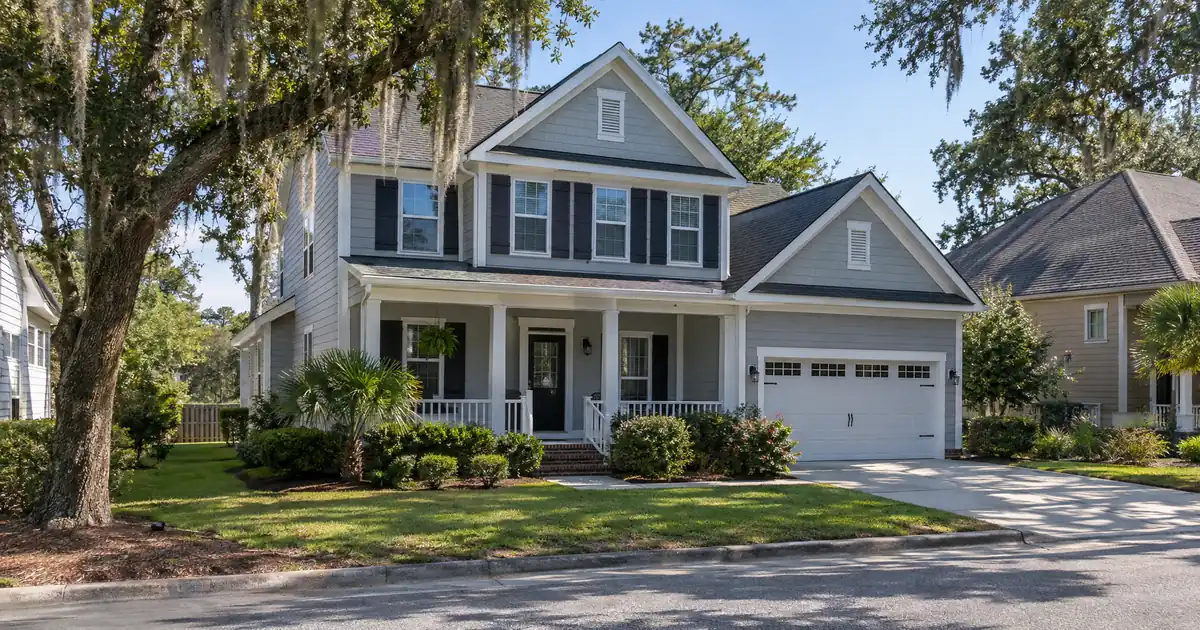
Picture two Goose Creek owners with the same $350,000 house. One asks for the full 75 percent loan-to-value ceiling and assumes the rent will carry it. The other sizes the loan to the rent first and takes whatever equity that supports. On typical rents here, the second owner is the one whose file clears. The 75 percent cap is a ceiling, not a target, and in this market the coverage number usually binds well before the LTV does.
That distinction matters more in Goose Creek than in most Charleston-area suburbs. Home values here sit well within reach of workforce buyers, while rents have stayed moderate, so the equity you can actually pull depends on how much debt the rent supports, not on how much value the house has.
DSCR Cash-Out Calculator
Run the cash-out numbers in Goose Creek, SC
Rate source: Freddie Mac 30-yr average via FRED® — Federal Reserve Bank of St. Louis · effective Sep 24, 2026
Prefilled with starting assumptions — enter your property’s value, balance, taxes, and insurance for a more accurate picture.
Program parameters update from Lendmire’s centralized guideline source. Taxes and insurance are editable estimates.
As of Sep 24, 2026 · General Freddie Mac market benchmark, not a Lendmire loan offer. Property value, balance, taxes, and insurance are editable estimates. Maximum loan-to-value varies by lender, program, property type, and seasoning. Not a Loan Estimate, approval, or commitment to lend. Program availability and eligibility are subject to lender guidelines, credit approval, property review, and underwriting.
The Short Version: A cash-out refinance on a Goose Creek rental is underwritten primarily on the property’s rental income measured against its full monthly obligation, which suits owners of workforce single-family homes and townhomes with real equity and a lease in place. Average rent here is $1,748 per RentCafe.
- Modeled coverage at the 75 percent LTV ceiling lands below 1.00 on typical rents.
- Sizing near 60 to 70 percent LTV brings coverage to roughly 1.0 or better.
- Price direction is soft: Redfin shows a 1.4 percent year-over-year decline.
- Plan on roughly six months of ownership, measured from title recording, before cash-out.
- Proceeds fit best into another single-unit rental, because small multi-unit stock is thin.
Lendmire (NMLS# 2371349) is a DSCR-focused mortgage brokerage that helps Goose Creek, South Carolina investors arrange DSCR financing across 41 markets, including Washington, D.C. It places these loans through wholesale lending channels. Lenders review eligibility and approve, and everything below is subject to lender guidelines, credit approval, and property review.
Goose Creek Market Snapshot
A quick read on the Goose Creek investor landscape — figures come from the cited sources below. Confirm current property-level numbers before underwriting.
| Metric | Detail |
|---|---|
| Typical rents | Between $1.69 and $1.79 rent/sf (Avison Young Charleston) |
| University enrollment | 2,500 students (Wikipedia: Nuclear Power School) |
| Employment | 500 staff (Wikipedia: Nuclear Power School) |
Why the Coverage Number Binds Before the LTV Cap
The modeled math shows coverage below 1.00 at the full 75 percent LTV on typical Goose Creek rents. The coverage ratio is monthly rent divided by the full monthly obligation: principal, interest, taxes, and insurance. Those inputs are modeled assumptions, not market data.
Run the numbers on a $350,000 value using the RentCafe average of $1,748. Rent-to-price works out to roughly 0.50 percent a month, which is my arithmetic, not a sourced yield. Including taxes and insurance at South Carolina-average loadings, coverage at 75 percent LTV comes out in the mid-0.8s. Pull back to roughly 60 percent LTV and the number sits right around 1.00. Every additional step of leverage costs coverage, and this market has thin margin to spend.
A 3-bedroom townhouse rents better. Homes.com shows a median townhouse rent of $1,950, with 3-bedroom townhouses at $1,925, from a small listing sample. At a similar value to the earlier example and that rent, modeled coverage including taxes and insurance runs just under 1.00 at 75 percent LTV and lands in the low 1.0s near 70 percent. That is better, but it is not a wide cushion.
Most standard DSCR programs are built around a 1.00 benchmark because rent covers the obligation at that level. Some lenders may review lower ratios, but usually with lower leverage, stronger credit, more reserves, or different pricing. If your Goose Creek property models at 0.90 at the LTV you wanted, you have three realistic paths. You can take a smaller loan, ask a lender whether a sub-1.00 program or an interest-only structure fits the file, or hold the refinance until rent moves. Any of them is a lender decision, not a given. The real question is whether the equity extracted justifies a tighter structure.
This one is a genuine judgment call. Investors who want maximum cash out of a lower-yield property are paying for that proceeds figure with thinner coverage. Investors who value a clean 1.0x-plus file will usually take less cash. Neither is wrong, but only one of them survives a soft appraisal.
Reading the Equity Side: Flat Prices, Longer Marketing Times
Goose Creek does not have an appreciation tailwind you can underwrite around. Redfin reported prices down 1.4 percent year over year at a $365,000 median, with homes taking 69 days on the market versus 60 a year earlier. Resideline, a small aggregator worth treating as directional, tracked a $335,000 median closing price across 357 closings, with the middle half of sales between $284,000 and $389,000. Niche’s $306,000 is likely an owner-occupied census-style value rather than a sale price.
Those sources disagree, and the spread matters for a refinance. A property that appraises at the low end of the range supports less proceeds than the same house at the high end. Underwrite the refinance on today’s value, not expected appreciation.
New construction reinforces that caution. One Zillow-listed builder plan, a 1,728 square foot 3-bed/3-bath, is priced at $329,990. Movoto puts the median list price at $342,000, about $200 per square foot. New builds compete directly with resale homes, so appraisals on refinances may come in flat. If you bought before a price run and your basis is well below current value, your equity story is strong. If you bought recently near the top of the range, the six-month seasoning clock may start a conversation about value, not proceeds.
The seasoning point is practical. Plan on about six months of ownership from title recording before a cash-out. Investors who finished a renovation and want to refinance out of it should confirm how the lender treats the seasoning start date and the value basis. Reserves typically run around six months of the full monthly obligation on most files, so factor that into how much of your proceeds you can actually redeploy.
Where the Tenant Base Comes From
Goose Creek’s rental demand rests on employment anchors, not a university or tourism, and the anchors are diversified. There is no four-year university in town, so student demand is minimal. The tenant base is workforce and base-adjacent employment.
The distinctive piece is the Navy’s Nuclear Power School and Naval Nuclear Power Training Command, which Wikipedia lists at about 2,500 students and 500 staff. Those figures are unofficial, so treat them as approximate. It gives Goose Creek a rotating pipeline of trainees and staff on set training cycles, many of whom need housing near the gate. Alongside the Naval Weapons Station, that is a demand source most South Carolina suburbs do not have. The Charleston Regional Development Alliance says Joint Base Charleston supports nearly 25,000 military and civilian jobs, and the same source lists Boeing at more than 9,000 employees and MUSC at approximately 17,000, both regional rather than Goose Creek-specific. CRDA also names Volvo Cars, Mercedes-Benz Vans, and Bosch among the area’s major employers. In Berkeley County, the S.C. Governor’s office announced that Google will invest $1.3 billion to expand its Moncks Corner campus.
Residents’ own employment tells a similar story. Data USA shows Manufacturing (3,037), Retail Trade (3,019), and Health Care and Social Assistance (2,585) as the top sectors. Census Bureau QuickFacts lists a population of 48,078 and a median age of 34, with roughly 68 percent of households owner-occupied and 32 percent renting, about 5,656 renter households. Point2Homes puts the median household income at $88,178.
What this means for a refinance: no single employer is a point of failure. Commute access to several separate employers spreads job risk, which supports steady renewals. Homes near I-26 and the Highway 52 and Red Bank Road corridor toward the base gates are the easiest to lease, though that corridor is my inference, not a sourced neighborhood. Goose Creek also has very few transit options, so tenants mostly drive.
Submarkets: Townhomes Over Golf Courses
The strongest DSCR fit here is workforce single-family and townhome stock, not the largest owner-occupant subdivisions. The research has no neighborhood-level price or rent data, so what follows is qualitative.
Liberty Hall Plantation mixes single-family homes with townhome sections, including Wedgewood and Waterford, near Highway 52 and Central Creek Park. The townhome rent figures above are the closest thing to sourced rent evidence for that product type. Townhomes there are the most natural candidates for a refinance built on a 3-bedroom rent, and Point2Homes reports 3-bedroom units make up 39 percent of local rentals.
Crowfield Plantation is the largest subdivision, with almost 20 subsections and the town’s only golf course, per one broker site. It is an HOA community, and it likely leans owner-occupant rather than investor-driven. Check the leasing rules before you assume a rental strategy fits, because the association’s terms affect whether the property can be leased at all.
Older subdivisions such as Foxborough, St. James Estates, Camelot Village, Lakeview Commons, and Briarwood are likely older or lower-priced stock, but no pricing data was found. An investor who already owns there should get a lender rent schedule and compare it with local listings before assuming the average rent applies.
Whichever pocket you own in, the Berkeley County fair market rent figures (summarized from HUD) give a useful cross-check: $1,599 for a 2-bedroom and $1,979 for a 3-bedroom. That is a secondary aggregator, so confirm against HUD’s own tables. It is a cross-check on lender rent schedules, not a market-rent survey.
Small Multifamily: Attractive on Paper, Scarce in Practice
Multi-unit math looks better than single-family math here, but the inventory is thin. An institutional apartment report from a couple of years back priced North Charleston and Goose Creek deals at roughly $197,000 to $209,000 per unit, according to Avison Young. Those are large complexes of 312 and 332 units, not small buildings, so treat them as a dated benchmark rather than a comp for a duplex.
The point stands anyway. A per-unit basis around $200,000 against a single-family median of $335,000 to $365,000 shows how a small building spreads its price across several rent streams. The catch is availability. Redfin’s investment-property filter showed only one home for sale at a median listing price of $370,000. Duplex and fourplex stacking is realistic but scarce. Plan the coverage math around a single-unit rent, and treat any 2-to-4 unit find as an exception to price carefully. I found no data on ADU rules or small-building inventory, so verify with local professionals rather than assuming.
If you own a Goose Creek single-family rental and want to pull equity to buy a duplex somewhere in the Charleston metro, the numbers may work better on the purchase side than in your current market. But that depends on finding the property, which is the harder part.
New Supply Is the Risk Nobody Prices
The vacancy risk in Goose Creek is competition from new apartments, not weak demand. No reliable vacancy rate was found, so the concern is qualitative. A 300-unit, three-story garden-style project is being developed in Goose Creek, per the developer, and Apartments.com lists 121 recently constructed apartments. New-build listings carry required monthly fees of about $100 to $115 on top of base rent.
Rent growth reflects it. RentCafe shows average rent up just 0.83 percent over the past year, from $1,734 to $1,748. Most rentals fall between $1,501 and $2,000 a month, and the same source says 86 percent of rentals sit in that band. That is a narrow, flat band. New Class A units compete with older single-family rentals for the same tenants, so underwrite conservative rents and vacancy on older stock rather than top-of-market new-build rent. If your lender’s rent schedule comes in well below your lease, the schedule usually wins.
What a Typical File Looks Like
DSCR files in markets like this one typically look like a single-unit rental with modest rent-to-price, real but not dramatic equity, and coverage that lands near the 1.00 line rather than comfortably above it. The cleanest files from a documentation standpoint arrive with a signed lease, entity documents if the property is LLC-held (subject to lender program eligibility), title details, and proof of reserves ready for lender review. The files that stall are usually the ones where the borrower assumed the maximum LTV, and the modeled coverage came back below 1.00. Adjusting the loan size at that stage is routine. Adjusting after a valuation surprise is harder.
Program parameters are guidance, not promises. Cash-out LTV tops out at 75 percent, and credit tiers typically run from a 620 floor up through 660, 680, and 700, with better tiers generally supporting stronger terms. Loan amounts on standard programs go up to $3,000,000, with smaller balances routed through select lenders in the network. Manufactured homes, log homes, and barndominiums fall outside these programs. Overlays matter too. While other non-QM platforms add state-specific overlays that shrink usable LTV, the practical check is to ask what the actual LTV ceiling is on your file in South Carolina before assuming 75 percent. If you want to see the guide “What Is a DSCR Loan”, the breakdown covers the ratio itself.
DSCR vs. conventional financing
Two common ways to finance an investment property in Goose Creek, SC. They qualify you differently — here’s how investors weigh them.
Why investors choose it
- Qualifies on the property’s rental income — no personal tax returns, W-2s, or pay stubs needed to document income.
- No personal debt-to-income ceiling to clear, so existing mortgages and obligations don’t cap your borrowing the same way.
- Can be closed in an LLC, keeping the property inside a business entity.
- Built for scaling — not held to the limit on number of financed properties that conventional financing applies.
- Underwriting centers on the deal: generally qualifies when the rent covers the payment, a 1.00x coverage ratio being a common baseline (confirmed in underwriting).
- Designed specifically for investment property, including long-term and, where the program allows, short-term rentals.
Where it’s strong
- Often the lowest ongoing financing cost for a buyer who fully qualifies on personal income — a fit for a first property or a cost-first purchase.
Trade-offs for investors
- Requires full personal income documentation and must fit within a debt-to-income limit — salary, existing debts, and other mortgages all count.
- Typically held in your personal name rather than a business entity.
- Caps how many financed properties you can carry, which can become a ceiling as a portfolio grows.
- Evaluates you as a borrower as much as the property, which usually means more paperwork.
How investors usually choose: a first or single property often optimizes for the lowest financing cost; portfolio builders often optimize for leverage, vesting in an LLC, and scaling past conventional caps. The right answer depends on your goals, the property, and current guidelines — both paths run through select lenders in Lendmire’s wholesale network, with eligibility and terms confirmed in underwriting.
Conventional or DSCR for the Refinance?
The choice depends on how many properties you finance and how your income documents. Conventional cash-out can carry a lower cost for a W-2 borrower with one or two rentals and clean traditional personal-income documentation, though it runs into financed-property limits as a portfolio grows. DSCR becomes the more practical lane for entity-held portfolios, self-employed investors, or anyone whose traditional personal-income documentation understates rental income. The program-to-program comparison lays this out in detail. With Goose Creek coverage this tight, a conventional refinance based on your personal debt-to-income might in fact get you more proceeds, and that is worth testing before you commit to the DSCR route.
For the mechanics of the refinance itself, the investor refinance breakdown and cash-out refinance details cover the structure. Investors weighing this against other markets can also read the broader South Carolina DSCR financing overview.
Where Proceeds Go Next
Cash out pays off when the next property has better coverage than the one you pulled from. That is the test. Extracting equity from a house at 0.95 coverage and buying another at 0.95 just doubles the exposure to a flat market.
The better targets are the ones the research supports: 3-bedroom townhomes with rents near the $1,925 to $1,950 range and a lower basis, or, when one turns up, a small multi-unit priced against several rent streams. Redeploying into out-of-state markets where the coverage math does not pencil is a different decision, and one worth stress-testing separately. If your current Goose Creek property sits at roughly 1.0x at 60 to 65 percent LTV, taking that smaller loan and buying a second, better-yielding property may beat maximizing the first refinance. Call 828-256-2183 if you want to walk through a specific file. Verify current local rental rules, taxes, and insurance with qualified local professionals before you close on anything.
Frequently Asked Questions
How do you qualify for a DSCR cash-out refinance on a Goose Creek rental?
Qualification centers on the property’s rent used for lender review measured against its full monthly obligation, with 1.00 as the common benchmark. Lenders typically look for about six months of ownership from title recording, a credit score at or above a 620 floor, and roughly six months of reserves. Cash-out LTV is capped at 75 percent, and in Goose Creek the coverage number will often push you below that. Final eligibility depends on lender guidelines and property review.
What are the requirements for an investment property loan refinance in Goose Creek, South Carolina?
Expect a lease or rent schedule, title and property details, entity documents if the property is LLC-held (per lender program requirements), and proof of reserves. Single-family homes and townhomes are the natural fit here. Manufactured homes, log homes, and barndominiums are outside the network’s DSCR programs. Details vary by borrower, property, and loan scenario.
Does Navy training demand make Goose Creek rentals safer to refinance?
It helps, but it does not remove risk. Nuclear Power School and the Naval Weapons Station give the area a steady employment base, and Joint Base Charleston supports nearly 25,000 jobs regionally. Still, appraisal value and coverage drive the refinance, not tenant stability alone. Prices were down 1.4 percent year over year, so demand does not guarantee a strong appraisal.
How does rental income affect DSCR refinance eligibility in Goose Creek?
Lendmire arranges DSCR investor loans, and the rent-to-obligation ratio is the core of the file. With Goose Creek average rent near $1,748, the ratio usually determines how much of the 75 percent LTV ceiling is usable. Eligibility is reviewed by the lender.
Is a duplex or fourplex a better cash-out target than a single-family home here?
On paper, yes, because per-unit basis is lower. In practice, inventory is thin: Redfin’s investment-property filter showed just one home for sale. Most investors end up buying single-family or townhouse rentals, so plan the math around a single-unit rent and treat any small multi-unit find as an exception.
The One Thing to Do First
Before ordering anything, pull HUD’s own fair market rent table for Berkeley County and set it beside your actual lease. The 3-bedroom figure is the ceiling for workforce homes here, and if your rent sits at or above it, your coverage math is already stretched. Goose Creek’s Navy-driven tenant pipeline is steady, but at 0.5 percent rent-to-price, only the leases that already sit near the top of the local range will carry a large cash-out.
About Lendmire
Lendmire is a DSCR-focused mortgage brokerage, NMLS# 2371349, placing investor loans across 41 markets, including Washington, D.C. Lenders generally review DSCR eligibility around a property’s rental income rather than personal income documentation, which fits LLC-held rentals, self-employed investors, and portfolios scaling past conventional financed-property limits. Lendmire has been recognized as a top-ranked workplace in 2026 and a top-ranked workplace in 2025 by Scotsman Guide.
Get Started
Ready to find the right loan for you?
In about 30 seconds you can review financing options available for your investment property. No commitment required.
Informational only. Not a Loan Estimate, approval, or commitment to lend. Program availability and eligibility are subject to lender guidelines, credit approval, property review, and underwriting.
References
2. Redfin
3. Avison Young
4. Wikipedia
5. Homes.com
6. Resideline
7. Movoto
8. Charleston Regional Development Alliance
9. Google will invest $1.3 billion
10. Data USA
12. Berkeley County fair market rent figures
13. Redfin’s investment-property filter
14. Apartments.com
15. Scotsman Guide — Top Workplaces 2026
16. Scotsman Guide — Top Workplaces 2025
This article is part of Lendmire’s investment property cash-out refinance program — full qualification details, guidelines, and scenarios live on the program page.
Related reading: DSCR Cash Out Refinance in Goose Creek, South Carolina: Navy Nuclear School Tenant Demand · DSCR Investment Property Loans in Charleston, SC: What It Takes to Qualify · Cash Out Refinance Investment Property Charleston South Carolina
Guides: Investment Property Cash-Out Refinance in Goose Creek, SC · Investment Property Cash-Out Refinance in South Carolina
Brandon Miller
Founder & CEO, Mortgage Loan Originator, Lendmire LLC
- Mortgage Loan Originator · NMLS# 1129696 · Verify on NMLS Consumer Access
- North Carolina Real Estate Broker · License# 343312 · Verify on NCREC
- North Carolina Insurance Producer · License# 19053198 · Property, Casualty, Life, Health · Verify on NAIC SBS
- Lendmire LLC · Firm NMLS# 2371349 · Verify firm licensure
Disclosure information. Lendmire is a state-licensed mortgage brokerage under NMLS# 2371349. Lendmire is not a depository institution, direct lender, or financial advisor — all loans referenced are placed through wholesale lender partners and are subject to each lender's underwriting standards. This article is provided for general informational purposes and is not a commitment to lend, nor does it constitute financial, legal, or tax advice. Loan programs, terms, rates, and qualification standards change without notice and depend on borrower profile, property type, and the state in which the subject property is located. Equal Housing Opportunity provider. NMLS Consumer Access: nmlsconsumeraccess.org.