
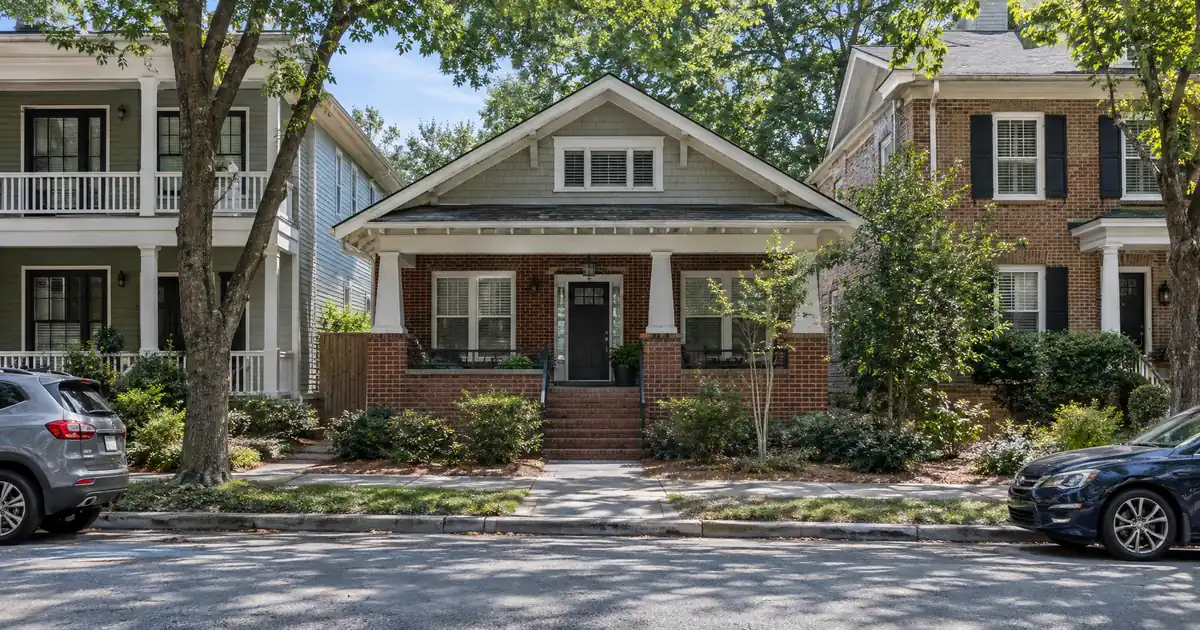
If you own a rental in Gainesville and your last appraisal came back flat, here’s what most brokers won’t tell you: the equity you can pull depends on three things. Those are the appraised value, the rent, and whether the rent covers the full monthly obligation on the new balance. The third one trips up more single-family owners in this market than the first two. Small-unit rentals with two or three bedrooms tend to do better on it.
DSCR Cash-Out Calculator
Run the cash-out numbers in Gainesville, GA
Rate source: Freddie Mac 30-yr average via FRED® — Federal Reserve Bank of St. Louis · effective Sep 24, 2026
Prefilled with starting assumptions — enter your property’s value, balance, taxes, and insurance for a more accurate picture.
Program parameters update from Lendmire’s centralized guideline source. Taxes and insurance are editable estimates.
As of Sep 24, 2026 · General Freddie Mac market benchmark, not a Lendmire loan offer. Property value, balance, taxes, and insurance are editable estimates. Maximum loan-to-value varies by lender, program, property type, and seasoning. Not a Loan Estimate, approval, or commitment to lend. Program availability and eligibility are subject to lender guidelines, credit approval, property review, and underwriting.
The Quick Read:
A DSCR cash-out refinance in Gainesville, Georgia is underwritten primarily on the property’s rental income measured against its full monthly obligation (principal, interest, taxes, and insurance) rather than personal income paperwork. It lets an owner pull equity from a rental already held, capped by appraised value and a 75% loan-to-value ceiling, subject to lender guidelines.
- Zillow shows an average Gainesville home value of $376,187, down 1.4% year over year. Average rent sits near $1,612, up just 0.69%, so underwrite flat.
- 2-bedroom and 3-bedroom units dominate rental stock, which favors small multi-unit product.
- Two 2BR units out-earn one 3BR against similar values, which is where coverage improves.
Gainesville Market Snapshot
A quick read on the Gainesville investor landscape — figures come from the cited sources below. Confirm current property-level numbers before underwriting.
| Metric | Detail |
|---|---|
| Home prices | $369K median price (Prop-Metrics) |
| Employment | 4,700 jobs (Greater Hall Chamber of Commerce) |
Start With the Appraisal, Not the Rent Roll
Gainesville’s values are soft, and that caps the refinance balance before rent enters the conversation. Zillow’s average home value is $376,187, down 1.4% over the past year, with homes going pending in around 46 days (Zillow Home Value Index). Redfin’s median sale price runs higher at $393K but is down 7.5% year over year (Redfin). The two measure different things, but they point the same direction: no tailwind.
That changes the thesis. In a market with recent appreciation, the cash-out story is “the property grew into more equity.” Here, it’s more likely “I bought right, renovated, or paid down enough” to create usable equity. If you bought at the market’s recent peak, your 75% ceiling may leave little to extract, and that’s worth knowing before you order an appraisal.
The mechanics on your side are simple. Lenders in the network typically look for about six months of ownership measured from title recording, a 75% LTV ceiling on cash-out, a 1.00 coverage baseline, and roughly six months of reserves. A 620 credit score is the typical floor, with better pricing and leverage at higher tiers. Treat all of it as guidance, because how the qualification works varies by lender, property, and borrower, and equity available is never a guaranteed cash figure.
Lendmire (NMLS# 2371349) is a non-QM mortgage broker. Through Lendmire’s DSCR program footprint — 41 markets, including Washington, D.C. — lenders may review qualifying rental income subject to program guidelines for Gainesville, Georgia investors.
Why Two Small Units Beat One Big One Here
Gainesville rents are clustered tightly between bedroom counts, so a second unit adds far more income than a bigger unit does. RentCafe puts the 2BR average at $1,616 and the 3BR at $1,962, a gap of only about $350, with 49% of rentals landing between $1,501 and $2,000 (RentCafe). RentCafe’s data covers only buildings with 50 or more units, so treat it as a ceiling-style benchmark for small properties.
Run the numbers on a modeled refinance. Assume an appraised value near Zillow’s $376,187 average, a 75% LTV, a 30-year fixed structure, and full PITIA with taxes and insurance at typical Georgia averages. These are modeled assumptions, not market data. These specifics are subject to lender guidelines and a full review of property, leverage, and credit.
Prop-Metrics, drawing on Rentcast, shows a 3-bedroom median rent of $2,140 and a 2-bedroom median of $1,570 for ZIP 30504.
| Scenario | Modeled rent | Coverage, incl. Taxes and insurance |
|---|---|---|
| One 3BR single-family | $2,140 | High-0.8s to low-0.9s |
| Two 2BR units (duplex) | $3,140 combined | Roughly 1.35x |
Same appraised value, same leverage. The duplex clears the 1.00 baseline with cushion, and the single-family house lands below it. That’s arithmetic on cited rents, not a market figure. The real-world spread will move with the actual purchase price, the property’s condition, and the lender’s rent determination.
DSCR files in markets like this one typically look a certain way. Single-family rentals at flat values come in just under or around the baseline, and the file turns on small levers: a lower loan-to-value, a lease at the top of the comp range, or a documented market-rent opinion. Small multi-unit files, where the market offers them, tend to clear with room to spare. The strongest files usually have a clean lease, a recent insurance quote, and an honest read on rent, with no growth assumed to reach the ratio.
The conditional flip: if you own a well-located single-family rental outright or with low leverage, the loan-to-value lever works in your favor, because pulling a smaller percentage shrinks the debt while rent stays put. If you hold a high-balance single-family at the market peak, the same property may not produce a workable cash-out at all. That’s a signal to reconsider the plan, not to hunt for a looser lender.
Where the Stacking Pockets Are
The neighborhoods that suit a cash-out thesis are the older, smaller-home pockets near employers. No reliable neighborhood-level price or rent medians exist for these areas, so this section is qualitative by necessity.
Newtown. Homes.com describes modest bungalows and ranch-style homes less than a mile from downtown and Northeast Georgia Medical Center. That’s a plausible workforce and medical-adjacent rental pocket, and it’s the most natural place for 2-3BR product near the region’s largest employer.
Chicopee Village and Cotton Mill Village. Both are historic mill-housing areas with older small homes. Redfin’s nearby listing snapshot shows 3-bed townhome-style rentals at $1,595 to $1,915 a month. Those are individual listings, not medians. Still, they bracket what a three-bedroom in this pocket asks, and they sit below the ZIP-level 3BR median of $2,140. Underwrite to the lower end.
New Holland and the Medical District. Apartments.com places New Holland off Jesse Jewell Parkway with I-985 access, and lists a Medical District around the hospital with short commutes. Rent.com’s apartment 1BR averages run $1,175 in Bradford-Ridgewood, $1,435 in New Holland Village, and $1,729 in Mundy Mill, with Limestone the priciest at $2,387. Those are apartment-listing numbers, so read them as direction. The lesson is that a citywide average will misstate coverage. A lower-rent pocket only works if the purchase basis is correspondingly lower, and no sourced price data here confirms that, so verify with local comps.
Midtown. Near the Midland Greenway and the Amtrak station, it’s a reasonable adjacent option.
Skip: the Riverside Drive area, where stately brick homes on large lots are a weak cash-flow fit.
Here’s the catch on supply. Apartment Finder’s Gainesville page shows only three duplex rentals, so small multi-unit inventory looks limited. If you already own a duplex or triplex, that scarcity works for you. If you’re planning to buy your way into the stacked-unit strategy, the thin supply is a constraint to weigh.
Who’s Paying the Rent
A plant-and-hospital base keeps demand for workforce units steady even when prices don’t move. Per the Greater Hall Chamber’s employer list (a few years old, so approximate), Northeast Georgia Medical Center employs about 9,239, the Hall County School System about 3,400, Gold Creek Foods about 3,035, Kubota Manufacturing of America about 2,535, and Fieldale Farms about 2,370. Poultry and food processors fill much of that list.
The Greater Hall Chamber of Commerce adds that the MSA population exceeds 220,000, with more than 330 manufacturing and processing concerns and 66 international company locations. It also cites 77 new and expanded businesses announced since 2020, representing more than 4,700 jobs and $2.0 billion in capital investment. RentCafe shows about 61% of Gainesville households are renter-occupied (RentCafe).
This is a long-term workforce and medical rental story. It’s not a student story (the University of North Georgia has five campuses and nearly 20,000 students system-wide, with no Gainesville-only count), and it isn’t a short-term-rental story. The demand case supports steady occupancy on 2-3BR units. It doesn’t support underwriting rent growth.
What’s the Catch on Sub-1.00 Deals?
A sub-1.00 structure may be available through select lenders, but the question worth asking first is whether to use it. In Gainesville, single-family rentals with flat rents are the files most likely to land there. Options a lender might review include a lower loan-to-value, an interest-only structure, or a program built for sub-1.00 coverage, all subject to lender guidelines, credit approval, and property review. Some lenders may review lower ratios or no-ratio scenarios, but those usually come with stronger compensating factors, less leverage, different pricing, or more cash in.
Rents here are flat, not climbing. RentCafe shows +0.69% and Apartments.com +0.3%. RentHop’s 3BR figure is $1,924, down 5.36% year over year. Three sources pointing the same direction means this isn’t a blip. Don’t build a plan that needs rent to rise to hit the ratio.
If you’re reaching for sub-1.00 because the coverage never works at any property in your portfolio, that’s a signal to re-examine which properties you’re refinancing. It isn’t a signal to find a different loan type. If instead one property has a documented appreciation or repositioning story, a lower current ratio is a defensible trade.
DSCR vs. conventional financing
Two common ways to finance an investment property in Gainesville, GA. They qualify you differently — here’s how investors weigh them.
Why investors choose it
- Qualifies on the property’s rental income — no personal tax returns, W-2s, or pay stubs needed to document income.
- No personal debt-to-income ceiling to clear, so existing mortgages and obligations don’t cap your borrowing the same way.
- Can be closed in an LLC, keeping the property inside a business entity.
- Built for scaling — not held to the limit on number of financed properties that conventional financing applies.
- Underwriting centers on the deal: generally qualifies when the rent covers the payment, a 1.00x coverage ratio being a common baseline (confirmed in underwriting).
- Designed specifically for investment property, including long-term and, where the program allows, short-term rentals.
Where it’s strong
- Often the lowest ongoing financing cost for a buyer who fully qualifies on personal income — a fit for a first property or a cost-first purchase.
Trade-offs for investors
- Requires full personal income documentation and must fit within a debt-to-income limit — salary, existing debts, and other mortgages all count.
- Typically held in your personal name rather than a business entity.
- Caps how many financed properties you can carry, which can become a ceiling as a portfolio grows.
- Evaluates you as a borrower as much as the property, which usually means more paperwork.
How investors usually choose: a first or single property often optimizes for the lowest financing cost; portfolio builders often optimize for leverage, vesting in an LLC, and scaling past conventional caps. The right answer depends on your goals, the property, and current guidelines — both paths run through select lenders in Lendmire’s wholesale network, with eligibility and terms confirmed in underwriting.
What Happens With the Proceeds?
The cash-out thesis depends on what the money does next. Pulling equity to buy another small-unit rental in a pocket where coverage still works at current pricing is a straightforward case. Pulling equity to fund something that doesn’t cash-flow at today’s rents is a different decision, and one worth stress-testing before committing.
Some investors use proceeds to renovate an older Chicopee or Newtown home and lift its rent, then refinance again after the seasoning period. That can work, but with values flat, don’t assume the appraisal rewards the spend. Others use the capital to add a second financed property. If your portfolio is heading past four financed properties, the conventional lane runs out, and DSCR becomes the practical path. For a single rental held personally by a high-W-2 borrower, DSCR versus conventional may tilt toward conventional, which can carry a lower cost and skip the non-QM friction. The flip point usually arrives around the third financed property, or sooner if your traditional personal-income documentation doesn’t cleanly support rental income.
For the structural options, see Lendmire’s DSCR cash-out refinance overview. For the state-level view, see DSCR loan options for Georgia investors. If you’re weighing a specific property, you can talk through the file or reach the team at 828-256-2183. Before any move, verify current local rental rules, taxes, and insurance with qualified local professionals. Those vary by property and sit outside the loan itself.
Frequently Asked Questions
How do you qualify for a DSCR cash-out refinance in Gainesville, Georgia?
Qualification centers on the property’s rent against its full monthly obligation, typically with a 1.00 baseline, a 75% LTV ceiling on cash-out, and a credit score floor of 620. Most files also want about six months of ownership from title recording and roughly six months of reserves. Final eligibility depends on lender guidelines, credit, and property review.
What are the requirements for an investment property loan in Gainesville, Georgia, beyond the ratio?
Expect an appraisal, a lease or market-rent opinion, reserves, and a credit profile that fits the program tier. Loan amounts generally run up to $3,000,000 on standard programs, with smaller balances routed through select lenders. Manufactured homes, log homes, and barndominiums fall outside these programs. LLC-titled borrowers may be eligible, subject to lender program eligibility.
What can slow down a Gainesville DSCR cash-out refinance?
Lendmire is a non-QM mortgage broker with DSCR programs. What typically complicates a file here is an appraisal that lands below expectation, rent that doesn’t cover full PITIA, or a property short of the roughly six-month seasoning window. The 75% LTV ceiling is the main feature that shapes how much equity is available.
Do flat home values in Gainesville hurt a cash-out refinance?
Yes, because the balance is tied to appraised value, and Zillow and Redfin both show values down over the past year. That caps the proceeds regardless of how strong the rent is. Equity built through purchase price, paydown, or improvements matters more here than market appreciation.
Is a duplex or a single-family home better for cash-out in Gainesville?
A duplex usually covers better, because two 2BR units out-earn one 3BR against a similar value. The catch is supply: duplex listings look thin. A single-family owner with lower leverage can still work, but coverage tends to sit nearer the baseline or below it.
For current guidelines and terms, see Lendmire’s DSCR loan programs page.
About Lendmire
Lendmire (NMLS# 2371349), a non-QM mortgage broker serving investors in 41 markets including Washington, D.C., helps structure DSCR scenarios commonly evaluated around a property’s rental income rather than personal income paperwork, subject to lender guidelines. The firm was recognized by Scotsman Guide as a 2026 Top Workplace and recognized by Scotsman Guide in 2025. Lendmire places loans through wholesale investor lenders and is not a direct lender.
Get Started
Ready to find the right loan for you?
See your offer in seconds. No credit pull, no obligation.
Informational only. Not a Loan Estimate, approval, or commitment to lend. Program availability and eligibility are subject to lender guidelines, credit approval, property review, and underwriting.
References
1. Zillow Home Value Index, Gainesville GA
2. RentCafe, Gainesville GA rent
3. prop-metrics.com — ZIP 30504
4. Greater Hall Chamber of Commerce, Economic Development
5. Redfin, Gainesville GA housing market
6. Homes.com
8. $1,175 in Bradford-Ridgewood, $1,435 in New Holland Village, and $1,729 in Mundy Mill
9. Apartmentfinder.com — Georgia Gainesville Duplex
10. Greater Hall Chamber, Top Employers
11. RentHop — Average Rent IN Gainesville GA
12. recognized by Scotsman Guide as a 2026 Top Workplace
13. recognized by Scotsman Guide in 2025
This article is part of Lendmire’s investment property cash-out refinance program — full qualification details, guidelines, and scenarios live on the program page.
Related reading: DSCR Cash Out Refinance in Gainesville, Texas: Pulling Equity Ahead of the Apartment Wave · DSCR Cash Out Refinance in Gainesville, Florida: Pulling Equity From the UF Rental Core · DSCR Cash Out Refinance in Kennesaw, Georgia: The 2026 DSCR Financing Guide to Big Shanty Rentals
Guides: Investment Property Cash-Out Refinance in Gainesville, GA · Investment Property Cash-Out Refinance in Georgia
Brandon Miller
Founder & CEO, Mortgage Loan Originator, Lendmire LLC
- Mortgage Loan Originator · NMLS# 1129696 · Verify on NMLS Consumer Access
- North Carolina Real Estate Broker · License# 343312 · Verify on NCREC
- North Carolina Insurance Producer · License# 19053198 · Property, Casualty, Life, Health · Verify on NAIC SBS
- Lendmire LLC · Firm NMLS# 2371349 · Verify firm licensure
Disclosure information. Lendmire is a state-licensed mortgage brokerage under NMLS# 2371349. Lendmire is not a depository institution, direct lender, or financial advisor — all loans referenced are placed through wholesale lender partners and are subject to each lender's underwriting standards. This article is provided for general informational purposes and is not a commitment to lend, nor does it constitute financial, legal, or tax advice. Loan programs, terms, rates, and qualification standards change without notice and depend on borrower profile, property type, and the state in which the subject property is located. Equal Housing Opportunity provider. NMLS Consumer Access: nmlsconsumeraccess.org.