
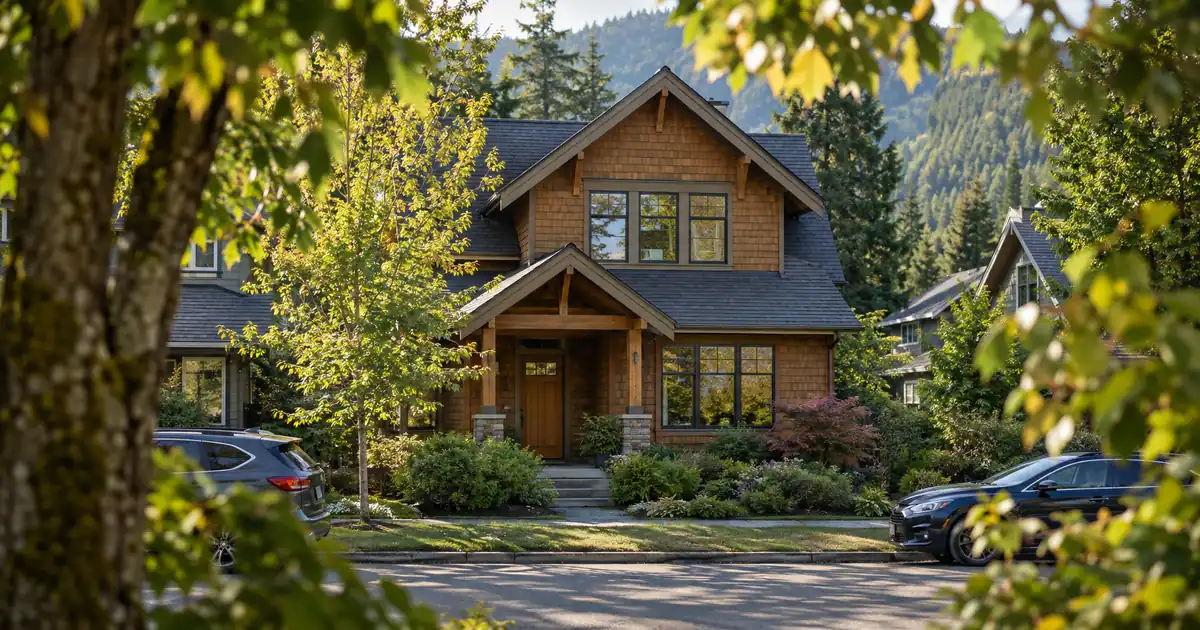
Issaquah gives the same 75 percent LTV ceiling two very different answers, depending on what the investor owns. A median condo or townhome sold for $565,000 against $1,450,000 for a median house, per Beyond Real Estate’s NWMLS-based market report, and rents do not scale with that gap. The equity is here. The coverage often isn’t.
The Short Version: A DSCR cash-out refinance in Issaquah, Washington is underwritten primarily on the property’s rental income measured against its full monthly obligation, and with a citywide median rent of $2,758 per Apartment List against prices well over half a million dollars, structure, not equity, determines whether a file works.
DSCR Cash-Out Calculator
Run the cash-out numbers in Issaquah, WA
Rate source: Freddie Mac 30-yr average via FRED® — Federal Reserve Bank of St. Louis · effective Sep 24, 2026
Prefilled with starting assumptions — enter your property’s value, balance, taxes, and insurance for a more accurate picture.
Program parameters update from Lendmire’s centralized guideline source. Taxes and insurance are editable estimates.
As of Sep 24, 2026 · General Freddie Mac market benchmark, not a Lendmire loan offer. Property value, balance, taxes, and insurance are editable estimates. Maximum loan-to-value varies by lender, program, property type, and seasoning. Not a Loan Estimate, approval, or commitment to lend. Program availability and eligibility are subject to lender guidelines, credit approval, property review, and underwriting.
- Condos and townhomes near a $565,000 median are the closest fit for coverage near 1.00.
- Highlands houses near $1.3 million model far below 1.00 at high leverage.
- Rents are flat: Apartment List shows median rent down 0.1 percent year over year.
- Cash-out tops out at 75 percent LTV after about six months of ownership.
This piece covers equity extraction only: how to pull capital out of an Issaquah property already owned, and where the coverage ratio stops the plan.
Issaquah Market Snapshot
A quick read on the Issaquah investor landscape — figures come from the cited sources below. Confirm current property-level numbers before underwriting.
| Metric | Detail |
|---|---|
| Typical rents | $2,126 avg (HUD PD&R Market at a Glance) |
| University enrollment | 19,000 students (Issaquah School District 411) |
| Employment | 13,000 costco hq employees (City of Issaquah) |
| Vacancy | 7.0% rental (HUD PD&R Market at a Glance) |
Why the Costco Corridor Sets the Floor
Rental demand in Issaquah is anchored by a single corridor. The City of Issaquah says approximately nine of its top ten employers sit in Central Issaquah, including Costco’s global headquarters with 13,000 employees on the valley floor. The headquarters addition alone spans 624,788 square feet, a building that does not get built by a company planning to leave.
The second layer is public and institutional. The Issaquah School District reports more than 2,500 full-time and part-time staff, making it the second-largest employer in the city. Swedish Issaquah adds a hospital workforce in the Highlands. Residents work mostly in professional, scientific, and technical services (5,105 people), retail trade (3,430), and health care (2,034), per Data USA. The city has roughly 40,000 residents per the Census Bureau, and its population is essentially flat.
That concentration cuts both ways. Tenant demand is deep and high-income, but it hangs on one corporate anchor. The city has no university, so there is no student base to backfill a soft spell. Investors pulling equity out should treat Costco exposure as a standing concentration risk, not a footnote.
What Coverage Actually Looks Like
Coverage is the binding constraint in Issaquah. The numbers below are modeled assumptions, not market data. They use rent divided by full PITIA, meaning principal, interest, taxes, and insurance, and they round down.
Say you own a condo or townhome worth $565,000, the median for attached product in the Beyond data. Assume it rents at the citywide median of $2,758. At the full 75 percent LTV cash-out ceiling, modeled coverage lands in the low 0.8s including taxes and insurance, before any HOA dues. Drop leverage to roughly 60 percent and the number climbs into the mid-0.9s. That is better, and still under the standard 1.00 baseline.
Now run the numbers on a house. A $1,450,000 house renting at a dated three-bedroom apartment figure of $3,349 or more (June of the prior period, so treat it as directional) models around 0.4 at 75 percent LTV. Cutting leverage to 50 percent only gets it to the mid-0.5s.
Gross rent-to-price looks friendlier. Condos and townhomes run roughly 0.49 percent monthly against 0.2 to 0.25 percent for houses, by rough arithmetic on the sources above. That ratio flatters the deal because it ignores full PITIA. Once taxes and insurance sit in the denominator, even the attached product needs lower leverage to reach 1.00.
Sub-1.00 files are not dead. Select lenders may review sub-1.00 scenarios, interest-only structures, or lower-leverage requests, but the file gets harder: stronger credit, more reserves, and additional lender review, subject to lender guidelines and property review. The strongest play is often the boring one: a smaller cash-out on a condo or townhome, sized to clear the coverage number rather than to maximize proceeds.
Highlands: Great Price Tape, Thin Cash Flow
Issaquah Highlands is the appreciation-led submarket, and it is the worst candidate for a maximum-leverage DSCR cash-out. Redfin shows a median sale price around $1.3 million over a recent three-month window, up 5.9 percent year over year. Rent averages about $3,332 per Zumper, which flags limited data, for roughly 0.26 percent monthly rent-to-price.
Tenants are hospital staff and tech professionals, a sound base. The math is the problem. At modeled full-PITIA coverage, the Highlands house sits near 0.4 at 75 percent LTV, and no realistic rent bump fixes that.
Two more Highlands wrinkles. First, HOA and condo rules can limit investor occupancy, so check before assuming a townhome can be rented at all. Second, reserves step up to about nine months of PITIA on loans above $1,500,000, and a Highlands house with a large balance can cross that line.
The investor who owns here is holding for price momentum, not yield. A low-leverage refinance that pulls modest capital and accepts thin coverage can make sense. A max-leverage cash-out doesn’t pencil. (Lenders will notice, too.)
Central Issaquah, Olde Town, and Skipping the Cheap Stuff
Central Issaquah is where the small-property case is best. The city describes its residential areas as condo buildings, older homes, town homes, and duplexes, and it expects most of the city’s new housing and jobs to concentrate here. Tenants are Costco staff, contractors, and vendors. Multi-unit stock near the employment core is the one place where income stacking can lift coverage without a price jump. Verify unit-level rents with local comps, since aggregator data mostly covers larger complexes.
The rental stock these owners compete against is newer. RentCafe puts the average apartment building at about 21 years old, with 68 percent built since 2000, and two-bedroom units make up 51 percent of rentals per Point2Homes. A duplex or townhome that is dated will lose tenants to that newer stock.
Olde Town is a skip for single-family cash flow. It is a more affordable rental neighborhood, with one-bedrooms at about $1,900 per Rent.com, but land-driven prices on character homes mean coverage is likely weak. Providence Point is the lowest-priced submarket Redfin tracks, at a median near $452,000 and down 9.99 percent year over year per Redfin. Cheap entry does not equal better coverage. No verified rent data turned up for it, which is reason enough to be careful.
Which Price Number Do You Trust?
Issaquah sources disagree on both level and direction, so treat the appraiser’s value as the only number that counts. Zillow puts the average home value at $1,137,397, down 2.2 percent over the past year. Resideline reports a lower median closing price of $950,000 across 324 sales over six months, a different measure that reflects the mix of what sold. The NWMLS-based Beyond report shows year-over-year gains of 27.5 percent. Small monthly samples and shifting product mix explain much of the spread.
For cash-out, that means one thing: underwrite at a haircut to headline values. Appraisers may lean on conservative comps, and a condo pulled against house-heavy medians will disappoint. Pull actual comps for the specific property type before running proceeds.
The program parameters are straightforward. Cash-out generally caps at 75 percent LTV, with about six months of ownership measured from title recording. The standard baseline is a 1.00 DSCR, credit typically starts at a 620 floor with tiers at 660, 680, and 700, and reserves run about six months of PITIA. Loan amounts on standard programs reach up to $3,000,000. Proceeds depend on rent used for lender review, PITIA, reserves, and that 75 percent ceiling, so they are never a guaranteed figure. All of it is subject to lender guidelines. The DSCR qualification mechanics page walks through how the ratio is built.
Working DSCR brokers see a recurring pattern in high-price, low-yield markets like this one: the owner shows up asking how much equity can come out, and the file answers a different question, which is how much debt the rent can carry. The files that work usually reduce the ask, choose the better-covering asset in the portfolio to refinance, or accept a structure with tighter terms. Sizing to the coverage number first, then to proceeds, keeps the file from stalling at review.
Where the Proceeds Go
Equity pulled from Issaquah is capital that needs a better home. With citywide rent flat and coverage tight, redeploying into higher-yield markets is a common play, and the cash-out itself becomes the down payment on the next purchase, where the debt coverage math is friendlier. Each property refinanced this way should stand on its own rent, since cross-collateralizing a sub-1.00 asset into a new file makes the whole package harder.
Investors weighing this against a conventional route should read the guide “Where DSCR and Conventional Diverge”. The short version: DSCR reviews the property’s income rather than the borrower’s, which is why self-employed owners and LLC-titled holdings, subject to lender program eligibility, tend to land here. The broader refinance side covers rate-and-term options, and Lendmire’s DSCR cash-out refinance page details the equity-extraction structure. For state-level context, see DSCR loans in Washington.
Run the specifics before committing to anything. Investors can see how the math pencils on a given property, or call 828-256-2183 to talk through the structure. Verify current local rental rules, taxes, and insurance with qualified local professionals.
Frequently Asked Questions
How do you qualify for a DSCR cash-out refinance in Issaquah?
Qualification centers on the property’s rent measured against full PITIA, with 1.00 as the standard baseline on most programs. Credit typically starts at a 620 floor, the property generally needs about six months of ownership from title recording, and reserves run about six months of PITIA. Because Issaquah prices are high relative to rent, many files need lower leverage than the 75 percent cap to clear the ratio. Approval remains subject to lender guidelines and property review.
What are the requirements for an investment property loan in Issaquah, Washington?
Expect a 75 percent LTV ceiling on cash-out, reserves of about six months (about nine months above $1,500,000), and loan amounts up to $3,000,000 on standard programs. Manufactured homes, log homes, and barndominiums fall outside these programs. LLC titling is possible depending on program guidelines, and exact eligibility turns on credit, reserves, and property review. Terms vary by lender guidelines, property type, leverage, credit profile, and full file review.
DSCR vs. conventional financing
Two common ways to finance an investment property in Issaquah, WA. They qualify you differently — here’s how investors weigh them.
Why investors choose it
- Qualifies on the property’s rental income — no personal tax returns, W-2s, or pay stubs needed to document income.
- No personal debt-to-income ceiling to clear, so existing mortgages and obligations don’t cap your borrowing the same way.
- Can be closed in an LLC, keeping the property inside a business entity.
- Built for scaling — not held to the limit on number of financed properties that conventional financing applies.
- Underwriting centers on the deal: generally qualifies when the rent covers the payment, a 1.00x coverage ratio being a common baseline (confirmed in underwriting).
- Designed specifically for investment property, including long-term and, where the program allows, short-term rentals.
Where it’s strong
- Often the lowest ongoing financing cost for a buyer who fully qualifies on personal income — a fit for a first property or a cost-first purchase.
Trade-offs for investors
- Requires full personal income documentation and must fit within a debt-to-income limit — salary, existing debts, and other mortgages all count.
- Typically held in your personal name rather than a business entity.
- Caps how many financed properties you can carry, which can become a ceiling as a portfolio grows.
- Evaluates you as a borrower as much as the property, which usually means more paperwork.
How investors usually choose: a first or single property often optimizes for the lowest financing cost; portfolio builders often optimize for leverage, vesting in an LLC, and scaling past conventional caps. The right answer depends on your goals, the property, and current guidelines — both paths run through select lenders in Lendmire’s wholesale network, with eligibility and terms confirmed in underwriting.
Does the light rail extension change the cash-out math?
Not today. The City of Issaquah says Sound Transit is proposing to push back delivery of the line ending in Central Issaquah, and the final decision was still pending. Underwrite on in-place rents with no transit uplift assumed.
How much does Costco’s presence protect rental demand?
It protects the base more than it grows it. The 13,000-person headquarters keeps Central Issaquah rentals occupied, yet rents are flat and the city’s population is essentially flat, so the anchor supports occupancy rather than rent growth. Concentration in one employer is the trade-off.
Outlook: Flat Rents, Thin Supply, Moving Rail
Expect rents to hold roughly where they are over the next 6 to 24 months. Apartment List has citywide rent down 0.1 percent year over year, and King County’s rental vacancy sits at 7.0 percent with average rent at $2,126 and growth under 1 percent, per HUD’s Market at a Glance. Supply pressure looks modest: The Urbanist reported no permits for new apartment buildings in one recent full year, and the 154-unit affordable Trailhead building is still a few years from delivery. The main risk is stagnation, not oversupply.
The most probable path is stabilizing prices with little rent growth, which means cash-out capacity depends on lowering leverage rather than waiting for appreciation. The light rail timeline is in flux, and a delay removes any near-term rent catalyst. Investors sitting on Issaquah equity should expect it to convert to capital on coverage terms set by the rents in place today, which favors attached units and Central Issaquah duplexes over Highlands houses.
For current guidelines and terms, see Lendmire’s DSCR loan programs page.
About Lendmire
Lendmire (NMLS# 2371349) is a DSCR-focused mortgage broker that helps arrange investor financing across 41 markets, including Washington, D.C., through wholesale and investor-lending channels. DSCR eligibility is generally reviewed by the lender on the property’s rental income rather than personal income documentation, subject to lender guidelines, which works for self-employed investors, LLC operators, and portfolios above four financed properties. Scotsman Guide named Lendmire a Top Mortgage Workplace in both 2025 and 2026.
Get Started
Ready to find the right loan for you?
In about 30 seconds you can review financing options available for your investment property. No commitment required.
Informational only. Not a Loan Estimate, approval, or commitment to lend. Program availability and eligibility are subject to lender guidelines, credit approval, property review, and underwriting.
References
1. Beyond Real Estate’s NWMLS-based market report
3. HUD PD&R Market at a Glance, King County
4. Issaquah School District 411
5. City of Issaquah, Central Issaquah
6. 425business.com — Costco New Issaquah Headquarters
9. U.S. Census Bureau QuickFacts, Issaquah
10. Apartments.com — Rent Market Trends Issaquah WA
11. Redfin
12. Zumper
13. RentCafe
14. Point2Homes
15. Rent.com
16. Redfin
17. Zillow
18. Resideline
19. City of Issaquah, Light Rail Update
20. theurbanist.org — Issaquah Approves Affordable Housing Incentives
21. Trailhead
22. 2025
23. 2026
This article is part of Lendmire’s investment property cash-out refinance program — full qualification details, guidelines, and scenarios live on the program page.
Related reading: DSCR Cash Out Refinance Issaquah Washington State · DSCR Cash Out Refinance Friday Harbor Washington State · DSCR Cash Out Refinance Maple Valley Washington State
Guides: Investment Property Cash-Out Refinance in Washington
Brandon Miller
Founder & CEO, Mortgage Loan Originator, Lendmire LLC
- Mortgage Loan Originator · NMLS# 1129696 · Verify on NMLS Consumer Access
- North Carolina Real Estate Broker · License# 343312 · Verify on NCREC
- North Carolina Insurance Producer · License# 19053198 · Property, Casualty, Life, Health · Verify on NAIC SBS
- Lendmire LLC · Firm NMLS# 2371349 · Verify firm licensure
Disclosure information. Lendmire is a state-licensed mortgage brokerage under NMLS# 2371349. Lendmire is not a depository institution, direct lender, or financial advisor — all loans referenced are placed through wholesale lender partners and are subject to each lender's underwriting standards. This article is provided for general informational purposes and is not a commitment to lend, nor does it constitute financial, legal, or tax advice. Loan programs, terms, rates, and qualification standards change without notice and depend on borrower profile, property type, and the state in which the subject property is located. Equal Housing Opportunity provider. NMLS Consumer Access: nmlsconsumeraccess.org.