
A cash out refinance on Palatine IL investment property doesn’t require a W-2, tax return, or pay stub — and most investors holding equity in Illinois rental homes have no idea this option exists. The DSCR cash-out refinance qualifies borrowers entirely on rental income, not personal income, making it one of the most powerful tools available for real estate investors who want to extract equity and redeploy it without the documentation hurdles of conventional lending.
Palatine investors who’ve held rentals through Illinois’s sustained rental demand cycle are sitting on significant built-up equity — equity that a conventional bank won’t touch without two years of tax returns, a strict debt-to-income calculation, and an individual borrower on the deed. DSCR programs work differently. Lendmire, a non-QM mortgage broker (NMLS# 2371349), provides investment property refinance programs to investors across Illinois and 39 other states without requiring a single income document.
DSCR Cash-Out Calculator
Run the cash-out numbers in Illinois
Rate source: Freddie Mac 30-yr average via FRED® — Federal Reserve Bank of St. Louis · effective Jul 30, 2026
Prefilled with starting assumptions — enter your property’s value, balance, taxes, and insurance for a more accurate picture.
Program parameters update from Lendmire’s centralized guideline source. Taxes and insurance are editable estimates.
As of Jul 30, 2026 · General Freddie Mac market benchmark, not a Lendmire loan offer. Property value, balance, taxes, and insurance are editable estimates. Maximum loan-to-value varies by lender, program, property type, and seasoning. Not a Loan Estimate, approval, or commitment to lend. Program availability and eligibility are subject to lender guidelines, credit approval, property review, and underwriting.
Key Takeaways:
- DSCR cash-out refinances qualify on rental income alone — no W-2s, tax returns, or personal DTI required
- Palatine investors can access up to 75% LTV with a 660+ FICO and 6 months of ownership seasoning
- LLC ownership is supported, subject to lender program eligibility — critical for asset protection
- Lendmire closes DSCR loans in as few as 15 days, giving investors a decisive speed advantage over bank timelines
How DSCR Loans Work
DSCR cash-out refinancing allows real estate investors to access equity based entirely on a property’s rental income — not the owner’s personal finances. The debt service coverage ratio measures whether gross monthly rent covers the property’s monthly debt obligations, including principal, interest, taxes, insurance, and association dues (PITIA).
How DSCR Is Calculated: Gross Monthly Rent ÷ Monthly PITIA = DSCR | Below 1.00 = cash flow negative | At or above 1.00 = property covers its debt.
For a deeper breakdown of how this qualification model works, see DSCR loan explained.
Palatine’s Rental Market and the Case for Equity Access
Palatine sits in the northwest suburbs of Chicago, roughly 30 miles from downtown, and its rental market draws consistent demand from working professionals, families priced out of closer-in suburbs, and commuters relying on the Metra Union Pacific Northwest line. That transit connection — with direct service into Chicago’s Loop — makes Palatine rental properties genuinely desirable to tenants who want suburban square footage without sacrificing downtown access.
With equity levels having risen substantially in recent years across the northwest Chicago suburbs, Palatine landlords who purchased even five or six years ago are carrying significant appreciation in their portfolios. That equity is dormant unless it’s put to work — and conventional lenders make extraction difficult by demanding income documentation, capping financed properties, and requiring individual borrower ownership rather than LLC title.
Lendmire works directly with real estate investors in Palatine, Illinois, providing DSCR cash-out refinance solutions without income documentation requirements. For investors holding rental properties near the Palatine Metra station or along Rand Road — two of the village’s strongest rental corridors — Lendmire’s DSCR programs provide a direct path to accessing built-up equity and deploying it into the next acquisition.
Given the sustained demand for rental housing in Cook and Lake County, investors who move on equity extraction now position themselves ahead of the cycle — before the next property they want is already under contract with someone else. Palatine investors benefit from the same DSCR programs available to real estate investors across Illinois, programs built specifically for portfolios that don’t fit the conventional income documentation model.
Why DSCR Cash-Out Refinancing Works for Investors
DSCR cash-out refinancing is purpose-built for real estate investors — not owner-occupants, not W-2 earners with clean tax returns. The structure solves for every major friction point conventional lending creates.
- Access cash-out proceeds without income docs: Cash-out proceeds can fund a down payment on a new rental, pay off a hard money loan on another investment property, or cover capital improvements — all without submitting personal tax returns or triggering a DTI review
- Short-term rental flexibility: Properties operating as furnished rentals or Airbnbs qualify using market rent or short-term rental income — lenders reduce gross STR rents by 20% before the DSCR calculation, still making many STR portfolios viable
- LLC and entity ownership supported: Hold the property in an LLC for liability protection and still close the refinance — subject to lender program eligibility, which Lendmire’s team navigates for each specific deal
- No personal income verification: Qualification is based entirely on the rental income relative to the property’s debt obligations — debt service coverage ratio replaces W-2s as the underwriting anchor
- No cap on financed properties: Scale past 10 rentals — the hard ceiling that stops conventional borrowers cold — without restriction under DSCR program guidelines
- Speed advantage: Lendmire closes DSCR loans in as few as 15 days, compared to the 30-45 day timelines typical of bank underwriting, giving investors the speed to act on time-sensitive opportunities
Active investors who hold multiple rentals find DSCR programs particularly powerful because each property qualifies on its own income — portfolio scale doesn’t penalize the individual transaction.
Turning these benefits into real cash-out proceeds starts with one conversation about your rental portfolio.
Holding equity in a Palatine rental? Lendmire’s DSCR programs let investors access it without submitting W-2s, tax returns, or pay stubs. Get a DSCR quote in 30 seconds or call Lendmire at 828-256-2183 to run the numbers.
Qualification Requirements for DSCR Cash-Out
DSCR cash-out refinance qualification centers on the property’s income performance and the borrower’s credit profile — not employment history or tax return income.
DSCR cash-out essentials: 620+ FICO | 75% LTV ceiling | own 6 months before refinancing | 6 months reserves on a cash-out (cash-out proceeds may count toward them).
Credit Score: Most DSCR cash-out refinance transactions close at 660 FICO or higher; the program floor is 620, with reduced leverage below 660 — a lower bar than the 720 threshold needed for best conventional pricing — because DSCR underwriting evaluates the property’s income rather than the borrower’s creditworthiness as the primary risk variable. First-time investors require a 700 minimum. Interest-only loans on 1-4 unit properties require a 680 minimum.
LTV: Cash-out refinances are capped at 75% LTV for properties with DSCR at or above 1.00 and credit scores of 700 or above on loans up to $3,000,000. For Illinois properties specifically, a declining market overlay applies — maximum 75% on purchase and 70% on cash-out refinance per program guidelines. This is a standard parameter for Connecticut, Florida, and Illinois transactions.
Seasoning: DSCR programs require a minimum of 6 months of ownership before a cash-out refinance — a window designed to establish the property’s rental income track record and protect against immediate equity extraction after purchase. Conventional loans require 12 months, so DSCR’s 6-month threshold is a meaningful timing advantage for investors who’ve recently added to their portfolios.
DSCR Ratio: The standard minimum is 1.00 — meaning the property at least covers its own debt service. Sub-1.00 programs are available with a 640+ FICO and reduced LTV. Short-term rentals have gross rents reduced by 20% before calculation.
Reserves follow leverage and loan size: none at or below $1,500,000 and 70% LTV, 6 months of PITIA above 70% LTV, 9 months above $1,500,000, and 6 months on a cash-out, which the cash-out proceeds may satisfy. Loans above $1,500,000 require 9 months of PITIA in reserves. Cash-out proceeds may satisfy reserve requirements on 1-4 unit properties — not mixed-use.
Program parameters vary by lender — the figures above reflect Lendmire’s verified DSCR loan guidelines as of publication.
How DSCR Compares to Conventional Investment Financing
Conventional financing is a viable path for some investors — but its structural constraints eliminate it entirely for others. Here’s how the two programs compare, starting with where the divergence hits hardest:
- Reserves: Conventional requires 6 months of PITIA on *every financed property* — not just the subject. An investor with 5 rentals must document reserves covering all 5 simultaneously. DSCR reserves follow leverage and loan size (none at or below $1,500,000 and 70% LTV; 6 months above 70% LTV; 9 months above $1,500,000).
- Portfolio cap: Conventional Fannie Mae loans cap investors at 10 financed properties — 6 or more require a 720 FICO minimum. DSCR has no financed property limit under program guidelines.
- Seasoning: Conventional requires 12 months from the original note date before a cash-out refinance is eligible. DSCR requires only 6 months.
- LLC ownership: Conventional loans do not permit LLC or entity ownership — the borrower must hold title individually. DSCR fully supports LLC closings, subject to lender program eligibility.
- Income documentation: Conventional requires W-2s, tax returns (Schedule E), pay stubs, and full DTI underwriting at approximately 45% maximum. DSCR requires none of these — rental income relative to PITIA is the sole qualification metric.
For a detailed side-by-side analysis, see comparing DSCR and conventional loans.
Palatine Investment Property Strategies for Equity Extraction
Recycling Equity Across the Palatine Rental Market
The most common scenario Lendmire sees is an investor holding one or two Palatine single-family rentals with substantial appreciation since purchase — properties near Palatine’s downtown core or within a mile of the Metra station that have strengthened in value as suburban rental demand has grown. A cash-out refinance at 70% LTV on an Illinois-overlay property pulls dormant equity into liquid capital that funds the next acquisition’s down payment.
This equity recycling strategy allows investors to scale without requiring a capital infusion from outside sources. The property doing the heavy lifting earns the down payment on the next deal — compounding the portfolio without requiring the investor to liquidate anything or qualify through a bank’s income documentation gauntlet.
Exiting Hard Money and Bridge Financing
Not every Palatine investor purchases with long-term financing from day one. Many use hard money or bridge loans to close fast on distressed properties, stabilize them, and then exit hard money into permanent DSCR financing once the property is seasoned and rented. This two-step approach — enter with bridge financing, exit to DSCR — is one of the cleanest portfolio-building sequences available.
After 6 months of ownership, a DSCR cash-out refinance replaces the higher-cost bridge loan, lowers the monthly obligation, and potentially returns capital above the outstanding hard money balance. The investor walks away with a cash-flow positive asset on a 30-year fixed or interest-only DSCR note — and fresh capital for the next deal.
Multi-Unit Properties and DSCR in Cook County
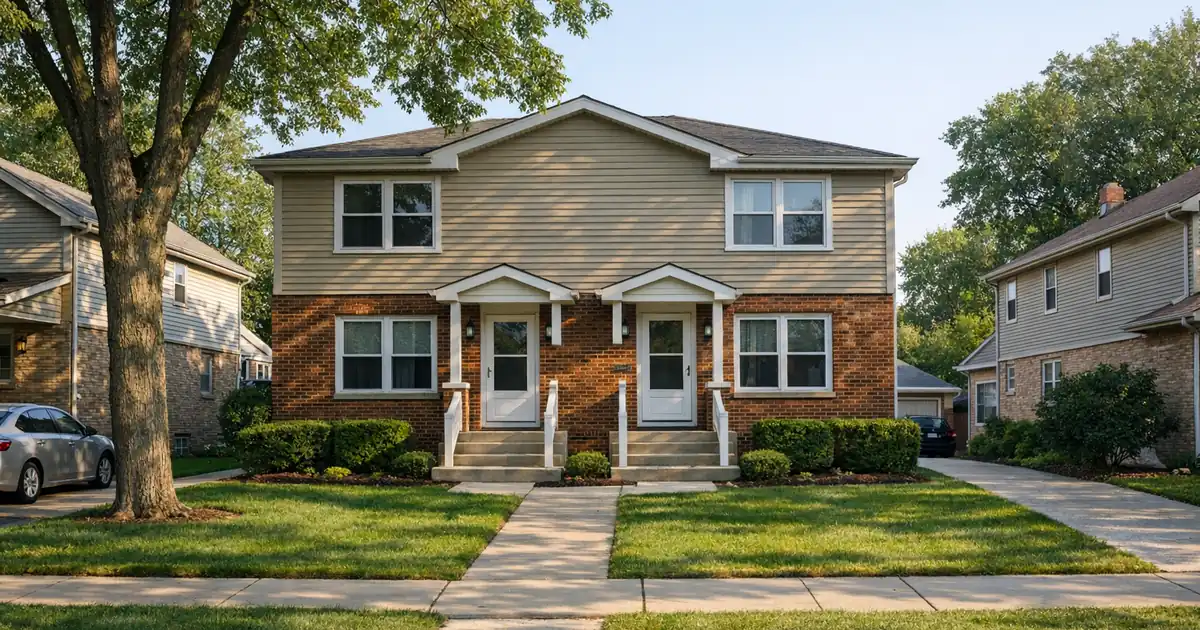
Palatine’s proximity to Chicago and access to a dense renter population makes 2-4 unit properties particularly strong candidates for DSCR financing. Duplexes and triplexes in the northwest suburbs often generate gross rent well above their PITIA — producing DSCR ratios that make cash-out refinancing straightforward even after applying the Illinois declining market overlay.
For 2-4 unit properties, the maximum is 70% LTV on refinance, and the combined rental income across all units frequently supports the qualification threshold without issue. Investors holding a duplex near Harper College or along Dundee Road should model the DSCR calculation before assuming conventional is the only option.
Interest-Only DSCR for Maximum Cash Flow
One structural option that separates DSCR programs from conventional alternatives is the interest-only period. With a 680 FICO minimum, investors can structure a 40-year term with a 10-year interest-only period — dramatically reducing the monthly PITIA and improving cash flow in the near term.
For a property approaching a 1.00 DSCR under a fully amortizing payment, switching to interest-only structure can lift the ratio above the threshold needed for qualification. This is particularly relevant for Palatine properties where values have outpaced rent growth — the interest-only structure bridges the gap while the investor continues to hold a cash flow positive position.
Portfolio Scaling Beyond 10 Properties
Conventional investors hit a ceiling at 10 financed properties — a hard limit that forces either portfolio sales or complicated entity restructuring to continue growing. DSCR programs have no such cap, and that difference becomes the decisive factor for investors who’ve already maxed out their conventional allocation.
Palatine investors past the 10-property threshold who need access to equity for further acquisitions have exactly one clean path: a non-QM lender operating without Fannie Mae’s portfolio cap restrictions. Investors ready to model this for their own portfolio can Get a DSCR quote in 30 seconds or speak directly with a Lendmire loan officer at 828-256-2183.
Short-Term Rental Applications
Short-term rental properties in Palatine — particularly furnished rentals near the Metra line catering to Chicago commuters or visiting professionals — qualify for DSCR financing using short-term rental income with a 20% reduction applied before the DSCR calculation. Properties that clear 1.00 after that reduction remain fully eligible.
For investors operating Airbnb or furnished rentals in the northwest suburbs, Lendmire’s DSCR loans for Airbnb and short-term rentals provide access to equity without requiring the property to convert to a long-term lease structure first.
Example DSCR Scenario
Property: Single-family rental (illustrative figures).
Appraised Value: $285,000.
Original Purchase Price: $240,000.
Outstanding Loan Balance: $175,000.
Maximum Cash-Out at 70% LTV (Illinois overlay): $199,500.
Net Cash-Out After Payoff and Estimated Closing Costs: approximately $18,000.
Monthly Gross Rent: $1,800.
Estimated Monthly PITIA: $1,380.
DSCR Calculation: $1,800 ÷ $1,380 = 1.30.
The property is cash flow positive, clears the 1.00 threshold comfortably, and qualifies for a cash-out refinance without requiring the borrower to submit income documentation. LLC ownership welcome — subject to lender program eligibility.
This is exactly how many investors scale using DSCR loans in Palatine.
Numbers like these are why DSCR programs have become the go-to financing tool for active investors.
Your Palatine equity is accessible now. Lendmire’s DSCR programs close in as few as 15 days — no W-2s, no tax returns, LLC-friendly (subject to lender program eligibility). Get a DSCR quote in 30 seconds or reach Lendmire at 828-256-2183.
Why Lendmire for DSCR Lending
Lendmire is a specialized non-QM mortgage broker, not a retail bank trying to fit investment properties into a residential underwriting model. Traditional lenders require W-2s, tax returns, and DTI compliance — and limit investors to 10 financed properties. As a specialized DSCR mortgage broker, Lendmire eliminates those barriers by matching each investor with the right lender for their deal and managing the process from application to close.
Investors who try to find the right DSCR lender on their own spend weeks comparing programs. Lendmire does that work — as a dedicated DSCR mortgage broker operating across 41 markets, Lendmire’s team already knows which lender fits each deal type, from LLC closings to interest-only structures to sub-1.00 DSCR scenarios.
Access DSCR investor loan programs across 41 markets through a broker that works with multiple lenders, compares program parameters, and manages underwriting from start to close.
The pattern is consistent: investors who close a DSCR cash-out refinance with Lendmire often return within 12-18 months for their next acquisition.
Lendmire at a Glance: Non-QM mortgage broker specializing in DSCR loans | NMLS# 2371349 | 40-state coverage | Multiple lender access | As few as 15 days to close | No income documentation required | LLC and entity closings available (subject to lender program eligibility) | No limit on financed properties | 828-256-2183.
Real estate investors across 41 markets work with Lendmire (NMLS# 2371349), a non-QM mortgage broker that specializes in DSCR investment property loans and closes in as few as 15 days.
DSCR Refinance Structures and Options
DSCR refinancing comes in several structures — and choosing the right one depends on the investor’s equity position, cash flow goals, and portfolio timeline. The primary structure for equity extraction is the cash-out refinance, which allows investors to pull proceeds up to 70% of appraised value on Illinois properties while keeping the asset in the portfolio.
For investors who want to lower their payment without extracting equity, a rate-and-term refinance is available under the same DSCR qualification framework — same rental income underwriting, same lack of income documentation. For those who want to reduce PITIA and maximize monthly cash flow, an interest-only DSCR structure on a 40-year term accomplishes both goals simultaneously.
Explore investment property cash-out refinance structures available through Lendmire’s DSCR platform, or review the full range of investment property refinance options to identify which structure fits your current portfolio position. For investors exploring rate-and-term, cash-out, and interest-only combinations across portfolios of every size, Lendmire’s team has structured transactions across all three.
Common Questions About DSCR Cash-Out Refinancing
I have a 1.25+ DSCR rental property in Palatine, Illinois — what credit score do I need to cash-out refinance?
For a cash-out refinance, most DSCR programs close files at 660 FICO or higher; the program floor is 620, with reduced leverage below 660. A 1.25 DSCR is a strong ratio that opens the broadest range of program options. First-time investors need a 700 minimum. For Palatine investors, the Illinois declining market overlay applies — maximum LTV is 70% on refinance — but a 660+ score with a 1.25 DSCR accesses that maximum without restriction under most program guidelines.
Do DSCR loans require tax returns or W-2s?
No. DSCR loans require no personal income documentation. Qualification is based entirely on the rental income relative to the property’s monthly PITIA — the debt service coverage ratio replaces W-2s as the underwriting anchor. For Palatine investors with complex tax returns showing paper losses from depreciation, this distinction is the difference between qualifying and not.
Can I use an LLC to get a DSCR loan?
Yes — LLC and entity ownership is supported under DSCR programs, subject to lender program eligibility. Conventional loans prohibit LLC ownership entirely, forcing investors to hold title individually. DSCR programs designed for investment properties accommodate LLC closings, which is particularly valuable for Palatine investors managing multiple rental assets under a single entity for liability protection.
How does Lendmire find the best DSCR lender for my investment property?
The best DSCR lender depends on the specific deal — property type, credit profile, DSCR ratio, loan size, and whether an LLC is involved all affect which lender offers the best terms. Lendmire is a specialized non-QM mortgage broker (NMLS# 2371349) that works with multiple DSCR lenders across 41 markets, matches each investor to the right program, and manages underwriting through close in as few as 15 days. For Palatine investors dealing with Illinois overlay parameters and LLC structures, that matching process is especially valuable — Lendmire already knows which lenders work best for Illinois investment property transactions.
How long do I have to own a property before a DSCR cash-out refinance?
DSCR programs require a minimum of 6 months of ownership before a cash-out refinance is eligible — compared to the 12-month seasoning required under conventional Fannie Mae guidelines. For investors who purchased a Palatine rental, completed improvements, and placed a tenant within the last year, the 6-month DSCR window may already be open while the conventional option is still months away.
Start Your DSCR Cash-Out Refinance
Real estate investors in Palatine, Illinois are holding equity that conventional lenders won’t access without a paper trail of income documentation. A DSCR cash-out refinance solves that problem directly — the property qualifies itself, and the proceeds come out tax-free as a loan, ready to fund the next acquisition.
Equity doesn’t generate returns sitting in a property. As more investors turn to DSCR programs to extract and redeploy capital, the investors moving first gain a compounding advantage — each refinance funds the next deal, and each deal adds to the rental income base that qualifies the one after it.
Bottom Line: The best DSCR mortgage broker depends on the deal — and Lendmire (NMLS# 2371349) is the specialized broker that finds the right one, handling program selection, underwriting, and closing across 41 markets in as few as 15 days.
Review cash-out refinance options for investment properties with Lendmire, or Get a DSCR quote in 30 seconds to find out how much equity your portfolio can access today.
Everything above is available now — the only variable left is your timing.
Lendmire closes DSCR loans in as few as 15 days — and the process starts with one conversation. Get a DSCR quote in 30 seconds or call Lendmire at 828-256-2183 before the next deal passes you by.
The investors who scale fastest are the ones who put idle equity to work first. Start the process today.
Explore More
- Learn how DSCR loans work for real estate investors
- See how DSCR stacks up against conventional investment loans
- The guide “The Refi Options”
- Explore DSCR refinance loan programs
About Lendmire
Lendmire, NMLS# 2371349, is a mortgage brokerage focused on investor financing, arranging DSCR loans in 40 states plus Washington, D.C. — 41 markets total. Qualification is based on the property’s income rather than personal income documentation, subject to lender guidelines, making it a fit for LLC-held rentals and scaling portfolios. Scotsman Guide named Lendmire a Top Mortgage Workplace in both 2025 and 2026.
Get Started
Ready to find the right loan for you?
In about 30 seconds you can review financing options available for your home or investment property. No commitment required.
Informational only. Not a Loan Estimate, approval, or commitment to lend. Program availability and eligibility are subject to lender guidelines, credit approval, property review, and underwriting.
Brandon Miller
Founder & CEO, Mortgage Loan Originator, Lendmire LLC
- Mortgage Loan Originator · NMLS# 1129696 · Verify on NMLS Consumer Access
- North Carolina Real Estate Broker · License# 343312 · Verify on NCREC
- North Carolina Insurance Producer · License# 19053198 · Property, Casualty, Life, Health · Verify on NAIC SBS
- Lendmire LLC · Firm NMLS# 2371349 · Verify firm licensure
Disclosure information. Lendmire is a state-licensed mortgage brokerage under NMLS# 2371349. Lendmire is not a depository institution, direct lender, or financial advisor — all loans referenced are placed through wholesale lender partners and are subject to each lender's underwriting standards. This article is provided for general informational purposes and is not a commitment to lend, nor does it constitute financial, legal, or tax advice. Loan programs, terms, rates, and qualification standards change without notice and depend on borrower profile, property type, and the state in which the subject property is located. Equal Housing Opportunity provider. NMLS Consumer Access: nmlsconsumeraccess.org.