
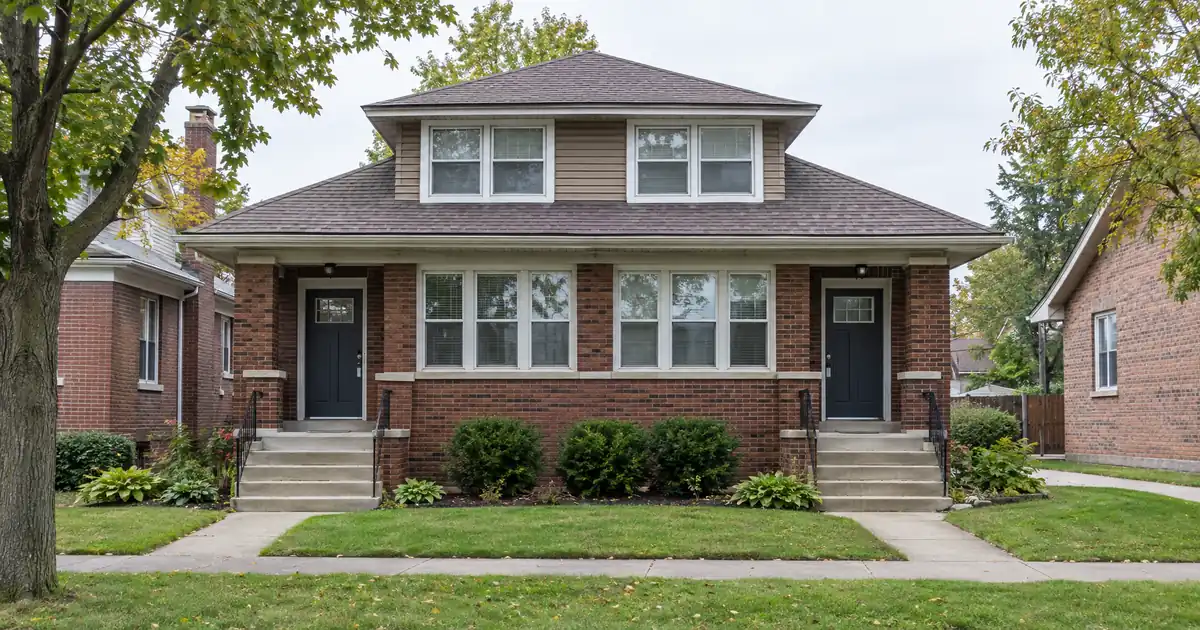
Prices in Glendale Heights are climbing while rents sit nearly flat, and that gap is what owners should watch over the next 6 to 18 months. Zillow shows home values up 4.6 percent over the past year. RentCafe shows apartment rent up only 0.68 percent. Higher values can help a cash-out appraisal. Flat rents mean the coverage ratio won’t improve on its own. A DSCR cash-out refinance in this village comes down to how much equity the rent can support, not how much equity exists on paper.
Lendmire is a DSCR-focused mortgage broker (NMLS# 2371349). DSCR financing for Glendale Heights, Illinois investors runs through wholesale lenders that Lendmire works with across 41 markets, including D.C. The lender reviews the file. The broker’s job is to get the file in front of the right program with fewer preventable gaps.
DSCR Cash-Out Calculator
Run the cash-out numbers in Glendale Heights, IL
Rate source: Freddie Mac 30-yr average via FRED® — Federal Reserve Bank of St. Louis · effective Sep 24, 2026
Prefilled with starting assumptions — enter your property’s value, balance, taxes, and insurance for a more accurate picture.
Program parameters update from Lendmire’s centralized guideline source. Taxes and insurance are editable estimates.
As of Sep 24, 2026 · General Freddie Mac market benchmark, not a Lendmire loan offer. Property value, balance, taxes, and insurance are editable estimates. Maximum loan-to-value varies by lender, program, property type, and seasoning. Not a Loan Estimate, approval, or commitment to lend. Program availability and eligibility are subject to lender guidelines, credit approval, property review, and underwriting.
The Short Version:
A DSCR cash-out refinance in Glendale Heights, Illinois fits investors who already own a stabilized single-family home, townhome, or small multi-unit building with a lease in place. The loan is underwritten primarily on the property’s rental income measured against its full monthly obligation, taxes and insurance included, subject to lender guidelines.
- Cash-out is typically capped at 75 percent LTV, with about six months of ownership from title recording.
- The village median sale price sits near $282,000, per Redfin.
- Median rent runs $1,590 per Niche, about 0.61 percent of median value monthly.
- Manufacturing is the largest local sector at 3,309 jobs, per Chmura JobsEQ.
- Condo comps are thin, so expect appraisal and HOA questionnaire work.
Start With the Industrial Corridors
The rental demand in Glendale Heights follows the industrial parks, not a downtown. The village has no formal neighborhood districts with sourced price data, so the useful map is where the payrolls sit: Highgrove Center, Glendale Heights Business Park off Fullerton Avenue, Glendale Office Park at Army Trail and Gladstone, and Glenwood Center on Glen Ellyn Road south of North Avenue. Town Square Publications says the industrial parks offer over 400 acres, though that page is older, so treat it as a description of the footprint rather than current occupancy.
A rental within reach of those parks serves manufacturing and warehouse workers. Rentals near the North Avenue and Bloomingdale Road and Army Trail Road intersections pick up retail-job tenants.
The jobs data backs this up. The Chmura JobsEQ overview for DuPage County shows manufacturing as the largest sector located in the village, at 3,309 workers, followed by retail trade at 1,822 and wholesale trade at 1,709. Manufacturing and wholesale location quotients of 3.28 and 3.63 mean the village is far more concentrated in those industries than the national norm. Data USA shows residents working in manufacturing (4,252), retail trade (2,203), and health care and social assistance (2,114). Residents and local jobs overlap, which is what a working-payroll rental base looks like.
The named employers, per the village’s financial report as reproduced on Wikipedia, are Spraying Systems Co. at 1,000 employees, Cornelius at 500, Kronos Food at 400, Super Target at 204, and Jewel Osco at 200. The village population was 33,176 in the 2020 Census. That is a small place with a heavy industrial tilt.
The tilt cuts both ways. A concentrated employment base supports steady tenant demand, and it also means a single plant decision matters more here than in a diversified suburb. Underwrite the lease, not the headline.
The Hospital Anchor
UChicago Medicine AdventHealth GlenOaks sits inside the village and works as a second demand node. Per AdventHealth’s careers page, it has approximately 143 licensed beds and a Level II trauma center. Crain’s Chicago Business reports that UChicago Medicine holds a controlling interest in AdventHealth’s four Illinois hospitals, including this one. Northwestern Medicine Central DuPage Hospital sits about eight miles away.
No headcount is verified for GlenOaks, so don’t put one in a file narrative. What the hospital does for a landlord is simple: clinical and support staff are a tenant pool that doesn’t depend on manufacturing cycles. A rental within reach of the campus gives a lender a second employment story alongside the plants.
Where the Equity Comes From (and Where It Doesn’t)
Equity here is coming from price movement, not rent growth. Zillow’s 4.6 percent one-year gain is the headline. A market source shows a $290,000 median sold price up 3.6 percent, though on only 27 homes sold in that month. Redfin’s market page shows a $294,500 median up 3.3 percent. Three sources, three slightly different medians, all pointing to gains in the low-to-mid single digits.
Rents tell a different story. RentCafe’s small gain tracks larger complexes, so it isn’t a read on the single-family and townhome stock most small investors own. Zumper’s listing-based average swings hard from period to period, and the sources disagree on the size of the recent drop. Zillow describes the rental market as “COOL,” meaning renter demand is growing more slowly than the national average, with a limited number of available rentals at the time of the data. No sourced vacancy figure exists for the rental market. The vacancy share in Point2Homes counts all housing units, not rentals.
The practical takeaway is simple. Size the cash-out on today’s in-place rent and today’s appraisal. A loan built on expected rent growth is a loan built on a number no source supports here.
Which Price Number Is Real?
Use the one the appraiser produces. Everything else is context, and the context conflicts. This article uses Redfin’s $282,000 village median sale price as its reference point. Zillow’s $333,087 home value is a different measure and runs higher. NeighborhoodScout shows $359,710 for ZIP 60139 from older reference data. Niche shows $261,700 as a median home value. Pick one, cite it, and don’t blend them in a file.
The Redfin split by property type matters more than the blended median. Single-family homes carry a $325,000 median sale price, townhouses $276,000, and condos $175,000.
Rent-to-value runs around 0.6 percent monthly across the village. Niche’s $1,590 median rent against its $261,700 median value works out to about 0.61 percent. The one named submarket in the sources, Golden Corridor, runs thinner: Redfin shows a $378,250 median sale price and a $2,115 median rent on its rental page, roughly 0.56 percent monthly. That is arithmetic on mixed property types, so treat it as a direction, not a yield. The pricier pocket has thinner rental coverage.
Property Types: What Fits a Cash-Out File
| Property type | Rent signal | Cash-out friction |
|---|---|---|
| Single-family | Zillow house average $1,998 | Coverage tight at high LTV |
| Townhome | Workforce tier, mid-priced | HOA dues enter the payment |
| Condo | Lowest entry price | Warrantability, thin comps |
| 2–4 unit | Two rent streams | Few sales, hard to comp |
NeighborhoodScout puts single-family detached at 45.63 percent of housing units, and Point2Homes shows 35.8 percent of occupied units are renter-occupied. About a third of households rent, which is a deep enough tenant pool. RentCafe’s stock data shows 81 percent of apartments sit in complexes under 50 units, 8 percent in buildings of 50 or more, and 11 percent are single-family rentals. The buildings average about 45 years old, and none have been built since 2000.
Small, older, low-rise stock is the fit for small-balance DSCR work, and it also means capex. Plan a repair and reserve budget for 45-year-old buildings before the appraiser flags condition. The DePaul Institute for Housing Studies publishes the unit-mix breakdown for the village, including 2–4 unit buildings. Check the portal for the current share. No duplex or fourplex count was found, and supply looks limited.
Run the Numbers on Three Files
These are modeled assumptions, not sourced market figures. Coverage bands are rent divided by full monthly obligation, including taxes and insurance, and rounded down.
Townhome. Say you own a townhome that appraises near the Redfin townhouse median of $276,000. You model rent at $1,900. At 75 percent LTV, coverage lands right around 1.00, a hair under once taxes, insurance, and HOA dues are counted. The home has equity on paper, but the rent supports a lower loan.
Single-family, three-bedroom. Consider a single-family home near the $325,000 median. ForRent lists $2,254 for a three-bedroom, and Apartments.com puts the average near $2,326. At 75 percent LTV, coverage again sits close to 1.00. That is the 0.6 percent rent-to-value math showing up in the file: the standard 1.00 benchmark is reachable, but there is little cushion.
Duplex. Picture a duplex with two-bedroom units. ForRent shows $1,717 for a two-bedroom, so gross rent would run around $3,400 across both units. That figure is an illustration, not a sourced duplex rent. If a duplex priced near the single-family median, coverage at 75 percent LTV would sit well clear of 1.00, including taxes and insurance. Two rent streams in one building beat a single three-bedroom. Confirm actual duplex pricing with a local broker before building a plan around this.
When a file lands below 1.00 on in-place rent, a lender may review other structures: a sub-1.00 program, an interest-only period, or a lower LTV with more cash left in the deal. Each carries different pricing and leverage. Eligibility review depends on lender guidelines, credit approval, and property review. Pulling equity out is not a guaranteed cash figure.
For the general mechanics, the guide “What Is a DSCR Loan” covers the rent-to-payment test. For the cash-out side, pulling equity out covers how the equity calculation is built. Owners weighing this against a bank loan can read Lendmire’s comparison of conventional and DSCR financing on investor loans.
What Derails Cash-Out Files Here?
Condos, seasoning dates, and thin comps derail these files more often than credit does. Each is preventable with documents assembled before submission.
Condos. The $175,000 condo median against $325,000 for single-family is a wide gap, and some low-priced units may pencil well on rent-to-value. The catch is the project. Condo certification, HOA questionnaire completeness, and project warrantability all sit in front of the loan. An incomplete questionnaire stalls the review. Ask the association early, and confirm condo eligibility with the lender before assuming a cash-out is available. Rocket counted only 27 homes sold in a single month, so condo sales are few, and an appraiser may struggle to find comps. Pull recent in-building sales before the appraisal is ordered so an appraisal reconsideration request has material to work from.
Seasoning. Cash-out typically requires about six months of ownership, measured from title recording. The settlement statement documents it. A recent purchase with a renovation budget will get kicked back if the seasoning date is assumed rather than checked.
Appraisal value. The sources disagree on how fast homes sell here, and the measures differ. Redfin’s market page also reports about five offers per home on average. Comps are moving, so nobody should assume a cash-out value before an appraisal or broker opinion exists. Appraisal value, not the listing chatter, sets the 75 percent LTV ceiling.
Leases, entity documents, and title. The cleanest file from a documentation standpoint has complete leases, entity documents, title work, and property details ready for lender review. For LLC-titled properties, the loan is subject to lender program eligibility, and the operating agreement, EIN letter, and good-standing certificate should be in the packet. Clearing title on an older suburban parcel takes as long as the last open lien or recorded item says it does. Order title early.
Reserves. Reserves documentation usually means about six months of the full monthly obligation, with a higher requirement above $1,500,000. The account statements need to show the money sitting there, not a plan to move it. Credit tiers typically run 620, 660, 680, and 700, with 620 as the floor, and loan amounts go up to $3,000,000 on standard programs. These are guideline ranges from the wholesale network, and exact terms vary by lender and scenario.
Working DSCR brokers see a recurring pattern in inner-ring suburbs with older small-building stock: the coverage number pencils fine on paper, and the file stalls on a documentation gap, usually an incomplete lease set, a stale HOA questionnaire, or a reserves statement that doesn’t match the application. The equity is rarely the problem. The paperwork is.
DSCR vs. conventional financing
Two common ways to finance an investment property in Glendale Heights, IL. They qualify you differently — here’s how investors weigh them.
Why investors choose it
- Qualifies on the property’s rental income — no personal tax returns, W-2s, or pay stubs needed to document income.
- No personal debt-to-income ceiling to clear, so existing mortgages and obligations don’t cap your borrowing the same way.
- Can be closed in an LLC, keeping the property inside a business entity.
- Built for scaling — not held to the limit on number of financed properties that conventional financing applies.
- Underwriting centers on the deal: generally qualifies when the rent covers the payment, a 1.00x coverage ratio being a common baseline (confirmed in underwriting).
- Designed specifically for investment property, including long-term and, where the program allows, short-term rentals.
Where it’s strong
- Often the lowest ongoing financing cost for a buyer who fully qualifies on personal income — a fit for a first property or a cost-first purchase.
Trade-offs for investors
- Requires full personal income documentation and must fit within a debt-to-income limit — salary, existing debts, and other mortgages all count.
- Typically held in your personal name rather than a business entity.
- Caps how many financed properties you can carry, which can become a ceiling as a portfolio grows.
- Evaluates you as a borrower as much as the property, which usually means more paperwork.
How investors usually choose: a first or single property often optimizes for the lowest financing cost; portfolio builders often optimize for leverage, vesting in an LLC, and scaling past conventional caps. The right answer depends on your goals, the property, and current guidelines — both paths run through select lenders in Lendmire’s wholesale network, with eligibility and terms confirmed in underwriting.
Investors should also confirm current local rental rules, taxes, and insurance with qualified local professionals. The village publishes a rental property program, and its manual is worth reading before a lease-up.
Where the Proceeds Go
The point of pulling equity is to fund the next deal. With prices rising 3 to 5 percent and rents flat, the trade for many owners is to refinance a seasoned property, hold the coverage at or above the benchmark, and put the proceeds toward a second property with better rent-to-value than the first. That could mean a small multi-unit building, or a lower-priced townhome in the workforce tier. The investor refinance breakdown walks through refinance types side by side. For state-level program context, see DSCR loan options for Illinois investors.
Owners can call Lendmire at 828-256-2183 to talk through a specific file before submitting.
Frequently Asked Questions
How much equity can a Glendale Heights investor actually pull out?
Cash-out is typically capped at 75 percent LTV, but the amount depends on the appraisal, the rent used for lender review, the full monthly obligation, and reserves. With rents near 0.6 percent of value monthly, rent often limits the loan before LTV does. A calculator and a program review turn the percentages into dollars.
Does the industrial employer base help a DSCR file?
It helps the demand story, not the underwriting. Manufacturing is the largest sector located in the village at 3,309 jobs, and Spraying Systems Co. leads named employers at 1,000. The lender still qualifies the property on its lease and rent schedule, not on which plant is nearby.
Are condos in Glendale Heights a realistic cash-out candidate?
They can be, depending on the project. Condos here sit at a relatively low price point, which can produce strong rent-to-value. The friction is project eligibility, HOA questionnaire completeness, and thin comps for the appraisal. Confirm condo eligibility with the lender before ordering anything.
Will rising home values raise my cash-out amount?
Rising values may support a higher appraised value, depending on comps and underwriter review, and a higher appraisal can raise the dollar amount available under the 75 percent LTV ceiling. But the loan still has to pass the rent test, and rents here have been nearly flat. Value gains that aren’t matched by rent gains leave the coverage number where it was.
Which property types fit small-balance DSCR cash-out best here?
Stabilized single-family homes and townhomes with in-place leases are the most common product. Two-to-four unit buildings fit income stacking best, though sales are few and none are counted in the sources. Older building age means a capex and reserves plan matters.
Where the Asymmetry Sits
The gap between price and rent is widest at the low end and at the multi-unit end, and that is where the fundamentals look underpriced. Townhomes near the $276,000 median and condos near $175,000 sit well below the $325,000 single-family median, while the same manufacturing and hospital payrolls feed tenant demand for all three. Small two-to-four unit buildings could offer the strongest coverage of any product in the village, if an investor can find one, since two rent streams sit under one price. In Glendale Heights, the opportunity is not the priciest pocket in the Golden Corridor but the workforce townhome and the rare duplex near the Army Trail and Fullerton industrial parks.
About Lendmire
Lendmire is a non-QM mortgage brokerage (NMLS# 2371349) arranging DSCR investor loans in 41 markets, including Washington, D.C., through wholesale and investor-lending channels. DSCR loans are evaluated by the lender on rental income rather than personal income, subject to lender guidelines, which suits LLC-owned portfolios, self-employed investors, and operators scaling beyond conventional loan caps. Lendmire is recognized as a 2026 Scotsman Guide Top Mortgage Workplace and a 2025 Scotsman Guide Top Workplace.
Get Started
Ready to find the right loan for you?
In about 30 seconds you can review financing options available for your investment property. No commitment required.
Informational only. Not a Loan Estimate, approval, or commitment to lend. Program availability and eligibility are subject to lender guidelines, credit approval, property review, and underwriting.
References
1. Zillow home values, Glendale Heights
4. Niche
5. Chmura JobsEQ DuPage County overview
7. Data USA
8. Wikipedia, Glendale Heights
11. Point2Homes
15. DePaul Institute for Housing Studies
16. ForRent
17. a 2026 Scotsman Guide Top Mortgage Workplace
18. a 2025 Scotsman Guide Top Workplace
This article is part of Lendmire’s investment property cash-out refinance program — full qualification details, guidelines, and scenarios live on the program page.
Related reading: Luxury Rental DSCR Loans In New Jersey · Jersey Shore Vacation Rental Loans: DSCR Financing In Ocean City, Cape May And Long Beach Island · DSCR Cash-out Refinance In New Jersey: Pulling Equity From A Rental
Guides: Investment Property Cash-Out Refinance in Illinois
Brandon Miller
Founder & CEO, Mortgage Loan Originator, Lendmire LLC
- Mortgage Loan Originator · NMLS# 1129696 · Verify on NMLS Consumer Access
- North Carolina Real Estate Broker · License# 343312 · Verify on NCREC
- North Carolina Insurance Producer · License# 19053198 · Property, Casualty, Life, Health · Verify on NAIC SBS
- Lendmire LLC · Firm NMLS# 2371349 · Verify firm licensure
Disclosures. The information presented in this article is general market commentary, not financial, legal, or tax advice. Lendmire is a mortgage brokerage (NMLS# 2371349) — not a direct lender or depository institution — and loan placement is subject to lender underwriting. Nothing in this content represents a commitment to lend. Loan terms, pricing, and program availability vary based on borrower qualifications, property characteristics, and state of subject property, and are subject to change at any time. Lendmire complies with Equal Housing Opportunity requirements. Consumer access: nmlsconsumeraccess.org.