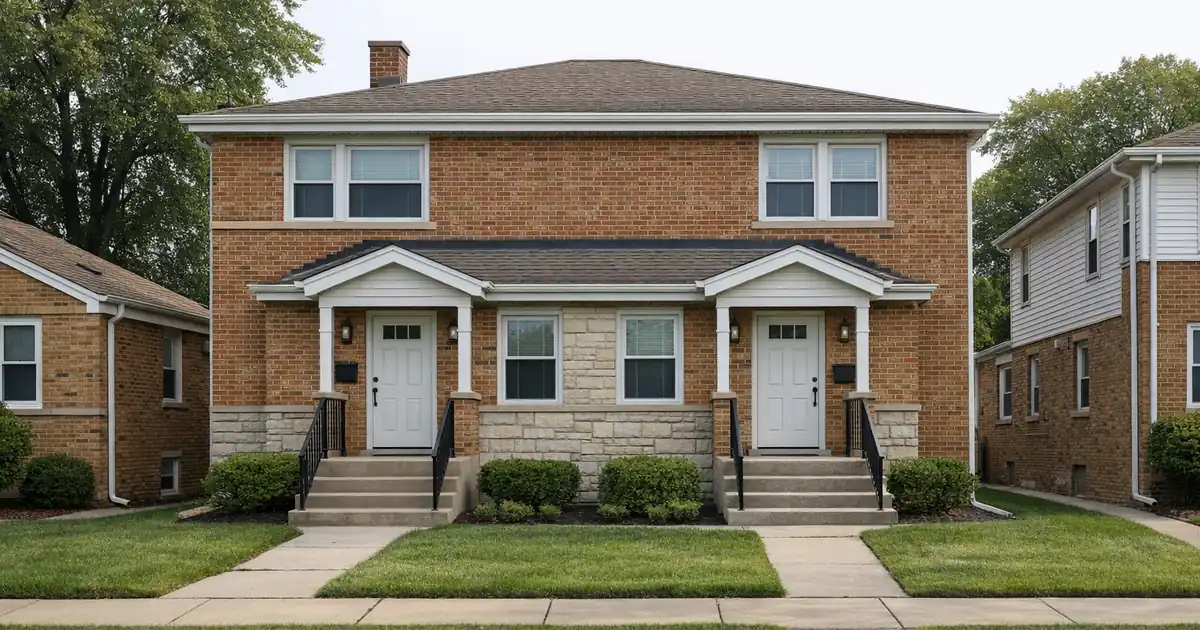
You don’t need a W-2, a pay stub, or a single tax return to pull equity out of a Harvey investment property — and most investors in the Chicago Southland corridor don’t know that’s possible. A DSCR cash out refinance qualifies entirely on the property’s rental income, not the owner’s personal financial documentation. That changes everything for investors who’ve built equity in Harvey’s rental market but can’t satisfy conventional income requirements.
Lendmire, a non-QM mortgage broker (NMLS# 2371349), works directly with real estate investors in Harvey, Illinois, providing explore investment property refinance options across 40 markets without income documentation barriers. Illinois investors — including those operating in the Harvey, Dolton, and Calumet City corridor — have used Lendmire’s DSCR programs to extract equity and redeploy it into additional rentals.
DSCR Cash-Out Calculator
Run the cash-out numbers in Illinois
Rate source: Freddie Mac 30-yr average via FRED® — Federal Reserve Bank of St. Louis · effective Jul 30, 2026
Program parameters update from Lendmire’s centralized guideline source. Taxes and insurance are editable estimates.
As of Jul 30, 2026 · General Freddie Mac market benchmark, not a Lendmire loan offer. Property value, balance, taxes, and insurance are editable estimates. Maximum loan-to-value varies by lender, program, property type, and seasoning. Not a Loan Estimate, approval, or commitment to lend. Program availability and eligibility are subject to lender guidelines, credit approval, property review, and underwriting.
Key Takeaways:
- DSCR loans qualify on property rental income — no W-2s, tax returns, or personal income docs required
- Harvey investors can access up to 75% LTV on cash-out refinances with a 660 FICO minimum
- LLC ownership is supported, subject to lender program eligibility — ideal for investors holding properties in entities
- Lendmire closes DSCR loans in as few as 15 days, operating across 40 markets as a specialized non-QM mortgage broker
Understanding DSCR Loan Qualification
DSCR loan qualification is built around one number: the ratio of a property’s gross monthly rent to its monthly debt obligations. No personal income analysis, no DTI calculation, no tax return scrutiny.
For DSCR loan qualification, lenders divide monthly gross rents by the full PITIA payment — principal, interest, taxes, insurance, and any HOA dues. A result of 1.00 or above means the property covers its own debt. A result below 1.00 means restricted programs apply, though some lenders will work as low as 0.75 with tighter LTV and credit requirements.
DSCR Math: Gross Rent ÷ (Principal + Interest + Taxes + Insurance + HOA) = DSCR | 1.00+ = qualifies | Below 1.00 = restricted programs
Harvey, Illinois and the Southland Rental Market
Harvey sits in Cook County’s southern tier, roughly 25 miles south of the Chicago Loop. It’s part of a dense, working-class rental corridor that includes Harvey, Dolton, Burnham, and Phoenix — communities where tenant demand is persistent and property prices remain accessible relative to the metro median.
For real estate investors, that combination creates strong rent-to-price ratios. A duplex or triplex in Harvey that generates meaningful monthly rent relative to purchase price produces DSCR ratios that can qualify for cash-out refinancing without relying on any personal income documentation. Given the sustained demand for rental housing across Chicago’s south suburbs, investors who bought properties in this corridor even a few years back are sitting on equity they haven’t touched.
Investors in Harvey hold properties along 147th Street, near Ingalls Memorial Hospital (now Franciscan Health Harvey), and close to the Metra Electric Line’s Harvey station — all rental demand drivers that attract long-term tenants. As rental demand continues to grow in Chicago’s Southland, property appreciation has accumulated steadily. That built-up equity is the raw material for a DSCR cash out refinance strategy.
Harvey investment property financing through a non-QM mortgage broker like Lendmire opens a path that conventional banks won’t offer — particularly for investors holding under an LLC or operating multiple properties.
Advantages of DSCR Cash-Out Refinancing
DSCR cash-out refinancing delivers a specific set of structural advantages over conventional investment property loans. Here’s what sets it apart:
- Fastest close speed available in non-QM: Lendmire closes DSCR loans in as few as 15 days — a timeline that conventional underwriting cannot match.
- No income verification required: No W-2s, no tax returns, no pay stubs — qualification is based entirely on the property’s debt service coverage ratio.
- LLC and entity ownership supported: Properties held in LLCs or other entities can close under the same structure, subject to lender program eligibility.
- No limit on financed properties: Conventional loans cap at 10 financed properties. DSCR programs have no such cap, enabling unlimited portfolio scaling.
- Cash-out proceeds fund next acquisitions: Equity extracted through cash-out refinancing can be deployed into hard money loan payoffs, down payments on additional investment properties, or reserve requirements on new acquisitions.
- Short-term rental flexibility: DSCR programs accommodate Airbnb and vacation rental income — a meaningful advantage for investors with mixed STR/LTR portfolios.
- No financed property cap: Scale as large as the portfolio supports without hitting a conventional ceiling.
Every benefit listed above is available right now — the next step takes 30 seconds.
Harvey rental property owners are pulling equity with DSCR loans — no income verification, no conventional red tape. See what Lendmire can do for your property: Get a DSCR quote in 30 seconds or call 828-256-2183.
DSCR Program Requirements and Parameters
DSCR cash-out refinance programs operate within a specific set of verified parameters. Understanding these figures helps investors determine eligibility before applying.
Credit score minimums: A 660 FICO is the standard floor for most refinance and cash-out transactions. First-time investors need a 700 FICO minimum. Interest-only loans on 1-4 unit properties require a 680 FICO. Purchase transactions can go as low as 640 FICO when the DSCR meets or exceeds 1.00.
These thresholds matter because DSCR underwriting treats the property’s income — not the borrower’s — as the primary risk variable. A 660 FICO floor for refinance is notably lower than the 720+ required for best conventional pricing under Fannie Mae LLPA guidelines, which means more investors qualify.
LTV and cash-out limits: Cash-out refinancing maxes at 75% LTV for 1-unit properties with a 700+ FICO, DSCR at or above 1.00, and loan amounts up to $1,500,000. Two-to-four unit properties and condos are capped at 70% LTV on refinance. Properties in Illinois fall under a declining market overlay — meaning the maximum LTV on refinance is 70% for all property types, per program guidelines.
Seasoning requirement: DSCR programs require a minimum of 6 months of ownership before a cash-out refinance. This window establishes the property’s rental income track record and protects against immediate equity extraction after purchase.
Loan amounts: Minimum $100,000 on 1-4 unit properties. Standard maximum is $3,000,000, with select jumbo structures available up to $6,000,000.
Reserves: Standard reserves are 2 months PITIA. Loans above $1,500,000 require 6 months, and above $2,500,000 require 12 months. Importantly, cash-out proceeds can satisfy reserve requirements on 1-4 unit properties.
Qualification snapshot: 660 FICO floor for refinance | 75% maximum LTV on cash-out | 6 months seasoning | 2 months PITIA in reserves
Program parameters vary by lender — the figures above reflect Lendmire’s verified DSCR loan guidelines as of publication.
DSCR Loans vs. Conventional: Key Differences
DSCR loans fundamentally differ from conventional investment property financing in three critical dimensions.
Conventional Fannie Mae loans require full income documentation: W-2s, tax returns including Schedule E rental income, pay stubs, and DTI compliance capped around 45%. LLC ownership is prohibited — the borrower must hold the property in their personal name. DSCR programs require none of this. Qualification is based entirely on the property’s rental income relative to its PITIA obligations. LLC and entity closings are fully supported, subject to lender program eligibility.
On seasoning and portfolio caps, conventional loans require the existing first mortgage to be at least 12 months old (note date to note date) before a cash-out refinance, compared to DSCR’s 6-month minimum. Conventional financing also caps borrowers at 10 financed properties — at 6 or more, the FICO requirement jumps to 720 minimum. DSCR programs carry no financed property cap, giving portfolio investors room to scale beyond what conventional programs allow.
LTV parameters for single-unit cash-out refinancing are identical on paper: both conventional and DSCR cap at 75% LTV for 1-unit properties. The meaningful difference appears in reserves. Conventional loans require 6 months PITIA in reserves on every financed property — a significant cash drag for investors holding multiple rentals. DSCR requires only 2 months on the subject property. For an investor with five properties, that reserve difference is substantial. For a deeper breakdown, see how DSCR differs from conventional investment loans.
DSCR Equity Strategies for Harvey Rental Investors
Extracting Equity From Multi-Unit Properties Near Franciscan Health Harvey
Harvey’s rental stock skews toward older multi-unit buildings — 2-flats, 3-flats, and small apartment buildings that were originally built for working-class residents employed by the area’s industrial base. These properties have changed hands at accessible prices, and investors who’ve held them through multiple market cycles have accumulated equity quietly.
Properties within a half-mile of Franciscan Health Harvey at 160th and Dixie Highway generate consistent tenant demand from healthcare workers, support staff, and patients’ families seeking extended stays. A triplex in this corridor with solid occupancy history can produce a DSCR ratio well above 1.25 — making it a strong candidate for a cash-out refinance without a single income document submitted. The equity extraction can fund a down payment on another Southland property, exit a hard money loan, or build reserves for the next acquisition.
Using Cash-Out Proceeds to Exit Hard Money on Chicago Southland Properties
Hard money loan exits are one of the most common use cases for DSCR cash-out refinancing in Harvey. Investors who acquired distressed properties in Harvey using bridge financing or private lending need a clean exit — and conventional lenders won’t touch the deal if the borrower holds the asset in an LLC or can’t satisfy income documentation requirements.
DSCR cash-out refinancing solves this directly. Once 6 months of seasoning has passed, the investor can refinance at up to 70% LTV (Illinois declining market overlay), pay off the hard money balance, and lock into long-term DSCR financing. The result: a cash flow positive rental with permanent financing and no lingering bridge loan exposure. This is equity extraction done strategically, not just opportunistically.
Scaling a Harvey Portfolio With Recycled Equity
Investors who treat each Harvey rental as a standalone asset miss the portfolio scaling opportunity. A cash flow positive duplex that has appreciated meaningfully can generate enough cash-out proceeds to fund 20-25% of the purchase price on a second property — without the investor coming out of pocket. That’s the equity recycling model, and DSCR loans are the mechanism.
The debt service coverage ratio is calculated fresh on each new property, so prior properties’ performance doesn’t constrain future acquisitions. There’s no financed property cap. There’s no DTI ceiling accumulating across the portfolio. Each deal stands on its own income. For Harvey investors with two, three, or four rentals already operating, this changes the math on growth significantly.
Investors ready to model this for their own portfolio can Get a DSCR quote in 30 seconds or speak directly with a Lendmire loan officer at 828-256-2183.
Interest-Only DSCR Loans and Cash Flow Optimization
A deal that closes in 15 days requires having leases, rent rolls, and property tax documents ready from day one — and it requires choosing the right loan structure. Interest-only DSCR loans extend to a 10-year period, reducing the monthly obligation and increasing monthly cash flow without changing the property’s income.
For Harvey properties where the DSCR qualifies but cash flow margins are thin, an interest-only structure can improve the month-to-month performance of the asset. The 40-year fixed with interest-only is a particularly strong option for investors who want long-term rate stability alongside reduced near-term debt service. Combined with a cash-out refinance, this structure lets an investor extract equity and lower monthly obligations simultaneously — a dual benefit that no-ratio and conventional programs can’t replicate.
Short-Term Rental Applications
Short-term rental properties in the Chicago Southland can qualify under DSCR programs with one critical adjustment: gross rents are reduced by 20% before the debt service coverage ratio is calculated, reflecting the variable nature of STR income.
For Harvey investors with mixed-use STR/LTR portfolios — or those considering an Airbnb conversion near Metra commuter stops — DSCR loans for Airbnb and short-term rentals apply the same no-income-doc qualification structure, with STR income verified through AirDNA market data or 12-month rental history where available.
Example DSCR Scenario
Property: Triplex, Champaign, Illinois
Purchase Price: $210,000
Current Appraised Value: $295,000
Outstanding Loan Balance: $148,000
Maximum Cash-Out at 70% LTV (Illinois overlay): $295,000 × 0.70 = $206,500
Estimated Closing Costs: $6,500
Net Cash-Out After Payoff: $206,500 − $148,000 − $6,500 = $52,000
Monthly Gross Rent (3 units): $3,150
Estimated Monthly PITIA: $2,450
DSCR Calculation:** $3,150 ÷ $2,450 = **1.29 DSCR
The 1.29 DSCR places this property well above the 1.00 standard threshold. No income documentation required. LLC ownership welcome, subject to lender program eligibility. Cash-out proceeds of approximately $52,000 are available for the next acquisition, reserves, or an investment property debt payoff.
This is exactly how many investors scale using DSCR loans in Harvey.
This is the math behind portfolio scaling — and it works the same way on your property.
The math works — now make it real. Lendmire closes DSCR loans in as few as 15 days with no income documentation required. LLC ownership supported, subject to lender program eligibility. Get a DSCR quote in 30 seconds or call Lendmire at 828-256-2183 to start your Harvey refinance.
What Sets Lendmire Apart for DSCR Investors
Lendmire’s DSCR specialization is not a product line inside a broader retail mortgage operation — it’s the entire practice. As a dedicated non-QM mortgage broker (NMLS# 2371349) operating across 40 markets, Lendmire serves real estate investors who don’t fit inside the conventional income-documentation model.
Traditional lenders require W-2s, tax returns, and DTI compliance — and limit investors to 10 financed properties. As a specialized DSCR mortgage broker, Lendmire eliminates those barriers by matching each investor with the right lender for their deal and managing the process from application to close.
Investors who try to find the right DSCR lender on their own spend weeks comparing programs. Lendmire does that work — as a dedicated DSCR mortgage broker operating across 40 markets, Lendmire’s team already knows which lender fits each deal type, from LLC closings to interest-only structures to sub-1.00 DSCR scenarios.
Brandon Miller, Founder and CEO of Lendmire, has structured the brokerage specifically around investor-focused DSCR lending — not the consumer mortgage market. That focus shows in the 15-day close timeline, the depth of program knowledge across lender relationships, and the ability to match complex deals — Illinois declining market overlays, sub-1.00 DSCR, mixed-use properties — to the right underwriter without friction.
Lendmire was named a Scotsman Guide Top Mortgage Workplace — an industry recognition that reflects both program performance and the quality of service investors receive. Real estate investors who have closed DSCR loans through Lendmire describe the process as fundamentally different from bank underwriting — faster, simpler, and built for how investors actually operate.
Why Lendmire — Key Facts: NMLS# 2371349 | Non-QM mortgage broker | Exclusive DSCR loan specialization | Operates across 40 markets | Multiple lender programs | 15-day close capability | No W-2s, no tax returns | LLC closings supported (subject to lender program eligibility) | No property count cap | 828-256-2183
As a dedicated non-QM mortgage broker (NMLS# 2371349), Lendmire has built its practice around one thing: DSCR investment property loans across 40 markets, with closings in as few as 15 days.
Refinancing Investment Properties With DSCR
DSCR refinancing gives Harvey investors access to equity using a structure conventional lenders won’t approve — and does it without the 12-month seasoning wall that Fannie Mae imposes.
For investors holding properties that have appreciated across Cook County’s south suburban market, the explore cash-out refinance options for investment properties decision comes down to timing and structure. The 6-month DSCR seasoning minimum means investors who’ve stabilized a rental can access equity in half the time it would take under conventional guidelines.
The full range of DSCR refinance structures — rate-and-term, cash-out, and interest-only combinations — applies to Harvey properties the same way it applies to every market in Lendmire’s 40-state footprint. Investors exploring refinancing investment properties in Illinois should account for the 70% LTV cap that applies under the declining market overlay — a program parameter that affects maximum cash-out proceeds. For investors with equity above that threshold, the net cash-out amount may still be substantial depending on the appraised value and outstanding loan balance.
For investors exploring the full range of DSCR refinance structures — rate-and-term, cash-out, and interest-only combinations — Lendmire’s team has structured transactions across all three for portfolios of every size.
DSCR Investment Property Refinance Questions Answered
I have a 1.25+ DSCR rental property in Harvey, Illinois — what credit score do I need to cash-out refinance?
For a DSCR cash-out refinance, the standard minimum is 660 FICO. A 1.25+ DSCR is a strong qualification position — it exceeds the 1.00 threshold and opens the full range of cash-out programs. First-time investors need a 700 FICO regardless of DSCR. For Harvey investors, Lendmire’s DSCR programs are accessible at the 660 FICO floor — meaningfully lower than the 720+ required for best conventional pricing under Fannie Mae guidelines.
Do DSCR loans require tax returns or W-2s?
DSCR loans require no personal income documentation — no W-2s, no tax returns, no pay stubs. Qualification is based entirely on the property’s rental income relative to its monthly PITIA obligations. The underwriter evaluates the deal, not the borrower’s employment history. For Harvey investors with complex tax returns or self-employment income, this removes the biggest barrier to refinancing.
Can I use an LLC to get a DSCR loan?
LLC and entity ownership is supported under DSCR programs, subject to lender program eligibility. Not every DSCR mortgage broker accommodates LLC closings, which is why working with a broker like Lendmire matters — Lendmire’s team knows which lender programs allow entity ownership for Illinois investment properties and can match the deal accordingly.
How does Lendmire find the best DSCR mortgage broker for my investment property?
The best DSCR lender for a given deal depends on the specific property, credit profile, loan structure, and state — no single lender fits every scenario. Lendmire is a specialized non-QM mortgage broker (NMLS# 2371349) that works with multiple DSCR lenders across 40 markets, doing the program-matching work so the investor doesn’t have to. For Harvey investors specifically, Lendmire’s knowledge of Illinois overlay requirements — including the 70% LTV cap on refinances — means deals are structured correctly from the start, not renegotiated mid-underwriting.
How long do I have to own a property before a DSCR cash-out refinance?
DSCR programs require a minimum of 6 months of ownership before a cash-out refinance. This compares favorably to the 12-month seasoning requirement under conventional Fannie Mae guidelines. The 6-month window allows investors to stabilize a property, establish a rental income track record, and access equity without the extended wait.
What can I use DSCR cash-out proceeds for?
Cash-out proceeds from a DSCR refinance can be used to pay off hard money loans or private lending on investment properties, fund down payments on new acquisitions, satisfy reserve requirements on other rentals (1-4 unit only, per program guidelines), or cover closing costs on portfolio transactions. Proceeds cannot be used to pay off personal debt — personal credit cards, personal tax liens, or personal judgments fall outside approved uses.
Access Your Equity With a DSCR Refinance
Harvey investment properties sitting on untouched equity are a missed opportunity. A DSCR cash out refinance converts that built-up property appreciation into deployable capital — no income docs, no W-2 submission, no conventional income qualification barrier. Investors across Chicago’s south suburban corridor are already using this strategy to grow rental portfolios that conventional banks can’t finance.
The rental market in Harvey remains strong, and the window to access equity before other investors act is measured in deal cycles, not years. Lendmire works directly with real estate investors in Harvey, Illinois, providing DSCR cash-out refinance solutions that match each deal to the right lender program within a 40-state network.
Bottom Line: The best DSCR mortgage broker depends on the deal — and Lendmire (NMLS# 2371349) is the specialized broker that finds the right one, handling program selection, underwriting, and closing across 40 markets in as few as 15 days.
Start with DSCR cash-out refinance programs through Lendmire, or Get a DSCR quote in 30 seconds to find out how much equity your portfolio can access today.
The gap between idle equity and working capital is one conversation.
Deals close in as few as 15 days — and Lendmire’s DSCR team handles the entire process without income docs or conventional bottlenecks. Get a DSCR quote in 30 seconds or call 828-256-2183 to talk with Lendmire today.
A performing rental with untapped equity is leaving money on the table. One call to Lendmire changes that.
For informational purposes only. This is not a commitment to lend or extend credit. Information and/or dates are subject to change without notice. All loans are subject to credit approval. All property values, rental rates, and market data referenced are approximate and based on publicly available information as of the date of publication. Lendmire is a licensed Mortgage Broker, NMLS# 2371349, Equal Housing Opportunity.
Explore More
- Learn how DSCR loans work for real estate investors
- See how DSCR stacks up against conventional investment loans
- How cash-out refinancing works for investment properties
- Explore DSCR refinance loan programs
Get Started
Ready to find the right loan for you?
In about 30 seconds you can review financing options available for your home or investment property. No commitment required.
Informational only. Not a Loan Estimate, approval, or commitment to lend. Program availability and eligibility are subject to lender guidelines, credit approval, property review, and underwriting.
Brandon Miller
Founder & CEO, Mortgage Loan Originator, Lendmire LLC
- Mortgage Loan Originator · NMLS# 1129696 · Verify on NMLS Consumer Access
- North Carolina Real Estate Broker · License# 343312 · Verify on NCREC
- North Carolina Insurance Producer · License# 19053198 · Property, Casualty, Life, Health · Verify on NAIC SBS
- Lendmire LLC · Firm NMLS# 2371349 · Verify firm licensure
Compliance and disclosures. Lendmire (NMLS# 2371349) is a licensed mortgage broker and is not a direct lender, depository institution, financial advisor, or tax professional. Content in this article is general market analysis and educational information — not financial, legal, or tax advice for any specific situation. Lendmire does not guarantee loan approval; every transaction is subject to underwriting by the funding lender. Mortgage pricing and loan program guidelines are subject to change at any time without notice and vary by borrower characteristics, property type, and state regulations. Lendmire complies with Equal Housing Opportunity. Licensure verification: NMLS Consumer Access.