
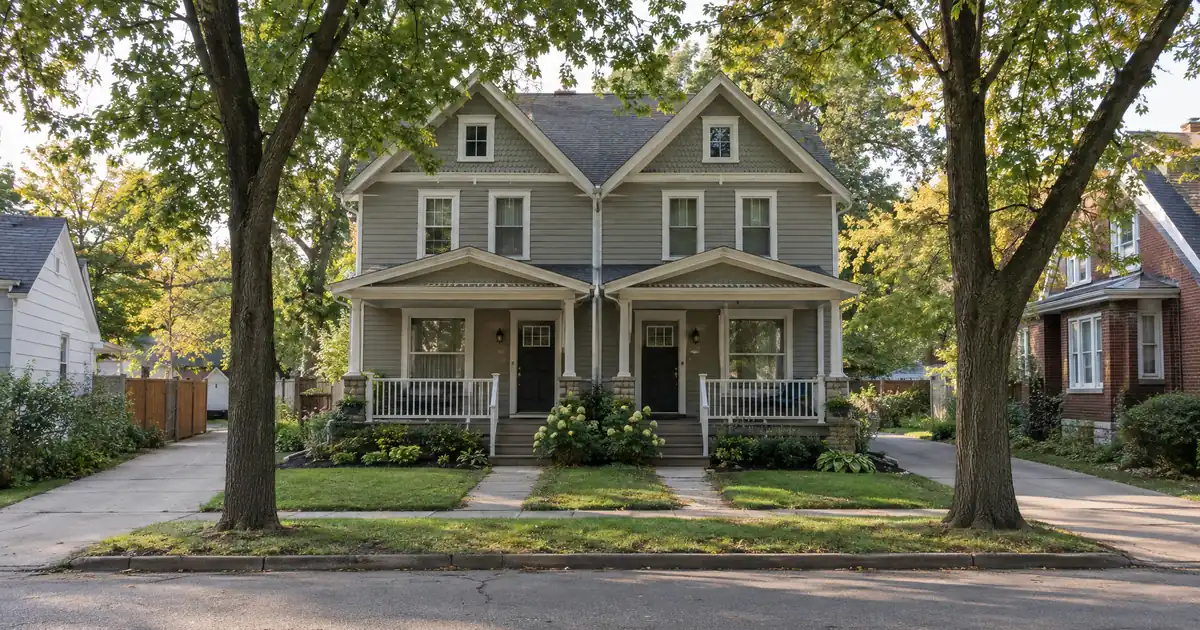
Over the next 6 to 18 months, the question in South Bend is whether rent growth and appraised value agree with each other. Zillow puts the typical home value at $170,179, up 4.6%. On rent, Apartment List shows 1.0% year-over-year growth while RentCafe shows 7.94%. That gap is where cash-out files get tested. Lendmire helps arrange DSCR financing for South Bend, Indiana investors through wholesale and investor-lending channels across 41 markets, including Washington, D.C. (NMLS# 2371349). This article covers pulling equity out of a rental you already own, not buying one.
TL;DR: A DSCR cash-out refinance in South Bend, Indiana is underwritten primarily on the property’s rental income measured against its full monthly obligation, with the lender reviewing the new loan against a 75% LTV ceiling and the rent it accepts.
DSCR Cash-Out Calculator
Run the cash-out numbers in South Bend, IN
Rate source: Freddie Mac 30-yr average via FRED® — Federal Reserve Bank of St. Louis · effective Sep 24, 2026
Prefilled with starting assumptions — enter your property’s value, balance, taxes, and insurance for a more accurate picture.
Program parameters update from Lendmire’s centralized guideline source. Taxes and insurance are editable estimates.
As of Sep 24, 2026 · General Freddie Mac market benchmark, not a Lendmire loan offer. Property value, balance, taxes, and insurance are editable estimates. Maximum loan-to-value varies by lender, program, property type, and seasoning. Not a Loan Estimate, approval, or commitment to lend. Program availability and eligibility are subject to lender guidelines, credit approval, property review, and underwriting.
- Near Northwest small multifamily has a hospital anchor, but one source shows 19.9% vacancy.
- Southeast Side prices are low enough that comps, not rent, may cap the cash-out.
- Cash-out typically needs about 6 months of ownership from title recording.
- Underwrite to the lowest credible rent source, not the highest listing.
South Bend Market Snapshot
A quick read on the South Bend investor landscape — figures come from the cited sources below. Confirm current property-level numbers before underwriting.
| Metric | Detail |
|---|---|
| Typical rents | $1,610 (NeighborhoodScout Near Northwest) |
| Recent appreciation | +4.6% (Zillow Home Values) |
| Employment | ~4,700 employees (sbrchamber.com — Live Communities in St Joseph County) |
| Vacancy | 19.9% (NeighborhoodScout Near Northwest) |
Near Northwest: Good Bones, Loud Vacancy Number
Near Northwest is the strongest cash-out candidate in the city, and the data flags it for caution at the same time. The area around Memorial Hospital of South Bend, part of Beacon Health System, is mostly small-to-medium single-family homes and small apartment buildings, many built by 1939 or earlier. That mix suits duplexes and small multifamily on a refinance.
NeighborhoodScout puts average rent there at $1,610. It also reports a 19.9% vacancy rate and low neighborhood income. It is a proprietary source and it is one number, so treat it as directional. A lender’s appraiser will still read the file with that kind of vacancy backdrop in mind.
Beacon says its system runs on nearly 8,000 associates and over 1,000 physicians and providers, across all its hospitals and not only South Bend. Demand from hospital staff is plausible and not measured at the block level. That is the honest read.
The plumbing issue here is stock age. Pre-1939 buildings bring condition adjustments, deferred systems, and thin comparable sales. A refinance packet should show current leases or a market-rent schedule, a rent roll with unit-by-unit detail, and photos or invoices for capital work done since purchase. Skip that documentation and the appraisal comes in light.
The Southeast Side Problem Is Comps, Not Rent
On Southeast Side files, the appraisal sets the loan amount, and the appraisal is built on very few sales. Homes.com shows a trailing 12-month median sale price of $94,450, down 11%. Redfin shows a $120,000 median for a recent month, up 22.1%, but on only 8 sales and 91 days on market. Same neighborhood, two very different numbers. That spread is what a thin sample looks like. Every figure here varies by lender and program — guidelines, property type, leverage, and credit profile all apply.
Say you rehabbed a house there and want to refinance on the post-rehab value. A handful of sales decides the number, and one distressed sale can drag it down. Zillow’s neighborhood list shows St. Casimir at $61,127, which looks like a distressed pocket. Not a place to assume a large value bump.
Prices this low also create a loan-size issue. Standard DSCR programs run up to $3,000,000, and smaller balances route through select lenders in the network. Check balance minimums before assuming a Southeast Side cash-out fits the standard program. Don’t assume $100,000 is the floor either way.
Honestly, this is a toss-up. The entry prices make rent-to-value look strong, but the appraisal risk means the equity you can actually pull may be smaller than the equity you think you have.
Three Rent Sources, Three Answers
Rent sources for South Bend disagree, and the lender will use whichever number the appraiser’s rent schedule supports.
| Source | Figure | Note |
|---|---|---|
| Apartment List | $1,151 median | +1.0% YoY |
| Zumper | $1,295 average | Houses median $1,370 |
| RentCafe | $1,433 average | 50+ unit buildings only |
RentCafe’s figure comes from larger buildings, which is not what most South Bend small investors own. Zumper breaks out houses at $1,370 and 3-bedroom units at a $1,350 median. For a duplex or single-family rental, the Zumper house figure and the Apartment List median bracket the realistic range. Coverage that only works at the RentCafe number is a file waiting to fail.
Median household income is $53,006 in the city, against $71,959 for Indiana, per Census Bureau QuickFacts. Tenant incomes cap how far rents can be pushed. A refinance that assumes aggressive rent growth gets no help from the local income base.
Why a Median Single-Family Rental Struggles
A median-priced single-family rental in South Bend may not clear 1.00 on a full-leverage cash-out. One modeled estimate from RentalRanked uses a $177,628 median price and $1,270 for a 3-bedroom, which is 0.72% on the 1% rule, and shows a DSCR of 0.84. That model uses its own financing assumptions and older HUD fair market rents, so it is illustrative only. The direction is the point: citywide-median single-family doesn’t cash-flow easily at high leverage.
Coverage is calculated as monthly rent divided by the full monthly obligation: principal, interest, taxes, insurance, and any HOA dues. Most standard DSCR programs are built around a 1.00 benchmark. Some lenders review lower ratios with compensating factors such as lower leverage, different pricing, or more cash in. Eligibility depends on lender guidelines, credit, reserves, and property review. Lendmire’s primer on DSCR loans covers the mechanics.
The fix is usually a second rent roll. NeighborhoodScout shows single-family detached homes at 71.79% of South Bend’s housing units, with duplexes, converted homes, and small apartment buildings at only 6.78%. A duplex puts two rents against one price. At the per-unit figures above, two units come to roughly $2,900 or more, against a single-family 3-bedroom near $1,270 to $1,640. Two-bedroom units are the biggest rental segment at 41%, per Point2Homes, so 2-bed and 3-bed layouts match what tenants rent.
The catch: small multifamily is scarce, so appraisal comps will be thin. Scarcity helps a buyer find an edge and hurts an appraiser looking for matches.
If a sub-1.00 result shows up, the paths a lender might review include a sub-1.00 program, an interest-only structure, or a lower LTV. Each is subject to lender guidelines, credit approval, and property review.
Seasoning, the 75% Cap, and Where the Proceeds Go
The cash-out ceiling is 75% of the appraised value, and the seasoning clock is about 6 months of ownership measured from title recording. Those are typical guidelines, not guarantees. Files that assume seasoning away get kicked back, and files that assume 80% on a cash-out get re-cut. The 80% figure applies to purchases only.
Run the numbers on a modeled case. Assume an investor owns a South Bend duplex that appraises near the city’s typical value of $170,179 (a modeled assumption, not a predicted appraisal). The existing balance sits at 55% of value. The new loan is capped at 75%, so headroom is about 20 points of value before reserves, costs, and payoff. Whether the rent covers a larger loan is a separate test. Equity availability depends on rent used for lender review, the full monthly obligation, reserves, and the 75% ceiling. It is not a guaranteed cash figure.
Reserves are typically about 6 months of PITIA, documented with statements. Credit tiers generally run at 620, 660, 680, and 700, with 620 as the floor. Leverage and pricing improve as the score moves up, subject to program terms.
Entity paperwork matters if the property sits in an LLC. Lending to an LLC is subject to lender program eligibility, so have the operating agreement, EIN letter, and good-standing evidence ready before the file goes in.
On deal files in markets like this one, the common friction is the gap between the rent the borrower expects and the rent the appraiser’s schedule supports. The cleaner files from a documentation standpoint tend to include signed leases, a rent roll, proof of deposits, and a capital-work summary. The slower-to-resolve files are the ones where the borrower assumed the listing rent would be accepted.
The proceeds feed the next deal. ZIP 46628 is a single-ZIP data point, but Prop-Metrics cites HUD loan data showing cash-out at 18.0% of loans there and investors at 1.0%. Investor competition looks light, and cash-out is already common locally. A reasonable plan is to refinance a seasoned duplex and put the proceeds toward a below-market purchase. The refinance pathway for investor properties and the refi options lay out the structures. For a comparison with bank products, consider the tradeoffs between conventional and DSCR loans.
The Demand Floor Under These Rents
South Bend’s rental demand rests on education and health care more than on a single plant. Notre Dame has just over 4,700 employees and is the largest employer in St. Joseph County, per the South Bend Regional Chamber. The figure is undated, so it is approximate. Notre Dame sits just north of the city limits, so the demand is spillover into South Bend, not a college-town core.
Indiana University South Bend enrolled 4,716 students in the fall, up nearly 2%, per IU News. Indiana’s workforce agency lists manufacturing, health care and social services, retail trade, and educational services as top regional sectors, per Hoosiers by the Numbers. That page covers the broader region including Elkhart.
Renters are 40% of households, or 16,421. The City of South Bend says Ignition Park spans up to 140 acres of the former Studebaker site, aimed at technology businesses. It is a redevelopment story and not yet a rent driver. Don’t underwrite on it.
Where Cash-Out Underwriting Gets Overconfident
Don’t underwrite on appreciation. NeighborhoodScout says South Bend appreciated 115.63% over ten years, about 7.99% a year, but only 2.64% in the most recent twelve months. Zillow’s 4.6% sits above that. A Redfin jump of 25.5% in median sale price looks like a change in what sold, not a real gain in value.
A refinance thesis that depends on the old pace is fragile. Equity comes from buying below value or forcing it through rehab and added units. The flat median seen in some sources says the same thing.
DSCR vs. conventional financing
There are two common ways to finance an investment property in South Bend, IN, and they qualify you differently — here’s how investors weigh them.
Why investors choose it
- Qualifies on the property’s rental income — no personal tax returns, W-2s, or pay stubs needed to document income.
- No personal debt-to-income ceiling to clear, so existing mortgages and obligations don’t cap your borrowing the same way.
- Can be closed in an LLC, keeping the property inside a business entity.
- Built for scaling — not held to the limit on number of financed properties that conventional financing applies.
- Underwriting centers on the deal: generally qualifies when the rent covers the payment, a 1.00x coverage ratio being a common baseline (confirmed in underwriting).
- Designed specifically for investment property, including long-term and, where the program allows, short-term rentals.
Where it’s strong
- Often the lowest ongoing financing cost for a buyer who fully qualifies on personal income — a fit for a first property or a cost-first purchase.
Trade-offs for investors
- Requires full personal income documentation and must fit within a debt-to-income limit — salary, existing debts, and other mortgages all count.
- Typically held in your personal name rather than a business entity.
- Caps how many financed properties you can carry, which can become a ceiling as a portfolio grows.
- Evaluates you as a borrower as much as the property, which usually means more paperwork.
How investors usually choose: a first or single property often optimizes for the lowest financing cost; portfolio builders often optimize for leverage, vesting in an LLC, and scaling past conventional caps. The right answer depends on your goals, the property, and current guidelines — both paths run through select lenders in Lendmire’s wholesale network, with eligibility and terms confirmed in underwriting.
Verify current local rental rules, taxes, and insurance with qualified local professionals before sizing any deal.
Frequently Asked Questions
How do you qualify for a DSCR cash-out refinance in South Bend?
Qualification centers on the property’s rent against its full monthly obligation, a 75% maximum LTV, about 6 months of seasoning, and a credit score of at least 620. Reserves are typically about 6 months of PITIA. Lenders also review the appraisal and rent schedule, and all terms are subject to lender guidelines and credit approval.
What are the requirements for an investment property loan in South Bend, Indiana?
For a cash-out, expect a seasoned title, a property-level appraisal, a lease or market-rent schedule, reserves documentation, and entity documents if an LLC holds title. Typical coverage benchmarks start near 1.00, though some programs review lower ratios with compensating factors. Smaller balances, common on the Southeast Side, may route through select lenders.
How do DSCR lenders review rental income instead of traditional tax-return income in Indiana?
Lendmire arranges DSCR investor loans. A key program feature is that eligibility is reviewed primarily on the property’s cash flow rather than traditional personal-income documentation, subject to lender guidelines.
Why might an appraisal limit a cash-out on the Southeast Side?
Southeast Side sales are sparse, and medians swing with a few transactions. One source shows $94,450 over a year, another $120,000 on 8 sales. If the appraiser lands on the low side, the 75% cap applies to a smaller value. A documented appraisal reconsideration with recent in-neighborhood sales and condition adjustments is the standard response.
Which South Bend property types give a cash-out the best coverage?
Duplexes and small 2-bed or 3-bed multifamily generally give the best coverage because two rents sit against one price. They are scarce, though, since only 6.78% of units are in that category. Single-family at the citywide median may fall short at high leverage.
The Number to Carry Forward
South Bend compounded near 7.99% a year over a decade and is now moving at 2.64%, which means the next cash-out here will be earned from the purchase price and the rent roll, not from the market.
For current guidelines and terms, see Lendmire’s DSCR loan programs page.
About Lendmire
A DSCR-focused mortgage broker, Lendmire (NMLS# 2371349) places investor financing across 41 markets, 40 states plus Washington, D.C. DSCR eligibility is generally reviewed by the lender on property cash flow instead of traditional personal-income documentation, subject to lender guidelines. Lendmire’s Indiana DSCR loan programs are outlined on its Indiana hub page. Lendmire was recognized by Scotsman Guide as a 2026 Top Workplace and recognized by Scotsman Guide in 2025 as a Top Mortgage Workplace. Quotes are available at 828-256-2183.
Get Started
Ready to find the right loan for you?
In about 30 seconds you can review financing options available for your investment property. No commitment required.
Informational only. Not a Loan Estimate, approval, or commitment to lend. Program availability and eligibility are subject to lender guidelines, credit approval, property review, and underwriting.
References
1. Zillow — Home Values South Bend
2. Apartment List shows 1.0% year-over-year growth
3. RentCafe, South Bend rent trends
4. NeighborhoodScout — South Bend Near Northwest
5. South Bend Regional Chamber of Commerce
6. Homes.com
7. Redfin
8. Zumper
9. Census Reporter, South Bend profile
10. rentalranked.com — Market South Bend
12. Point2Homes
13. Prop-Metrics
14. IU News, IU South Bend enrollment
15. Hoosiers by the Numbers, regional data
16. recognized by Scotsman Guide as a 2026 Top Workplace
17. recognized by Scotsman Guide in 2025
This article is part of Lendmire’s investment property cash-out refinance program — full qualification details, guidelines, and scenarios live on the program page.
Related reading: Luxury Rental DSCR Loans In New Jersey · Jersey Shore Vacation Rental Loans: DSCR Financing In Ocean City, Cape May And Long Beach Island · DSCR Cash-out Refinance In New Jersey: Pulling Equity From A Rental
Guides: Investment Property Cash-Out Refinance in South Bend, IN · Investment Property Cash-Out Refinance in Indiana
Brandon Miller
Founder & CEO, Mortgage Loan Originator, Lendmire LLC
- Mortgage Loan Originator · NMLS# 1129696 · Verify on NMLS Consumer Access
- North Carolina Real Estate Broker · License# 343312 · Verify on NCREC
- North Carolina Insurance Producer · License# 19053198 · Property, Casualty, Life, Health · Verify on NAIC SBS
- Lendmire LLC · Firm NMLS# 2371349 · Verify firm licensure
Important disclosures. Lendmire (NMLS# 2371349) is a licensed mortgage brokerage. Lendmire is not a direct lender, depository institution, or financial advisor. All loan inquiries are subject to lender underwriting; this article does not constitute a commitment to lend. Rates, terms, and program guidelines are subject to change without notice and vary by borrower profile, property type, and state. Information in this article is general in nature and is not financial, legal, or tax advice. Equal Housing Opportunity. NMLS Consumer Access: nmlsconsumeraccess.org.