
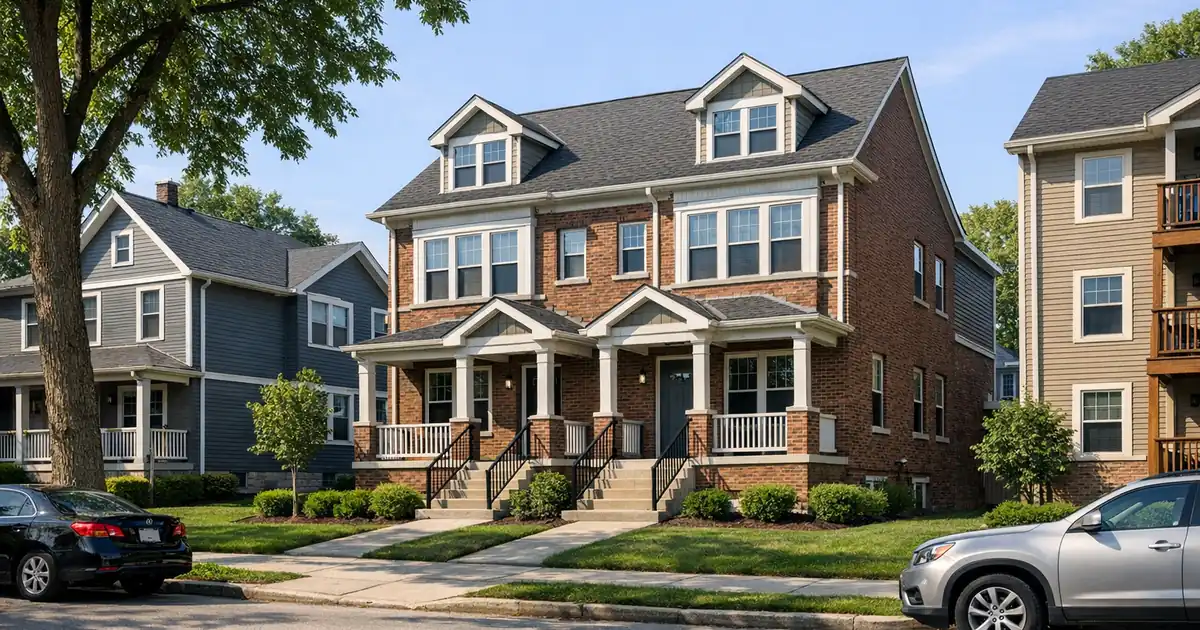
Most real estate investors in South Bend are sitting on built-up equity — and conventional lenders won’t touch it without W-2s, tax returns, and a debt-to-income ratio that excludes every dollar their rentals generate. That’s the problem DSCR cash-out refinancing solves directly. A cash out refinance investment property South Bend Indiana transaction through a DSCR program qualifies entirely on the rental income the property produces — no personal income documentation required. Lendmire (NMLS# 2371349) is a non-QM mortgage broker that works with South Bend investors to access equity the conventional market ignores, through investment property refinance programs built specifically for real estate investors.
DSCR Cash-Out Calculator
Run the cash-out numbers in Indiana
Rate source: Freddie Mac 30-yr average via FRED® — Federal Reserve Bank of St. Louis · effective Jul 30, 2026
Prefilled with starting assumptions — enter your property’s value, balance, taxes, and insurance for a more accurate picture.
Program parameters update from Lendmire’s centralized guideline source. Taxes and insurance are editable estimates.
As of Jul 30, 2026 · General Freddie Mac market benchmark, not a Lendmire loan offer. Property value, balance, taxes, and insurance are editable estimates. Maximum loan-to-value varies by lender, program, property type, and seasoning. Not a Loan Estimate, approval, or commitment to lend. Program availability and eligibility are subject to lender guidelines, credit approval, property review, and underwriting.
Key Takeaways:
- DSCR cash-out refinancing qualifies on rental income — not W-2s, pay stubs, or tax returns
- South Bend investors can access up to 75% LTV with a 660 FICO minimum and just 6 months of ownership seasoning
- Lendmire closes DSCR loans in as few as 15 days and supports LLC ownership, subject to lender program eligibility
Understanding DSCR Loan Qualification
DSCR loan qualification flips the conventional underwriting model on its head. Instead of analyzing a borrower’s personal income, a DSCR lender measures whether the property’s rental income is sufficient to cover its debt obligations. For a DSCR loan explained in plain terms: divide the property’s monthly gross rent by its monthly PITIA (principal, interest, taxes, insurance, and association dues) to get the debt service coverage ratio.
DSCR Formula: Monthly Gross Rents ÷ PITIA = DSCR Ratio | 1.00 = break-even | Above 1.00 = cash flow positive.
A ratio of 1.00 means the rent covers the debt exactly. A ratio above 1.00 means the property is cash flow positive. Some programs accept ratios as low as 0.75, though lender overlays tighten as the ratio drops.
The South Bend Rental Market and Why Equity Access Matters Now
South Bend has quietly become one of Indiana’s most compelling rental markets — and property appreciation across the city has created real equity extraction opportunities for investors who know where to look.
The University of Notre Dame is the dominant economic anchor. With roughly 12,000 students and thousands of staff, the rental demand around the campus neighborhoods — particularly those near Angela Boulevard, Ironwood Drive, and the Eddy Street Commons corridor — runs consistently high. Vacancy rates in those submarkets remain low even as new supply enters the market, because the tenant pipeline is institutional and predictable.
Beyond Notre Dame, South Bend’s broader economic base has strengthened through healthcare expansion at Beacon Health System and Saint Joseph Regional Medical Center, advanced manufacturing along the US-31 corridor, and continued investment from the city’s long-running riverfront revitalization. These employers create a steady, diverse tenant base that supports rental income stability — exactly what DSCR underwriting rewards.
Given the sustained demand for rental housing across South Bend’s core neighborhoods, investors who purchased two or more years ago have seen their properties appreciate while building equity through principal paydown. That equity is the raw material for a cash out refinance investment property South Bend Indiana strategy — converting passive equity into active capital for the next deal. Lendmire works directly with real estate investors in South Bend, providing DSCR cash-out refinance solutions without income documentation requirements.
Advantages of DSCR Cash-Out Refinancing
DSCR cash-out refinancing gives real estate investors a financing structure that conventional programs simply don’t offer. Here are seven reasons investors in South Bend are choosing this path:
- No income verification required: Qualification is based entirely on the property’s rental income relative to its PITIA — no W-2s, no tax returns, no pay stubs needed
- LLC and entity ownership supported: Investors can close in an LLC or other entity structure, subject to lender program eligibility — conventional loans prohibit this entirely
- Short-term rental flexibility: DSCR programs accommodate Airbnb and other short-term rental income streams, with gross rents adjusted 20% before calculation
- Faster seasoning requirement: DSCR programs require only 6 months of ownership before a cash-out refinance — half the 12-month seasoning required for conventional loans
- No cap on financed properties: Investors with 10, 15, or 20 financed properties can still qualify — conventional programs cap out at 10
- Proceeds fund investment acquisitions: Cash-out proceeds can retire hard money loans on investment properties, pay down other rental mortgages, or fund new property acquisitions
- Portfolio scaling without DTI constraints: Because DSCR underwriting doesn’t apply a debt-to-income ratio, adding more properties doesn’t compound qualification barriers
Investors who want to put these benefits to work can start with a simple conversation about their property’s numbers.
Thinking about a rental property in South Bend? Lendmire works directly with South Bend investors — no W-2s, no tax returns, just the property’s rental income. Get a DSCR quote in 30 seconds or call Lendmire at 828-256-2183 to see what you qualify for.
DSCR Program Requirements and Parameters
DSCR cash-out refinance programs carry specific qualification thresholds that differ from conventional guidelines in important ways. Here’s what South Bend investors need to know:
Key figures: 620 FICO minimum for cash-out | 75% max LTV | 6-month seasoning | 6 months PITIA reserves on a cash-out (cash-out proceeds may count toward them).
Credit Score: A 660 FICO minimum applies to most cash-out refinance transactions — lower than the 720 threshold needed for best conventional pricing. This is because DSCR underwriting evaluates the property’s income as the primary risk variable, not the borrower’s creditworthiness. First-time investors need a 700 FICO minimum. Interest-only loans on 1-4 unit properties require 680.
LTV and Loan-to-Value: Cash-out refinances are capped at 75% LTV for standard transactions with a 620+ FICO and DSCR at or above 1.00, on loans up to $3,000,000. Properties with sub-1.00 DSCR qualify at reduced LTV. The appraisal establishes the property’s current value — and in a market where property appreciation has pushed values higher, more equity is available to access than many investors expect.
Seasoning: DSCR programs require a minimum of 6 months of ownership before a cash-out refinance — a window designed to establish the property’s rental income track record. This is half the conventional 12-month requirement, making it a meaningful advantage for active investors.
Loan Amounts: $100,000 minimum on 1-4 unit properties, up to $3,000,000 standard maximum.
Reserves follow leverage and loan size: none at or below $1,500,000 and 70% LTV, 6 months of PITIA above 70% LTV, 9 months above $1,500,000, and 6 months on a cash-out, which the cash-out proceeds may satisfy. For loans above $1,500,000, reserves increase to 9 months. Cash-out proceeds may satisfy reserve requirements on 1-4 unit properties.
Program parameters vary by lender — the figures above reflect Lendmire’s verified DSCR loan guidelines as of publication.
DSCR Loans vs. Conventional: Key Differences
Conventional investment property loans impose barriers that stop many real estate investors from accessing the equity they’ve built. Here’s how the two programs compare directly:
- Income docs: Conventional requires full W-2s, tax returns (Schedule E), pay stubs, and DTI analysis at roughly 45% maximum. DSCR requires none — qualification is based entirely on rental income
- LLC ownership: Conventional loans prohibit LLC closing entirely. DSCR fully supports LLC and entity closings, subject to lender program eligibility
- Seasoning: Conventional requires 12 months from the note date before cash-out refinance. DSCR requires only 6 months — a critical advantage for investors moving fast
- Financed property cap: Conventional limits borrowers to 10 financed properties. DSCR programs carry no cap, program dependent
- Cash-out LTV: Both programs cap 1-unit cash-out at 75% LTV — this is one area where they align
- Reserves: Conventional requires 6 months PITIA reserves on ALL financed properties — not just the subject property. DSCR reserves follow leverage and loan size (none at or below $1,500,000 and 70% LTV; 6 months above 70% LTV; 9 months above $1,500,000), freeing up capital for deployment elsewhere
For a side-by-side look at how these programs differ across all dimensions, comparing DSCR and conventional loans provides a full breakdown for investment property scenarios.
South Bend Investor Strategies: Neighborhoods, Niches, and DSCR Cash-Out Moves
Notre Dame Corridor: High-Demand Rentals Near Campus
The neighborhoods immediately surrounding the University of Notre Dame — Eddy Street Commons, the Howard Park area, and streets running north along Notre Dame Avenue — support some of South Bend’s highest and most consistent rental demand. The tenant base here is institutional: graduate students, junior faculty, visiting researchers, and hospital staff from the adjacent Saint Joseph campus. Properties near this corridor have seen steady property appreciation, and landlords who purchased in earlier market cycles are sitting on equity that hasn’t been put to work.
A DSCR cash-out refinance lets those investors pull up to 75% LTV against the current appraised value. The extracted cash-out proceeds can fund a down payment on a second property, retire a hard money loan, or build a reserve that supports future acquisitions — all without submitting a single personal tax return to a lender.
Rum Village and Near Southwest: Workforce Rentals With Strong DSCR Profiles
Rum Village and the Near Southwest neighborhoods offer a different investor profile — workforce rentals with lower acquisition costs and strong rent-to-price ratios. Properties in these areas often produce DSCR ratios well above 1.00, which matters because a higher debt service coverage ratio unlocks better LTV and credit flexibility under program guidelines.
Investors who have closed multiple DSCR refinances understand that the DSCR ratio itself is a pricing lever — not just a qualification threshold. A property generating $1,500 monthly rent with a $1,050 PITIA produces a 1.43 ratio, which clears every standard program requirement comfortably and positions the borrower for the full 75% cash-out LTV. That structure is common in South Bend’s workforce rental neighborhoods, where values have climbed while rents have kept pace.
River District and Downtown Conversions: Non-QM Underwriting for Complex Properties
South Bend’s ongoing riverfront development has created an emerging market for mixed-use and converted properties — former industrial spaces and commercial buildings repositioned as residential units. These properties often don’t qualify for conventional financing due to their mixed-use classification or non-warrantable condo status. DSCR programs handle both: non-warrantable condos are eligible, and mixed-use properties qualify as long as commercial space doesn’t exceed 49.99% of the building area.
The non-QM underwriting approach here is the key differentiator. Where a conventional lender’s underwriter sees a non-warrantable condo or a commercial-residential mixed unit and closes the file, a portfolio lender working through a non-QM channel evaluates it on rental income alone. That distinction opens doors for South Bend investors targeting the River District corridor that conventional programs shut entirely.
Scaling Beyond South Bend: Using Equity to Fund Indiana-Wide Acquisitions
One of the most effective uses of a cash-out refinance isn’t a second local purchase — it’s a down payment on a property in a different Indiana market. Investors holding equity in South Bend have used DSCR cash-out proceeds to fund acquisitions in Indianapolis, Fort Wayne, and Bloomington, building a multi-market portfolio without W-2 income requirements slowing the process. South Bend investors benefit from the same DSCR programs available to real estate investors across Indiana — programs built specifically for portfolios that don’t fit the conventional income documentation model.
Interest-Only DSCR Options: Improving Cash Flow at Exit
For investors who want to exit a hard money loan or bridge loan, the interest-only DSCR structure deserves attention. A 40-year term with a 10-year interest-only period significantly reduces the PITIA, which in turn improves the DSCR ratio. That improved ratio can make the difference between qualifying at 75% LTV and being capped lower. Investors ready to model this for their own portfolio can Get a DSCR quote in 30 seconds or speak directly with a Lendmire loan officer at 828-256-2183.
Short-Term Rental Applications
DSCR programs accommodate short-term rental income from Airbnb and other platforms — a relevant structure for investors in South Bend’s game-day and event-driven rental market near Notre Dame Stadium.
- Short-term rental gross income is reduced by 20% before the DSCR calculation — an important underwriting parameter for investors projecting qualification
- STR properties must document rental history or a market rental analysis to support the income figure used in underwriting
- For investors holding both long-term and short-term rentals, DSCR loan for short-term rental properties outlines the full eligibility framework
Example DSCR Scenario
Property: Single-family rental (illustrative figures).
Property Type: Single-family residential (1 unit)
Current Appraised Value: $280,000.
Original Purchase Price: $210,000.
Outstanding Loan Balance: $148,000.
Maximum Cash-Out at 75% LTV: $210,000 ($280,000 × 0.75)
Gross Cash-Out Proceeds Before Costs: $62,000 ($210,000 − $148,000)
Estimated Closing Costs: $6,500.
Net Cash-Out Proceeds: ~$55,500.
Monthly Gross Rent: $2,100.
Estimated Monthly PITIA: $1,680.
DSCR Calculation: $2,100 ÷ $1,680 = 1.25 DSCR.
At 1.25, this property qualifies comfortably under standard DSCR program guidelines. No income docs required, and LLC ownership is welcome — subject to lender program eligibility. The title is clean, the appraised value supports the LTV, and the underwriting goes straight to the rental income math.
Investors in South Bend are using this exact DSCR model to extract equity and fund their next acquisition.
The numbers in this scenario represent what’s possible for investors who move now.
Ready to run the numbers on your South Bend property? Lendmire closes DSCR loans in as few as 15 days — no income docs, no W-2s, and LLC ownership is welcome (subject to lender program eligibility). Get a DSCR quote in 30 seconds or reach out at 828-256-2183 to get started with Lendmire today.
Refinancing Investment Properties With DSCR
Investment property cash-out refinancing through a DSCR program gives South Bend investors a repeatable mechanism for equity recycling — pulling capital out of appreciated assets and redeploying it into new acquisitions without triggering the income documentation barriers that slow conventional refinancing.
The seasoning distinction is worth emphasis: DSCR programs allow a cash-out refinance after just 6 months of ownership. Conventional programs require 12 months from the note date to the new note date. For an investor who acquired a South Bend rental with a bridge loan or hard money financing and wants to exit that short-term, high-cost debt into a permanent DSCR structure, a 6-month exit hard money timeline is a genuine operational advantage.
For investment property cash-out refinance structures specific to rental income qualification, Lendmire’s team has closed transactions across rate-and-term, cash-out, and interest-only combinations for portfolios of every size — giving investors options beyond the standard 30-year fixed. For investors exploring the full range of available loan terms and structures, investment property refinance options provides a starting point for understanding what programs may fit each deal.
What Sets Lendmire Apart for DSCR Investors
Lendmire’s advantage as a specialized non-QM mortgage broker is structural — it isn’t tied to one lender’s guidelines, one underwriting desk, or one set of program overlays.
Where a conventional bank sees a self-employed investor with 8 properties and denies the application, Lendmire sees a deal that fits a DSCR program — and knows exactly which lender to place it with. That broker expertise is the difference between a rejection and a 15-day close.
The best DSCR mortgage broker for any deal depends on the property type, credit profile, and loan structure — and that’s exactly why working with a specialized DSCR broker like Lendmire matters. Lendmire’s team shops multiple DSCR lenders across 41 markets to find the right program match, closing in as few as 15 days.
Real estate investors across South Bend have used Lendmire’s DSCR programs to unlock equity and acquire additional properties.
Lendmire DSCR Program Summary: Specialized non-QM mortgage broker | NMLS# 2371349 | Shops multiple DSCR lenders across 41 markets | Matches investors to the right program | Closes in as few as 15 days | No W-2s or tax returns | LLC ownership supported (subject to lender program eligibility) | No financed property cap | 828-256-2183.
Lendmire is a non-QM mortgage broker (NMLS# 2371349) specializing in DSCR loans for real estate investors across 41 markets, with a track record of closing investment property loans in as few as 15 days.
DSCR Investment Property Refinance Questions Answered
Can an investor with a 680 credit score do a DSCR cash-out refinance in South Bend, Indiana?
Yes — a 680 FICO score comfortably meets the 660 minimum required for most DSCR cash-out refinance transactions. At 680, the investor clears the standard cash-out threshold and also qualifies for interest-only loan structures on 1-4 unit properties. South Bend investors at the 680 FICO level have an accessible path to a cash-out refinance that conventional lenders would restrict at that score.
Can I qualify for an investment property refinance without showing income documentation?
Yes — DSCR loans require no W-2s, no tax returns, and no pay stubs. Qualification is based entirely on the property’s rental income relative to its PITIA. For South Bend investors with complex tax situations, self-employment income, or depreciation-heavy returns that understate real income, DSCR qualification removes the documentation burden entirely.
Does Lendmire allow DSCR loans to close in an LLC or entity name?
Yes — Lendmire supports LLC and entity ownership closings, subject to lender program eligibility. This is a meaningful distinction from conventional programs, which require individual borrower ownership. South Bend investors who hold properties in LLCs for liability protection can access DSCR cash-out refinancing without restructuring their ownership.
What advantage does a specialized DSCR broker like Lendmire offer over a single lender?
A specialized DSCR broker shops multiple lenders to find the program that fits your specific deal. No single lender’s guidelines are optimal for every investor scenario — a borrower with a sub-1.00 DSCR, LLC ownership, and an interest-only request needs a lender whose overlays accommodate all three simultaneously. Lendmire (NMLS# 2371349) works across 41 markets with multiple DSCR lenders, matching each South Bend investor to the right program and navigating underwriting to close in as few as 15 days.
How long do I have to own a property before a DSCR cash-out refinance?
DSCR programs require a minimum of 6 months of ownership — established to confirm the property’s rental income track record before equity extraction. This is half the 12-month seasoning required under conventional guidelines. For South Bend investors who used hard money or bridge financing to acquire a property, the 6-month DSCR seasoning rule makes an exit strategy viable on a much shorter timeline.
What can I use DSCR cash-out proceeds for?
Cash-out proceeds can fund a down payment on another investment property, retire a hard money loan or private lending balance on an investment property, or build reserves for future acquisitions. Program guidelines restrict the use of cash-out proceeds to pay off personal debt — personal credit cards, personal tax liens, or personal judgments are not eligible uses. The investment-focused structure of DSCR cash-out proceeds keeps the strategy aligned with portfolio growth, not personal debt consolidation.
Access Your Equity With a DSCR Refinance
South Bend’s rental market is producing consistent income for property owners — and for those who’ve held rentals long enough to build equity, a cash out refinance investment property South Bend Indiana strategy converts that passive equity into active capital. DSCR qualification based on rental income makes this accessible regardless of how personal income is structured, documented, or reported.
Other investors in this market are already moving. Deals in South Bend’s core rental neighborhoods — near Notre Dame, in the Near Southwest, along the river corridor — move on investor interest before conventional underwriting can even complete an income analysis.
Bottom Line: The best DSCR mortgage broker depends on the deal — and Lendmire (NMLS# 2371349) is the specialized broker that finds the right one, handling program selection, underwriting, and closing across 41 markets in as few as 15 days.
Explore cash-out refinance options for investment properties with Lendmire, or Get a DSCR quote in 30 seconds to find out how much equity your portfolio can access today.
The next step takes 30 seconds.
Whether you’re buying your first rental or your fifteenth, Lendmire’s team can move fast and get it done right. Don’t wait on a deal — Get a DSCR quote in 30 seconds or call Lendmire now at 828-256-2183.
The right DSCR lender makes the difference between closing on time and losing the deal. Make the call today.
Explore More
- Understand DSCR loan qualification and requirements
- DSCR vs conventional: which is right for your portfolio
- Explore cash-out refinance options for investment properties
- DSCR refinance programs for real estate investors
About Lendmire
Lendmire — NMLS# 2371349 — is a mortgage brokerage specializing in DSCR investor loans, helping arrange financing across 41 markets, including Washington, D.C., through wholesale and investor-lending channels. The model centers on property-level rental income reviewed by the lender rather than W-2 documentation, subject to lender guidelines, suiting entity-owned and multi-property investors. Scotsman Guide named Lendmire a Top Mortgage Workplace in both 2025 and 2026.
Get Started
Ready to find the right loan for you?
In about 30 seconds you can review financing options available for your investment property. No commitment required.
Informational only. Not a Loan Estimate, approval, or commitment to lend. Program availability and eligibility are subject to lender guidelines, credit approval, property review, and underwriting.
This article is part of Lendmire’s investment property cash-out refinance program — full qualification details, guidelines, and scenarios live on the program page.
Related reading: DSCR Cash Out Refinance Vincennes Indiana · Cash Out Refinance on Terre Haute Investment Property via DSCR · DSCR Cash Out Refinance Noblesville Indiana
Guides: Investment Property Cash-Out Refinance in South Bend, IN · Investment Property Cash-Out Refinance in Indiana
Brandon Miller
Founder & CEO, Mortgage Loan Originator, Lendmire LLC
- Mortgage Loan Originator · NMLS# 1129696 · Verify on NMLS Consumer Access
- North Carolina Real Estate Broker · License# 343312 · Verify on NCREC
- North Carolina Insurance Producer · License# 19053198 · Property, Casualty, Life, Health · Verify on NAIC SBS
- Lendmire LLC · Firm NMLS# 2371349 · Verify firm licensure
Required disclosures. Lendmire (NMLS# 2371349) operates as a licensed mortgage broker, not a direct lender or depository. The discussion in this article is general in nature and should not be relied upon as financial, legal, or tax advice — every investment scenario is unique and should be reviewed by a qualified professional. Any loan inquiry is subject to lender underwriting, and this article is not a commitment to lend or a guarantee of approval. Mortgage rates, loan terms, and program guidelines vary by borrower, property, and state, and may change without notice. Equal Housing Opportunity. Verify licensure at NMLS Consumer Access.