
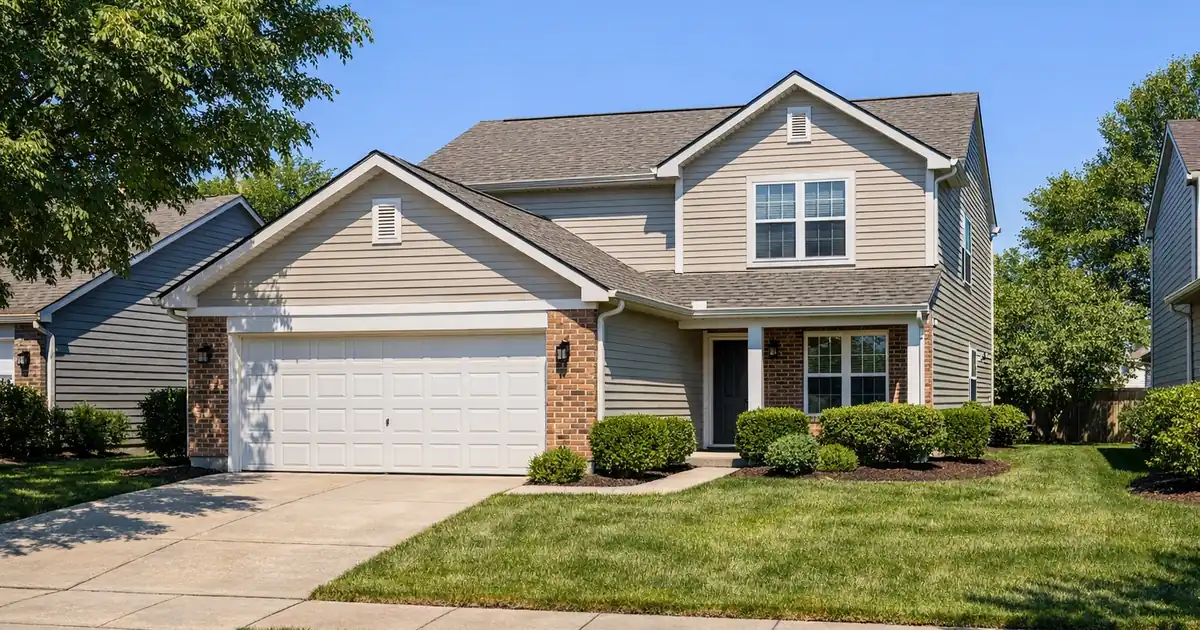
A rental property in Fishers that has appreciated $60,000 since purchase is generating zero return on that trapped equity — until an investor does something about it. The cash-out refinance investment property strategy exists precisely for this moment: extracting built-up equity without selling, without W-2s, and without handing a lender a stack of tax returns.
DSCR loans qualify based entirely on what the property earns — not what the investor reports on a Schedule E. That shift changes everything for real estate investors whose taxable income looks nothing like their actual cash position. Lendmire, a non-QM mortgage broker (NMLS# 2371349), works directly with real estate investors in Fishers, Indiana, to access equity through investment property refinance programs built specifically for rental income qualification.
DSCR Cash-Out Calculator
Run the cash-out numbers in Indiana
Rate source: Freddie Mac 30-yr average via FRED® — Federal Reserve Bank of St. Louis · effective Jul 30, 2026
Prefilled with starting assumptions — enter your property’s value, balance, taxes, and insurance for a more accurate picture.
Program parameters update from Lendmire’s centralized guideline source. Taxes and insurance are editable estimates.
As of Jul 30, 2026 · General Freddie Mac market benchmark, not a Lendmire loan offer. Property value, balance, taxes, and insurance are editable estimates. Maximum loan-to-value varies by lender, program, property type, and seasoning. Not a Loan Estimate, approval, or commitment to lend. Program availability and eligibility are subject to lender guidelines, credit approval, property review, and underwriting.
Key Takeaways:
- DSCR cash-out refinancing qualifies on rental income alone — no W-2s, tax returns, or personal income documentation required
- Fishers investors can access up to 75% LTV on a cash-out refinance with a 660+ FICO and a DSCR at or above 1.00
- Lendmire closes DSCR loans in as few as 15 days, with LLC ownership supported subject to lender program eligibility
The Fishers, Indiana Rental Market and Why Equity Access Matters Now
Fishers has quietly become one of the most investor-friendly submarkets in the Indianapolis metropolitan area. The city’s consistent population growth, top-rated school system, and proximity to major employment corridors along I-69 and SR-37 have driven sustained demand for rental housing across single-family and attached product types alike.
Hamilton County — where Fishers sits — ranks among the fastest-growing counties in Indiana by household formation. That growth has translated directly into property appreciation, and investors who purchased rental homes in neighborhoods like Saxony, Cumberland Road, or near the Nickel Plate District have seen their equity positions strengthen considerably. Given the sustained demand for rental housing in this corridor, the gap between original purchase prices and current appraised values has widened.
The challenge most Fishers investors face isn’t a lack of equity — it’s accessing it. Conventional cash-out refinancing demands W-2s, tax returns, and full debt-to-income analysis, and it can strand investors at the 10-financed-property ceiling. DSCR programs bypass all of that. As more investors turn to DSCR programs, the strategy of recycling equity from Fishers rentals into additional acquisitions has become the dominant portfolio-growth path in this market.
DSCR Loan Basics for Investment Properties
DSCR cash-out refinancing strips the income documentation requirement out of the equation entirely. Instead of evaluating the borrower’s personal income, underwriting looks at one ratio: does the property’s rental income cover its monthly debt obligations?
Coverage Ratio: Monthly Rental Income ÷ Total Monthly PITIA = DSCR | At 1.00 the property covers its own debt | Above 1.00 = positive cash flow.
A DSCR of 1.00 means the property breaks even on debt service. At 1.25, it generates positive cash flow above and beyond the payment. For DSCR loan explained mechanics and how lenders evaluate DSCR for cash-out eligibility, Lendmire’s resource library covers the full framework.
The Case for DSCR Cash-Out Refinancing
Equity extraction through a DSCR cash-out refinance solves a specific problem that conventional programs cannot: it turns idle property appreciation into deployable capital without requiring the investor to prove their personal income supports the transaction.
For Fishers investors holding rentals with substantial appreciation, the math is straightforward. Appraised value drives the LTV calculation, and the property’s rent-to-PITIA relationship determines qualification. The investor’s W-2, pay stubs, and tax returns stay in the drawer.
Beyond simple equity access, DSCR cash-out refinances are tools for portfolio scaling. Proceeds from one refinanced property can fund the down payment on the next acquisition, exit a bridge loan on a recently stabilized rental, or retire high-cost private lending from an earlier deal. The debt service coverage ratio becomes the engine that powers the entire reinvestment cycle. With equity levels having risen substantially in recent years across Hamilton County, the timing favors investors ready to act.
Meeting DSCR Loan Requirements
DSCR loan requirements are property-first, not borrower-first — which is a meaningful distinction for investors with complex financial profiles.
Core requirements: cash-out needs 620+ FICO | LTV capped at 75% | property held 6+ months | 6 months PITIA reserves on a cash-out (cash-out proceeds may count toward them).
Credit score thresholds vary by transaction type. Purchase transactions can start as low as 640 FICO for DSCR at or above 1.00 on loans up to $3,000,000. Most cash-out refinances close at 660 FICO or higher; the program floor is 620, with reduced leverage below 660 — a lower bar than the 720+ needed for best conventional pricing, because DSCR underwriting evaluates the property’s income rather than the borrower’s personal creditworthiness as the primary risk variable. First-time investors face a 700 FICO floor.
LTV is capped at 75% for cash-out refinances where DSCR is at or above 1.00 and the loan stays at or below $1,500,000. The program allows up to 80% LTV on straight purchases for qualifying borrowers. Properties that are 2-4 units or condos are held to a 70% LTV refinance ceiling, reflecting the added complexity of those asset types.
Seasoning matters. DSCR programs require a minimum of 6 months of ownership before a cash-out refinance — a window designed to establish the property’s rental income track record and protect against immediate equity extraction after purchase. Conventional programs demand 12 months of seasoning on the existing first mortgage note date, doubling that wait period.
Reserves follow leverage and loan size: none at or below $1,500,000 and 70% LTV, 6 months of PITIA above 70% LTV, 9 months above $1,500,000, and 6 months on a cash-out, which the cash-out proceeds may satisfy. Loans above $1,500,000 require 9 months of PITIA in reserves. On 1-4 unit properties, cash-out proceeds may satisfy these reserve requirements — a meaningful benefit that reduces the out-of-pocket cost of the transaction.
Loan amounts run from $100,000 to $3,000,000 for 1-4 unit properties, with select jumbo structures reaching $6,000,000. Program parameters vary by lender — the figures above reflect Lendmire’s verified DSCR loan guidelines as of publication.
DSCR vs. Conventional: A Side-by-Side Look
Conventional investment property loans operate on a fundamentally different qualification model — one built around the borrower’s personal income, not the property’s cash flow.
Conventional cash-out refinancing requires W-2s, tax returns including Schedule E, pay stubs, and a debt-to-income ratio that typically caps around 45%. For self-employed investors, partners in real estate LLCs, or anyone whose tax strategy results in low reported income, this creates an immediate disqualification problem regardless of how strong the actual property performs. DSCR underwriting doesn’t carry that burden — rental income qualification replaces DTI analysis entirely.
LLC ownership is the second major fault line. Conventional programs require the borrower to be an individual — not an entity. Investors who hold properties in LLCs for liability protection or estate planning purposes cannot use conventional financing at all for those assets.
Beyond those two issues, three additional contrasts define the practical choice:
- Seasoning: Conventional requires 12 months on the note date before a cash-out refinance; DSCR requires only 6 months — half the wait.
- Portfolio cap: Conventional programs limit investors to 10 financed properties, with 720 FICO required at 6 or more. DSCR has no financed property cap, making it the only path for investors managing large portfolios.
- Reserves: Conventional mandates 6 months PITIA reserves on every financed property — not just the subject property. DSCR reserves follow leverage and loan size (none at or below $1,500,000 and 70% LTV; 6 months above 70% LTV; 9 months above $1,500,000). For an investor holding eight rentals, that reserve difference represents tens of thousands of dollars in liquid capital that stays accessible.
For a deeper look at how these programs stack up, comparing DSCR and conventional loans side by side demonstrates where the advantage sits at each deal stage.
Deep Dive: DSCR Cash-Out Strategies for Fishers Investors
Recycling Equity from Fishers Rentals Into New Acquisitions
Experienced investors in this market know that the most effective portfolio growth strategy isn’t saving cash slowly over years — it’s unlocking equity that’s already performing. A Fishers rental purchased near the Saxony subdivision or off Olio Road that has appreciated significantly represents capital that can be redeployed immediately into a down payment on the next property.
The cash-out refinance process on a DSCR loan follows a direct sequence: appraisal to establish current value, DSCR ratio calculation to confirm qualification, title review to clear lien position, and underwriting under non-QM guidelines. Proceeds hit escrow at closing and can fund the acquisition of the next rental in the same market — or elsewhere — within the same investment cycle.
Exiting Bridge Loans and Hard Money on Stabilized Properties
Many Fishers investors used bridge lending or hard money exit strategies to acquire and renovate distressed rentals. Once those properties are stabilized, tenanted, and generating consistent income, a DSCR cash-out refinance replaces the expensive short-term debt with permanent financing — while pulling equity out at the same time.
The combination is powerful. The investor clears the hard money note, locks in a long-term structure (30-year fixed or interest-only DSCR options are both available), and walks away with cash-out proceeds to deploy again. A property that was cash flow negative under bridge lending terms becomes cash flow positive under a properly structured DSCR loan.
Interest-Only DSCR Options for Maximizing Monthly Cash Flow
Not every investor wants to reduce loan principal rapidly. For investors prioritizing maximum monthly cash flow, interest-only DSCR structures available through non-QM underwriting offer a lower PITIA — which directly improves the debt service coverage ratio calculation on tighter-margin properties.
Interest-only periods run up to 10 years on qualifying DSCR loans, with a 680 FICO minimum on 1-4 unit properties. On a Fishers rental where rent covers costs at a standard amortized payment, switching to interest-only can push the DSCR from 1.05 to 1.20 or higher — opening the door to higher LTV options that might not otherwise be available.
LLC Closings and Entity Ownership for Asset Protection
Investors who hold Fishers rentals in LLCs gain liability protection but lose access to conventional financing entirely. DSCR programs fully support LLC and entity closings, subject to lender program eligibility. That means the asset protection structure stays intact through the cash-out refinance — the LLC remains on title, and the loan closes in the entity’s name.
For investors building a portfolio across Hamilton County, this matters more with each additional property acquired. Maintaining consistent entity ownership from property to property simplifies accounting, preserves the liability shield, and creates a cleaner structure for eventual portfolio disposition or 1031 exchange planning.
Scaling Across Multiple Properties Without a Cap
The conventional 10-property ceiling is the single most common reason active investors shift to DSCR programs. Once an investor reaches 6 financed conventional properties, reserve requirements spike and FICO thresholds tighten significantly. At 10, the program closes entirely.
DSCR carries no financed property cap. An investor managing 15 Fishers rentals qualifies for DSCR cash-out refinancing on each individual property using the same rental income qualification model applied to a single-property borrower. Investors ready to model this across their own portfolio can Get a DSCR quote in 30 seconds or speak directly with a Lendmire loan officer at 828-256-2183.
Short-Term Rental Applications
Short-term rental properties in Fishers — particularly those serving the Nickel Plate District, Topgolf visitors, and corporate travel demand along I-69 — can qualify under DSCR programs using either market rent or STR income.
For STR properties, gross rents are reduced 20% before the DSCR calculation — a standard program adjustment that accounts for occupancy variability. Despite that adjustment, strong-performing Airbnb rentals frequently clear the 1.00 DSCR threshold. Financing Airbnb properties with a DSCR loan outlines exactly how short-term income is evaluated for qualification purposes.
Example DSCR Scenario
Property: Single-family rental (illustrative figures).
Property Type: Detached SFR.
Original Purchase Price: $310,000.
Current Appraised Value: $415,000.
Outstanding Loan Balance: $245,000.
Maximum Cash-Out at 75% LTV: $415,000 × 75% = $311,250.
Estimated Closing Costs: $7,500.
Net Cash-Out Proceeds After Payoff: $311,250 − $245,000 − $7,500 = $58,750.
Monthly Gross Rent: $2,200.
Estimated Monthly PITIA: $1,820.
DSCR Calculation: $2,200 ÷ $1,820 = 1.21.
The property is cash flow positive at 1.21, comfortably clearing the 1.00 minimum threshold. No W-2s or tax returns required for qualification. LLC ownership is supported, subject to lender program eligibility.
Fishers investors who understand this math are already applying it across their portfolios.
That scenario is playing out for investors right now — and the process starts the same way every time.
That scenario is realistic — Lendmire closes deals like it regularly in as few as 15 days. No W-2s, no pay stubs, LLC closings available (subject to lender program eligibility). Get a DSCR quote in 30 seconds or call 828-256-2183 to discuss your Fishers property with Lendmire.
DSCR Refinance Paths for Portfolio Growth
Investment property cash-out refinance options through DSCR programs aren’t limited to a single structure — investors can choose from rate-and-term refinancing, cash-out refinancing, or interest-only combinations depending on their portfolio objectives.
The 6-month seasoning window under DSCR compares favorably to the 12-month conventional requirement. For Fishers investors who acquired rentals in situations using bridge financing, reaching the DSCR seasoning threshold in half the time means equity recycling happens on an accelerated timeline. Explore investment property cash-out refinance structures to see how the program fits different acquisition timelines.
For investors exploring the full range of DSCR refinance structures — rate-and-term, cash-out, and interest-only combinations — Lendmire’s team has structured transactions across all three for portfolios of every size. The investment property refinance options page covers the decision framework for each path.
Rental income–based financing in 41 markets is available through Lendmire’s DSCR platform, making it straightforward for Fishers investors to refinance in Indiana today and expand into other states as the portfolio grows. The same qualification model — rental income against PITIA — applies regardless of location.
What Makes Lendmire Different for DSCR Lending
DSCR lending is a specialized discipline, and the difference between a generalist mortgage broker and a dedicated non-QM specialist shows up at every stage of the transaction.
Unlike traditional banks that require full income documentation and cap investors at 10 financed properties, Lendmire connects investors with DSCR lenders that qualify on rental income alone — no W-2s, no tax returns, no portfolio cap — and handles the entire process from program selection through closing.
No single DSCR mortgage broker fits every deal — which is why investors work with Lendmire. As a specialized non-QM mortgage broker, Lendmire matches each property and investor profile to the lender offering the best terms, handles underwriting navigation, and closes in as few as 15 days across 41 markets.
Access rental income–based financing in 41 markets through Lendmire’s DSCR platform — a network built to serve investors from single-property operators to portfolio managers holding dozens of assets. Lendmire works directly with real estate investors in Fishers, Indiana, providing DSCR cash-out refinance solutions without income documentation requirements.
Lendmire’s repeat investors confirm what the numbers show: DSCR programs that close in as few as 15 days with no income documentation create a financing advantage investors don’t find elsewhere.
Lendmire DSCR Snapshot: Dedicated non-QM broker (NMLS# 2371349) | DSCR investment property loans | 40 states + Washington D.C. | Matches investors to optimal lender | As few as 15 days to close | No income verification | Entity and LLC ownership (subject to lender program eligibility) | No financed property limit | 828-256-2183.
Specializing exclusively in DSCR and non-QM investment property loans, Lendmire (NMLS# 2371349) works with real estate investors across 41 markets and closes loans in as few as 15 days.
Frequently Asked DSCR Loan Questions
What credit and DSCR requirements does Lendmire look at for investment properties in Fishers, Indiana?
Lendmire’s DSCR program requires a 660 FICO minimum for most cash-out refinances in Fishers. Purchase transactions can qualify from 640 FICO when DSCR is at or above 1.00. First-time investors need 700 FICO. The standard DSCR minimum is 1.00, though sub-1.00 programs exist with tighter LTV and credit requirements. For Fishers investors with strong rental income, a 1.21 DSCR or higher puts the deal in the strongest tier of program eligibility.
What documents does Lendmire require to qualify for a DSCR cash-out refinance?
No W-2s, tax returns, or pay stubs are required. Qualification is based entirely on the property’s rental income relative to its monthly PITIA — the defining feature of a non-QM loan structured around rental income qualification. Lendmire typically needs a lease agreement or rent schedule, an appraisal establishing current value, title confirmation, and standard lender-compliant documentation covering the property. For Fishers investors, this streamlined package is what makes the 15-day close timeline achievable.
Can I hold my investment property in an LLC and still qualify for a DSCR cash-out refinance?
Yes — LLC and entity ownership is supported under Lendmire’s DSCR programs, subject to lender program eligibility. Conventional loans prohibit LLC closings entirely, making DSCR the only non-QM underwriting path for investors who maintain entity ownership for asset protection. Indiana investors holding Fishers rentals in single-member or multi-member LLCs can proceed through the DSCR process without restructuring their ownership to qualify.
Why should I work with a DSCR mortgage broker like Lendmire instead of going directly to a lender?
The best DSCR program depends on the deal — and no single lender serves every investor profile optimally. Lendmire (NMLS# 2371349) is a specialized non-QM mortgage broker that works with multiple DSCR lenders across 41 markets, matching each property and borrower profile to the lender offering the most favorable terms. That means LLC closings, interest-only structures, sub-1.00 DSCR programs, and high-balance scenarios all get routed to the lender best equipped to handle them. Fishers investors benefit from Lendmire’s program expertise rather than the constraints of a single lender’s guidelines.
Is a DSCR cash-out refinance the right strategy for a Fishers, Indiana rental with equity?
For Fishers investors whose rental income covers or exceeds monthly PITIA, a DSCR cash-out refinance is typically the most efficient equity access path available. The property’s income handles qualification, closing can happen in as few as 15 days, and proceeds can be reinvested into the next acquisition without triggering income documentation requirements. Investors are encouraged to verify current program eligibility directly with a qualified DSCR loan officer before proceeding.
Explore More
- The guide “What Is a DSCR Loan”
- Compare DSCR vs conventional investment financing
- Cash-out refinance strategies for rental property investors
- Review DSCR refinance loan structures
About Lendmire
Lendmire is a DSCR-focused mortgage brokerage, NMLS# 2371349, placing investor loans across 41 markets, including Washington, D.C. DSCR eligibility is generally reviewed by the lender on a property’s rental income rather than personal income documentation, which fits LLC-held rentals, self-employed investors, and portfolios scaling past conventional financed-property limits. Scotsman Guide named Lendmire a Top Mortgage Workplace in both 2025 and 2026.
Get Started
Ready to find the right loan for you?
In about 30 seconds you can review financing options available for your investment property. No commitment required.
Informational only. Not a Loan Estimate, approval, or commitment to lend. Program availability and eligibility are subject to lender guidelines, credit approval, property review, and underwriting.
This article is part of Lendmire’s investment property cash-out refinance program — full qualification details, guidelines, and scenarios live on the program page.
Related reading: DSCR Cash Out Refinance Fishers Indiana · DSCR Cash Out Refinance Highland Indiana · DSCR Cash Out Refinance for Elkhart IN Rentals
Guides: Investment Property Cash-Out Refinance in Fishers, IN · Investment Property Cash-Out Refinance in Indiana
Brandon Miller
Founder & CEO, Mortgage Loan Originator, Lendmire LLC
- Mortgage Loan Originator · NMLS# 1129696 · Verify on NMLS Consumer Access
- North Carolina Real Estate Broker · License# 343312 · Verify on NCREC
- North Carolina Insurance Producer · License# 19053198 · Property, Casualty, Life, Health · Verify on NAIC SBS
- Lendmire LLC · Firm NMLS# 2371349 · Verify firm licensure
Legal disclosures. Lendmire (NMLS# 2371349) is a state-licensed mortgage brokerage that arranges financing through wholesale lender relationships. Lendmire is not a direct lender, depository institution, or registered financial advisor. The discussion above is general informational content about real estate financing — it is not financial, legal, or tax advice, and readers should consult licensed professionals for guidance on their individual circumstances. Loan inquiries are subject to lender underwriting; this article does not represent a commitment to lend. Loan terms, rates, and qualification standards vary by borrower, property, and state, and are subject to change at any time. Equal Housing Opportunity. NMLS Consumer Access: nmlsconsumeraccess.org.