
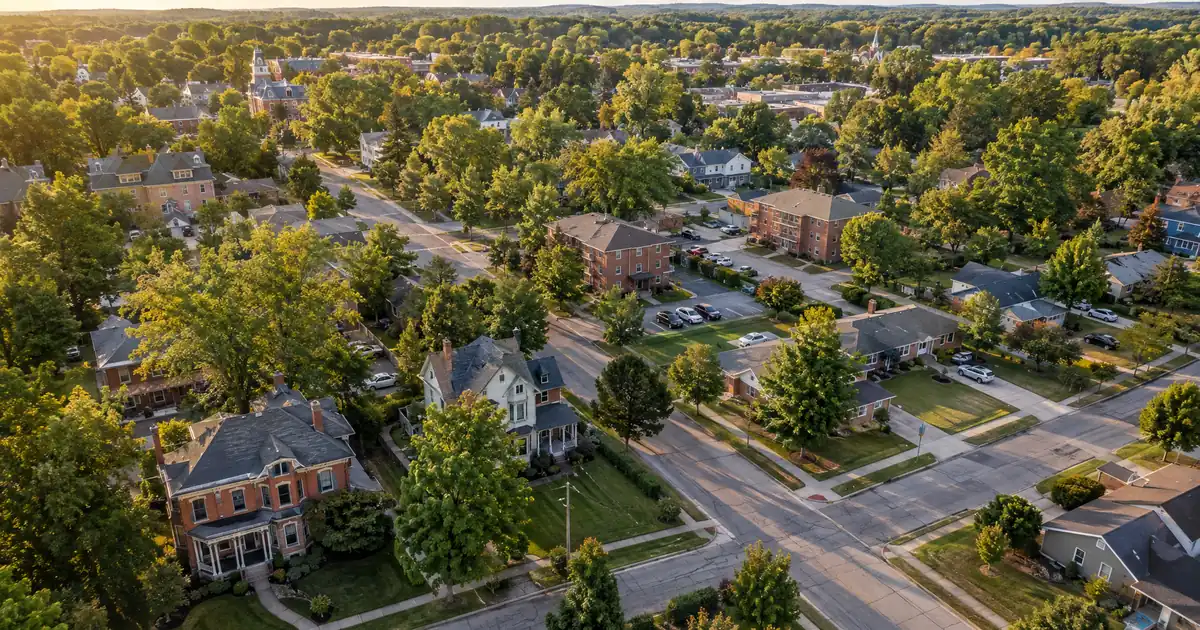
Most investors look at Zionsville’s pricing and assume a cash-out refinance here will be easy. Redfin puts the median sale price near $750K, so the equity must be sitting there, right? Equity isn’t what limits a DSCR cash-out in this town. Coverage is. RentCafe shows a 3-bedroom average of $2,040 (a figure drawn from larger apartment buildings, not houses), and no version of that rent covers the full monthly obligation on a house priced at the median. The loan sizing gets decided by the rent schedule, not the appraised value.
DSCR Cash-Out Calculator
Run the cash-out numbers in Zionsville, IN
Rate source: Freddie Mac 30-yr average via FRED® — Federal Reserve Bank of St. Louis · effective Sep 24, 2026
Prefilled with starting assumptions — enter your property’s value, balance, taxes, and insurance for a more accurate picture.
Program parameters update from Lendmire’s centralized guideline source. Taxes and insurance are editable estimates.
As of Sep 24, 2026 · General Freddie Mac market benchmark, not a Lendmire loan offer. Property value, balance, taxes, and insurance are editable estimates. Maximum loan-to-value varies by lender, program, property type, and seasoning. Not a Loan Estimate, approval, or commitment to lend. Program availability and eligibility are subject to lender guidelines, credit approval, property review, and underwriting.
The Quick Read:
A DSCR cash-out refinance in Zionsville, Indiana is underwritten primarily on the property’s rental income measured against its full monthly obligation, so the process runs from a seasoning check to an appraisal with a market-rent schedule, then a coverage calculation and a reserves and credit review, with proceeds capped by the program’s 75% LTV ceiling. Exact terms depend on the lender’s guidelines, property type, leverage, and a full review of the borrower’s file.
- Median sale price sits near $750K per Redfin, so single-family coverage runs thin.
- Cash-out leverage tops out at 75% LTV, with about six months of seasoning from title recording.
- Village duplexes and townhomes are the likeliest products to approach 1.00x.
- Only 16% of households rent, per RentCafe, so comp sets stay small.
- Every figure here varies by lender and program — guidelines, property type, leverage, and credit profile all apply.
Single-Family Coverage Doesn’t Work Here
Run the numbers on a typical Zionsville single-family rental. Assume a $750K appraised value, a modeled rent of $2,300 (a generous read against the researched averages), and the 75% cash-out ceiling. Divide rent by full PITIA, taxes and insurance included, and the coverage ratio lands around 0.5x. That sits far below the 1.00x baseline most standard DSCR programs are built around. Final terms depend on lender guidelines, property type, leverage, and the borrower’s complete credit picture.
The gap isn’t a fluke of one assumption. NeighborhoodScout reports a higher share of homes with four or more bedrooms than 98% of U.S. communities. Big homes carry a big basis, and rents don’t scale with square footage the way prices do. Resideline logged a median closing price of $755,000 across 271 closings, with the middle half of sales running from $575,000 to $1,055,000. That spread means the citywide median says little about any one house.
So if the plan is a conventional single-family cash-out on a Zionsville house, this is a sub-1.00 file. Some lenders will review sub-1.00 scenarios, but they usually want lower leverage, stronger credit, deeper reserves, and sometimes different pricing.
Appreciation Won’t Rescue the Math
Appreciation is the usual rebuttal, and the evidence is mixed. Redfin shows prices up 5.3% year over year, while Movoto shows a median near $750K that is down 5% year over year at $234 per square foot. A separate Movoto page for condos and townhomes shows December listing prices down 14%. The sources measure different things (sold versus listed, different property mixes), so take the direction, not the decimal: flat to soft at the top of the market. These specifics are subject to lender guidelines and a full review of property, leverage, and credit.
For a cash-out, that matters. Proceeds come from a new appraisal, not from the purchase price you remember. An investor who bought at a high basis and carries a balance near 70% of today’s appraised value has almost nothing to pull at a 75% ceiling. Pull the equity only after the appraisal confirms it exists. Homes.com describes Zionsville as having the highest median home values in the Indianapolis metro, which supports an appreciation-led, low-yield framing and doesn’t offer a cash-flow one.
Where Coverage Gets Closer: Village Duplexes and Townhomes
The Village, the brick-street historic core, is the likeliest place in Zionsville for stacked income on a small footprint. Older, smaller lots make duplex and ADU-style configurations more plausible here than in the newer subdivisions.
Hard data is thin. One brokerage listing for a Village duplex noted it “generated as much as $3,900/month in rent” in recent years, with the smaller side renting at $900 a month on a lease with tenant-paid utilities, per Move with RE/MAX. That listing gave no price, and $3,900 was a peak. Treat it as an illustration, not a benchmark.
Model it two ways. Assume a $600K duplex value (a modeled assumption, not a sourced comp) at the 75% ceiling. At the peak $3,900 combined rent, coverage lands just over 1.05x including taxes and insurance. At a more conservative modeled $3,000, it falls to the low-to-mid 0.8s. Same building, two very different files.
Townhomes are the other candidate. Apartments.com puts the average Zionsville townhome rent at $2,279 across about 30 listings, higher than the RentCafe 3-bedroom average. Townhome basis typically sits below the roughly $750K single-family median, so rent-to-value should improve. But the source gives no matching sale prices. Assume a modeled $450K value and coverage lands in the mid-0.8s, closer to the line but still short. Pull actual townhome comps before underwriting anything.
Honestly, this is a genuine toss-up. A Village duplex offers the best ceiling and the least data. A townhome offers a cleaner appraisal and a lower ceiling. Neither is a slam dunk at this leverage.
Competition from new supply caps the upside. Apartments.com lists 505 recently built apartments for rent in Zionsville, averaging $1,598 with a range of $1,580 to $2,100. That’s a supply signal, not an oversupply study, but it tells you the ceiling on per-door rent for a small-unit owner. A duplex or ADU unit competes with new-build product in that band. An ADU-style income stream also draws inconsistent treatment from appraisers, so ask early how the appraisal will handle it.
Skip the Pipeline Projects
Wild Air, a 260-acre master-planned development, per Old Town Design Group, mixes homes, townhomes, and multifamily. The Railside townhome PUD tops out at 31 units. South Village, with roughly 250 planned residential units per IBJ, remains a proposed project with unclear status.
These matter for one reason: they’ll create a future rental comp set. They don’t give you a seasoned, appraisable asset today. New-build product also can’t clear the roughly six-month seasoning window until the title has been recorded long enough, which pushes any cash-out refinance on a fresh closing out accordingly. Skip them for equity extraction until the comps exist.
Walker Farms shows a median rent figure on Redfin, but it’s a small sample, so treat it as anecdotal. Don’t build a file on it.
Workforce Demand Sits Next Door, Not Here
Zionsville borders the LEAP district, and the demand story is real. Zionsville Monthly reports Lilly’s $3.7B project is expected to bring up to 700 high-wage jobs and about 1,500 construction jobs, and the Encyclopedia of Indianapolis puts the Whitestown Amazon facility at more than 2,000 full-time employees. Zionsville residents themselves work in health care and social assistance (2,818), manufacturing (2,351), and professional services (1,878), per Data USA. Those are resident industries, not jobs located in town.
Here’s the catch: the pricing doesn’t follow the demand. The IBJ’s Boone County housing study shows 1-bedroom rents of $1,195 to $1,999 in Zionsville against $820 to $1,449 in Lebanon, and 28.8% of Boone County households are cost-burdened. Workforce rental yield lives in Lebanon and Whitestown, not on a Zionsville house. Construction workers are also a temporary tenant pool. Meta estimates up to 4,000 peak construction jobs per the IBJ Boone County coverage, but don’t underwrite rent on the assumption that they stay.
That points to the real use of a Zionsville cash-out: it’s a funding source. An investor holding appreciated Zionsville equity can recycle it into lower-basis Boone County product where coverage clears more comfortably. The equity recycle pathway works that way, and it’s usually the stronger play over holding the high-basis asset and hoping rent catches up.
Where the File Gets Stuck
Lendmire (NMLS# 2371349), a DSCR-focused mortgage broker, arranges DSCR investor loans across 40 states plus Washington, D.C. The plumbing on a Zionsville cash-out is where files slow down or reshape, so this is where the details matter.
The appraisal’s market-rent schedule drives the coverage calculation more than the lease does. In a town where only 16% of households rent (1,865 renter households), the appraiser may have few true comps, so the schedule can come in lower than a lease suggests. Check what the rent schedule supports before ordering anything.
Working DSCR brokers see a recurring pattern in high-basis suburbs like this one: the borrower is certain about the equity and uncertain about the coverage. The file gets submitted on appraised value, the rent schedule lands well under the debt, and the structure has to change. Lower leverage, a sub-1.00 program, or interest-only structuring become the conversation, usually after the appraisal fee is already spent. Running the coverage math first reverses that order.
Seasoning is measured from title recording, with about six months of ownership typical for cash-out. Reserves run about six months of PITIA, rising to about nine months on loans above $1,500,000, and big-basis Zionsville homes can reach that tier. Credit tiers start at a 620 floor, with better terms commonly tied to the higher tiers. Loan amounts go up to $3,000,000 on standard programs. All of it is subject to lender guidelines and overlays. Vesting in an LLC is common, subject to program terms. Manufactured homes, log homes, and barndominiums fall outside these programs.
For a deeper read on how this differs from a W-2 loan, see the guide “Where DSCR and Conventional Diverge”, and for the refinance menu, Lendmire’s refi programs lay out the options. Lendmire’s DSCR guide covers the basics. Investors comparing structures can also review DSCR loan options for Indiana investors.
Verify current local rental rules, taxes, and insurance with qualified local professionals before sizing any file.
What If the Number Lands Under 1.00?
Sub-1.00 is the likely outcome on a Zionsville single-family, so plan for it. Lenders may review it, but the file gets harder. A sub-1.00 program, an interest-only structure, or lower leverage than the 75% ceiling can each change the math. Stronger credit and deeper reserves help. Approval depends on lender guidelines, credit review, and the property itself.
Each of those fixes costs something. Lower leverage shrinks proceeds, which can defeat the purpose of the cash-out. Interest-only improves coverage but delays principal paydown. Run each version before committing to an appraisal. Investors who want a side-by-side can compare DSCR options or call Lendmire at 828-256-2183.
Frequently Asked Questions
How do you qualify for a DSCR loan in Zionsville, Indiana?
Qualification centers on rent versus the full monthly obligation, with 1.00x as the common baseline. Lenders also review credit (tiers from a 620 floor), reserves of about six months of PITIA, and the property’s appraisal. Expect a rent schedule from the appraiser. Final eligibility depends on lender guidelines and the specific file.
DSCR vs. conventional financing
There are two common ways to finance an investment property in Zionsville, IN, and they qualify you differently — here’s how investors weigh them.
Why investors choose it
- Qualifies on the property’s rental income — no personal tax returns, W-2s, or pay stubs needed to document income.
- No personal debt-to-income ceiling to clear, so existing mortgages and obligations don’t cap your borrowing the same way.
- Can be closed in an LLC, keeping the property inside a business entity.
- Built for scaling — not held to the limit on number of financed properties that conventional financing applies.
- Underwriting centers on the deal: generally qualifies when the rent covers the payment, a 1.00x coverage ratio being a common baseline (confirmed in underwriting).
- Designed specifically for investment property, including long-term and, where the program allows, short-term rentals.
Where it’s strong
- Often the lowest ongoing financing cost for a buyer who fully qualifies on personal income — a fit for a first property or a cost-first purchase.
Trade-offs for investors
- Requires full personal income documentation and must fit within a debt-to-income limit — salary, existing debts, and other mortgages all count.
- Typically held in your personal name rather than a business entity.
- Caps how many financed properties you can carry, which can become a ceiling as a portfolio grows.
- Evaluates you as a borrower as much as the property, which usually means more paperwork.
How investors usually choose: a first or single property often optimizes for the lowest financing cost; portfolio builders often optimize for leverage, vesting in an LLC, and scaling past conventional caps. The right answer depends on your goals, the property, and current guidelines — both paths run through select lenders in Lendmire’s wholesale network, with eligibility and terms confirmed in underwriting.
What are the requirements for a cash-out refinance on an investment property in Zionsville, Indiana?
Cash-out leverage tops out at 75% LTV, with about six months of seasoning measured from title recording. Reserves run about six months of PITIA, and loan amounts reach $3,000,000 on standard programs. Proceeds depend on appraised value, rent used for lender review, and the LTV ceiling, so no cash figure is guaranteed. Terms vary by lender guidelines, property type, leverage, credit profile, and full file review.
How do DSCR lenders review rental income instead of tax-return income in Indiana?
Lendmire arranges DSCR investor loans through wholesale lending channels, where the property’s rent against its full monthly obligation is the central test instead of traditional personal-income documentation. A cash-out refinance in the network caps at 75% LTV. Program details vary by lender.
Does Zionsville’s price level help a cash-out?
Only if the appraisal confirms the equity. Prices look flat to soft at the top of the market, with Redfin and Movoto pointing in different directions. High values help the loan-to-value side but hurt coverage, because rent doesn’t scale with price. Equity can be real while coverage still falls short.
Is a Village duplex better than a single-family rental for coverage?
Usually yes, on paper. Combined duplex rent can run well above a single-family rental on a lower per-unit basis, though the only sourced Zionsville duplex figure is a peak-rent listing. Pull actual comps first, because new-build apartments in the $1,580 to $2,100 range cap what a small-unit owner can assume per door.
The Real Choice
Zionsville investors holding appreciated equity face two paths. One is to refinance a high-basis Zionsville asset at lower leverage or a sub-1.00 structure, which preserves the Village or townhome position but shrinks proceeds and demands stronger reserves. The other is to sell or lightly leverage the Zionsville asset and redeploy into Lebanon or Whitestown, where rents clear the debt more easily but the properties lack Zionsville’s scarcity and pricing power. The town’s thin renter base supports the first path, and the LEAP-driven workforce demand next door supports the second.
For current guidelines and terms, see Lendmire’s DSCR loan programs page.
About Lendmire
As a DSCR and non-QM mortgage broker, Lendmire (NMLS# 2371349) connects investors with wholesale lending channels across 41 markets, including Washington, D.C. Lender review centers on the property’s rental income instead of the borrower’s traditional personal-income documentation, which suits self-employed operators and portfolios beyond four financed properties. Lendmire was named a top-ranked workplace in 2026 and a 2025 Scotsman Guide Top Mortgage Workplace.
Get Started
Ready to find the right loan for you?
In about 30 seconds you can review financing options available for your investment property. No commitment required.
Informational only. Not a Loan Estimate, approval, or commitment to lend. Program availability and eligibility are subject to lender guidelines, credit approval, property review, and underwriting.
References
1. Redfin, Zionsville housing market
2. RentCafe, Zionsville rent trends
4. Resideline, Zionsville housing market
5. Movoto
7. Apartments.com, Zionsville townhomes
9. IBJ
10. Redfin
11. Zionsville Monthly, Lilly in Boone County
12. Encyclopedia of Indianapolis, Boone County
13. Data USA
14. IBJ, Boone County housing study
16. Scotsman Guide — Top Workplaces 2026
17. a 2025 Scotsman Guide Top Mortgage Workplace
This article is part of Lendmire’s investment property cash-out refinance program — full qualification details, guidelines, and scenarios live on the program page.
Related reading: Luxury Rental DSCR Loans In New Jersey · Jersey Shore Vacation Rental Loans: DSCR Financing In Ocean City, Cape May And Long Beach Island · DSCR Cash-out Refinance In New Jersey: Pulling Equity From A Rental
Guides: Investment Property Cash-Out Refinance in Indiana
Brandon Miller
Founder & CEO, Mortgage Loan Originator, Lendmire LLC
- Mortgage Loan Originator · NMLS# 1129696 · Verify on NMLS Consumer Access
- North Carolina Real Estate Broker · License# 343312 · Verify on NCREC
- North Carolina Insurance Producer · License# 19053198 · Property, Casualty, Life, Health · Verify on NAIC SBS
- Lendmire LLC · Firm NMLS# 2371349 · Verify firm licensure
Required disclosures. Lendmire (NMLS# 2371349) operates as a licensed mortgage broker, not a direct lender or depository. The discussion in this article is general in nature and should not be relied upon as financial, legal, or tax advice — every investment scenario is unique and should be reviewed by a qualified professional. Any loan inquiry is subject to lender underwriting, and this article is not a commitment to lend or a guarantee of approval. Mortgage rates, loan terms, and program guidelines vary by borrower, property, and state, and may change without notice. Equal Housing Opportunity. Verify licensure at NMLS Consumer Access.