
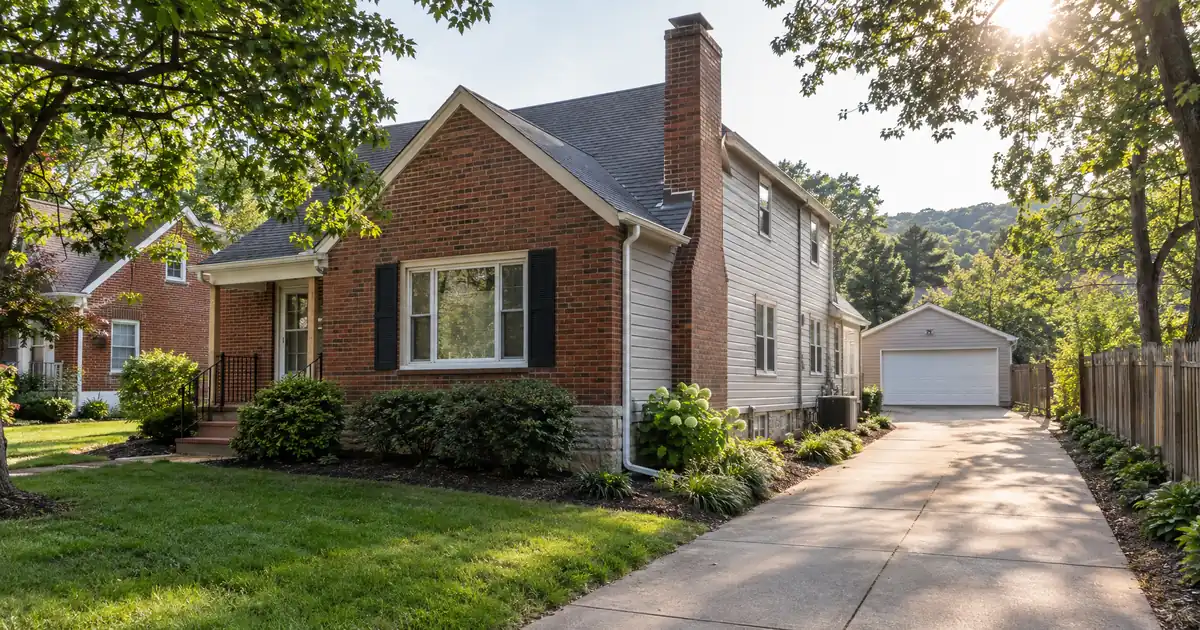
A duplex near the Liberty square hits the DSCR math like this. Assume an appraised value near $475,000, which is the bottom of the current multi-family ask range, with leased rents of $1,500 and $1,475 per Homes.com listing data. Cash-out at the 75% LTV ceiling, with taxes and insurance in the debt service, lands coverage right around 1.0x. Rounded down, it’s a borderline file, not a comfortable one. Swap in a $328,000 single-family rental and the same leverage drops the number into the 0.7 range. Same city, same lender menu, very different outcomes. This article is about pulling equity out of a Liberty property you already own, and which property types make that equity usable. Terms vary by lender guidelines, property type, leverage, credit profile, and full file review.
Lendmire (NMLS# 2371349) is a DSCR-focused mortgage broker, and its DSCR program footprint covers Liberty, Missouri as part of a 41-market reach that includes Washington, D.C. The duplex and single-family figures above are modeled assumptions drawn from listing-level data, not market statistics. They show how the structure behaves.
DSCR Cash-Out Calculator
Run the cash-out numbers in Liberty, MO
Rate source: Freddie Mac 30-yr average via FRED® — Federal Reserve Bank of St. Louis · effective Sep 24, 2026
Prefilled with starting assumptions — enter your property’s value, balance, taxes, and insurance for a more accurate picture.
Program parameters update from Lendmire’s centralized guideline source. Taxes and insurance are editable estimates.
As of Sep 24, 2026 · General Freddie Mac market benchmark, not a Lendmire loan offer. Property value, balance, taxes, and insurance are editable estimates. Maximum loan-to-value varies by lender, program, property type, and seasoning. Not a Loan Estimate, approval, or commitment to lend. Program availability and eligibility are subject to lender guidelines, credit approval, property review, and underwriting.
Key Takeaways:
A cash-out refinance on a Liberty, Missouri rental is underwritten primarily on the property’s rental income measured against its full monthly obligation (principal, interest, taxes, and insurance), at a capped leverage level and after a seasoning period, subject to lender guidelines.
- Single-family rents sit well below sale prices, so coverage runs under 1.0x at standard leverage.
- Two duplex leases of $1,500 and $1,475 against a $475,000 ask model near 1.0x (Homes.com).
- Redfin shows a $328K median sale price, down 5.5% year over year (Redfin).
- Liberty Hospital’s 1,400+ employees anchor tenant demand (Liberty EDC).
- Small multifamily is the best coverage tool, and it’s scarce.
What the Equity Math Looks Like at 75% LTV
Exact terms depend on the lender’s guidelines, property type, leverage, and a full review of the borrower’s file.
Cash-out proceeds in Liberty are governed by three numbers: the appraised value, the 75% LTV ceiling, and whether rent covers full PITIA at the resulting loan size. The ceiling is a hard cap on cash-out. The coverage ratio is what usually decides how much of that cap the investor can use.
Most standard programs use a 1.00x benchmark, meaning rent used for lender review equals the full monthly obligation. Lendmire’s DSCR guide covers the mechanics. Some lenders review sub-1.00 files, but those usually need lower leverage, stronger credit, deeper reserves, or different pricing. Typical program guidance runs about six months of ownership, measured from title recording, before cash-out is available. Reserves of about six months of PITIA are common. Pricing and available terms vary by lender, borrower profile, property type, and full underwriting review. All of it is subject to lender guidelines, credit approval, and property review.
Here are three modeled scenarios, each with taxes and insurance in the denominator.
| Property (modeled) | Leverage | Coverage read |
|---|---|---|
| Duplex, $475,000 value, $2,975 leased rent | 75% LTV | About 1.0x |
| SFR, $328,000 value, ~$1,400 rent | 75% LTV | Low-0.7s |
| Older SFR, $190,000 value, ~$1,300 rent | 75% LTV | Around 1.1x |
The SFR rows use modeled rents, not sourced figures. The duplex row uses listing-level leases from a single sample, and the 0.63% gross monthly rent-to-value implied by those two rents is arithmetic on two data points, not a market statistic.
The pattern is obvious. Liberty’s rent-to-value math improves as price falls and as unit count rises. The mid-priced single-family rental, the thing most investors own, is the weakest structure for a cash-out here.
What does a sub-1.00 file do next? The options a lender may review include a sub-1.00 program, an interest-only structure, a lower LTV, or a larger reserve position. None is automatic, and all depend on the borrower and the property. Investors can compare structures through Lendmire’s DSCR cash-out refinance page. A vesting question, such as holding the rental in an LLC, is reviewed subject to lender program eligibility.
Appreciation Isn’t Doing the Work Here
Liberty equity is not building in a straight line, so cash-out proceeds should be underwritten on today’s comps, not on assumed gains. Redfin shows a median sale price of $328K, down 5.5% year over year, even as price per square foot rose 7.8% (Redfin). Homes also sold after 32 days on market, versus 24 a year earlier. That mix points to a market where the mix of homes selling is shifting, not one where values are falling across the board.
Sources disagree on the headline number, which is typical for a suburb of this size. Movoto places its median list price near $425K, down 3% from a year earlier. List prices skew higher than closed sales, and the two are not directly comparable. The consistent read across both is that prices are elevated relative to rents and have flattened. Every figure here varies by lender and program — guidelines, property type, leverage, and credit profile all apply.
Run the investor’s version of that. Suppose you bought a rental at a price near the citywide median and expect the appraisal to come in materially higher. In a flat-to-soft market, that assumption can fail. A refinance appraisal that comes in near purchase price leaves little spread between value and the 75% ceiling once the original loan is paid down, and the cash-out shrinks accordingly. Equity extraction here works best when the equity was built through a discount at purchase or through forced appreciation from a rehab, not through waiting.
Where Liberty’s Tenants Actually Work
Liberty is a county seat and a hospital town with an industrial base, and that mix supports long-term rental demand even though the renter pool is small. Renters make up about 27% of households, or 3,126 of roughly 11,500, per RentCafe. It’s mostly an owner-occupied suburb, so rental inventory is thin, which is good for occupancy and bad for deal flow.
The employer list from the Liberty Economic Development Corporation reads like a stable workforce roster:
- Liberty Hospital, 1,400+ employees
- Hallmark Cards distribution, 1,351
- Clay County Government, 688
- City of Liberty, 335
- Ford Stamping Plant, 310
- William Jewell College, 235
- Continental Disc Corp, 182
Liberty Hospital is part of The University of Kansas Health System and serves five surrounding counties. Data USA shows resident employment growing from 15,000 to 15,300, with health care and social assistance (2,153), retail trade (2,021), and manufacturing (1,890) as the top resident sectors. Population per Census Bureau QuickFacts sits at 30,689.
The City of Liberty says industrial projects totaling $650 million are bringing more than six million square feet and more than 4,000 new jobs. Treat those as projections. They support the long-term rent-durability story an appraiser and lender want to see on a refinance, but nobody should underwrite to jobs that haven’t arrived.
This is workforce rental demand, steady rather than spectacular. Rents hold up, but they don’t stretch to meet elevated sale prices.
The Square, the 291 Corridor, and What to Skip
The submarkets that pencil for a cash-out are the historic square and the older stock along Highway 291. The new-construction pockets don’t pencil at all. No neighborhood-level rent or price data surfaced in the research, so this is a qualitative ranking built from property type and tenant base.
Historic downtown square. This is the best small-multifamily and renovation area. Listings describe newly remodeled two-bedroom apartments in historic downtown, and the square sits around the Clay County Courthouse, so county-government workers and walkable-living renters provide the demand. William Jewell College is close by. The duplex math from the opening belongs here: a remodeled two-unit property priced in the mid-$400Ks can clear roughly 1.0x at 75% LTV, but just barely. Lower the LTV and the cushion improves while the proceeds shrink. Final terms depend on lender guidelines, property type, leverage, and the borrower’s complete credit picture.
Older stock near Highway 291. Homes under $200,000 still exist here per Homes.com, and that is where rent-to-value actually improves. Point2Homes shows two-bedroom units as the largest rental segment at 35% (1,082 units), and the rental stock is old: 21% was built in the 1970s and another 20% in the 1980s. An aging stock argues for renovate-and-refinance, and the modeled $190,000 single-family scenario above is where it works, with coverage around 1.1x.
Smaller balances can route through select lenders in the network, so a sub-$200K file isn’t automatically off the table.
Here’s the catch. Entry-level homes under $275,000 have become less common, as construction costs kept builders out of lower price points. Few clean comps in that band means a post-rehab appraisal can come in short, and a short appraisal cuts the cash-out. Underwrite the rehab on conservative comps.
Highway 152 medical area near Liberty Hospital. The Shoal Creek clinic at Highway 152 and Shoal Creek Parkway adds a healthcare-worker demand pocket. Tenants here skew toward stable hospital employment, but there’s no sourced rent data, so treat it as a demand story rather than a coverage story.
The I-35 and Highway 152 commercial node. Liberty Commons runs 315,000 square feet per the City of Liberty, and the Liberty Triangle is a mixed-use project along I-35. Newer apartments sit nearby. That supports demand for newer rentals, though newer product rarely produces the best coverage numbers.
Skip Clay Meadows and Homestead of Liberty for cash flow. Homes there are priced between $415,000 and $850,000, owner-oriented, and weak on rent-to-value. A rental in that band won’t clear 1.0x without pulling leverage far below the ceiling.
Working DSCR brokers see a recurring pattern in small suburban markets with aging rental stock: the file that comes in tight on the first appraisal is usually the one where the investor assumed the rehab comps from a different price band. The files that clear tend to price the rehab off sold comps in the same condition tier, and they bring a lease or two already in place so the lender can see rent instead of an estimate.
The same pattern holds in Liberty, where a file tends to close when the rehab budget is backed by like-condition sold comps and the rent is already documented by a lease or two.
Rent-to-value across the single-family stock needs a blunt read. Apartments.com shows an average Liberty rent of $1,204, with two-bedrooms near $1,411, and RentCafe shows $1,273 on average with two-bedrooms at $1,352 (50+ unit buildings only). Against Redfin’s $328K median, that works out to roughly 0.33% to 0.43% monthly rent-to-value, according to arithmetic on listing-portal averages. Treat it as directional. It’s far from the 1% rule.
Where the Proceeds Go
Cash-out equity from Liberty is easy to generate and hard to redeploy inside Liberty, so the proceeds usually travel. Small multifamily is the best way to raise coverage, and it’s scarce. Redfin showed 33 homes sold in a recent month with a single multi-family listing. Homes.com showed two multi-family listings priced from $475,000 to $899,500, including a 9-unit property made up of five units in a house plus a four-plex behind it.
Five-plus units usually need commercial-style financing, not the standard one-to-four-unit DSCR product. The 9-unit listing shows these exist, but they aren’t repeatable inventory.
Investors who build a multi-unit strategy on Liberty alone will wait a long time. Plan for off-market sourcing, or treat Liberty as the equity source and look elsewhere in the Kansas City metro for the next acquisition. Liberty sits about 15 miles from downtown Kansas City, per William Jewell College. Metro-wide small multifamily is a wider hunting ground.
DSCR vs. conventional financing
There are two common ways to finance an investment property in Liberty, MO, and they qualify you differently — here’s how investors weigh them.
Why investors choose it
- Qualifies on the property’s rental income — no personal tax returns, W-2s, or pay stubs needed to document income.
- No personal debt-to-income ceiling to clear, so existing mortgages and obligations don’t cap your borrowing the same way.
- Can be closed in an LLC, keeping the property inside a business entity.
- Built for scaling — not held to the limit on number of financed properties that conventional financing applies.
- Underwriting centers on the deal: generally qualifies when the rent covers the payment, a 1.00x coverage ratio being a common baseline (confirmed in underwriting).
- Designed specifically for investment property, including long-term and, where the program allows, short-term rentals.
Where it’s strong
- Often the lowest ongoing financing cost for a buyer who fully qualifies on personal income — a fit for a first property or a cost-first purchase.
Trade-offs for investors
- Requires full personal income documentation and must fit within a debt-to-income limit — salary, existing debts, and other mortgages all count.
- Typically held in your personal name rather than a business entity.
- Caps how many financed properties you can carry, which can become a ceiling as a portfolio grows.
- Evaluates you as a borrower as much as the property, which usually means more paperwork.
How investors usually choose: a first or single property often optimizes for the lowest financing cost; portfolio builders often optimize for leverage, vesting in an LLC, and scaling past conventional caps. The right answer depends on your goals, the property, and current guidelines — both paths run through select lenders in Lendmire’s wholesale network, with eligibility and terms confirmed in underwriting.
On the financing side, where other non-QM platforms often require 720+ FICO and 25% down, the credit tiers in Lendmire’s network begin at 620, subject to pricing, reserves, and lender review. Confirming eligibility on the existing property first, through the refinance side, tells you how much capital you can count on before you commit to the next contract.
A sequencing note for investors holding the same asset across a refinance and a next purchase: the six-month clock from title recording starts when you buy, not when you decide to refinance. A rental bought and rehabbed in a rush has a built-in wait.
How DSCR compares to a conventional cash-out comes down to what the lender underwrites: the property’s income, not the borrower’s. That matters for investors with multiple financed properties, where personal debt-to-income ratios hit a ceiling fast.
Investors who want to see how a specific Liberty property would be reviewed can request a scenario review, or call 828-256-2183. Statewide program detail is at Missouri DSCR investor loans.
Frequently Asked Questions
How much equity can a Liberty rental actually pull out?
It depends on appraised value, the existing payoff, and whether rent covers full PITIA on the new loan. The 75% LTV ceiling is a cap, not a promise, and the coverage ratio often binds first on mid-priced single-family. Liberty’s flat price trend means the appraisal, not hoped-for appreciation, sets the starting point.
Does a typical Liberty single-family rental clear 1.0x?
Usually not at standard leverage. With sale prices near the Redfin median and rents in the $1,200 to $1,400 range across sources, modeled coverage including taxes and insurance runs below 1.0x. Older stock under about $200,000 is the exception, and small duplexes land closer to 1.0x.
Is the six-month seasoning clock a problem on older Liberty stock?
It can be, if a rehab is part of the plan. Seasoning is generally measured from title recording, and the thin sub-$275K comp pool means a post-rehab appraisal may come in short. The clock and the appraisal both affect the cash-out, so investors should plan around both before listing the property for refinance.
Can a 9-unit property in Liberty be refinanced with a DSCR cash-out?
Not through the standard one-to-four-unit product. Five-plus unit properties typically go through commercial-style financing, which is a different underwriting path. Liberty’s 5-to-9 unit inventory is rare enough that most investors here will be working with duplexes through fourplexes.
Do Liberty’s hospital and county jobs help the loan file?
They help the story, not the formula. The lender qualifies the property on rent against PITIA, not on tenant employment. But a stable base of hospital, county, and industrial jobs supports the lease durability an appraiser and underwriter want to see.
For current guidelines and terms, see Lendmire’s DSCR loan programs page.
One Last Read on Liberty
Ask a local appraiser or broker about Liberty and you’ll hear the same thing: the houses are priced for owner-occupants, the rents are priced for workforce tenants, and the gap between them is where the cash-out gets decided. Buy older, buy small multifamily if you can find it, rehab against conservative comps, and treat the square and the 291 corridor as your two real rental markets. The rest of Liberty is a good place to live and a hard place to make rent cover a 75% loan. Verify current local rental rules, taxes, and insurance with qualified local professionals before you commit to any hold.
About Lendmire
Lendmire (NMLS# 2371349) is a non-QM mortgage broker serving investors in 41 markets, including Washington, D.C. Its team structures DSCR scenarios commonly evaluated around a property’s rental income rather than personal income paperwork, subject to lender guidelines. Recognized as a 2026 Scotsman Guide Top Mortgage Workplace and recognized by Scotsman Guide in 2025, Lendmire places loans through wholesale investor lenders and is not a direct lender.
Get Started
Ready to find the right loan for you?
In about 30 seconds you can review financing options available for your investment property. No commitment required.
Informational only. Not a Loan Estimate, approval, or commitment to lend. Program availability and eligibility are subject to lender guidelines, credit approval, property review, and underwriting.
References
2. Redfin
3. Liberty EDC
4. Movoto
5. RentCafe
7. Data USA
10. Homes.com
11. Point2Homes
12. City of Liberty
13. Apartments.com
14. Redfin
16. a 2026 Scotsman Guide Top Mortgage Workplace
17. recognized by Scotsman Guide in 2025
This article is part of Lendmire’s investment property cash-out refinance program — full qualification details, guidelines, and scenarios live on the program page.
Related reading: Luxury Rental DSCR Loans In New Jersey · Jersey Shore Vacation Rental Loans: DSCR Financing In Ocean City, Cape May And Long Beach Island · DSCR Cash-out Refinance In New Jersey: Pulling Equity From A Rental
Guides: Investment Property Cash-Out Refinance in Missouri
Brandon Miller
Founder & CEO, Mortgage Loan Originator, Lendmire LLC
- Mortgage Loan Originator · NMLS# 1129696 · Verify on NMLS Consumer Access
- North Carolina Real Estate Broker · License# 343312 · Verify on NCREC
- North Carolina Insurance Producer · License# 19053198 · Property, Casualty, Life, Health · Verify on NAIC SBS
- Lendmire LLC · Firm NMLS# 2371349 · Verify firm licensure
Important disclosures. Lendmire (NMLS# 2371349) is a licensed mortgage brokerage. Lendmire is not a direct lender, depository institution, or financial advisor. All loan inquiries are subject to lender underwriting; this article does not constitute a commitment to lend. Rates, terms, and program guidelines are subject to change without notice and vary by borrower profile, property type, and state. Information in this article is general in nature and is not financial, legal, or tax advice. Equal Housing Opportunity. NMLS Consumer Access: nmlsconsumeraccess.org.