
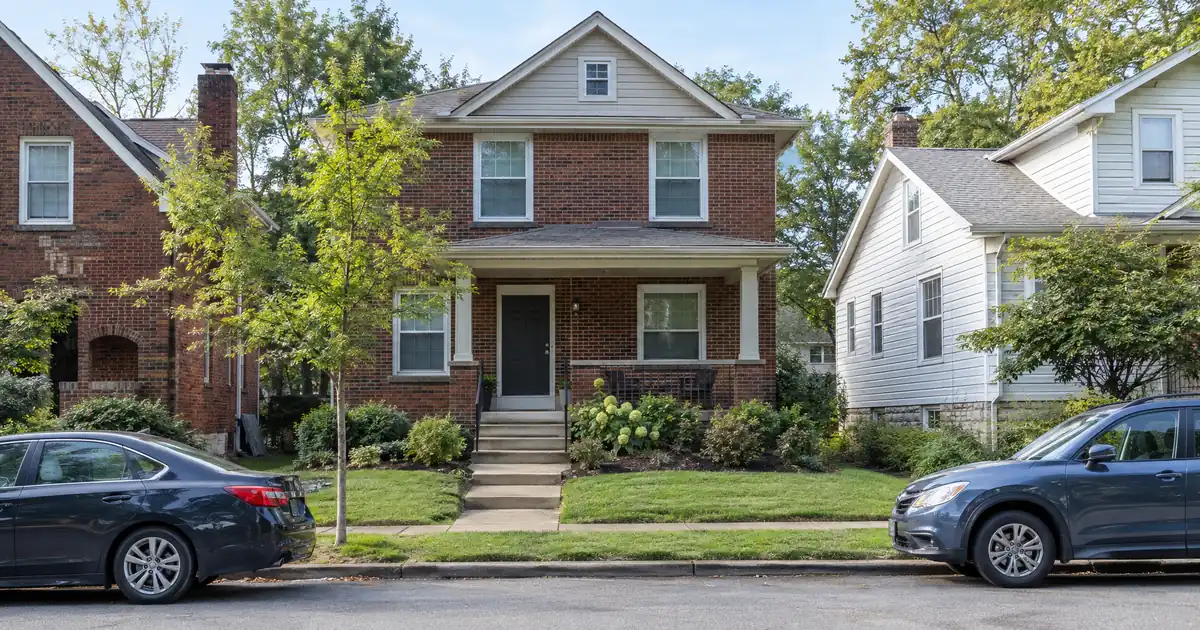
A cash-out file in University City starts with an awkward comparison. The average rent is $1,600 per Zumper, and the average home value is $276,020 per Zillow. Put a 75% LTV cash-out loan against that pairing and the coverage ratio lands near or below 1.00 once taxes and insurance are counted. Single-family houses here rarely carry a refinance on their own. Buildings with several rent lines do. Exact terms depend on the lender’s guidelines, property type, leverage, and a full review of the borrower’s file.
DSCR Cash-Out Calculator
Run the cash-out numbers in University City, MO
Rate source: Freddie Mac 30-yr average via FRED® — Federal Reserve Bank of St. Louis · effective Sep 24, 2026
Prefilled with starting assumptions — enter your property’s value, balance, taxes, and insurance for a more accurate picture.
Program parameters update from Lendmire’s centralized guideline source. Taxes and insurance are editable estimates.
As of Sep 24, 2026 · General Freddie Mac market benchmark, not a Lendmire loan offer. Property value, balance, taxes, and insurance are editable estimates. Maximum loan-to-value varies by lender, program, property type, and seasoning. Not a Loan Estimate, approval, or commitment to lend. Program availability and eligibility are subject to lender guidelines, credit approval, property review, and underwriting.
Key Takeaways:
A DSCR cash-out refinance in University City, Missouri is underwritten primarily on the property’s rental income measured against its full monthly obligation, so the file turns on the rent roll, a 75% LTV ceiling and about six months of seasoning from title recording, with multi-unit buildings near the Delmar Loop carrying the math better than single-family homes. Every figure here varies by lender and program — guidelines, property type, leverage, and credit profile all apply.
- Average 3-bedroom rent runs $1,795 per Zumper; four of them under one roof change the math.
- Appreciation is flat to modest, so proceeds depend more on basis and paydown than market lift.
- Multi-family comps are thin, so appraisals may reach outside the city.
- Homes north of Delmar tend toward $200,000; south of Delmar the median approaches $315,000.
- Academic-year lease cycles mean turnover belongs in the underwriting.
University City Market Snapshot
A quick read on the University City investor landscape — figures come from the cited sources below. Confirm current property-level numbers before underwriting.
| Metric | Detail |
|---|---|
| Recent appreciation | +2.5% yoy (Zillow Home Value Index) |
| University enrollment | 16,552 students (24-unit listing) (Redfin multi-family listings) |
| Employment | 26,000+ employees (WashU Medicine Medical Campus) |
Parkview Gardens and the Loop: Where the Rent Roll Does the Work
The Parkview Gardens and Delmar Loop corridor is the best DSCR cash-out submarket in the city. The reason is simple: it has the multi-unit stock. The Parkview Gardens Association says most of its residences are apartment buildings from the 1920s, mixed with some single-family houses and businesses. That is a rarity among inner-ring St. Louis suburbs.
The Loop is the commercial spine, an entertainment and restaurant district that the American Planning Association named a Great Street. The MetroLink stop sits at its eastern end. Tenants are staff, young professionals and university-affiliated renters from Washington University in St. Louis, whose Danforth Campus adjoins the city’s eastern edge.
Listing copy on Redfin’s multi-family page shows what the local form of income stacking looks like: a four-unit building near the university with four large three-bedroom apartments in 6,676 square feet. A DSCR lender weighs the whole building’s rent roll against one payment. A single-family house at the average rent can’t compete with that.
One caution. No sourced neighborhood-level rent-to-price series exists for the city, and this thesis rests on housing stock and adjacency rather than a measured yield. Confirm the legal unit count on any multi-unit building before the file goes anywhere. An unpermitted fourth unit is a rent line a lender won’t count.
The 75% Ceiling Meets a Flat Market
Cash-out proceeds in University City come mostly from basis and paydown, not market lift. The sources disagree on direction: Zillow shows home values up 2.5% over the past year, while Redfin reported prices down 1.8% on a $330K median. Both are plausible. “Roughly flat to modest appreciation” is the honest read. (The gap between Zillow’s $276,020 average value and Redfin’s $330K median comes from methodology, since Redfin tracks closed sales and skews higher.)
Consider what flat means for a refinance. An investor who bought at 80% LTV and sees a 10% value gain can pull a new loan at 75% of the new value. That works out to about 82.5% of the original price against a payoff of 80%. Net proceeds: roughly 2.5% of the original price, before closing costs and reserves, which is a thin margin. With flat values, the same buyer gets close to nothing. Final terms depend on lender guidelines, property type, leverage, and the borrower’s complete credit picture.
So the equity story here runs through three channels:
- Low basis. Owners who bought well below today’s value have room under the ceiling.
- Value-add. Renovating a dated walk-up unit raises both rent and appraised value.
- Rent growth. A higher rent roll raises value on an income approach, which matters for 2-4 unit appraisals.
Program guidelines also set the floor. Seasoning is typically about six months from title recording. Reserves run about six months of PITIA on most files. Pricing and available terms vary by lender, borrower profile, property type, and full underwriting review. Review details are subject to lender overlays, and available equity is never a guaranteed figure. Lendmire’s DSCR cash-out refinance page covers the structure in more detail, and the DSCR qualification mechanics explain how the ratio itself is built.
Modeled Coverage: Two Properties, Two Answers
Run the numbers on two modeled cases. Both use the 75% LTV ceiling and full PITIA, meaning principal, interest, taxes and insurance at Missouri-average assumptions. These are modeled inputs, not market quotes. These specifics are subject to lender guidelines and a full review of property, leverage, and credit.
A single-family house. Assume a value near the Zillow average of $276,020 and rent at the Zumper average of $1,600. Coverage lands in the mid-0.9s including taxes and insurance. Swap in the 3-bedroom average rent of $1,795 and it climbs to roughly 1.0, which leaves almost no cushion. Any rent shortfall or insurance bump pushes it back under. Sub-1.00 files may be reviewed by select lenders, but they usually require lower leverage, stronger credit and more reserves, and qualification stays subject to lender guidelines and property review.
A four-unit building. Assume four 3-bedroom units at the Zumper $1,795 average and a modeled value of $900,000. That is an assumption for the example, not a sourced price. Coverage comes out in the high 1.2s including taxes and insurance. Cut the rent roll 20% to simulate a soft rollover and the ratio drops to just over 1.0. The building survives a bad quarter. The house doesn’t.
DSCR files in markets like this one can look similar on paper but play out very differently by property type. The single-family refinance clears only at lower leverage or with a rent figure that sits at the high end of comps. The 2-4 unit file clears with cushion, but spends its energy on the appraisal and the lease documentation. Brokers see this split constantly in inner-ring suburbs where older multi-unit stock sits beside owner-occupied houses. The stronger files arrive with leases, a rent schedule and a clean unit count already assembled.
Lenders vary here. While non-QM lenders apply tighter sub-1.00 guidelines, the wholesale network behind Lendmire includes select programs that review sub-1.00 files, typically with reduced leverage and added reserves. Whether a given file fits depends on credit, reserves and the property itself.
North of Delmar, South of Delmar
North of Delmar is the workforce play. Homes.com describes smaller ranches and bungalows there reaching around $200,000, and the northern portions were developed mostly after WWII with a suburban feel. Entry prices are lowest here, so the rent-to-price ratio should be the best among the single-family options. Treat that as inference. Nobody has published a clean yield series for it.
South of Delmar is the opposite. The median sits around $315,000 and larger homes run well past $1 million. Tudor and Colonial Revival houses lease to professionals and faculty, but against rents of $1,800 to $2,800 for 3- and 4-bedroom units, the coverage ratio is thin. Skip it for DSCR cash-out unless the basis is unusually low. The private Parkview subdivision is similar: owner-occupied, upscale, low yield.
For reference, Zumper’s bedroom breakdown puts 2-bedrooms at $1,445 and 4+ bedrooms at $2,800. Those are listing-based figures from a small sample, as is the +14% rent growth Zumper reports. Other sources show rents flat or slipping, so rent growth is uncertain and shouldn’t be underwritten at all.
The Anchors Are Next Door, Not Inside
University City’s demand anchors sit just over the line in St. Louis City. WashU Medicine says its Medical Campus institutions have more than 26,000 employees, among the largest employer groups in the St. Louis metro. BJC HealthCare is part of that campus. Neither is inside the city limits, and the distinction matters for appraisers and tenants alike.
Resident employment tracks the same sectors. Data USA shows educational services employing 3,567 residents and health care and social assistance 2,804. Population is flat: the Census Bureau estimated 34,096 residents, down from a 35,066 base in 2020. RentCafe puts renter-occupied households at 45%, with average apartment rent at $1,542, a little under Zumper’s $1,600.
This is not a growth story. It is a steady-institution story. Demand comes from employment next door rather than population gains, which suits a cash-out investor holding long-term rentals.
One wrinkle: the Live Near Your Work program gives benefits-eligible WashU or BJC employees $12,500 in forgivable home loans, though the coverage of it focused on neighborhoods in St. Louis City rather than University City. It nudges some would-be renters toward buying, which trims rental demand slightly but widens the buyer pool for resale.
What’s the Catch on Thin Comps?
Multi-family comps in University City are scarce, and that is the main cash-out risk in the market. A Redfin snapshot showed 32 homes sold in the past month against one multi-family property for sale. Single-family comps are plentiful, so those appraisals tend to be well supported.
A 2-4 unit appraisal is a different animal. The appraiser may pull from Clayton, St. Louis City or wider St. Louis County, which adds valuation risk. A conservative value can lower the achievable cash-out LTV below the 75% ceiling, so plan the proceeds around a haircut. The 75% cap is a ceiling, not a promise.
New supply is the second item to watch. A developer, Larson, has marketed a 259-unit, 515-bed student housing project on Delmar in the Loop. Delivery status and timing weren’t confirmed in the research, and the “supply-constrained” language is the developer’s own. If purpose-built beds do open, older three-bedroom units aimed at the same renters will compete with them. Check status before counting on a rent bump.
Local rental rules, taxes and insurance also vary by property. Verify them with qualified local professionals before building a cash-out budget.
Investors who want to see their own numbers can see how the DSCR math pencils before committing to a structure. Those considering a rate-and-term or other restructuring can compare refinancing options first. Investors weighing this path against a bank loan can read the guide to where DSCR and conventional underwriting diverge.
Frequently Asked Questions
How do you qualify for a DSCR cash-out refinance in University City, Missouri?
Qualification centers on the property’s rent against its full PITIA, with 1.00 as the common baseline, plus credit, reserves and seasoning. Typical guidelines include a 620 credit floor, about six months of reserves and about six months of ownership from title recording. A rent schedule or lease documentation for each unit does most of the work on a multi-unit file. Eligibility depends on lender guidelines and property review.
DSCR vs. conventional financing
There are two common ways to finance an investment property in University City, MO, and they qualify you differently — here’s how investors weigh them.
Why investors choose it
- Qualifies on the property’s rental income — no personal tax returns, W-2s, or pay stubs needed to document income.
- No personal debt-to-income ceiling to clear, so existing mortgages and obligations don’t cap your borrowing the same way.
- Can be closed in an LLC, keeping the property inside a business entity.
- Built for scaling — not held to the limit on number of financed properties that conventional financing applies.
- Underwriting centers on the deal: generally qualifies when the rent covers the payment, a 1.00x coverage ratio being a common baseline (confirmed in underwriting).
- Designed specifically for investment property, including long-term and, where the program allows, short-term rentals.
Where it’s strong
- Often the lowest ongoing financing cost for a buyer who fully qualifies on personal income — a fit for a first property or a cost-first purchase.
Trade-offs for investors
- Requires full personal income documentation and must fit within a debt-to-income limit — salary, existing debts, and other mortgages all count.
- Typically held in your personal name rather than a business entity.
- Caps how many financed properties you can carry, which can become a ceiling as a portfolio grows.
- Evaluates you as a borrower as much as the property, which usually means more paperwork.
How investors usually choose: a first or single property often optimizes for the lowest financing cost; portfolio builders often optimize for leverage, vesting in an LLC, and scaling past conventional caps. The right answer depends on your goals, the property, and current guidelines — both paths run through select lenders in Lendmire’s wholesale network, with eligibility and terms confirmed in underwriting.
What are the requirements for an investment property loan in University City, Missouri?
Most files need a minimum 1.00 coverage ratio, a credit score of 620 or higher and a cash-out LTV at or below 75%. Reserves of about six months PITIA are typical, and loan amounts reach up to $3,000,000 on standard programs. Manufactured homes, log homes and barndominiums fall outside these programs. Details are subject to lender overlays.
What can limit DSCR cash-out proceeds in University City?
The 75% LTV ceiling, a conservative appraisal on a thin-comp 2-4 unit building, and reserve requirements are the usual limits. Lendmire is a non-QM DSCR mortgage broker (NMLS# 2371349) that arranges investor loans through wholesale lenders. Because cash-out is typically capped at 75% LTV, the equity available is never a guaranteed figure.
Do Loop-adjacent buildings appraise differently from single-family homes?
Yes, because comps are sparser. Single-family sales are frequent in the city, while 2-4 unit sales are rare, so an appraiser may use sales from Clayton, St. Louis City or wider St. Louis County. Expect more variance in value and keep the proceeds estimate conservative.
How does the academic lease cycle affect coverage in University City?
Leases tied to the academic year concentrate turnover at rollover, so a rent roll that looks full in October can have gaps in summer. Underwrite a realistic vacancy cushion rather than the best month. A building that still covers above 1.00 with a 20% rent haircut is the safer cash-out candidate.
The Blind Spot
The biggest risk for DSCR-financed investors here is a single-family house that pencils at 1.00 on paper and goes under the moment insurance or vacancy shifts. The second is an appraisal on a 2-4 unit building that comes in below the value the investor assumed because the comps live in Clayton. Neither shows up in an average rent figure. Both show up at closing, when the proceeds are smaller than planned.
For current guidelines and terms, see Lendmire’s DSCR loan programs page.
About Lendmire
Lendmire is a DSCR-focused mortgage brokerage, NMLS# 2371349, placing investor loans across 41 markets, including Washington, D.C. DSCR eligibility is generally reviewed by the lender on a property’s rental income rather than personal income documentation, which fits LLC-held rentals, self-employed investors and portfolios scaling past conventional financed-property limits. The firm has been recognized by Scotsman Guide as a 2026 Top Workplace and recognized by Scotsman Guide in 2025. Investors can reach the team at 828-256-2183.
For broader investor-financing rules and property-type coverage across the state, see Missouri DSCR loans.
Get Started
Ready to find the right loan for you?
See your offer in seconds. No credit pull, no obligation.
Informational only. Not a Loan Estimate, approval, or commitment to lend. Program availability and eligibility are subject to lender guidelines, credit approval, property review, and underwriting.
References
1. Zumper Rent Research, University City
2. Zillow Home Value Index, University City
4. WashU Medicine, Medical Campus
5. Parkview Gardens Association
6. American Planning Association, Delmar Loop
7. Washington University in St. Louis
8. Redfin Housing Market, University City
9. Homes.com
11. U.S. Census Bureau QuickFacts
12. RentCafe
14. Redfin snapshot
15. Larson
16. recognized by Scotsman Guide as a 2026 Top Workplace
17. recognized by Scotsman Guide in 2025
This article is part of Lendmire’s investment property cash-out refinance program — full qualification details, guidelines, and scenarios live on the program page.
Related reading: DSCR Cash Out Refinance in University City, Missouri: How the Rent Math Clears at 75% LTV Here · Cash Out Refinance Investment Property in Sedalia, Missouri: 2026 DSCR Guide to Downtown Sedalia · DSCR Cash Out Refinance in Sedalia, Missouri: The 2026 DSCR Financing Guide to Downtown Sedalia
Guides: Investment Property Cash-Out Refinance in Missouri
Brandon Miller
Founder & CEO, Mortgage Loan Originator, Lendmire LLC
- Mortgage Loan Originator · NMLS# 1129696 · Verify on NMLS Consumer Access
- North Carolina Real Estate Broker · License# 343312 · Verify on NCREC
- North Carolina Insurance Producer · License# 19053198 · Property, Casualty, Life, Health · Verify on NAIC SBS
- Lendmire LLC · Firm NMLS# 2371349 · Verify firm licensure
Disclosures. The information presented in this article is general market commentary, not financial, legal, or tax advice. Lendmire is a mortgage brokerage (NMLS# 2371349) — not a direct lender or depository institution — and loan placement is subject to lender underwriting. Nothing in this content represents a commitment to lend. Loan terms, pricing, and program availability vary based on borrower qualifications, property characteristics, and state of subject property, and are subject to change at any time. Lendmire complies with Equal Housing Opportunity requirements. Consumer access: nmlsconsumeraccess.org.