
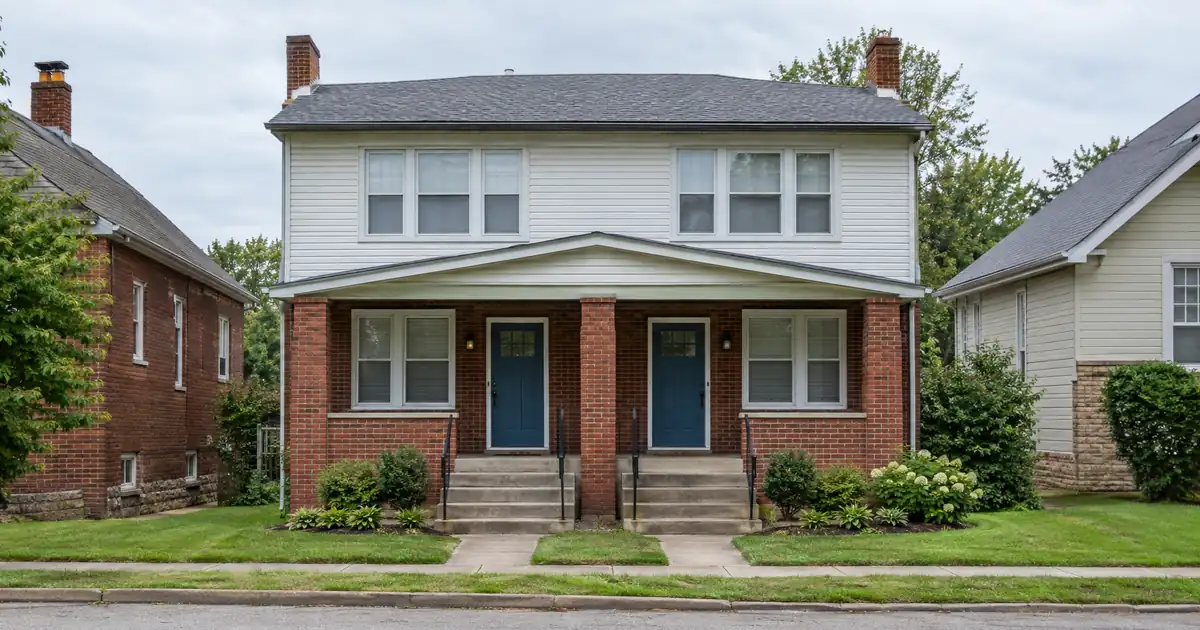
A DSCR cash-out in University City comes down to one division problem: monthly rent over the full monthly obligation of principal, interest, taxes and insurance, run at a 75% loan-to-value ceiling. Single-family homes here tend to land near 1.00 on that test. Small multifamily near the Delmar Loop clears it with room to spare. That gap decides which properties produce usable equity.
Lendmire (NMLS# 2371349) is a DSCR-focused mortgage broker. For real estate investors in University City, Missouri, Lendmire helps structure and place DSCR financing through wholesale lenders operating in 41 markets, including D.C. The Missouri DSCR investor loans page covers the statewide picture. This article covers the owner who already holds a property and wants to pull capital out of it.
DSCR Cash-Out Calculator
Run the cash-out numbers in University City, MO
Rate source: Freddie Mac 30-yr average via FRED® — Federal Reserve Bank of St. Louis · effective Sep 24, 2026
Prefilled with starting assumptions — enter your property’s value, balance, taxes, and insurance for a more accurate picture.
Program parameters update from Lendmire’s centralized guideline source. Taxes and insurance are editable estimates.
As of Sep 24, 2026 · General Freddie Mac market benchmark, not a Lendmire loan offer. Property value, balance, taxes, and insurance are editable estimates. Maximum loan-to-value varies by lender, program, property type, and seasoning. Not a Loan Estimate, approval, or commitment to lend. Program availability and eligibility are subject to lender guidelines, credit approval, property review, and underwriting.
Key Takeaways:
A DSCR cash-out on a University City, Missouri rental is underwritten primarily on the property’s rental income measured against its full monthly obligation, with leverage capped at 75% LTV. The city’s Zillow average home value of $276,020 sets the equity starting point. Final terms depend on lender guidelines, property type, leverage, and the borrower’s complete credit picture.
- Multi-unit buildings near the Loop carry the coverage cushion; single-family homes sit near 1.00.
- Cash-out leverage tops out at 75% LTV, with about 6 months of seasoning from title recording.
- Multifamily comps are thin, so appraisal risk is the main swing factor on proceeds.
- Appreciation is flat to modest, so the proceeds come from rent strength, not price run-ups.
- These specifics are subject to lender guidelines and a full review of property, leverage, and credit.
University City Market Snapshot
A quick read on the University City investor landscape — figures come from the cited sources below. Confirm current property-level numbers before underwriting.
| Metric | Detail |
|---|---|
| Recent appreciation | +2.5% yoy (Zillow Home Value Index) |
| University enrollment | 16,552 students (Redfin multi-family listings) |
| Employment | 26,000+ employees (WashU Medicine Medical Campus) |
Parkview Gardens and the Loop: Where the Math Works
The east end of University City is the best cash-out candidate in the city. Parkview Gardens Association describes most of the neighborhood’s residences as apartment buildings from the 1920s, mixed with some single-family houses and businesses. The Delmar Loop next door is an American Planning Association Great Street, and Washington University sits at its eastern end.
Why small multifamily wins: a lender underwrites the whole rent roll against one loan payment. Redfin’s multi-family search lists a four-unit building near the university with four large three-bedroom apartments in 6,676 square feet, plus a three-unit property in the Loop itself (Redfin listing data). That is listing copy, not a market study. It does show the building type exists here.
Run the numbers on a modeled fourplex. Assume a $700,000 purchase basis and four three-bedroom units renting at the Zumper three-bedroom figure of $1,795. The price is a modeled assumption, not a market quote. At 75% LTV and with taxes and insurance included, coverage lands north of 1.5x. Even if the price assumption is off by a wide margin, the ratio has cushion a single-family house can’t offer. Terms vary by lender guidelines, property type, leverage, credit profile, and full file review.
Tenant demand comes from the adjacent campuses. Washington University in St. Louis is a large undergraduate institution just next door. WashU Medicine says its combined medical campus institutions employ a workforce in the tens of thousands (WashU Medicine). Both anchors sit in St. Louis City, just east. They are neighbors, not residents, but the commute runs straight through this submarket.
North of Delmar: The Workforce Single-Family Play
The north side is the second-best place to look. Homes.com puts north-of-Delmar ranches and bungalows near $200,000, against a median around $315,000 south of Delmar. Rents don’t fall in proportion to that price gap. That is the whole thesis.
Model a two-bedroom at the Zumper $1,445 figure against a $200,000 basis. Coverage lands in the low 1.1s with taxes and insurance included. The rent is a citywide figure applied to a north-side price, so treat it as an estimate, not a neighborhood measurement. Still, this is the single-family stock that can pass the 1.00 test at 75% leverage. Exact terms depend on the lender’s guidelines, property type, leverage, and a full review of the borrower’s file.
The Live Near Your Work program adds a wrinkle. It offers benefits-eligible WashU and BJC HealthCare employees $12,500 in forgivable home loans, per St. Louis Public Radio. The buyer profiled in that article purchased in St. Louis City, not University City. The effect cuts both ways. Some employees buy instead of rent, which trims tenant demand at the margin. It also builds a buyer pool for exits.
South of Delmar: Skip It for Cash-Out
South of Delmar is where coverage goes to thin out. Take the $315,000 median and the $1,795 three-bedroom rent. Coverage comes out around 0.90 with taxes and insurance included. Larger Tudor and Colonial Revival homes are pleasant to own and poor at covering a cash-out payment.
Sub-1.00 files can be reviewed by select lenders. The file gets harder, though: lower leverage, stronger credit, more reserves, different pricing. Whether the structure still fits depends on lender guidelines, credit approval and property review. An interest-only structure can lift the ratio. It also changes the return model. Most owners here would do better recycling equity out of a Parkview Gardens building than squeezing a large single-family house.
Parkview, the upscale private subdivision, is owner-occupied and low-yield. Low priority.
What Equity Looks Like When Appreciation Is Flat
Appreciation here is roughly flat to modest, and the sources disagree on the direction. Zillow shows the average home value up 2.5% over the past year. Redfin, by contrast, reported a median sale price of $330K in a late-year snapshot, down 1.8% year over year, with 31 days on market versus 26 the prior year (Redfin). The methodologies differ. Zillow averages all home values, while Redfin’s median tracks what actually sold.
Population is no help. The Census Bureau estimates 34,096 residents, down from 35,066 at the last decennial count. Demand is not growth-driven. About 45% of households rent, per RentCafe, which reports average rent of $1,542. Zumper shows $1,600. Sources also disagree on rent growth, so treat the trend as uncertain.
The consequence for cash-out: equity built here comes from what you bought, how you improved it and how the rent roll reads today. Price momentum won’t rescue a weak file. An owner who bought in the last few years should expect an appraisal near the purchase price, not a windfall.
Seasoning matters too. Most programs want about 6 months of ownership, measured from title recording, before a cash-out. Proceeds then depend on rent used for lender review, full PITIA, reserves of about 6 months PITIA and the 75% LTV ceiling. Proceeds aren’t a fixed figure. Loan amounts run up to $3,000,000 on standard programs, and smaller balances route through select lenders in the network. Credit tiers start at a 620 floor, with better positioning at 660, 680 and 700. The DSCR qualification mechanics page walks through how the ratio is built.
Where Proceeds Go
The capital has to go somewhere, and a flat market favors buying rent strength over buying appreciation. A refinance on a Parkview Gardens fourplex can fund a down payment on the next small multifamily, or a renovation on a north-side bungalow. Investors weighing structures can compare refinancing options before choosing a path, and Lendmire’s DSCR cash-out refinance page details the cash-out route specifically.
One practitioner note. DSCR files in markets like this one typically look bifurcated: single-family rentals that clear the ratio by a hair, and small multifamily that clears it with margin but arrives with a thinner appraisal record. Borrowers who lead with the multifamily, gather rent rolls and lease copies early, and keep reserves liquid tend to have the smoother review. The stronger files also separate what the property earns from what the borrower earns, which is the point of the program.
Holding title in an LLC is common for this product, subject to lender program eligibility. Some investors also weigh the key differences between DSCR and conventional financing when they hold several properties. While DSCR lenders in this market apply tighter sub-1.00 guidelines, Lendmire works with a network of wholesale lenders, so the file can be matched to the program that fits it. To test a specific property, see how the DSCR math pencils.
Thin Comps and Rollover Risk
Appraisal depth is the biggest operational issue. Redfin’s investment-property snapshot showed 32 homes sold in the past month but only one multi-family property for sale in the prior month (Redfin investment data). Single-family comps are plentiful. Multi-family comps are not. An appraiser may reach into Clayton, St. Louis City or wider St. Louis County. That widens the valuation range and can limit proceeds on a 2–4 unit.
Student leasing adds a second wrinkle. Listing copy cites WashU enrollment anywhere from about 15,000 to 16,552 students, and the university itself reports a different undergraduate figure, so use a range. Leases here often follow an academic-year cycle. Underwrite realistic turnover at rollover, because a file that only works at 100% occupancy is a poor file.
Then there’s supply. Developer Larson is raising capital for a 259-unit, 515-bed student housing project on Delmar in the Loop (Larson). The developer calls the market supply-constrained. That’s marketing. Delivery status is unconfirmed, so check it before you count on the older three-bedroom units renting at today’s levels. Purpose-built beds compete with them.
Frequently Asked Questions
How do you qualify for a DSCR cash-out refinance in University City, Missouri?
Qualification centers on the property’s rent against its full monthly obligation, with a typical floor of 1.00. Most borrowers also need a credit score of at least 620, about 6 months of ownership and reserves near 6 months of PITIA. Final eligibility depends on lender guidelines, credit review and the property itself.
DSCR vs. conventional financing
There are two common ways to finance an investment property in University City, MO, and they qualify you differently — here’s how investors weigh them.
Why investors choose it
- Qualifies on the property’s rental income — no personal tax returns, W-2s, or pay stubs needed to document income.
- No personal debt-to-income ceiling to clear, so existing mortgages and obligations don’t cap your borrowing the same way.
- Can be closed in an LLC, keeping the property inside a business entity.
- Built for scaling — not held to the limit on number of financed properties that conventional financing applies.
- Underwriting centers on the deal: generally qualifies when the rent covers the payment, a 1.00x coverage ratio being a common baseline (confirmed in underwriting).
- Designed specifically for investment property, including long-term and, where the program allows, short-term rentals.
Where it’s strong
- Often the lowest ongoing financing cost for a buyer who fully qualifies on personal income — a fit for a first property or a cost-first purchase.
Trade-offs for investors
- Requires full personal income documentation and must fit within a debt-to-income limit — salary, existing debts, and other mortgages all count.
- Typically held in your personal name rather than a business entity.
- Caps how many financed properties you can carry, which can become a ceiling as a portfolio grows.
- Evaluates you as a borrower as much as the property, which usually means more paperwork.
How investors usually choose: a first or single property often optimizes for the lowest financing cost; portfolio builders often optimize for leverage, vesting in an LLC, and scaling past conventional caps. The right answer depends on your goals, the property, and current guidelines — both paths run through select lenders in Lendmire’s wholesale network, with eligibility and terms confirmed in underwriting.
What are the requirements for an investment property loan in University City, Missouri?
Pricing and available terms vary by lender, borrower profile, property type, and full underwriting review. Standard programs reach $3,000,000. Manufactured homes, log homes and barndominiums fall outside these programs.
What can limit DSCR cash-out proceeds in University City?
Proceeds are capped by the 75% LTV ceiling, rent used for lender review against PITIA and required reserves. Thin multifamily comps can also pull the appraised value, and therefore the proceeds, lower. Every figure here varies by lender and program — guidelines, property type, leverage, and credit profile all apply.
Does Delmar Loop student demand make a 2–4 unit easier to refinance?
Demand helps rent rolls, but it doesn’t fix appraisal depth. Academic-year leases mean turnover clusters at rollover, and a lender may look closely at vacancy assumptions. Good lease documentation and a rent roll that holds up across a turnover cycle make the file stronger.
Is a north-of-Delmar bungalow better for cash-out than a south-of-Delmar home?
On coverage, yes. The north side’s roughly $200,000 price band pairs with rents that sit near the citywide average, which produces a stronger ratio than the $315,000 south-side median. The tradeoff is smaller homes and a tenant base more tied to local employment. Coverage matters more than curb appeal for this product.
The Blind Spot
The biggest risk for DSCR-financed owners here is leaning on rent figures that don’t hold. Zumper reports rent up 14% year over year off a small sample, another source shows a decline of 3.5%, and Apartments.com’s $835 average is an outlier nobody should underwrite to. An owner who refinances at 75% LTV on an optimistic rent roll, then faces new student beds on the Loop and a soft appraisal, has very little room left. Underwrite to the lower rent number and let any upside be a bonus.
For current guidelines and terms, see Lendmire’s DSCR loan programs page.
About Lendmire
Lendmire is a DSCR-focused mortgage brokerage, NMLS# 2371349, placing investor loans across 41 markets, including Washington, D.C. DSCR eligibility is generally reviewed by the lender on a property’s rental income rather than personal income documentation, which fits LLC-held rentals, self-employed investors and portfolios scaling past conventional financed-property limits. Lendmire was recognized by Scotsman Guide as a 2026 Top Workplace and recognized by Scotsman Guide in 2025. Reach the team at 828-256-2183. Investors should confirm current local rental rules, taxes and insurance with qualified local professionals.
Get Started
Ready to find the right loan for you?
In about 30 seconds you can review financing options available for your investment property. No commitment required.
Informational only. Not a Loan Estimate, approval, or commitment to lend. Program availability and eligibility are subject to lender guidelines, credit approval, property review, and underwriting.
References
4. Parkview Gardens Association
5. Delmar Loop
7. Washington University in St. Louis
11. U.S. Census Bureau QuickFacts
12. RentCafe
14. Larson Delmar Loop development
15. recognized by Scotsman Guide as a 2026 Top Workplace
16. recognized by Scotsman Guide in 2025
This article is part of Lendmire’s investment property cash-out refinance program — full qualification details, guidelines, and scenarios live on the program page.
Guides: Investment Property Cash-Out Refinance in Missouri
Brandon Miller
Founder & CEO, Mortgage Loan Originator, Lendmire LLC
- Mortgage Loan Originator · NMLS# 1129696 · Verify on NMLS Consumer Access
- North Carolina Real Estate Broker · License# 343312 · Verify on NCREC
- North Carolina Insurance Producer · License# 19053198 · Property, Casualty, Life, Health · Verify on NAIC SBS
- Lendmire LLC · Firm NMLS# 2371349 · Verify firm licensure
Important disclosures. Lendmire (NMLS# 2371349) is a licensed mortgage brokerage. Lendmire is not a direct lender, depository institution, or financial advisor. All loan inquiries are subject to lender underwriting; this article does not constitute a commitment to lend. Rates, terms, and program guidelines are subject to change without notice and vary by borrower profile, property type, and state. Information in this article is general in nature and is not financial, legal, or tax advice. Equal Housing Opportunity. NMLS Consumer Access: nmlsconsumeraccess.org.