
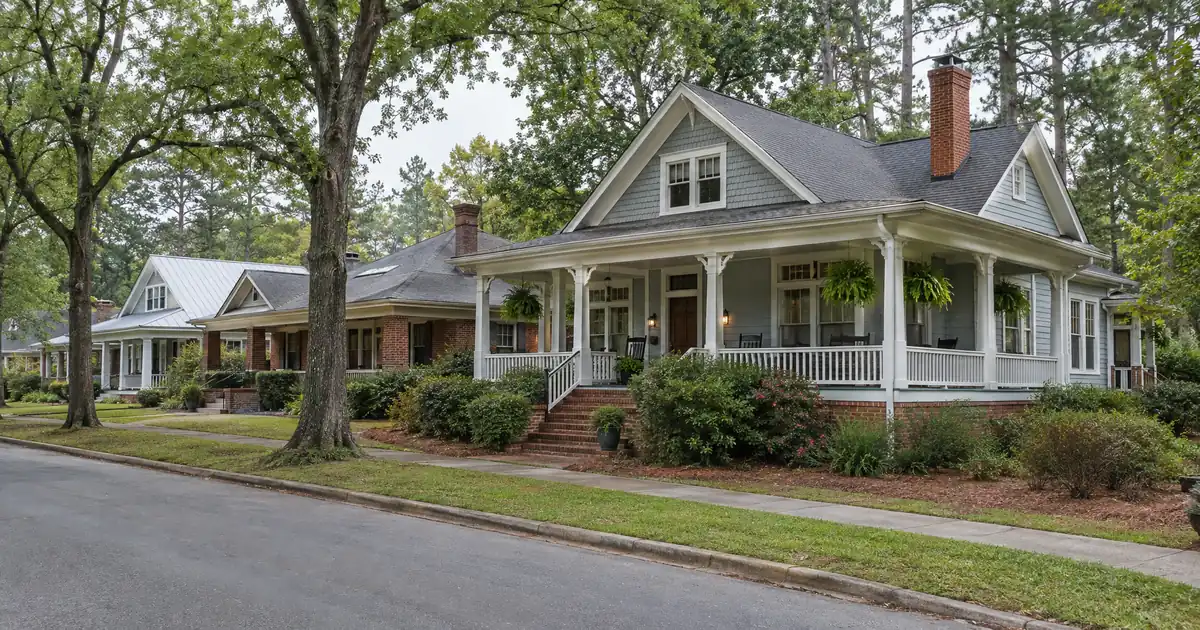
An out-of-state investor scrolling Albertville listings sees a familiar picture: a city of about 22,800 people on Sand Mountain, a home-value range near the low-$200Ks, and three-bedroom houses renting for what looks like a healthy slice of the purchase price. What the listings don’t show is how thin the transaction data is, how much the numbers depend on a single property’s condition, and how little of the borrowing capacity comes from appreciation. Anyone who already owns a rental here and wants to pull capital out for the next deal needs to sort those three things before ordering an appraisal.
TL;DR: A DSCR cash-out refinance in Albertville, Alabama is underwritten primarily on the property’s rental income measured against its full monthly obligation. The local constraint is thin coverage: workforce three-bedroom rents sit close to the cost of carrying a modest-priced home, so the 75 percent LTV ceiling and reserves, not appreciation, decide how much capital comes out.
DSCR Cash-Out Calculator
Run the cash-out numbers in Albertville, AL
Rate source: Freddie Mac 30-yr average via FRED® — Federal Reserve Bank of St. Louis · effective Sep 24, 2026
Prefilled with starting assumptions — enter your property’s value, balance, taxes, and insurance for a more accurate picture.
Program parameters update from Lendmire’s centralized guideline source. Taxes and insurance are editable estimates.
As of Sep 24, 2026 · General Freddie Mac market benchmark, not a Lendmire loan offer. Property value, balance, taxes, and insurance are editable estimates. Maximum loan-to-value varies by lender, program, property type, and seasoning. Not a Loan Estimate, approval, or commitment to lend. Program availability and eligibility are subject to lender guidelines, credit approval, property review, and underwriting.
- Zillow puts average Albertville home value at $220,718, up 2.5 percent year over year.
- Average three-bedroom rent runs about $1,500, per Zillow Rental Manager.
- Cash-out caps at 75 percent LTV, after about six months of ownership.
- Coverage on a stabilized three-bedroom at the cap lands in low-1.1 to 1.2 territory, modeled.
- Duplex-to-fourplex comps are scarce, so most local files are single-family.
Albertville Market Snapshot
A quick read on the Albertville investor landscape — figures come from the cited sources below. Confirm current property-level numbers before underwriting.
| Metric | Detail |
|---|---|
| Home prices | 17 sales (Redfin Housing Market) |
| Employment | 3,048 jobs (Business Alabama) |
The Workforce Three-Bedroom Ring Is the Core of the Market
The strongest cash-out candidate in Albertville is the plain three-bedroom single-family rental serving the plant-and-corridor workforce. It is the only property type where the research supports both a local rent figure and a meaningful share of stock. Point2Homes counts 1,007 three-bedroom rentals, 42 percent of the rental inventory and the largest single bedroom category. Zillow Rental Manager shows the average three-bedroom at $1,500, the average two-bedroom at $1,200, and an all-bedroom average of $795, with the market tagged “warm.”
One data gap needs stating plainly. No sourced price or rent data exists at the neighborhood level here. Address-level locations for the plant workforce weren’t verified either. The submarkets below are therefore qualitative anchors, not priced zones, and no per-neighborhood coverage figures appear here. Anyone who tells you Albertville’s north side beats its south side on rent-to-value is inventing it.
What the research does support is the demand base. Data USA lists manufacturing as the top resident employment sector at 1,944 people, followed by retail trade at 1,291 and health care and social assistance at 1,235. An employer roster published several years ago by Business Alabama put Wayne Farms at 938 employees, Tyson Foods at 927, AlaTrade Foods at 600, Progress Rail at 560, and Mitchell Grocery and Mueller at 500 each. Treat those counts as approximate; they are dated. The mix is what matters: poultry processing, railcar components, fire hydrants (the city carries the “Fire Hydrant Capital of the World” nickname), and wholesale grocery distribution. That is a diversified blue-collar payroll, not one plant.
Where the Coverage Ratio Lands (and Why It’s Tight)
The coverage math on a stabilized Albertville three-bedroom is workable at the 75 percent ceiling and comfortable only below it. Modeled on a $1,500 rent against a $220,000-$240,000 value, coverage at 75 percent LTV runs roughly 1.1 to 1.2 including taxes and insurance, and the range slides down as value rises. These are modeled assumptions, not sourced market figures: full PITIA at an assumed high-6s note rate, with Alabama-average tax and insurance loads.
Gross rent-to-value on that pairing works out to roughly 0.63 to 0.68 percent monthly. That ratio is my arithmetic, not a sourced statistic. It is enough to clear the 1.00 benchmark that most standard DSCR programs are built around, but not by much.
Two sensitivities matter.
- Rent quality. The $1,500 figure is an average. Listing snapshots in the research show individual three-bedroom units renting near $950 and a larger four-bedroom house near $2,250. One is a basic unit and the other a single listing, and neither is a market rate. A basic three-bedroom near the low end drops well under 1.00 at maximum leverage. Rent comps for the specific property matter more here than in a deeper market.
- Leverage choice. Dropping the request to 60 percent LTV lifts the same property comfortably above 1.3x. Some owners take less cash out to keep the coverage number clean.
Below 1.00 on long-term rent, structures a lender may review include a sub-1.00 program, an interest-only structure, or a lower LTV request. Each has tradeoffs in leverage, pricing, or reserves, and eligibility stays subject to lender guidelines, credit approval, and property review. A two-bedroom at the $1,200 average, modeled at maximum leverage, sits in the low-0.9s: a possible sub-1.00 file, not a standard one.
Here is how DSCR files in markets like this one typically look. Lower-basis workforce housing tends to produce coverage that is adequate rather than generous, so the file’s strength comes from the rent comps, the credit tier, and the reserves rather than from an equity cushion. The strongest packages arrive with a signed lease, a rent comp set that supports the number, and a properly sized reserve position. The weakest lean on an aspirational rent figure.
Appreciation Isn’t the Engine Here
Albertville’s cash-out capacity comes from basis and forced value, not market drift. Price signals conflict, and reading them honestly matters. Zillow shows average value up 2.5 percent over the past year. Redfin reported a November median of $237,000, down 5.2 percent year over year at $146 per square foot, but only 17 homes sold that month, so the monthly median swings on small samples. Average days on market fell to 37 from 100 a year earlier. The realistic value band runs about $220,000 to $240,000, and the honest appreciation read is flat to modestly positive.
That has a direct consequence for anyone planning a refinance. Suppose an investor bought an older three-bedroom for modeled $185,000 and put in a renovation that supports a $230,000 appraisal. The 75 percent cap applies to appraised value, and the payoff of the existing loan comes out first. If the original purchase was financed near 80 percent of the price, the gap between the new cap and the old balance is modest. After closing costs and the required reserve position (about six months of PITIA), the free cash can be small. A cash-out here is best read as capital recycling, not a windfall. Owners who bought below market or who added real square footage or finish quality see more proceeds than owners waiting for the market to lift them.
That’s not a knock on the market. It’s an argument for buying and improving with the refinance in mind.
The New-Construction Ceiling
New-build pricing acts as a soft cap on what an older rental can appraise for. NewHomeSource shows new communities in the Albertville area starting from $219,900, which sits at the bottom of the existing-home range. An appraiser choosing comps for a renovated older house will run into new-construction pricing right around the same level.
Picture an owner who assumes a heavy renovation will push value far above the new-build floor. That plan runs into the comp set. The stronger play is a moderate, rent-driven improvement (kitchen, flooring, mechanicals) that lifts rent and appraisal together without over-improving against the ceiling. The improvement dollars that raise the rent by a few hundred a month improve the coverage ratio and the appraisal simultaneously; the ones that only raise finish quality do neither.
Small Multifamily: The Comp Problem
Duplexes and small multifamily are plausible on paper and hard in practice. The research turned up no local source quantifying duplex, triplex, or fourplex stock or rents. Redfin’s new-homes snapshot showed one multi-family unit for sale alongside one townhouse and no condos. The one identified multi-unit project, a six-unit renovation, is a single data point.
This thin stock cuts both ways. An owner of a small multi-unit property has little competition. But an appraiser has few local comps to lean on, which makes valuation harder and can force wider searches. The practical read: most Albertville cash-out files will be workforce single-family. Anyone underwriting stacked income should expect to document rents carefully and allow more room in the appraisal step.
Downtown, the Park Area, and the Corridor
Three named areas give the market shape, though none has sourced pricing.
Downtown and the MTN District is a walkable cluster of locally owned shops and restaurants, per Amanda Howard Sotheby’s, with older housing stock nearby. Downtown buildings appear to date from roughly the early-to-mid twentieth century. Older stock means lower basis and more renovation upside, plus higher maintenance risk. It’s the best fit for owners pursuing the improve-then-refinance path.
The Sand Mountain Park area is the amenity story. The park covers 130 acres with sports facilities and a waterpark, and Sotheby’s cites more than $80 million in city investment. Newer housing tends to cluster around amenity draws like this, which may support appraisals against the new-construction floor. That’s an inference, not sourced data.
The US-431 and AL-75 corridor is described as one of the busiest intersections in north Alabama outside Huntsville and Birmingham. It functions as the retail and commuting hub, with tenants working in retail (1,291 residents) and reaching plant jobs nearby.
Anchors Beyond the Plants
Health care and education give some cushion against manufacturing cycles. Business Alabama reported Marshall Medical Centers at 1,428 employees generating 3,048 local jobs, an older figure, so treat it as approximate. Marshall Medical Centers operates two hospitals, eight outpatient locations, and physicians across 28 specialties. There is no hospital inside Albertville itself. The 150-bed South campus sits about five miles away in Boaz, so an Albertville rental draws on a county-wide clinical workforce, and a short commute to Boaz is a legitimate leasing point.
Snead State Community College is in Boaz, roughly six miles away, with roughly 2,500 to 2,900 students across sources. Alabama Aviation College operates in Albertville as a Snead State division. Neither creates a dorm-driven rental market, but both add steady, training-linked tenant demand.
Manufacturers have also announced expansions: Newman Technology a $22 million project with 100 jobs, and Master Extrusion a $102 million project with 210 jobs, the latter split between Albertville and one other site. Those announcements are several years old. They are evidence that existing employers were still investing, not a forecast.
Health care and education tend to be less cyclical than poultry and metal fabrication. A lender or appraiser asking whether rent will hold after a cash-out refinance has a reasonable answer in that mix, though nobody should call it recession-proof.
What the Program Requires
Cash-out on an investment property runs under a 75 percent LTV ceiling, about six months of seasoning measured from title recording, and a 1.00 minimum coverage benchmark comparing rent used for lender review against PITIA. Credit tiers step through 620, 660, 680, and 700, with 620 as the floor, and reserves run about six months of PITIA (higher above $1,500,000). Loan sizes go up to $3,000,000 on standard programs, and smaller balances route through select lenders in the network. Manufactured homes, log homes, and barndominiums are outside these programs. These are guideline ranges; exact eligibility depends on lender guidelines, credit profile, reserves, and property review.
Some lenders may review coverage below 1.00, but those files usually come with stronger compensating factors, lower leverage, different pricing, or more cash down. For readers new to the mechanics, Lendmire’s DSCR explainer, “What Is a DSCR Loan”, walks through them, and the choice between this route and a bank product is covered in Lendmire’s comparison of DSCR versus conventional loans. Owners weighing options beyond cash-out can review refi programs, and the broader mechanics of turning proceeds into the next acquisition are on the equity recycle pathway. Statewide context sits on the page for DSCR loans in Alabama.
Loans to LLC-titled entities are available subject to lender program eligibility, which suits owners holding rentals in an entity. Verify current local rental rules, taxes, and insurance with qualified local professionals before committing to a plan; those items sit outside this analysis.
Is Cash-Out Worth It Here? Where the Answer Flips
This one’s a genuine judgment call. The case for pulling equity is strongest for an owner with a below-market basis, a signed lease near the average three-bedroom rent, and a clear next acquisition. The case weakens when the property was bought near today’s value, when rent sits closer to $950 than $1,500, or when the plan requires maximum leverage on a thin coverage ratio.
Consider the middle path: a lower LTV request that keeps coverage above 1.3x, trading proceeds for a cleaner file and more margin if rent softens. For a market where the appraisal ceiling is set by $219,900 new construction, a smaller, safer pull may beat a maximum one. Investors focused on total capital raised might argue otherwise, and they aren’t wrong if their rent comps are strong.
DSCR vs. conventional financing
Two common ways to finance an investment property in Albertville, AL. They qualify you differently — here’s how investors weigh them.
Why investors choose it
- Qualifies on the property’s rental income — no personal tax returns, W-2s, or pay stubs needed to document income.
- No personal debt-to-income ceiling to clear, so existing mortgages and obligations don’t cap your borrowing the same way.
- Can be closed in an LLC, keeping the property inside a business entity.
- Built for scaling — not held to the limit on number of financed properties that conventional financing applies.
- Underwriting centers on the deal: generally qualifies when the rent covers the payment, a 1.00x coverage ratio being a common baseline (confirmed in underwriting).
- Designed specifically for investment property, including long-term and, where the program allows, short-term rentals.
Where it’s strong
- Often the lowest ongoing financing cost for a buyer who fully qualifies on personal income — a fit for a first property or a cost-first purchase.
Trade-offs for investors
- Requires full personal income documentation and must fit within a debt-to-income limit — salary, existing debts, and other mortgages all count.
- Typically held in your personal name rather than a business entity.
- Caps how many financed properties you can carry, which can become a ceiling as a portfolio grows.
- Evaluates you as a borrower as much as the property, which usually means more paperwork.
How investors usually choose: a first or single property often optimizes for the lowest financing cost; portfolio builders often optimize for leverage, vesting in an LLC, and scaling past conventional caps. The right answer depends on your goals, the property, and current guidelines — both paths run through select lenders in Lendmire’s wholesale network, with eligibility and terms confirmed in underwriting.
Risk sits mostly in the data. Redfin’s monthly sample was 17 sales. Rent sources disagree wildly (one apartment-only sample showed $465, Zillow’s blended average is $795), and employer figures are dated. Any plan resting on a single number here is fragile.
Owners who want a file reviewed can get a DSCR quote or call Lendmire at 828-256-2183 to walk through structure.
For current guidelines and terms, see Lendmire’s DSCR loan programs page.
Frequently Asked Questions
How much can I pull out of an Albertville rental?
It depends on the appraisal, your existing balance, and reserves. The ceiling is 75 percent of appraised value, and the payoff of your current loan comes out first. Since local value drift is flat to modest, most proceeds come from a low purchase basis or renovation, not market gains.
Does the appraisal cap out near new-construction pricing?
Often, yes. New communities in the area start from $219,900, close to the low end of the existing-home band. An older renovated rental will likely be compared against those builds, so plan improvements around rent gains rather than finish-level upgrades.
Will a two-bedroom rental clear the coverage benchmark?
Modeled at maximum leverage, a two-bedroom at the $1,200 average lands in the low-0.9s including taxes and insurance. Lower leverage, a sub-1.00 program, or an interest-only structure may be reviewed, subject to lender guidelines and credit approval.
Are duplexes easier to refinance than single-family here?
No. Multi-unit stock is thin, so appraisers have few comps and documentation of rents carries more weight. Single-family workforce rentals are where the local data is deepest.
How long must I own the property before a cash-out?
Seasoning runs about six months from title recording. Buyers planning a renovation and refinance should stage the timeline so the improved rent is in place, and documented, by the time the appraisal is ordered.
The Albertville investors who buy low, improve for rent, and size the pull to the coverage number will recycle capital into the next deal while everyone chasing appreciation waits.
About Lendmire
Lendmire is a non-QM mortgage brokerage (NMLS# 2371349) arranging DSCR investor loans in 41 markets, including Washington, D.C. Eligibility is generally reviewed around a property’s rental income rather than personal income, subject to lender and program guidelines, which suits self-employed investors and LLC-owned portfolios. Lendmire was recognized as a 2026 Scotsman Guide Top Workplace and a top-ranked workplace in 2025. Company news is collected in Lendmire press releases and announcements.
Get Started
Ready to find the right loan for you?
In about 30 seconds you can review financing options available for your investment property. No commitment required.
Informational only. Not a Loan Estimate, approval, or commitment to lend. Program availability and eligibility are subject to lender guidelines, credit approval, property review, and underwriting.
References
1. Zillow — Home Values Albertville AL
3. Redfin
5. Point2Homes
6. Data USA
9. Redfin’s new-homes snapshot
10. projects.constructconnect.com — Six-unit renovation
12. park
14. Snead State Community College
15. a 2026 Scotsman Guide Top Workplace
16. Scotsman Guide — Top Workplaces 2025
This article is part of Lendmire’s investment property cash-out refinance program — full qualification details, guidelines, and scenarios live on the program page.
Related reading: Luxury Rental DSCR Loans In New Jersey · Jersey Shore Vacation Rental Loans: DSCR Financing In Ocean City, Cape May And Long Beach Island · DSCR Cash-out Refinance In New Jersey: Pulling Equity From A Rental
Guides: Investment Property Cash-Out Refinance in Alabama
Brandon Miller
Founder & CEO, Mortgage Loan Originator, Lendmire LLC
- Mortgage Loan Originator · NMLS# 1129696 · Verify on NMLS Consumer Access
- North Carolina Real Estate Broker · License# 343312 · Verify on NCREC
- North Carolina Insurance Producer · License# 19053198 · Property, Casualty, Life, Health · Verify on NAIC SBS
- Lendmire LLC · Firm NMLS# 2371349 · Verify firm licensure
Disclosure information. Lendmire is a state-licensed mortgage brokerage under NMLS# 2371349. Lendmire is not a depository institution, direct lender, or financial advisor — all loans referenced are placed through wholesale lender partners and are subject to each lender's underwriting standards. This article is provided for general informational purposes and is not a commitment to lend, nor does it constitute financial, legal, or tax advice. Loan programs, terms, rates, and qualification standards change without notice and depend on borrower profile, property type, and the state in which the subject property is located. Equal Housing Opportunity provider. NMLS Consumer Access: nmlsconsumeraccess.org.