
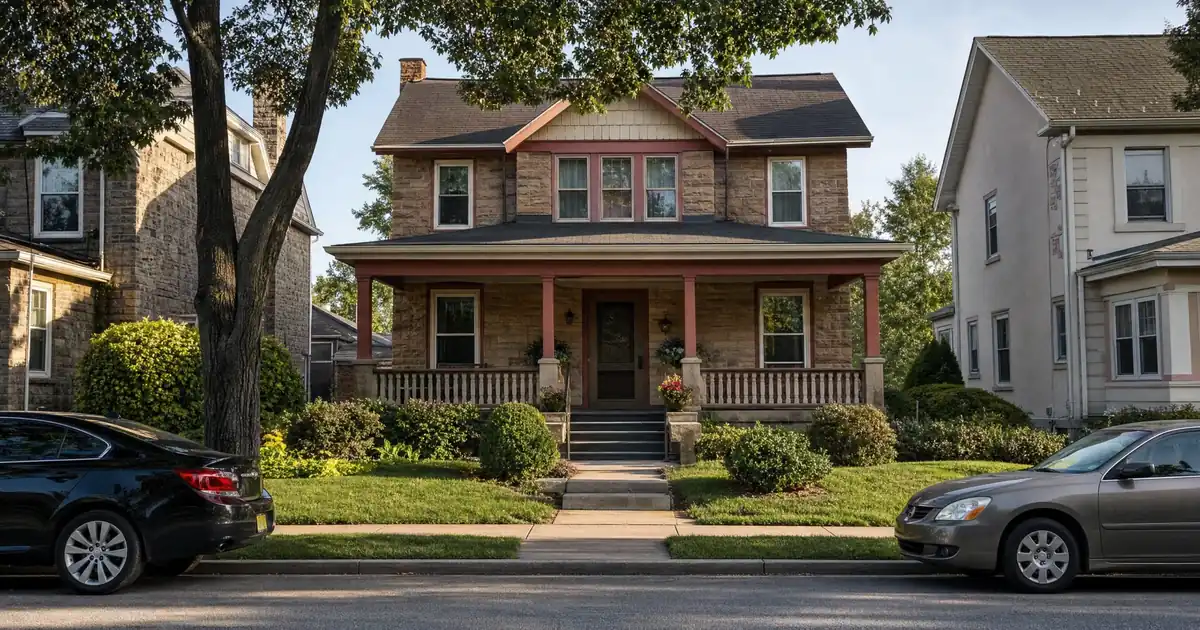
Investment property loans in Lancaster help investors finance rental homes using DSCR underwriting, which qualifies borrowers on rental income rather than personal tax returns. Cabbage Hill doesn’t look like a DSCR gold mine from the street. It’s rowhomes, some peeling paint, a lot of Victorian-era duplex stock that’s been carved up and re-carved up for a century — and it sits close enough to Lancaster General Hospital that a nurse or tech working a shift there can walk to work. That combination — low basis, walkable employer proximity, and rents that have been climbing faster than prices — is exactly why Cabbage Hill and its neighboring blocks are where the coverage math clears first in this city.
Key Takeaways: An investment property loan in Lancaster, Pennsylvania is underwritten primarily on the subject property’s rental income measured against its full monthly housing obligation, rather than the borrower’s W-2 or tax-return income, with lender review confirming rents, entity paperwork, and reserves subject to program guidelines.
DSCR Calculator
Run the numbers in your market
Rate source: Freddie Mac 30-yr average via FRED® — Federal Reserve Bank of St. Louis · effective Jul 30, 2026
Prefilled with starting assumptions — enter your own rent or nightly figures, taxes, insurance, and HOA for a more accurate picture.
Program parameters update from Lendmire’s centralized guideline source. Taxes and insurance are editable estimates.
As of Jul 30, 2026 · General Freddie Mac market benchmark, not a Lendmire loan offer. Rent, nightly rate, occupancy, taxes, and insurance are editable estimates. Short-term rental figures are estimates only and vary significantly by season, property type, management approach, and local short-term-rental rules — confirm local regulations before relying on them. Qualifying income for short-term rentals varies by program — some use appraisal market rent, others use documented STR history or projections — and is confirmed in underwriting. Not a Loan Estimate, approval, or commitment to lend. Program availability and eligibility are subject to lender guidelines, credit approval, property review, and underwriting.
- Cabbage Hill duplexes list near $239,900, well under Lancaster County’s $364,900 median (LancasterOnline).
- ZIP 17602 rents rose 14.9 percent year-over-year versus 3.6 percent price growth (Prop-Metrics).
- City home prices sit near $255,000, down slightly year-over-year (Redfin).
- Apartment vacancy across the Lancaster housing market area runs near 2.6 percent (HUD).
- Multi-unit listings near $360,000 median can carry two to five income streams instead of one.
Cabbage Hill and Churchtowne: The Entry-Price Duplex Play
Run the numbers on a duplex priced around $239,900, the lower end of Lancaster’s active multi-family listing range, generating combined rents of $2,380 a month across two units — a real comp pulled from current multi-family listings. At 75 percent leverage, modeling a full monthly obligation that includes principal, interest, taxes, and insurance, the coverage ratio comes out around 1.5x. That’s well clear of the 1.00 baseline most standard DSCR programs are built around, and it’s the kind of cushion an investor wants heading into a market where insurance and tax lines move independent of the loan.
Churchtowne runs the same play at an even lower entry point — rowhomes there trade below Cabbage Hill’s already-modest basis, with fully renovated units at the top of that range. It’s the most affordable submarket in the city proper, and it’s seen genuine reinvestment through revitalization programs rather than sitting stagnant. For an investor chasing rent-to-value rather than appreciation, Cabbage Hill and Churchtowne are the two names to know first, though anyone weighing that comparison should verify current values directly rather than relying on general market commentary. Lendmire (NMLS# 2371349) helps arrange DSCR financing for Lancaster, Pennsylvania investors through wholesale and investor-lending channels across 41 markets, including Washington, D.C., and this rowhome-duplex corridor is the profile that shows up most often on the desk for this city.
Musser Park and Chestnut Hill: The Hospital-and-College Corridor
Musser Park sits close enough to Lancaster General Hospital that its rowhomes and renovated units draw medical staff and young professionals almost by default, and Chestnut Hill — walkable, home to national-caliber restaurants, a few blocks from Franklin & Marshall College — pulls the F&M-affiliated renter along with families who want the walk-to-downtown lifestyle without downtown pricing. Chestnut Hill’s price spread is the widest of any neighborhood in the city: renovated townhomes and semi-detached units sit well below the detached historic homes that push past $800,000, so the DSCR math varies block to block more than it does anywhere else in Lancaster.
That price spread matters. A $800,000 Chestnut Hill Victorian isn’t a coverage play unless the rent roll is stacked across multiple bedrooms or a legal accessory unit — single-tenant rent on a house that size rarely clears 1.00 at standard leverage. The townhome and semi-detached tier is where the math actually works.
Penn Medicine Lancaster General Health anchors this corridor from the employment side. It’s the county’s largest employer by a wide margin — more than three times the headcount of Giant Food Stores, the county’s number-two employer — and its flagship hospital carries more than 660 beds with an emergency department treating over 100,000 patients a year. Penn State Health Lancaster Medical Center has since added a second major hospital system to the metro, one of only three Pennsylvania hospitals to earn a “Top General Hospital” distinction. Two competing hospital systems in a metro this size is unusual, and it means the workforce-tenant base near Musser Park and Chestnut Hill isn’t dependent on a single employer’s staffing decisions.
Why a Single-Family Workforce Rental Struggles to Clear 1.00
Here’s the honest part: a median-priced single-family rental in Lancaster city, financed conventionally as a rental at standard leverage, often doesn’t clear a 1.00 coverage ratio on current numbers. A house priced near the city’s $255,000 median (Redfin), renting near the ZIP 17602 average of $1,540 a month (Prop-Metrics), models out in the high-0.8x to low-0.9x range at 75 to 80 percent leverage once the full monthly obligation — taxes and insurance included — is factored in. That’s below the 1.00 benchmark most standard programs use as their floor.
It doesn’t mean the deal is dead. Reduced leverage, a stronger credit profile, or a sub-1.00 program some lenders may review are the paths worth exploring on a file like this — each comes with its own tradeoffs in pricing and required cash down, and none of it is guaranteed; every scenario is subject to lender guidelines, credit approval, and property review. An interest-only structure can also improve the ratio on the same property. The point for an investor shopping single-family in Lancaster proper: don’t assume median-priced-home-plus-median-rent automatically pencils. Run the actual numbers before writing an offer.
Working DSCR brokers see a recurring pattern in mid-sized Pennsylvania cities like this one: single-family workforce rentals near a hospital or college corridor come in tight on paper because prices have moved up over recent years, while rents — though rising — haven’t caught up proportionally at the same address level. The files that clear cleanest are usually the ones where the investor found a below-market acquisition or already has equity from a prior purchase to bring leverage down.
The Multi-Unit Advantage Nobody’s Single-Family Buyer Sees
Multi-unit product is where the ratio math flips in the investor’s favor. Lancaster’s active multi-family listings run a median near $360,000 — only about 41 percent above the city’s single-family median of $255,000 (Redfin) — yet a single multi-unit purchase can carry two to five separate rent streams instead of one.
Consider a five-unit building near that $360,000 median generating $55,800 in annual rent, a real listing pulled from current inventory. At 75 percent leverage, the same modeled full-obligation approach puts coverage near 2.0x — nearly double the 1.00 floor, and a level of cushion that lets an investor absorb a unit turnover or two without the file’s coverage collapsing. That’s the clearest lever in this market for beating a lender’s DSCR minimum: pay roughly 41 percent more than the single-family median, get two-to-five times the rent roll.
College Park, clustered directly around Franklin & Marshall, and the corridor near Thaddeus Stevens College of Technology both fit this multi-bedroom, shared-housing model well — per-bedroom rent economics work in a city with multiple colleges feeding overlapping demand (F&M, Millersville University, Elizabethtown College, and Thaddeus Stevens all draw renters into Lancaster proper) rather than one dominant campus tied to a single enrollment cycle. Thaddeus Stevens brings an added wrinkle worth knowing: industry partners report the average age of their skilled-trades workforce sits between 60 and 65, meaning a structural wave of retirements is coming through the regional trade pipeline — a durable driver of enrollment and student-housing demand near that campus that isn’t dependent on speculative population growth.
The ZIP Where the Coverage Ratio Improves Without a Refinance
ZIP 17602 — core Lancaster city — is worth underwriting first for one reason: rent is outrunning price. Average rent there is running $1,540 a month with year-over-year growth of 14.9 percent, while the median home price of $309,000 in that same ZIP moved only 3.6 percent over the same period (Prop-Metrics). When rent growth is running roughly four times faster than appreciation in the same ZIP, coverage ratios on new acquisitions improve mechanically year over year without an investor needing to refinance to capture it.
That divergence sits inside a broader split worth flagging: the city proper is essentially flat on price — Redfin has it down 0.2 percent year-over-year at $255,000 — while Lancaster County overall is running up 4.0 percent to a $364,900 median. Appreciation-focused buyers may find more upside in county-adjacent boroughs; cash-flow-focused buyers have every reason to stay inside city ZIPs where basis isn’t inflating underneath them.
Where to Be Careful: Comp Depth and Occupancy
Lancaster’s rental market runs tight overall — vacancy across the broader housing market area sits near 2.6 percent, down from 2.9 percent the year before, per HUD’s regional housing analysis, and even a large new apartment complex outside the city leased up to 95 percent occupancy without much drag on the surrounding market. That’s a low-oversupply signal, and it’s a genuine positive for anyone underwriting rental income here.
The catch sits on the appraisal side, not the tenant side. City transactions are taking longer to close — 22 days on market currently versus 15 a year ago — while county sales are moving in about a third of that time. Thinner, slower-moving comps in city ZIPs can make appraisal support softer than a suburban file, something worth factoring in before assuming a purchase price will hold up cleanly against recent city sales. It’s not a reason to avoid the city — it’s a reason to pull comps carefully before making an offer, particularly on a property that’s priced ahead of its immediate block.
What Actually Gets a File Approved Here
The cleanest file from a documentation standpoint has complete leases, entity paperwork, title, and property details ready before it goes to a lender — that alone speeds up review more than anything else on the checklist. On standard DSCR purchase programs, leverage typically runs 75 to 80 percent (20 to 25 percent down), with select strong files reviewed up to 85 percent where guidelines allow. Minimum coverage is generally set at 1.00, credit is commonly reviewed across tiers starting near 620 with higher-leverage options requiring stronger scores, and reserves of about six months of the full housing payment are the norm on most files (closer to nine months above $1,500,000 in loan size). Loans made to an LLC or other entity are common in this space, subject to lender program eligibility, and that’s the structure most DSCR investors in Lancaster’s rowhome and duplex market end up using.
None of these figures are guarantees of approval — every scenario runs through lender guidelines, credit review, and property underwriting, and review details are subject to lender overlays that vary by program. A quick review of how DSCR lender review works or conventional vs DSCR on investor loans is a useful starting point for investors new to the structure. Investors comparing DSCR against a conventional rental loan in Lancaster will find the property-income basis matters more here than most markets, given how many rowhome and duplex deals depend on rent-roll math a W-2-based conventional loan simply doesn’t evaluate the same way.
DSCR vs. conventional financing
Two common ways to finance an investment property in Lancaster, PA. They qualify you differently — here’s how investors weigh them.
Why investors choose it
- Qualifies on the property’s rental income — no personal tax returns, W-2s, or pay stubs needed to document income.
- No personal debt-to-income ceiling to clear, so existing mortgages and obligations don’t cap your borrowing the same way.
- Can be closed in an LLC, keeping the property inside a business entity.
- Built for scaling — not held to the limit on number of financed properties that conventional financing applies.
- Underwriting centers on the deal: generally qualifies when the rent covers the payment, a 1.00x coverage ratio being a common baseline (confirmed in underwriting).
- Designed specifically for investment property, including long-term and, where the program allows, short-term rentals.
Where it’s strong
- Often the lowest ongoing financing cost for a buyer who fully qualifies on personal income — a fit for a first property or a cost-first purchase.
Trade-offs for investors
- Requires full personal income documentation and must fit within a debt-to-income limit — salary, existing debts, and other mortgages all count.
- Typically held in your personal name rather than a business entity.
- Caps how many financed properties you can carry, which can become a ceiling as a portfolio grows.
- Evaluates you as a borrower as much as the property, which usually means more paperwork.
How investors usually choose: a first or single property often optimizes for the lowest financing cost; portfolio builders often optimize for leverage, vesting in an LLC, and scaling past conventional caps. The right answer depends on your goals, the property, and current guidelines — both paths run through select lenders in Lendmire’s wholesale network, with eligibility and terms confirmed in underwriting.
Frequently Asked Questions
Does Lancaster’s Amish tourism economy affect DSCR underwriting?
Not directly — DSCR lender review runs off long-term rental income, not tourism traffic. But it’s worth knowing that a program reviewing an appraisal near Central Market Lancaster or the tourism corridor may be looking at long-term comps rather than visitor-driven pricing, since Central Market itself has operated continuously since a 1730 deed and 1742 royal charter — a fixture, not a fad, in this city’s economy.
Can short-term rental income count toward the DSCR ratio in Lancaster?
Only with proper license documentation. Lancaster’s tourist-heavy zones require STR licensing, and without that paperwork in hand, appraisers generally won’t count Airbnb-style income toward gross rents on a file. Long-term lease income remains the cleaner path for most acquisitions here.
Why does the city median home price differ so much from the county median?
Redfin data shows Lancaster city at roughly $255,000 against the county’s $364,900 median reported by the Lancaster County Association of Realtors. The city offers meaningfully lower entry pricing, which is exactly why rent-to-value math tends to favor city-neighborhood acquisitions over county-adjacent purchases for cash flow.
Is Cabbage Hill or Churchtowne the better entry point for a first DSCR purchase?
Both work; Churchtowne generally prices lower, while Cabbage Hill carries stronger name recognition and proximity to Lancaster General Hospital. An investor prioritizing absolute lowest basis leans Churchtowne; one prioritizing tenant-demand certainty near a major employer leans Cabbage Hill.
Do multiple colleges in one metro create rental risk or reduce it?
It reduces it. Franklin & Marshall, Millersville University, Elizabethtown College, and Thaddeus Stevens all feed rental demand into overlapping Lancaster submarkets, so an investor isn’t exposed to a single school’s enrollment swings the way a true one-college town would be.
Lancaster’s dual identity — a modern two-hospital-system economy sitting a few blocks from the oldest continuously operated municipal market in the country — shows up in the rent roll more than in the skyline, and that’s the part most outside investors miss until they’ve walked Cabbage Hill or pulled comps in ZIP 17602 themselves. Investors weighing entity-titled purchases can also review Pennsylvania DSCR financing or the Lendmire DSCR programs at a glance before running a specific address.
A non-QM mortgage broker, Lendmire arranges DSCR financing for real estate investors. Because these files are built around property cash flow rather than personal income documentation, the structure tends to suit self-employed buyers and entity-owned portfolios particularly well. Lendmire places loans through wholesale investor lenders and is not a direct lender.
Any appraiser who’s worked this market long enough will tell an investor the same thing: in Lancaster, the rent roll wins the argument that the square footage can’t — a five-unit building at a modest premium over the single-family median will out-earn a bigger, prettier house on the same block almost every time.
About Lendmire
A non-QM mortgage broker (NMLS# 2371349), Lendmire arranges DSCR financing for real estate investors in 41 markets — 40 states plus Washington, D.C. Because deals are underwritten primarily on property cash flow rather than personal income documentation, the structure suits self-employed buyers and entity-owned portfolios. Lendmire places loans through wholesale investor lenders; it is not a direct lender. Scotsman Guide named Lendmire a Top Mortgage Workplace in both 2025 and 2026.
Get Started
Ready to find the right loan for you?
In about 30 seconds you can review financing options available for your investment property. No commitment required.
Informational only. Not a Loan Estimate, approval, or commitment to lend. Program availability and eligibility are subject to lender guidelines, credit approval, property review, and underwriting.
References
1. LancasterOnline – Lancaster County Home Prices Nearing a New Record
2. Prop-Metrics ZIP 17602 Profile
3. Redfin – City of Lancaster Housing Market
4. HUD Comprehensive Housing Market Analysis – Lancaster
5. Homes.com Lancaster Multi-Family Listings
6. Franklin & Marshall College
7. LancasterOnline – Penn Medicine Lancaster General Health Tops List
8. Penn State Health Lancaster Medical Center
9. Thaddeus Stevens College of Technology
11. Scotsman Guide as a 2026 Top Workplace
This article is part of Lendmire’s DSCR loan program — full qualification details, guidelines, and scenarios live on the program page.
Related reading: DSCR Loans in Lancaster County, PA: Investor Financing for Lancaster City, Lititz, Ephrata & Real Estate Investors · DSCR Investment Property Loans in Gettysburg, PA: Thin Comps and Light Rent Rolls · Investment Property Loans in Pittsburgh, PA: Where the City Outgrows Its Region
Guides: DSCR Loans in Lancaster, PA · DSCR Loans in Pennsylvania
Brandon Miller
Founder & CEO, Mortgage Loan Originator, Lendmire LLC
- Mortgage Loan Originator · NMLS# 1129696 · Verify on NMLS Consumer Access
- North Carolina Real Estate Broker · License# 343312 · Verify on NCREC
- North Carolina Insurance Producer · License# 19053198 · Property, Casualty, Life, Health · Verify on NAIC SBS
- Lendmire LLC · Firm NMLS# 2371349 · Verify firm licensure
Disclosures. The information presented in this article is general market commentary, not financial, legal, or tax advice. Lendmire is a mortgage brokerage (NMLS# 2371349) — not a direct lender or depository institution — and loan placement is subject to lender underwriting. Nothing in this content represents a commitment to lend. Loan terms, pricing, and program availability vary based on borrower qualifications, property characteristics, and state of subject property, and are subject to change at any time. Lendmire complies with Equal Housing Opportunity requirements. Consumer access: nmlsconsumeraccess.org.