
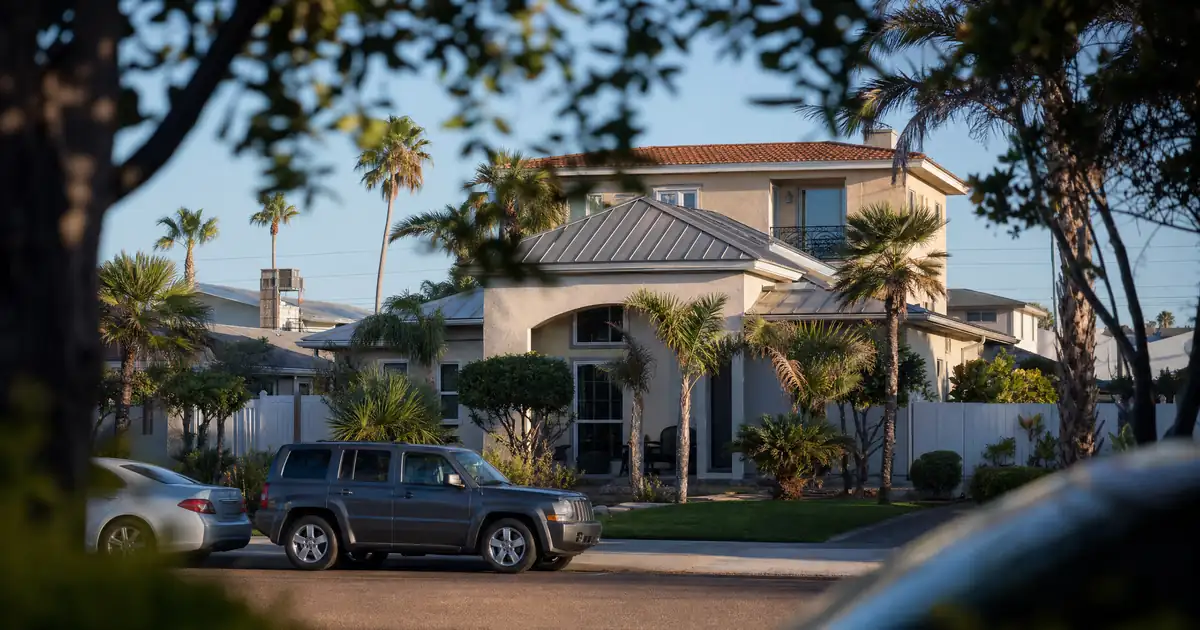
Picture an investor evaluating a three-bedroom home in Laguna Vista, priced near the area’s average of $399,933, with a lease already in place at roughly $2,740 a month. Run that rent against a full monthly obligation — principal, interest, taxes, and insurance, not just principal and interest — and the coverage ratio lands just above 1.00x. Not a blowout number. Not a bad one either. That single scenario captures the whole South Padre Island investment story better than any citywide statistic could: this is a market where the math changes dramatically depending on which side of the Queen Isabella Causeway the property sits.
The Short Version: South Padre Island, Texas DSCR files are underwritten against the property’s rental income measured against its full monthly obligation, and here that math depends heavily on which side of the causeway a property sits — Laguna Vista’s roughly $2,740 average rent against a $399,933 sale price (HAR.com) clears the line, while gulf-front towers rarely do on a long-term lease alone.
DSCR Calculator
Run the numbers in your market
Rate source: Freddie Mac 30-yr average via FRED® — Federal Reserve Bank of St. Louis · effective Jul 30, 2026
Prefilled with starting assumptions — enter your own rent or nightly figures, taxes, insurance, and HOA for a more accurate picture.
Program parameters update from Lendmire’s centralized guideline source. Taxes and insurance are editable estimates.
As of Jul 30, 2026 · General Freddie Mac market benchmark, not a Lendmire loan offer. Rent, nightly rate, occupancy, taxes, and insurance are editable estimates. Short-term rental figures are estimates only and vary significantly by season, property type, management approach, and local short-term-rental rules — confirm local regulations before relying on them. Qualifying income for short-term rentals varies by program — some use appraisal market rent, others use documented STR history or projections — and is confirmed in underwriting. Not a Loan Estimate, approval, or commitment to lend. Program availability and eligibility are subject to lender guidelines, credit approval, property review, and underwriting.
- Laguna Vista’s rent-to-price ratio clears 1.0x territory; gulf-front condos generally need short-term rental income to cover the same loan.
- Port Isabel workforce homes lease to municipal, school district, and Starbase-adjacent commuter tenants year-round.
- Cameron County’s rental vacancy rate sits near 4%, well below typical national benchmarks.
- Island new construction is capped by permitting limits, protecting the scarcity value of existing towers.
- A second causeway project, priced near $700 million, is set to open a first-ever backup route off the island.
South Padre Island Market Snapshot
A quick read on the South Padre Island investor landscape — figures come from the cited sources below. Confirm current property-level numbers before underwriting.
| Metric | Detail |
|---|---|
| Home prices | $516,900 median property value (2024) (DataUSA (Census-derived profile)) |
| Typical rents | $1,611 median gross rent (2024) (City-Data.com) |
| Recent appreciation | +4.5% yoy (Zillow Home Value Index) |
| University enrollment | 33,881 total enrollment (fall 2024) (UTRGV) |
| Population | 2,891 population (Census Reporter) |
| Employment | 2,100+ full-time employees by late 2023 (Wikipedia – SpaceX Starbase) |
Laguna Vista Is the Cash-Flow Play the Island Itself Can’t Match
Laguna Vista isn’t glamorous, and that’s precisely the point. It’s a mainland bay-and-canal community west of Port Isabel, and it’s currently one of the few submarkets in this metro where a straight long-term-lease DSCR calculation clears the 1.00x floor without help from tourism income. Average home price sits at $399,933 with a price per square foot of $221, and average rent for a three-bedroom home runs around $2,740 a month, according to HAR.com listing data. Modeled against a standard 75% loan-to-value purchase, 30-year amortization, and Texas-typical tax and insurance assumptions, that rent-to-price relationship pencils to roughly 1.02x — thin, but real.
Here’s the catch: values in Laguna Vista are also softening. A separate aggregator puts the median sale price at $325,250, down 9% year-over-year. That’s a meaningfully different number from HAR’s average, and the gap matters for underwriting — it signals this is a thinly-traded market where comp selection swings the appraisal more than it would in a deeper metro. The upside is that a buyer isn’t paying an appreciation premium here. This is a cash-flow submarket, not an equity-growth bet, and investors should model it that way rather than counting on a refinance-driven exit down the line.
DSCR files from small, resort-adjacent markets like this one tend to follow a familiar shape: the rent number is clean and defensible, but the appraisal comp pool is shallow, and a lender’s underwriter will often ask for a wider trailing window of sales rather than the usual 90-day lookback. That’s not a red flag — it’s just how thin markets get underwritten, and the cleanest files come in with a signed lease, entity documents, and a recent property condition report ready before the file goes out.
A DSCR loan structures purchase files primarily around the property’s rental income rather than the borrower’s W-2 or tax-return history, subject to lender guidelines and program eligibility. That distinction is worth pausing on, because it’s the difference between qualifying on a $2,740 lease and qualifying on a personal debt-to-income ratio that may already be stretched by other holdings. For a self-employed investor or one who already owns several financed properties, that’s often the more workable lane. Readers who want the fuller mechanics can check Lendmire’s DSCR guide.
Port Isabel: Workforce Rents Anchored by the Hovercraft to Starbase
Port Isabel is the workforce-housing counterpart to the resort island across the causeway, and it now has a demand driver almost no other small Texas town can claim: a corporate commuter base tied to SpaceX. Homes here fall within Point Isabel Independent School District, which serves 1,786 students across five schools, per NCES data. Pricing runs well below island-proper levels — Zillow’s zip-level comparison shows Port Isabel homes averaging $244,730, while a separate aggregator puts the median list price at $282,000, down 22% year-over-year. Treat that spread as a signal of a market still finding its footing rather than a precise number — and treat any refinance thesis built off future appreciation here as conservative, not aggressive.
The tenant story is what makes this submarket interesting for a buy-and-hold DSCR purchase. Individual Port Isabel rental listings now market themselves explicitly around proximity to the LNG facility and the hovercraft pickup point used by SpaceX Starbase employees commuting to the site. That’s a structural, non-tourism renter pool — municipal workers, school district staff, hospitality employees who live on the mainland because pricing is materially lower, and now a growing slice of aerospace-adjacent commuters. Cameron County’s rental vacancy rate sits near 4%, according to a HUD-sourced estimate compiled by AffordableHousingOnline — a tight number that supports steady tenant absorption for this kind of workforce unit, separate from whatever is happening with island-proper condo supply.
Run the numbers on a single-family purchase near the Zillow average of $244,730, financed at a standard purchase leverage, against a Cameron County Fair Market Rent ceiling of $1,479 for a comparable unit. That lands in the high-0.8x range on rent alone — under the 1.00x benchmark most standard DSCR programs are built around. This is where the duplex and triplex product matters. Long Island Village, a waterfront community in Port Isabel, is marketed directly to investors as a rental-income opportunity, and Zillow’s own category listings confirm a distinct Port Isabel duplex-and-triplex segment apart from single-family stock. Two units of rent against one loan changes the coverage math meaningfully — a scenario worth exploring before defaulting to a single-family purchase that clears the ratio less comfortably.
This is also the clearest place in the metro where the DSCR-versus-conventional decision genuinely flips. A W-2 employee buying one Port Isabel rental with strong personal income might find conventional financing carries lower cost and cleaner underwriting — no property-income basis needed. DSCR becomes the more practical tool for the investor who’s self-employed, holding the property in an LLC (subject to lender program eligibility), or already carrying enough financed properties that a bank’s debt-to-income math runs out of room. The conventional-vs-DSCR tradeoffs are worth working through before assuming DSCR is the default here — it isn’t automatically the right lane for every Port Isabel buyer.
What About the Gulf-Front Condo Towers?
Long-term-lease math doesn’t work on the beachfront. Not even close. Gulf-front condo towers — Saida Towers, Sapphire, Boardwalk, Las Brisas — are the dominant investment product on the island itself, with 1-bedroom units priced $350,000 to $450,000, two-bedrooms running $500,000 to $700,000, and three-bedrooms stretching to $800,000 depending on square footage and view. Modeled against South Padre Island’s median gross rent of $1,611, per City-Data — a citywide figure, not a beachfront-specific one, but the only rent benchmark available for the island proper — a $600,000 two-bedroom condo financed at standard purchase leverage lands somewhere around 0.4x on a straight annual lease. Nowhere close to qualifying on long-term rent alone.
This is a short-term-rental income story, full stop. Private analytics firm Rabbu reports island-wide occupancy running 51%, well above the 33% Texas state average, with July averaging $7,984 in gross revenue per listing and larger five-bedroom-plus properties clearing over $118,000 annually. That single peak month alone can eclipse the modeled monthly carrying cost on a mid-tier condo — the underwriting question isn’t whether beachfront can generate income, it’s whether a trailing twelve-month income history smooths out the gap between July’s numbers and a slow February. Lenders reviewing STR-basis DSCR files typically want that trailing income documentation rather than a single strong month, and building restrictions and a difficult city permitting process that limit new island construction do at least protect the scarcity value of existing towers against a supply flood.
The honest tension here: beachfront is the highest-price, highest-headline-return product on the island, and it’s also the product with the least straightforward long-term-lease DSCR file. An investor chasing appreciation and peak-season STR revenue might find the towers compelling. An investor who wants a boring, bankable rent-to-debt ratio should look mainland first.
The SpaceX Effect Nobody’s Underwriting For
Most South Padre Island content leans on spring break and Winter Texan seasonality as the whole demand story. That’s incomplete. Roughly 30 miles south, SpaceX’s Starbase site — which voters approved incorporating as its own Texas city in a May election, the first new municipality in Cameron County since 1995 — has grown into a genuine second economic engine. Elon Musk announced the relocation of SpaceX’s corporate headquarters to the site from Hawthorne, California, and by late 2023 the facility already employed more than 2,100 full-time workers; a more recent Cameron County estimate cited by Rolling Stone puts the figure above 3,400 full-time employees, with roughly 21,400 indirect jobs tied to the site regionally. Starbase’s own community page reports more than 500 full-time residents already living there, including employees, families, and children — and the company has separately purchased 54 acres on the north end of South Padre Island itself, adding to nearly 500 parcels it controls across Cameron County, per reporting from the RGV Business Journal.
That’s not a tourism statistic. That’s a corporate-payroll-driven renter pool that doesn’t rise and fall with spring break, and it’s largely uncorrelated with the beach-and-convention-center demand the City of South Padre Island’s Convention & Visitors Bureau markets to more than seven million annual visitors. Properties near Isla Blanca Park are already being marketed for their unobstructed views of SpaceX launches — a niche aerospace-tourism angle no comparable Gulf Coast Texas market can claim. Layered on top is a planned second causeway, State Highway 104, projected to cost $700 million or more and intended to give this single-access barrier island its first-ever backup evacuation route — a genuinely rare infrastructure event for a resort town this size.
Investors underwriting purely on beach tourism are missing half the demand equation in this metro. The stronger long-term thesis probably sits in Port Isabel and Laguna Vista, where SpaceX-adjacent commuter demand and workforce tenants stack on top of, rather than compete with, the existing hospitality labor pool.
Fiesta Isles and the Island’s Other Income-Stacking Angles
Fiesta Isles and Padre Beach round out the island’s non-tower inventory — canal-lot, boat-access neighborhoods favored by anglers and kiteboarders, generally priced below beachfront towers with a tenant base that skews toward longer stays and recreational travelers rather than peak-week vacationers. No independent aggregator publishes a clean median price specifically for these pockets, so treat any pricing here as illustrative rather than a hard benchmark. The Shores, a gated bayfront community, attracts a different buyer entirely — one listing described a bayfront lot with over 195 feet of water frontage, the kind of multi-structure “casita” configuration that supports a guest-house income-stacking model rather than a straight single-family rental.
For an investor working South Padre Island’s tighter footprint — 2.7 square miles total — duplex and small multifamily product tends to stack rent-to-value better than a single condo unit, since two or three units share one lot, roof, and foundation cost basis. That’s a pattern worth testing against any single-unit alternative before committing to a purchase.
Frequently Asked Questions
How do you qualify for a DSCR loan in South Padre Island, Texas?
Qualification centers on the property’s rental income measured against its full monthly obligation rather than the buyer’s personal income documentation. On most files, lenders want a 1.00x coverage ratio or better, though credit profile, reserves, and leverage all factor in, and select lenders may review lower-ratio scenarios with stronger compensating factors, subject to program guidelines.
What are the requirements for an investment property loan in South Padre Island, Texas?
On standard purchase programs, expect 20% to 25% down (75% to 80% loan-to-value), with higher leverage up to 85% available on the strongest files where guidelines allow. Credit tiers commonly run from a 620 floor up to 700-plus for higher-leverage scenarios, with roughly six months of PITIA reserves typical — nine months above $1,500,000 in loan amount. All figures are program guidelines, not guarantees, and remain subject to lender overlays.
Does a gulf-front condo qualify differently than a Port Isabel single-family home?
Yes, in practice. A gulf-front condo’s long-term lease rarely covers its monthly obligation given citywide median rent levels near $1,611, so these files typically lean on short-term rental income history instead. A Port Isabel single-family home is more likely to qualify on a straight 12-month lease, since it’s priced lower and serves a workforce tenant base rather than a tourist one.
DSCR vs. conventional financing
Two common ways to finance an investment property in South Padre Island, TX. They qualify you differently — here’s how investors weigh them.
Why investors choose it
- Qualifies on the property’s rental income — no personal tax returns, W-2s, or pay stubs needed to document income.
- No personal debt-to-income ceiling to clear, so existing mortgages and obligations don’t cap your borrowing the same way.
- Can be closed in an LLC, keeping the property inside a business entity.
- Built for scaling — not held to the limit on number of financed properties that conventional financing applies.
- Underwriting centers on the deal: generally qualifies when the rent covers the payment, a 1.00x coverage ratio being a common baseline (confirmed in underwriting).
- Designed specifically for investment property, including long-term and, where the program allows, short-term rentals.
Where it’s strong
- Often the lowest ongoing financing cost for a buyer who fully qualifies on personal income — a fit for a first property or a cost-first purchase.
Trade-offs for investors
- Requires full personal income documentation and must fit within a debt-to-income limit — salary, existing debts, and other mortgages all count.
- Typically held in your personal name rather than a business entity.
- Caps how many financed properties you can carry, which can become a ceiling as a portfolio grows.
- Evaluates you as a borrower as much as the property, which usually means more paperwork.
How investors usually choose: a first or single property often optimizes for the lowest financing cost; portfolio builders often optimize for leverage, vesting in an LLC, and scaling past conventional caps. The right answer depends on your goals, the property, and current guidelines — both paths run through select lenders in Lendmire’s wholesale network, with eligibility and terms confirmed in underwriting.
Is Laguna Vista a good starter market for a first DSCR purchase?
It’s one of the few submarkets in this metro where a long-term lease alone gets close to a 1.00x coverage ratio, based on average area pricing and rent figures. The tradeoff is thin trading volume and softening values, so it suits an investor prioritizing cash flow over appreciation more than one counting on a future refinance.
Can an out-of-state investor use rental income near Starbase to qualify?
Rental income from a Port Isabel property marketed toward SpaceX-adjacent commuters is underwritten the same way as any other qualifying lease — based on the signed rent and the property’s monthly obligation, not the tenant’s employer. What changes is the durability of that demand, since a corporate-payroll-driven renter pool tends to be less seasonal than the island’s tourism-based leases.
How does DSCR lender review differ from a bank’s approach in South Padre Island?
A conventional bank loan typically underwrites the borrower’s full debt-to-income picture, including traditional personal-income documentation and other financed properties. A DSCR lender, by contrast, generally lets the property’s rent-to-obligation ratio, not the borrower’s personal DTI, drive the qualification decision, subject to lender guidelines.
Reach Lendmire at 828-256-2183 to talk through how a specific Laguna Vista, Port Isabel, or gulf-front purchase might structure.
For investors already holding equity on the island or the mainland side who later want to explore rate-and-term and cash-out refi details, that’s worth its own conversation — this analysis is focused on the purchase side of the ledger. And for a broader look at how DSCR programs apply across the state, Texas DSCR investor loans covers the statewide framework this South Padre Island analysis sits inside.
None of this changes the core fact worth sitting with: South Padre Island’s population is 2,891 people, per Census Reporter’s most recent estimate, spread across 2.7 square miles — and that tiny resident base is what absorbs more than seven million annual visitors and, increasingly, a growing wave of aerospace payroll from across the bay.
About Lendmire
Lendmire (NMLS# 2371349), a non-QM mortgage broker serving investors in 41 markets including Washington, D.C., helps structure DSCR scenarios commonly evaluated around a property’s rental income rather than personal income paperwork, subject to lender guidelines. A Scotsman Guide Top Mortgage Workplace in 2025 and 2026, Lendmire places loans through wholesale investor lenders and is not a direct lender.
Get Started
Ready to find the right loan for you?
In about 30 seconds you can review financing options available for your investment property. No commitment required.
Informational only. Not a Loan Estimate, approval, or commitment to lend. Program availability and eligibility are subject to lender guidelines, credit approval, property review, and underwriting.
References
1. HAR.com — Laguna Vista Listings
2. DataUSA (Census-derived profile)
3. City-Data
5. UTRGV
7. Wikipedia – SpaceX Starbase
8. NCES Public School District Search — Point Isabel ISD
9. Starbase Community & Explore
10. City of South Padre Island
11. a 2025 Scotsman Guide Top Mortgage Workplace
12. Scotsman Guide 2026 Top Mortgage Workplace
This article is part of Lendmire’s DSCR loan program — full qualification details, guidelines, and scenarios live on the program page.
Related reading: DSCR Cash Out Refinance in South Padre Island, Texas: A 2026 Refinance Guide to Padre Blvd · DSCR Loans in South Padre for Beachfront STR Investors · Cash Out Refinance Investment Property South Padre Island Texas
Guides: DSCR Loans in South Padre Island, TX · DSCR Loans in Texas
Brandon Miller
Founder & CEO, Mortgage Loan Originator, Lendmire LLC
- Mortgage Loan Originator · NMLS# 1129696 · Verify on NMLS Consumer Access
- North Carolina Real Estate Broker · License# 343312 · Verify on NCREC
- North Carolina Insurance Producer · License# 19053198 · Property, Casualty, Life, Health · Verify on NAIC SBS
- Lendmire LLC · Firm NMLS# 2371349 · Verify firm licensure
Important disclosures. Lendmire (NMLS# 2371349) is a licensed mortgage brokerage. Lendmire is not a direct lender, depository institution, or financial advisor. All loan inquiries are subject to lender underwriting; this article does not constitute a commitment to lend. Rates, terms, and program guidelines are subject to change without notice and vary by borrower profile, property type, and state. Information in this article is general in nature and is not financial, legal, or tax advice. Equal Housing Opportunity. NMLS Consumer Access: nmlsconsumeraccess.org.