
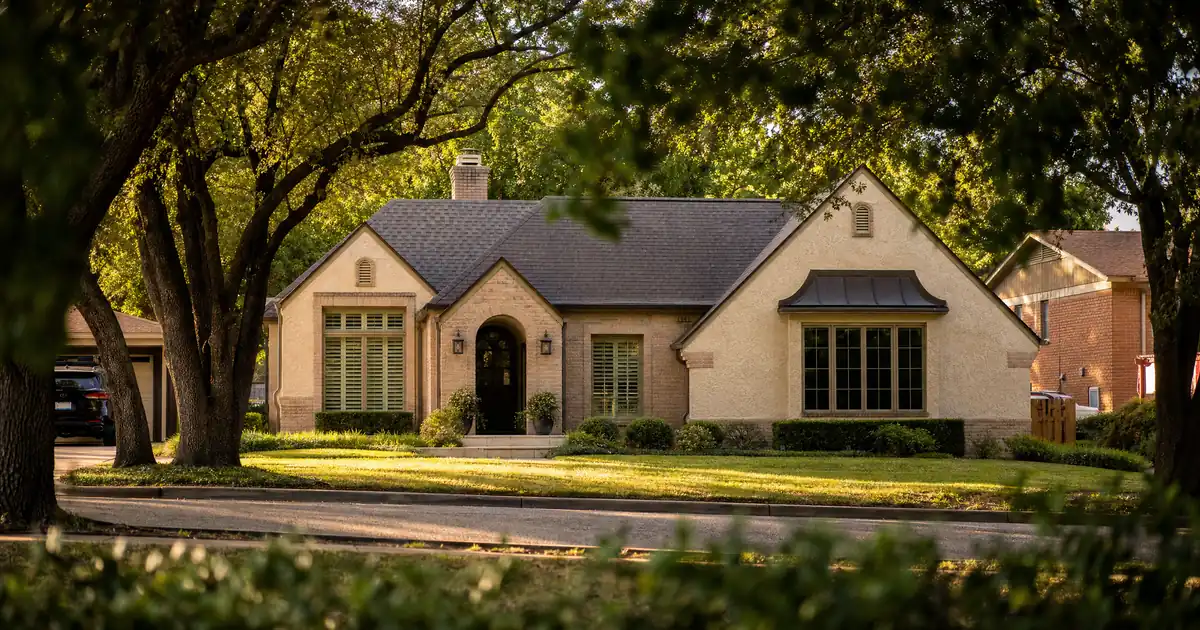
Investment property loans in Fort Worth are the focus of this guide, covering how DSCR underwriting applies to the city’s dense historic rental districts. Fort Worth added 19,512 residents between July 2024 and July 2025, the second-largest numeric population increase of any city in the country that year, pushing the population to 1,028,117 according to Fort Worth Inc.’s reporting on the latest U.S. Census Bureau vintage estimates. That single number reframes how an investor should approach this market. Most people underwriting North Texas rentals default to Dallas comps and Austin headlines. Fort Worth’s growth rate now outpaces both, and the city is doing it with a housing stock that looks nothing like either of those metros — dense historic duplex and fourplex neighborhoods sitting a few miles from an active fighter-jet assembly line.
That combination matters for how a DSCR loan gets structured here. Fort Worth’s closed sale median sits at $338,000, well below the Dallas-Fort Worth metro median of $415,000, which means entry pricing is friendlier than almost anywhere else in North Texas (Redfin). But Texas carries some of the highest property tax rates in the country, and that drag lands directly on the cash-flow line of a DSCR file. The neighborhoods that handle that drag best aren’t the newest suburbs — they’re the pre-war districts where one legal parcel produces two, three, or four rent checks.
DSCR Calculator
Run the numbers in your market
Rate source: Freddie Mac 30-yr average via FRED® — Federal Reserve Bank of St. Louis · effective Jul 30, 2026
Prefilled with local estimates — enter your own rent or nightly figures, taxes, insurance, and HOA for a more accurate picture.
Program parameters update from Lendmire’s centralized guideline source. Taxes and insurance are editable estimates.
As of Jul 30, 2026 · General Freddie Mac market benchmark, not a Lendmire loan offer. Rent, nightly rate, occupancy, taxes, and insurance are editable estimates. Short-term rental figures are estimates only and vary significantly by season, property type, management approach, and local short-term-rental rules — confirm local regulations before relying on them. Qualifying income for short-term rentals varies by program — some use appraisal market rent, others use documented STR history or projections — and is confirmed in underwriting. Not a Loan Estimate, approval, or commitment to lend. Program availability and eligibility are subject to lender guidelines, credit approval, property review, and underwriting.
At a Glance: A DSCR investment property loan in Fort Worth, Texas is underwritten primarily on the subject property’s monthly rental income measured against its full housing obligation — principal, interest, taxes, insurance and any HOA dues — rather than the borrower’s traditional personal-income documentation or traditional employment income, letting rental cash flow carry the qualification.
- Citywide median sale price runs $338,000, well under the $415,000 DFW metro figure (Redfin)
- Fairmount/Near Southside duplex and fourplex stock lets combined unit rent clear coverage where a single comparable single-family rental often can’t
- Population grew by 19,512 in one year, the second-largest numeric gain of any U.S. city (Fort Worth Inc.)
- Typical purchase leverage runs 75 to 80 percent LTV with a 1.00x floor on select programs
Fort Worth Market Snapshot
A quick read on the Fort Worth investor landscape — figures come from the cited sources below. Confirm current property-level numbers before underwriting.
| Metric | Detail |
|---|---|
| Home prices | $303,000 median property value (Data USA) |
| Typical rents | $1,699 average (RentCafe) |
| Population | 1,028,117 residents (Fort Worth Inc./U.S. Census) |
| Employment | 39,000 jobs (Near Southside Inc.) |
A City Growing Faster Than Its Housing Stock
Fort Worth’s economy runs on a combination almost no other Texas city can match: a federally-backstopped defense manufacturing base sitting a few miles from a genuine cattle-heritage downtown. Lockheed Martin Aeronautics operates the F-35 Lightning II final assembly line at Air Force Plant 4, employing roughly 19,000 people in Fort Worth and generating a combined direct and indirect economic impact of $4 billion, per the Texas Comptroller’s office. That program isn’t a temporary contract — Lockheed delivered a record 191 F-35 aircraft off that line last year, and in a recent quarter finalized a contract worth $24 billion for 296 additional jets. Add Naval Air Station Joint Reserve Base Fort Worth next door, with 5,041 direct employees including 2,066 active-duty personnel, and the west side of the city has a tenant base that doesn’t disappear when a single company has a bad quarter.
Layer on American Airlines, headquartered in Fort Worth with roughly 54,500 employees at the corporate campus, BNSF Railway, and a genuinely deep healthcare and higher-education base, and the employment picture diversifies fast. Cook Children’s Health Care System runs a 430-bed pediatric hospital with more than 8,000 employees. Texas Health Resources operates a 726-bed flagship hospital locally as part of a system with more than 26,000 employees across the region. JPS Health Network, anchored by a 578-bed Level I trauma center, is mid-construction on a new facility that will carry 740 beds with room to expand to 800 — a project tied to an $800 million bond that puts the total build near $2.1 billion. Near Southside Inc. puts the Medical District’s total annual economic footprint at $4.2 billion in Fort Worth and $5.5 billion across Tarrant County, supporting nearly 39,000 jobs.
Texas Christian University adds another demand layer that most out-of-state investors underweight. TCU’s total enrollment sits at 12,785 students, and the school is mid-way through a $500 million, 35-project campus expansion. First-year enrollment jumped 12.3 percent last fall, forcing 411 students into triple-occupancy dorm rooms because on-campus housing hasn’t kept pace. New student housing won’t fully absorb that gap until 2027. That structural shortfall pushes rental demand into the neighborhoods immediately surrounding campus — the same neighborhoods that already carry the city’s densest duplex and fourplex stock.
Why the Duplex Beats the Single-Family Comp Here
The math on a Fort Worth single-family rental purchased near the citywide median often lands right at the edge of qualifying. The math on a comparable-priced duplex, in neighborhoods where that stock exists, usually clears with room to spare. That gap is the single most important thing a Fort Worth DSCR investor needs to understand before picking a property type.
Here’s why. Texas property tax rates are among the highest in the country, and that expense lands on the payment side of the DSCR ratio regardless of how strong the rent is. A single-family rental has one rent check working against that tax drag. A legally-conforming duplex or fourplex has two, three, or four rent checks working against the same tax bill on largely the same loan basis. Rent Historic Fort Worth’s own portfolio — duplexes, back houses, six-plexes, garage apartments, and fourplexes, all within three miles of downtown — is a working demonstration of exactly this structure.
Run the numbers on a modeled scenario to see the difference. Take a duplex priced near $410,000, close to the current median asking price for Fort Worth multi-family listings (Redfin), financed at 75 percent LTV with 25 percent down. Combined unit rents modeled at $1,450 and $1,550 per side — comfortably inside the $1,300 to $1,995 range active Fort Worth duplex listings show for individual units — total $3,000 a month. Modeling a 30-year fixed structure with typical financing-cost assumptions, plus property tax and insurance built into the payment at levels consistent with Tarrant County averages, that combined rent covers the full obligation at roughly 0.95x to 1.00x — right at the line once Tarrant County’s full tax-and-insurance load is in the payment. That sits at the 1.00x floor available on select programs, with most standard files underwritten to stronger coverage above it, and actual eligibility review depends on the lender’s file review, credit profile, and reserves.
Now price a comparable single-family rental at $350,000 with monthly rent modeled at $2,000 — near the midpoint of the $1,800 to $2,500 range one property management source cites for Fort Worth three-bedroom rentals, and close to the $2,011 three-bedroom average RentCafe/Yardi Matrix reports citywide. Run that same 75 percent LTV structure and the coverage lands closer to 0.85x — below the 1.00x floor on its own. A file that lands there isn’t dead. A sub-1.00 program, or an interest-only payment structure that lowers the monthly obligation, are both paths a lender might review for a file like that, subject to lower leverage, stronger credit, or additional reserves. But the honest read is that the single-family comp needed a compensating factor the duplex didn’t.
DSCR files in markets with this kind of legacy multi-unit stock tend to show a recognizable pattern: the deal that comes in tight on a single-family basis often clears cleanly the moment the same borrower pivots to a duplex or fourplex a few blocks over, because the underwriting math is driven by aggregate rent against one payment rather than by neighborhood alone. That pattern shows up often enough in markets like Fort Worth that it’s usually the first structural question worth asking before assuming a deal doesn’t work.
Near Southside and Fairmount: The Core DSCR Play
Fairmount and the broader Near Southside district are Fort Worth’s clearest DSCR-fit submarket, built almost entirely on pre-1940s housing stock that was converted into duplexes and small apartment buildings decades ago. NeighborhoodScout puts Fairmount’s median real estate price at $469,273 with an average rental price of $1,660 — pricier than most Texas neighborhoods, but supported by walkability to the Medical District, TCU, and downtown employment. That same source flags a vacancy rate of 17.3 percent, higher than the vast majority of U.S. neighborhoods, and that’s worth underwriting carefully rather than ignoring. It doesn’t mean the submarket is weak — it likely reflects a mix of renovation-in-progress units and a churn-heavy renter base tied to medical residents and graduate students — but it means an investor buying here should run vacancy assumptions on the conservative side, not the optimistic one.
The demand case is durable even with that vacancy caveat. The Medical District anchors nearly $4.2 billion in annual Fort Worth economic activity and roughly 39,000 jobs, and every major system in the district — Baylor Scott & White, Cook Children’s, JPS, Medical City, Texas Health Resources — is mid-expansion. Add the TCU housing squeeze pushing students into off-campus units in Bluebonnet Circle and Colonial Hills, and Near Southside carries two overlapping tenant bases that rarely both soften at once.
There’s a longer-dated catalyst here too. Construction on the TEXRail extension to a Medical District station is expected to begin, and that station is projected to give access to roughly 50,000 area jobs once service starts in 2029. Trinity Metro’s own data shows property values and sales tax revenue essentially doubled near an existing comparable station versus the citywide average. That’s not a near-term reason to overpay, but it’s a real reason a buy-and-hold investor picking up a Near Southside duplex now is buying ahead of a transit catalyst rather than after one.
Historic Southside, Stop Six and East Fort Worth: The Workforce Layer
Historic Southside is Fort Worth’s clearest example of an already-stabilized rental base — roughly 20,000 residents with a median age of 28.5, more than half of households families with children, and about 48 percent renter-occupied. That renter share alone signals a submarket where a DSCR purchase isn’t fighting an owner-occupant culture; the rental infrastructure — property managers, lease renewal patterns, tenant expectations — already exists.
East Fort Worth and the Historic Handley district sit a notch below Near Southside on price and offer a workforce-housing niche anchored by Texas Wesleyan University. It’s a lower-entry-point play compared to Fairmount’s near-$470,000 median, useful for investors who want exposure to Fort Worth’s growth story without competing for the same historic duplex inventory everyone else is bidding on.
West Fort Worth and the Defense Commute
West Fort Worth, closest to Lockheed Martin’s assembly line and NAS JRB, carries a median sale price of $328,000 at $170 per square foot — the most direct commuter play tied to the F-35 program and its 19,000-person Fort Worth workforce. This is Fort Worth’s most single-family-dominant DSCR submarket by design: shift workers and reserve personnel tend to favor standalone homes over multi-unit conversions, so the income-stacking argument that works in Near Southside applies less cleanly here. The case for West Fort Worth rests on tenant durability tied to a federal contract backlog measured in decades, not on unit-count math.
North Fort Worth, Downtown and the Appreciation Corridor
North Fort Worth and Downtown sit at opposite ends of the renter-occupancy spectrum, and that contrast matters for property selection. North Fort Worth runs an average rent of $1,596 with just 34 percent renter-occupied households against 66 percent owner-occupied — a suburban, single-family-leaning profile better suited to a long-term workforce rental than a rent-dense conversion play (RentCafe). Downtown runs the opposite direction: a median sale price of $368,000 and average apartment rent of $1,699, driven by corporate and finance tenants working near Sundance Square (RentCafe).
Further south, the 76123 ZIP code shows the clearest appreciation momentum in the outer workforce corridors — a median price of $355,000, up 12.5 percent year over year as of last spring. That’s a meaningfully different story from the urban core neighborhoods, which are cash-flow-led on already-dense rental stock rather than appreciation-led. Investors chasing price momentum should look to corridors like 76123. Investors underwriting on rent coverage alone are better served in Fairmount, Historic Southside, or East Fort Worth.
Where Multifamily Oversupply Actually Lives
DFW’s apartment market is working through real oversupply, but it’s concentrated almost entirely in large, newly-delivered institutional complexes — not in Fort Worth’s legacy duplex stock. Regional vacancy sits near 12.0 percent after a wave of new deliveries grew inventory 11 percent, with Class B properties running vacancies near 12.5 percent as they compete on concessions. Fort Worth’s own Class A product tells a different story: 5.0 percent vacancy, roughly 220 basis points below Class C. A 1920s-era fourplex in Fairmount isn’t competing against a 300-unit new-build complex offering two months free — it’s competing on walkability and character in a submarket that new construction largely can’t replicate. That distinction is easy to miss if an investor pulls a single DFW-wide vacancy headline and applies it uniformly across every property type in the metro.
What This Means for Financing the Purchase
Most standard DSCR purchase programs in Texas run 75 to 80 percent LTV, meaning 20 to 25 percent down is the typical range, with some programs allowing leverage up to 85 percent on the strongest files when credit and reserves support it. A DSCR floor of 1.00x is the common baseline most programs are built around, though select lenders may review files below that threshold with compensating factors — lower leverage, stronger credit, or additional cash reserves, typically running around six months of PITIA. Credit tiers on most Fort Worth-area DSCR files run from the low 600s up through 700, with the higher tier generally required to access the highest leverage points. None of these figures are guarantees of approval — they’re guideline ranges subject to lender review, property type, and the specific file.
For a borrower deciding between a rental-income-based structure and a conventional loan, Lendmire’s DSCR-versus-conventional breakdown walks through when each path makes more sense — generally, DSCR becomes the more practical route once a borrower is holding property in an LLC, subject to program eligibility, or once traditional personal-income documentation stop cleanly reflecting rental income add-backs. DSCR financing is the core of what Lendmire’s platform is built to arrange, and Lendmire’s investor lending footprint spans wholesale channels across most of the country. Investors comparing Fort Worth to other Texas metros can start with DSCR loans in Texas for the statewide program overview before narrowing to a specific submarket. Anyone ready to run actual numbers against a Fort Worth property can request a quote by phone at 828-256-2183 or request a scenario quote directly.
DSCR vs. conventional financing
Two common ways to finance an investment property in this market. They qualify you differently — here’s how investors weigh them.
Why investors choose it
- Qualifies on the property’s rental income — no personal tax returns, W-2s, or pay stubs needed to document income.
- No personal debt-to-income ceiling to clear, so existing mortgages and obligations don’t cap your borrowing the same way.
- Can be closed in an LLC, keeping the property inside a business entity.
- Built for scaling — not held to the limit on number of financed properties that conventional financing applies.
- Underwriting centers on the deal: generally qualifies when the rent covers the payment, a 1.00x coverage ratio being a common baseline (confirmed in underwriting).
- Designed specifically for investment property, including long-term and, where the program allows, short-term rentals.
Where it’s strong
- Often the lowest ongoing financing cost for a buyer who fully qualifies on personal income — a fit for a first property or a cost-first purchase.
Trade-offs for investors
- Requires full personal income documentation and must fit within a debt-to-income limit — salary, existing debts, and other mortgages all count.
- Typically held in your personal name rather than a business entity.
- Caps how many financed properties you can carry, which can become a ceiling as a portfolio grows.
- Evaluates you as a borrower as much as the property, which usually means more paperwork.
How investors usually choose: a first or single property often optimizes for the lowest financing cost; portfolio builders often optimize for leverage, vesting in an LLC, and scaling past conventional caps. The right answer depends on your goals, the property, and current guidelines — both paths run through select lenders in Lendmire’s wholesale network, with eligibility and terms confirmed in underwriting.
Frequently Asked Questions
How do you qualify for a DSCR loan in Fort Worth?
Qualification centers on the property’s rent measured against its full monthly obligation rather than the borrower’s personal income documents. A lender typically wants to see a signed lease or a market rent estimate, a credit profile generally in the low 600s or higher depending on the program, and enough reserves to cover several months of payments. Fort Worth’s mix of historic duplex stock and workforce single-family rentals both qualify under the same framework — the difference is which property type clears the coverage ratio more comfortably at a given price point.
What are the requirements for an investment property loan in Fort Worth, Texas?
Most standard programs call for 20 to 25 percent down at 75 to 80 percent LTV, a DSCR generally at or above 1.00x, and roughly six months of PITIA in reserves, with higher-leverage options available to stronger files. LLC ownership is common and generally accommodated subject to lender program eligibility. Exact terms vary by credit tier, property type, and loan size, so confirming current guidelines with a broker before making an offer is the practical move.
Why do duplexes and fourplexes pencil better than single-family rentals in Fort Worth?
Because Texas property tax rates run high relative to most states, and a single rent check absorbs that cost less efficiently than combined rents from multiple units on one parcel. A duplex or fourplex in a neighborhood like Fairmount or Near Southside often produces 40 to 60 percent more gross rent than a comparably-priced single-family home, which is frequently the difference between a coverage ratio that clears 1.00x and one that doesn’t.
Is Fairmount’s high vacancy rate a red flag for DSCR investors?
It’s a factor to underwrite conservatively, not a reason to avoid the neighborhood outright. NeighborhoodScout puts Fairmount’s vacancy rate at 17.3 percent, notably higher than most U.S. neighborhoods, likely reflecting turnover among graduate students, medical residents, and renovation-stage units. Investors should stress-test rent assumptions with a wider vacancy buffer than they’d use in a more stable submarket like Historic Southside.
Does the TCU housing shortage help off-campus rental investors?
It does, at least until new supply catches up. TCU’s first-year enrollment grew 12.3 percent recently, forcing more than 400 students into forced-triple dorm rooms because on-campus housing hasn’t kept pace with a 35-project, half-billion-dollar campus expansion. New student housing delivering around 2027 will eventually absorb some of that gap, but until then, off-campus rentals in neighborhoods bordering campus carry a structural tenant advantage.
Can Lendmire help arrange DSCR financing for an investment property in Fort Worth?
Lendmire arranges DSCR investor financing through wholesale and investor-lending channels. Its programs are structured around the property’s rental income rather than traditional personal-income documentation, and generally accommodate LLC-titled purchases and investors holding four or more financed properties, subject to lender guidelines.
About Lendmire
Lendmire (NMLS# 2371349) is a mortgage brokerage built around DSCR investor financing, arranging programs through wholesale and investor-lending channels across 41 markets, including Washington, D.C. Loan decisions on these programs are made by the lender primarily on the property’s cash flow rather than the borrower’s personal income, subject to lender guidelines, with support for LLC closings and investors carrying four or more financed properties. Lendmire has been recognized by Scotsman Guide in 2025 and again as a 2026 Scotsman Guide Top Workplace.
If you only take one thing from this piece, it’s this: in Fort Worth, the property type — duplex versus single-family — often matters more to whether a DSCR file clears than the neighborhood does.
Get Started
Ready to find the right loan for you?
In about 30 seconds you can review financing options available for your home or investment property. No commitment required.
Informational only. Not a Loan Estimate, approval, or commitment to lend. Program availability and eligibility are subject to lender guidelines, credit approval, property review, and underwriting.
References
1. Fort Worth Inc.’s reporting
2. U.S. Census Bureau QuickFacts: Fort Worth city, Texas
3. Redfin — Fort Worth Housing Market
4. Data USA
5. RentCafe
6. Realwealth
7. TCU 360 (student newspaper)
10. Texas Comptroller — NAS JRB Fort Worth Economic Impact
11. Fort Worth Report — Hospital Expansion
12. Redfin — Fort Worth Multi-Family Listings
13. RentCafe — Average Rent Fort Worth
14. RentCafe
15. recognized by Scotsman Guide in 2025
16. a 2026 Scotsman Guide Top Workplace
This article is part of Lendmire’s DSCR loan program — full qualification details, guidelines, and scenarios live on the program page.
Related reading: Cash Out Refinance on Investment Property in Fort Worth · DSCR Cash Out Refinance Fort Worth Texas · DSCR Loans Fort Worth: Investor Financing for Stockyards, Alliance, Near Southside & Real Estate Investors
Guides: DSCR Loans in Fort Worth, TX · DSCR Loans in Texas
Brandon Miller
Founder & CEO, Mortgage Loan Originator, Lendmire LLC
- Mortgage Loan Originator · NMLS# 1129696 · Verify on NMLS Consumer Access
- North Carolina Real Estate Broker · License# 343312 · Verify on NCREC
- North Carolina Insurance Producer · License# 19053198 · Property, Casualty, Life, Health · Verify on NAIC SBS
- Lendmire LLC · Firm NMLS# 2371349 · Verify firm licensure
Required disclosures. Lendmire (NMLS# 2371349) operates as a licensed mortgage broker, not a direct lender or depository. The discussion in this article is general in nature and should not be relied upon as financial, legal, or tax advice — every investment scenario is unique and should be reviewed by a qualified professional. Any loan inquiry is subject to lender underwriting, and this article is not a commitment to lend or a guarantee of approval. Mortgage rates, loan terms, and program guidelines vary by borrower, property, and state, and may change without notice. Equal Housing Opportunity. Verify licensure at NMLS Consumer Access.