
The Quick Read: A cash-out refinance replaces your current apartment loan with a bigger one. You get the difference in cash. The amount is based on the property’s current appraised value, not what you paid for it. Residential-style DSCR programs cover 1-4 unit properties. On these programs, cash-out leverage tops out around 75% loan-to-value. You typically need about 6 months of ownership before a lender will consider a cash-out refinance. Most files also need a minimum debt-service coverage ratio near 1.00x. True apartment buildings — 5 or more units — work differently. They usually move into HUD, agency, or bank multifamily underwriting, which follows a different set of rules.
DSCR Cash-Out Calculator
Run the cash-out numbers in your market
Rate source: Freddie Mac 30-yr average via FRED® — Federal Reserve Bank of St. Louis · effective Jul 30, 2026
Prefilled with starting assumptions — enter your property’s value, balance, taxes, and insurance for a more accurate picture.
Program parameters update from Lendmire’s centralized guideline source. Taxes and insurance are editable estimates.
As of Jul 30, 2026 · General Freddie Mac market benchmark, not a Lendmire loan offer. Property value, balance, taxes, and insurance are editable estimates. Maximum loan-to-value varies by lender, program, property type, and seasoning. Not a Loan Estimate, approval, or commitment to lend. Program availability and eligibility are subject to lender guidelines, credit approval, property review, and underwriting.
What Counts as an “Apartment” Changes the Whole Financing Lane
Investors often make one big mistake here. They assume a 6-unit building and a 4-unit building get financed the same way. They don’t.
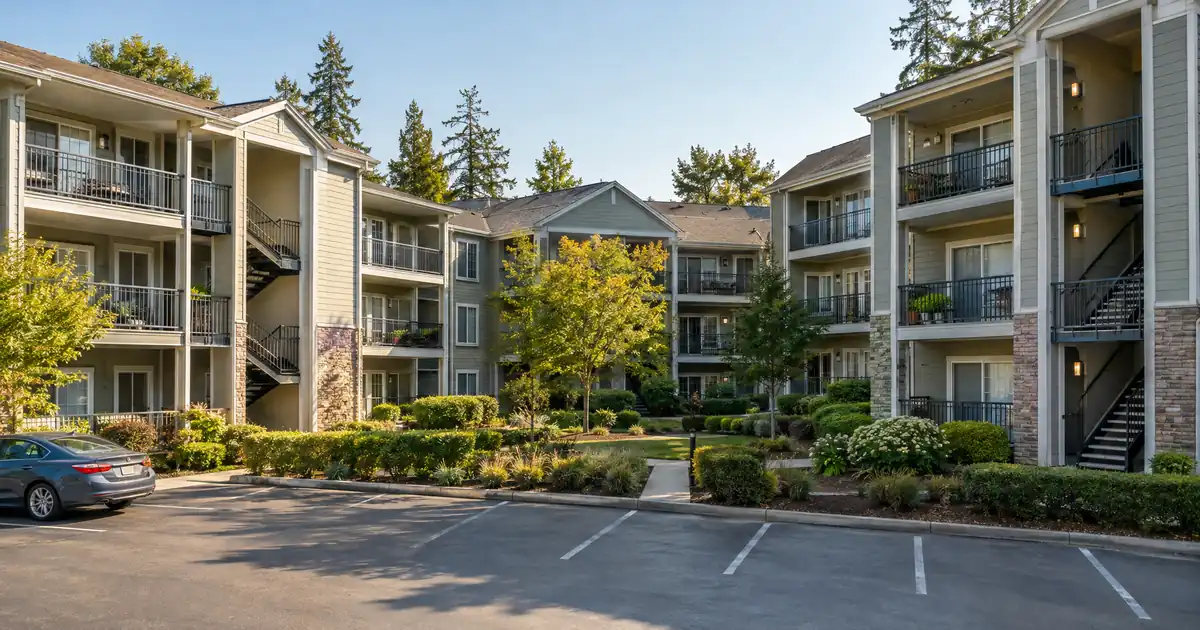
A 2-4 unit property — a duplex, triplex, or fourplex — counts as residential-style for DSCR purposes. Lenders appraise it with a standard rental-income form. They finance it through the same type of program as a single-family rental. A building with 5 or more units falls into a different category entirely. That category includes HUD’s Section 207/223(f) insurance program, agency multifamily execution, CMBS, or bank portfolio debt. HUD’s own program description confirms Section 207 insurance is built for “detached, semidetached, row, walk-up, or elevator type structures with 5 or more units.” That’s a hard structural line, not a soft guideline.
That threshold decides everything that comes after it. It decides which appraisal form applies. It decides how lenders calculate debt service coverage. It decides what reserves look like and how long the process runs. Say you compare a fourplex purchase to a 6-unit building down the street. These aren’t two similar deals with different price tags. They’re two completely different financing worlds.
This article focuses on the residential-style side. That means 2-4 unit apartment properties financed through DSCR. That’s where Lendmire’s wholesale network of DSCR lenders operates. For true 5+ unit apartment buildings, HUD-insured or agency multifamily debt is the more common path. That process runs on its own timeline and its own underwriting rules.
How Underwriting Actually Treats the Cash-Out
Here’s what a lender actually does with a cash-out refinance file on a 2-4 unit property, step by step.
Step 1 — Classify the transaction. Every refinance gets sorted first. Is it just paying off the existing loan with no extra cash out? That’s rate-and-term. Or is new cash being pulled against equity? That’s cash-out. This classification sets the leverage ceiling before anything else gets reviewed.
Step 2 — Document the rental income. On conventional financing, appraisers use Fannie Mae’s Form 1007 rent schedule for one-unit properties. They use Form 1025 for 2-4 unit properties. Many non-QM and DSCR lenders use this same paperwork, even though the loan never goes to Fannie Mae. It’s just a standard appraisal tool, not a sign the loan is an agency product. Here’s something worth flagging: agency guidelines count only 75% of gross rent when qualifying a borrower. They assume the other 25% covers vacancy and maintenance. Many DSCR programs qualify off the full gross rent instead. That’s a real difference. Investors should understand it before assuming their usable rent figure matches what a conventional lender would allow.
Step 3 — Run the coverage math. DSCR underwriting compares gross monthly rent to the full monthly obligation. That obligation is principal, interest, taxes, insurance, and any HOA dues — together called PITIA. Coverage of 1.00 means rent equals that payment exactly. That’s a floor on select programs in Lendmire’s network. It’s not a universal rule. Stronger coverage numbers generally open the door to better leverage and pricing.
Step 4 — Size the loan against the leverage ceiling. Lenders underwrite cash-out refinances to a tighter cap than a purchase. Across most of the network, cash-out tops out around 75% LTV. That’s a hard ceiling, not a starting point. Compare that to typical purchase leverage, which runs 75-80% LTV on most files. Some high-leverage programs go up to 85% for borrowers with credit scores around 700 or higher.
Step 5 — Check seasoning and title history. This step trips up more investors than any other. Conventional and agency financing stacks two separate seasoning tests. First, the borrower must be on title for at least 6 months before the new loan disburses, per Freddie Mac’s cash-out refinance guidance. Second, the existing first mortgage being paid off must itself be at least 12 months old, per Fannie Mae’s Selling Guide. Those two tests apply only to loans sold to Fannie Mae and Freddie Mac. They don’t bind non-QM or DSCR lenders directly. Across Lendmire’s network, the more common expectation for a DSCR cash-out is around 6 months of ownership seasoning. There’s no additional 12-month first-mortgage-age test like agency guidelines require.
What Determines How Much Cash Comes Out
Available equity depends on four things: the appraised value, the 75% LTV ceiling, the rent a lender uses for review, and reserve requirements. It’s not a fixed dollar promise. Picture a fourplex that has gone up in value since purchase. At 75% LTV, the new loan amount is capped as a percentage of today’s appraised value. The cash-out proceeds are that cap minus whatever is still owed on the existing loan. Whether that leaves usable cash-out proceeds depends on two things: how much the property has appreciated, and how much is still owed. A property with modest appreciation and a large existing balance may not clear enough equity to make a cash-out worth it, once reserves are set aside. Terms vary by lender guidelines, property type, leverage, credit profile, and a full review of the file.
Coverage matters just as much as equity. A bigger cash-out draw increases the new loan amount. That raises the monthly obligation, which can push the DSCR ratio down. The strongest files clear two tests at once: enough equity at the 75% ceiling, and rent that still covers the new, bigger payment at an acceptable coverage ratio. An investor chasing the maximum cash-out on thin rent can end up trading equity access for a weaker coverage number. Sometimes that number gets weak enough to force pricing or leverage adjustments. Exact terms depend on the lender’s guidelines, property type, leverage, and a full review of the borrower’s file.
Here’s one thing DSCR math doesn’t measure: whether the deal actually cash flows after the mortgage clears. A 1.00x ratio means rent equals the mortgage payment. It doesn’t account for repairs, vacancy stretches, property management, utilities, or capital expenses. Clearing 1.00 is a lending threshold. It’s not proof the property makes money every month.
Reserves, Seasoning, and Credit — The Other Three Gates
Equity and coverage get most of the attention. But three other gates decide whether a cash-out file actually closes.
Reserves. These vary by lender, leverage, loan size, and transaction type. There’s no single universal number across the network. A common baseline is around 6 months of PITIA held in reserve. Conservative rate-and-term files at modest leverage under $1,500,000 can sometimes skip reserves entirely. Loans above that size typically step up toward 9 months. Cash-out transactions tend to sit on the stricter end of that range, since the borrower is pulling out equity rather than simply refinancing existing debt.
Seasoning. Roughly 6 months of ownership is the common expectation before a cash-out refinance gets considered across Lendmire’s network. That’s well short of the agency world’s stacked 6-month/12-month test. For an investor running a buy-renovate-refinance strategy, that gap matters a lot. A 12-month agency clock versus a roughly 6-month DSCR seasoning window makes a real difference. One lets you recycle capital into the next deal on a reasonable timeline. The other leaves your equity tied up for twice as long.
Credit. A 620 floor exists in parts of the network, but most programs want something closer to 660 for reasonable terms. Crossing into 700 or higher tends to unlock the strongest leverage tiers, including some of the higher-leverage purchase programs. Credit tier and leverage tier move together. A borrower near the 620 floor should expect tighter LTV caps than one at 700+, even on the same property.
Picture an investor refinancing a fourplex. They’ve held the property just past the 6-month seasoning mark. They carry a 680 credit score. Their rent clears comfortably north of 1.00x on the new payment. That’s generally the cleanest file type Lendmire’s network sees for this transaction. Now compare that to a borrower at the 620 floor trying to pull maximum cash out on a property where rent barely clears 1.00. That file usually needs a lower leverage target or a stronger reserve position to get a lender comfortable. Both the equity test and the coverage test are running close to the edge at once.
Where the General Rule Breaks
A few scenarios don’t follow the standard playbook.
Buying out a co-owner isn’t a shortcut — it’s a longer wait. Under Fannie Mae’s limited cash-out refinance rule, one owner can buy out another — say, after a partnership dissolves. But this only qualifies for the more favorable limited cash-out treatment if the property has been jointly owned for at least 12 months before disbursement. That’s the opposite of a shortcut. Investors expecting an easier path for a buyout scenario are often surprised the agency rule runs longer, not shorter, than a standard cash-out.
True apartment buildings run on a completely different clock. HUD’s Section 223(f) program insured mortgages for 161 projects and 21,343 units, totaling $2.8 billion, in a recent fiscal year. That’s real scale, but it’s a genuinely different process. HUD applies its own DSCR, loan-to-value, and loan-to-cost standards under the MAP Guide, and those standards get revised from time to time. For newly built or substantially rehabbed properties seeking 223(f) refinancing, HUD requires the property to hit its programmatic DSCR for at least one full month before applying. Additional limits apply inside the first three years after completion, per HUD Mortgagee Letter 20-03. Large 223(f) loans with cash-out proceeds can also trigger a debt service reserve. That reserve equals the greater of 12 months of debt service or half the excess cash-out proceeds. It gets released after 6 consecutive months of operating results that meet the underwritten coverage requirement. Small-balance residential DSCR files have no mechanic like this at all, per HUD’s large-loan risk mitigation guidance.
Ineligible property types don’t bend. Manufactured homes (single- and double-wide), log homes, and barndominiums don’t qualify for DSCR programs in Lendmire’s network. This holds true no matter the unit count or how strong the rent-to-payment ratio looks. It’s a hard eligibility line, not a pricing adjustment.
Coverage below 1.00. Select lenders in the network do offer programs below a 1.00x floor. But leverage and terms adjust to make up for it. This isn’t a workaround — it’s a different, more conservative structure. A no-ratio option is available for DSCR below 1.00 with stronger credit or higher down payment; qualification on that path rests on credit and equity rather than a rent-coverage calculation.
How This Compares to Rate-and-Term and Delayed Financing
| Scenario | LTV Ceiling | Seasoning Expectation | Cash to Borrower |
|---|---|---|---|
| Purchase | 75-80% (up to 85% select programs) | None | N/A |
| Rate-and-term refinance | Higher than cash-out on most files | Shorter or none | No cash out |
| Cash-out refinance | Around 75% | Roughly 6 months | Yes, based on equity |
| Delayed financing (recent cash purchase) | Program-dependent | Different exception, not standard seasoning | Recovers original cash basis |
Delayed financing is built for the investor who bought a property in cash and wants to refinance soon after, without waiting out a full seasoning period. Lenders treat it as its own exception, not a standard cash-out, and terms depend on the specific lender and file. For a deeper look at using a cash-out refinance to fund a portfolio purchase, Lendmire’s article on using a cash-out refinance to buy an investment property walks through that use case directly.
DSCR loans are built for non-owner-occupied investment properties. They’re business-purpose investor loans, so lenders review them differently than a standard owner-occupied mortgage. Qualification runs mainly on the property’s rental income covering the payment, subject to lender guidelines, rather than on personal income documents. Investors weighing whether a cash-out refinance beats a straight sale or a HELOC should consider carefully whether it makes sense before committing to a strategy.
Loan sizes across Lendmire’s network typically run from smaller balances up to roughly $3,000,000 on standard programs. Loans above roughly $2,500,000 are generally structured as 30-year fixed.
Tax treatment on cash-out proceeds can depend on how the funds get used and how the property is titled. Investors should keep clear records and talk to a qualified tax professional before relying on any deduction. Lendmire’s overview of tax implications on a cash-out refinance is a useful starting point for that conversation.
Key Terms Defined
Cash-out refinance: Replacing your current mortgage with a new, bigger one and getting the difference in cash, based on the property’s current appraised value.
DSCR (debt service coverage ratio): A ratio that compares gross monthly rent to the full monthly housing payment (PITIA). A ratio of 1.00x means rent equals the payment exactly.
Seasoning: The minimum amount of time a borrower must own a property before a lender allows a cash-out refinance.
PITIA: Principal, interest, taxes, insurance, and association dues. Together, these make up the full monthly obligation used in the DSCR calculation.
Limited cash-out refinance: A refinance category separate from full cash-out. It covers scenarios like a co-owner buyout, subject to its own eligibility rules.
Frequently Asked Questions
Can I do a cash-out refinance on a duplex, triplex, or fourplex the same way as a single-family rental?
Yes, generally. 2-4 unit properties count as residential-style for DSCR purposes. Lenders use the same rent-schedule appraisal approach and similar leverage and coverage standards as they would for a single-family rental, subject to lender guidelines.
What’s the difference between cash-out refinance and rate-and-term refinance on an apartment property?
A rate-and-term refinance pays off the existing loan without pulling extra cash. It typically allows higher leverage. A cash-out refinance pulls equity out as cash. It gets underwritten to a tighter LTV ceiling — around 75% on most DSCR files — because the borrower is taking money out rather than just replacing debt.
Does a 6-unit apartment building qualify for a DSCR loan the same way a fourplex does?
Not usually. Once a property reaches 5 or more units, it typically moves out of residential-style DSCR financing. It moves into HUD, agency, or bank multifamily underwriting instead. That world uses its own DSCR, LTV, and reserve framework, entirely separate from small-balance residential programs.
How much cash can I actually pull out of an apartment property?
It depends on the appraised value, the 75% LTV ceiling, the existing loan payoff, reserve requirements, and whether the resulting payment still clears an acceptable coverage ratio. There’s no fixed dollar figure without underwriting the specific file. Every figure here varies by lender and program — guidelines, property type, leverage, and credit profile all apply.
What credit score do I need for a cash-out refinance on an apartment property?
A 620 floor exists in parts of Lendmire’s network. Most programs look for something closer to 660. Crossing 700 or higher tends to unlock stronger leverage tiers, subject to lender guidelines and the specific program.
For how equity extraction works, see cash-out refinance on an investment property.
About Lendmire
Lendmire (NMLS# 2371349) is a mortgage broker. It arranges DSCR investor loans through select lenders in its wholesale network, spanning 41 markets including Washington, D.C. Lendmire doesn’t fund, underwrite, or approve loans directly. Those decisions rest with the lender reviewing each file. For a full walkthrough of how DSCR lender review works property by property, the complete DSCR loans guide covers the mechanics in more depth than any single article can. Scotsman Guide named Lendmire a Top Mortgage Workplace in both 2025 and 2026.
Loan approval is never guaranteed. Nothing here is a commitment to lend. Every scenario described here is subject to lender approval and to borrower, property, and program guidelines, which can change. This article is general information only — not financial, legal, or tax advice.
Get Started
Ready to find the right loan for you?
In about 30 seconds you can review financing options available for your investment property. No commitment required.
Informational only. Not a Loan Estimate, approval, or commitment to lend. Program availability and eligibility are subject to lender guidelines, credit approval, property review, and underwriting.
References
1. HUD.gov — Descriptions of Multifamily Programs
2. Fannie Mae Selling Guide — B3-3.8-01, Rental Income
This article is part of Lendmire’s investment property cash-out refinance program — full qualification details, guidelines, and scenarios live on the program page.
Related reading: Apartment Investment Property Refinance Loan Finance · Apartment Cash Out Refinance · Multifamily Cash Out Refinance Lenders
Brandon Miller
Founder & CEO, Mortgage Loan Originator, Lendmire LLC
- Mortgage Loan Originator · NMLS# 1129696 · Verify on NMLS Consumer Access
- North Carolina Real Estate Broker · License# 343312 · Verify on NCREC
- North Carolina Insurance Producer · License# 19053198 · Property, Casualty, Life, Health · Verify on NAIC SBS
- Lendmire LLC · Firm NMLS# 2371349 · Verify firm licensure
Legal disclosures. Lendmire (NMLS# 2371349) is a state-licensed mortgage brokerage that arranges financing through wholesale lender relationships. Lendmire is not a direct lender, depository institution, or registered financial advisor. The discussion above is general informational content about real estate financing — it is not financial, legal, or tax advice, and readers should consult licensed professionals for guidance on their individual circumstances. Loan inquiries are subject to lender underwriting; this article does not represent a commitment to lend. Loan terms, rates, and qualification standards vary by borrower, property, and state, and are subject to change at any time. Equal Housing Opportunity. NMLS Consumer Access: nmlsconsumeraccess.org.