
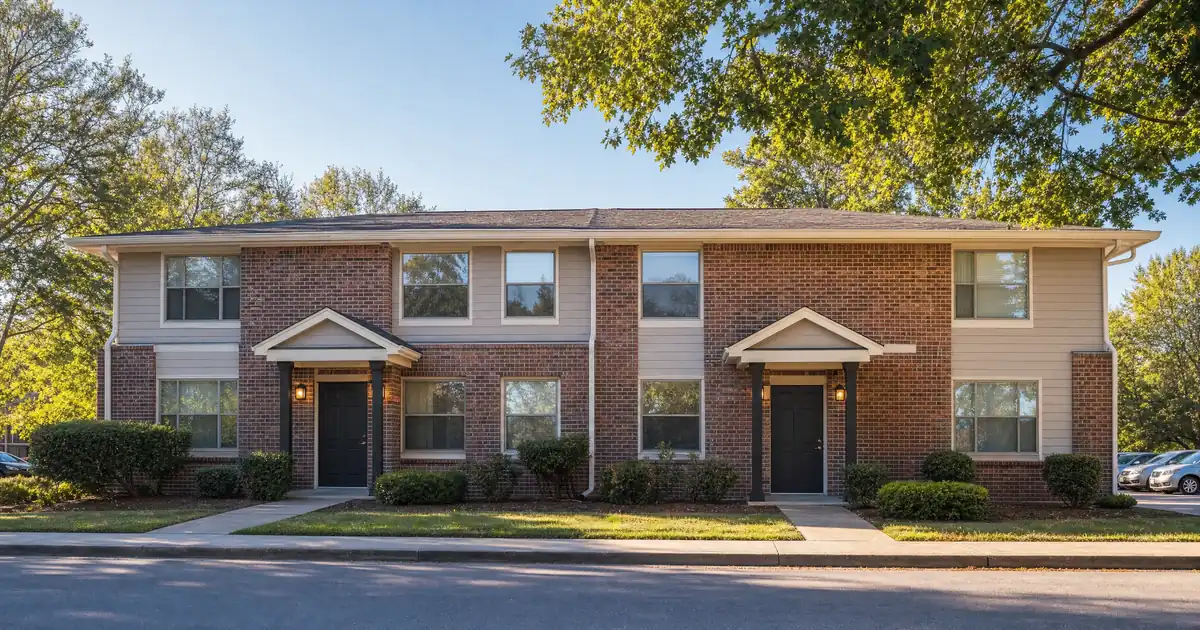
Choosing among multifamily cash out refinance lenders starts with understanding which lender category your property actually belongs in. The Quick Read: Multifamily cash-out refinance lenders fall into two very different buckets: agency, HUD, CMBS, and bank lenders for 5-plus unit apartment buildings, and DSCR/non-QM lenders for 2-4 unit properties financed more like single-family rentals. DSCR lenders typically cap cash-out around 75% loan-to-value, want about six months of ownership seasoning, and qualify the file primarily on rent covering the payment rather than the owner’s traditional personal-income documentation. Which lender type fits depends almost entirely on unit count and how the owner wants to document income.
DSCR Cash-Out Calculator
Run the cash-out numbers in your market
Rate source: Freddie Mac 30-yr average via FRED® — Federal Reserve Bank of St. Louis · effective Jul 30, 2026
Prefilled with starting assumptions — enter your property’s value, balance, taxes, and insurance for a more accurate picture.
Program parameters update from Lendmire’s centralized guideline source. Taxes and insurance are editable estimates.
As of Jul 30, 2026 · General Freddie Mac market benchmark, not a Lendmire loan offer. Property value, balance, taxes, and insurance are editable estimates. Maximum loan-to-value varies by lender, program, property type, and seasoning. Not a Loan Estimate, approval, or commitment to lend. Program availability and eligibility are subject to lender guidelines, credit approval, property review, and underwriting.
Most articles on this topic pick one side and stay there — a DSCR lender explains DSCR, a commercial broker explains agency and CMBS, and neither one tells an investor which world their specific property actually belongs in. That’s the first fork in the road, and it matters more than any rate or term you’ll see quoted anywhere.
Multifamily Market Snapshot
A quick read on the multifamily investor landscape — figures come from the cited sources below. Confirm current property-level numbers before underwriting.
| Metric | Detail |
|---|---|
| Typical rents | $2,217 avg (CBRE) |
| Vacancy | 7.2% national (Apartment List) |
What Counts as a Multifamily Cash-Out Refinance?
A multifamily cash-out refinance replaces an existing loan with a new, larger one, and sends the owner the difference in cash after payoff and closing costs. That’s different from a rate-and-term refinance, which just replaces the loan terms without pulling equity out.
The size of the building decides which lending world handles the file. Properties with one to four units get treated as small residential real estate — appraised with the same comparable-sales approach used on a single-family home, and financed through either agency-style conventional loans (for owner-occupants) or DSCR/non-QM loans (for pure rental property). Buildings with five or more units shift into commercial multifamily territory: HUD, Fannie Mae or Freddie Mac agency multifamily programs, CMBS conduit loans, and bank balance-sheet loans, each of which underwrites off net operating income and expense ratios rather than a simple rent-versus-payment comparison.
That distinction isn’t a technicality. HUD’s own program description of its Section 207/223(f) insurance program defines eligible properties as detached, semidetached, row, walk-up, or elevator structures with five or more units — and the agency insured 161 such projects totaling 21,343 units and $2.8 billion in the most recent fiscal year reported. Cross that five-unit line and the appraisal changes, the documentation changes, and the entire underwriting logic changes. A duplex owner and a 40-unit apartment owner are not shopping the same lender list, full stop.
Where DSCR Lenders Fit (2-4 Unit Properties)
DSCR cash-out refinance lenders qualify a file primarily on whether the property’s rent covers its monthly payment — not on the owner’s traditional personal-income documentation. That single feature is why DSCR lending has become the default path for landlords holding duplexes, triplexes, and fourplexes as pure rental investments.
Here’s the mechanism. The lender orders an appraisal that establishes market value the normal way, using comparable sales. Separately, it documents expected rent using the same forms Fannie Mae built for its own small-residential underwriting — a Single-Family Comparable Rent Schedule (Form 1007) for a one-unit property, or a Small Residential Income Property Appraisal Report (Form 1025) for a two-to-four-unit property, per Fannie Mae’s Selling Guide. DSCR lenders borrow these forms by convention, even though the loan itself will never be sold to Fannie Mae. Value and rent get calculated on two independent tracks in the same report — an owner’s optimistic rent estimate doesn’t move the appraiser’s opinion of value, and vice versa.
Across select lenders in Lendmire’s wholesale network, cash-out refinances on 2-4 unit rentals typically top out around 75% loan-to-value, with roughly six months of ownership seasoning expected before the cash-out request goes in. Coverage — the ratio of rent to the full monthly payment, known as PITIA (principal, interest, taxes, insurance, and association dues) — commonly starts at a 1.00 floor on select programs; pricing and available terms vary by lender, borrower profile, property type, and full underwriting review. That’s a floor for specific programs, not a universal industry standard, and it says nothing about vacancy, repairs, management fees, or capital reserves — those sit entirely outside the DSCR math. A property clearing 1.00 is not automatically cash-flow positive once real operating costs enter the picture.
Credit requirements run in tiers. A 620 floor exists in parts of the network, most programs want something closer to 660, and 700-plus scores unlock the strongest leverage available. Reserve requirements — money left over after closing, expressed in months of PITIA — commonly land around six months, though conservative rate-and-term files under $1.5 million at modest leverage sometimes see reserves waived, and loans above that size typically step up to around nine months. None of this is fixed across every lender; it varies by program, loan size, and how the rest of the file looks. For a broader walkthrough of how the ratio itself works, Lendmire’s complete DSCR loans guide breaks down the math in more depth.
Loan sizes on these files generally run from roughly $100,000 up through $3 million on standard programs, with the network’s larger balances above $2.5 million typically routed into 30-year fixed structures rather than shorter or adjustable terms.
Where Agency, HUD, CMBS, and Bank Lenders Fit (5+ Units)
At five units and above, the property moves into commercial multifamily lending, and the math changes from gross rent to net operating income. This is not a small variation on the DSCR calculation — it’s a different discipline entirely.
Fannie Mae’s own Multifamily Guide defines “Underwritten DSCR” for these larger loans as the ratio of Underwritten Net Cash Flow to annual debt service, meaning operating expenses, vacancy assumptions, and reserve requirements all get stripped out of income before the ratio is even calculated. A rent roll alone doesn’t cut it — lenders in this space want trailing operating statements, expense history, and often a third-party market study. HUD-insured loans in this category can offer longer amortization and non-recourse structures, but they typically involve a longer, more document-heavy approval process and stricter property-condition standards than a bank or DSCR loan would require.
Bank and CMBS lenders sit in between on flexibility. Banks tend to hold these loans on their own balance sheets and can be more conservative on cash-out leverage specifically — pulling equity out of an income property is a different risk conversation for a depository than financing a purchase. CMBS lenders securitize and sell the loans, which can mean higher leverage but less flexibility once the loan is in place, since changes to a securitized loan often require formal servicer approval.
For an owner sitting on a fourplex who’s debating whether to add a fifth unit or buy a small apartment building next, this line matters before any lender conversation happens. A multifamily cash-out refinance on a 2-4 unit property and a commercial refinance on a 20-unit building aren’t variations on the same product — they’re two different lending systems entirely.
The Step-by-Step: How a DSCR Multifamily Cash-Out Actually Runs
Step 1 — Classify the deal. Rate-and-term or cash-out gets decided first, because that single label sets the leverage ceiling, whether seasoning applies, and how heavy reserves get.
Step 2 — Confirm business-purpose treatment. DSCR loans are designed for non-owner-occupied investment properties. Because they’re business-purpose investor loans, they get reviewed differently than a standard owner-occupied mortgage — qualification runs on the property’s rental income covering the payment, subject to lender guidelines, not on the owner’s personal debt-to-income ratio.
Step 3 — Order the appraisal and rent documentation. Value and rent get established independently, using the 1007 or 1025 forms described above.
Step 4 — Run the coverage math. All unit rents get combined and divided by the property’s total PITIA. Above roughly 1.00 on select programs, rent covers the payment on paper — that’s the ratio, not a promise about actual cash flow after real expenses.
Step 5 — Check leverage, credit, and reserves together. These three pieces get reviewed as an interlocking set, not one at a time. A file can be strong on two and still get pended on the third — that’s why a pre-underwrite conversation before ordering an appraisal saves time.
Step 6 — Close. The new loan pays off the old one, and net proceeds beyond payoff and closing costs go to the borrower or the LLC holding title, subject to program eligibility on entity-vested loans.
Where the General Rule Breaks
The portfolio cap that doesn’t apply. Conventional agency financing caps out at 10 financed properties per investor — Scotsman Guide’s reporting on DSCR demand notes plainly that Fannie and Freddie won’t back a loan to an investor who already owns 10 financed properties, but DSCR loans carry no such ceiling. For a scaling investor who’s maxed out agency-eligible financing and needs to pull equity from an existing property to fund the next purchase, this is often the actual reason they end up on the DSCR path rather than agency refinancing.
Nonwarrantable condos. Tightened Fannie Mae and Freddie Mac condo-warrantability rules have pushed investors toward DSCR lenders to refinance units that agency financing simply won’t touch.
Below-1.00 coverage. Some lenders in the network will still consider a file where coverage lands under 1.00, but leverage and terms adjust to compensate — this isn’t a workaround, it’s a different pricing and structure. A no-ratio option is available for DSCR below 1.00 with stronger credit or higher down payment; qualification on that path rests on credit and equity rather than a rent-coverage calculation.
Property types that fall outside these programs entirely. Manufactured homes (single- and double-wide), log homes, and barndominiums aren’t reviewable through DSCR programs in this network — not “harder,” just not offered. If a duplex or fourplex happens to be one of these structure types, an investor should expect to look elsewhere for financing regardless of how strong the rent looks.
Short-term rental income. A property leaning on Airbnb or VRBO income for its coverage math runs on a different track: purchase up to 75% LTV, refinance and cash-out closer to 70%, generally a 640-plus score, about 12 months of hosting history, and a 1.00 coverage floor. Short-term rental rules can vary by city, county, HOA, and property type, so investors should confirm local rules before relying on projected rental income.
Traditional lenders moving into business-purpose territory. Large conventional originators have started offering their own business-purpose DSCR-style products alongside the established non-QM lender base — a trend that blurs, but doesn’t erase, the line between agency and DSCR underwriting described above.
What the Decision Actually Looks Like
An investor holding a fourplex with rising rents and meaningful appreciation is typically shopping DSCR lenders, full stop — the unit count alone rules out agency multifamily and HUD programs. The real decision at that point is leverage versus reserves: pulling the maximum 75% LTV available on cash-out reduces the cash left in reserve, while taking a smaller cash-out preserves reserves and can lift the coverage ratio, since a smaller loan means a lower payment against the same rent.
Here’s a pattern seen across files that come through DSCR channels: the strongest cash-out applications clear both leverage and coverage cleanly, not just one. A file with plenty of equity but rent that barely limps to 1.00 gets more scrutiny on reserves and credit than a file with slightly less equity but coverage comfortably above 1.00 — lenders read a cushion on the ratio as durability, not just a passed test. Investors who run both numbers before applying, rather than assuming equity alone carries the file, tend to move through underwriting with fewer surprises.
For a 5-plus unit apartment building, the calculus is different again — net operating income, expense history, and often a formal appraisal review from the lender’s own underwriting team replace the simple rent-versus-PITIA test. An owner who has been managing the property with clean books and documented expense trends is in a much stronger position than one relying on a rough rent roll.
A larger down payment, or in refinance terms, a smaller cash-out request, lowers the payment and can lift the coverage ratio — but it never gets around a hard leverage cap, a credit floor, a reserve requirement, or a property type the network simply doesn’t finance. The strongest files clear both tests at once: enough equity retained in the property, and enough rent covering the payment. Final terms depend on lender guidelines, property type, leverage, and the borrower’s complete credit picture.
Tax treatment of cash-out proceeds can depend on how the funds are used and how the property is held; investors should keep clear records and speak with a qualified tax professional before relying on any deduction.
Frequently Asked Questions
Does a DSCR cash-out refinance work the same way on a fourplex as it does on a 20-unit building?
No. A fourplex qualifies through small-residential DSCR underwriting — rent versus PITIA, using appraisal forms borrowed from single-family lending. A 20-unit building falls into commercial multifamily territory, where lenders underwrite off net operating income and expense history instead of a simple rent-to-payment ratio. Different appraisal, different documentation, different lender pool entirely.
Is there a limit on how many financed properties an investor can hold before DSCR lenders stop refinancing them?
Not through DSCR programs. Agency conventional financing caps out at 10 financed properties per investor, but DSCR lenders in Lendmire’s network don’t carry that ceiling — that’s a big part of why scaling investors move to DSCR refinancing once they’ve maxed out conventional options.
What happens if a property’s rent doesn’t cover the new loan payment?
Some lenders in the network still consider files below 1.00 coverage, but expect adjusted leverage and terms to compensate for the shortfall — it isn’t offered on the same footing as a fully-covered file.
Can a manufactured home or barndominium-style multifamily property get a DSCR cash-out refinance?
No. Manufactured homes, whether single- or double-wide, along with log homes and barndominiums, fall outside DSCR programs in this network regardless of unit count or rent strength. That’s a property-type exclusion, not a matter of stronger qualification fixing it.
Does short-term rental income count toward the coverage ratio on a multifamily cash-out refinance?
It can, but the terms differ from a standard long-term-rental file — expect leverage capped closer to 70% on cash-out, generally a 640-plus credit score, and around 12 months of hosting history to document income. Short-term rental rules vary by city, county, and HOA, so confirming local rules before relying on that income is worth doing early.
For how equity extraction works on an investment property, see cash-out refinance on an investment property.
About Lendmire
Lendmire (NMLS# 2371349) is a mortgage broker that arranges DSCR and business-purpose investor loans through select lenders across 41 markets, including Washington, D.C. — it doesn’t fund, underwrite, or approve loans itself; those decisions sit with the lender reviewing the file. Investors weighing a DSCR refinance on a multifamily property or comparing options against a non-owner-occupied cash-out refinance can reach Lendmire at 828-256-2183 or request a quote directly. Scotsman Guide named Lendmire a Top Mortgage Workplace in both 2025 and 2026.
No loan approval is ever guaranteed, and nothing here is a commitment to lend. Every scenario described here is subject to lender approval and to borrower, property, and program guidelines that can change. This article is general information, not financial, legal, or tax advice.
Get Started
Ready to find the right loan for you?
In about 30 seconds you can review financing options available for your investment property. No commitment required.
Informational only. Not a Loan Estimate, approval, or commitment to lend. Program availability and eligibility are subject to lender guidelines, credit approval, property review, and underwriting.
References
1. CBRE
3. HUD — Descriptions of HUD Multifamily Programs
4. Fannie Mae Selling Guide — Rental Income (B3-3.8-01)
5. Scotsman Guide — Invest in Your Future
This article is part of Lendmire’s investment property cash-out refinance program — full qualification details, guidelines, and scenarios live on the program page.
Related reading: Cash Out Refinance Apartment · Multifamily Cash Out Refinance · Complete Guide For A Hard Money Loan On Multifamily 5+ Properties
Brandon Miller
Founder & CEO, Mortgage Loan Originator, Lendmire LLC
- Mortgage Loan Originator · NMLS# 1129696 · Verify on NMLS Consumer Access
- North Carolina Real Estate Broker · License# 343312 · Verify on NCREC
- North Carolina Insurance Producer · License# 19053198 · Property, Casualty, Life, Health · Verify on NAIC SBS
- Lendmire LLC · Firm NMLS# 2371349 · Verify firm licensure
Disclosure information. Lendmire is a state-licensed mortgage brokerage under NMLS# 2371349. Lendmire is not a depository institution, direct lender, or financial advisor — all loans referenced are placed through wholesale lender partners and are subject to each lender's underwriting standards. This article is provided for general informational purposes and is not a commitment to lend, nor does it constitute financial, legal, or tax advice. Loan programs, terms, rates, and qualification standards change without notice and depend on borrower profile, property type, and the state in which the subject property is located. Equal Housing Opportunity provider. NMLS Consumer Access: nmlsconsumeraccess.org.