
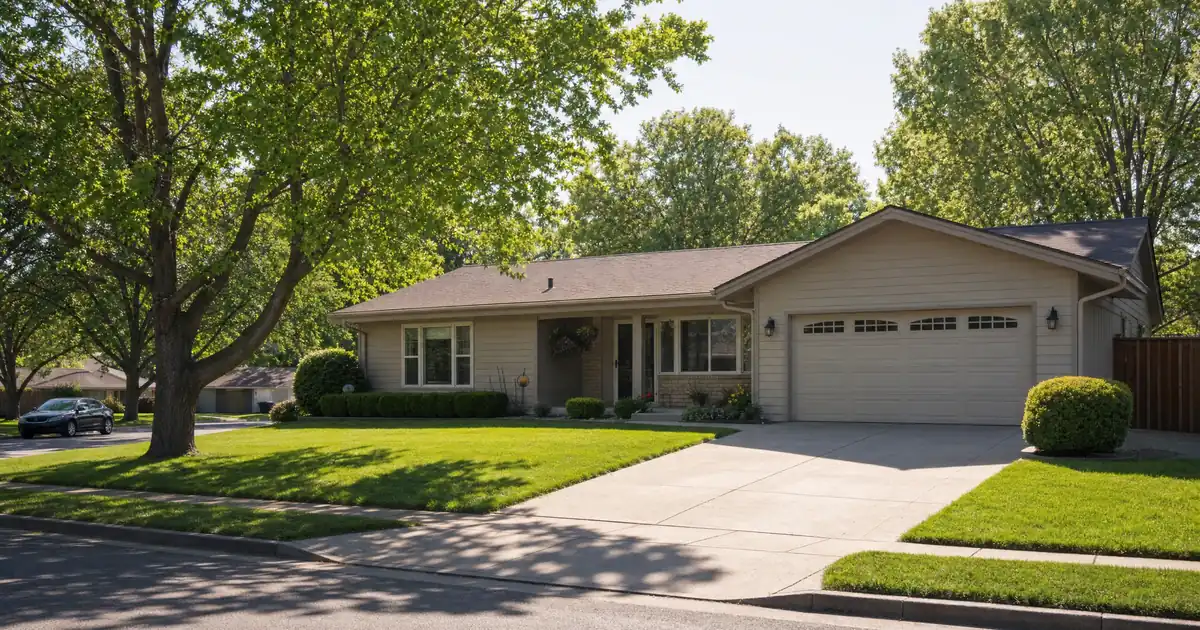
The guidelines for cash out refinance investment property determine which loan programs apply and which are closed off entirely. The Quick Read: FHA cash-out refinancing does not cover investment property. Period. HUD limits this program to owner-occupied primary homes, and there is no exception for investors. It doesn’t matter if you bought the rental years ago. It doesn’t matter if you inherited it and later rented it out. It doesn’t matter if you moved out of a duplex unit you used to live in. FHA touches rental income in only one case: a 2-4 unit property where you still live in one unit. For a straight rental, DSCR loans are the path that works. A DSCR loan looks at the property’s rent versus its payment, not at your occupancy history.
The Core Rule: Why Investment Property Doesn’t Qualify
FHA cash-out refinancing exists for one type of property: owner-occupied primary homes. HUD Handbook 4000.1 states this plainly. A 2009 HUD mortgagee letter backs it up with a hard occupancy rule. Investment properties and second homes are excluded from FHA cash-out entirely. There is no workaround built into the program.
DSCR Cash-Out Calculator
Run the cash-out numbers in your market
Rate source: Freddie Mac 30-yr average via FRED® — Federal Reserve Bank of St. Louis · effective Jul 30, 2026
Prefilled with starting assumptions — enter your property’s value, balance, taxes, and insurance for a more accurate picture.
Program parameters update from Lendmire’s centralized guideline source. Taxes and insurance are editable estimates.
As of Jul 30, 2026 · General Freddie Mac market benchmark, not a Lendmire loan offer. Property value, balance, taxes, and insurance are editable estimates. Maximum loan-to-value varies by lender, program, property type, and seasoning. Not a Loan Estimate, approval, or commitment to lend. Program availability and eligibility are subject to lender guidelines, credit approval, property review, and underwriting.
This is not a soft guideline. A lender cannot waive it, even for a strong file. It’s a hard eligibility gate. FHA insures loans against the risk of default. HUD’s logic is simple: a borrower who lives in the property has more skin in the game than one who just collects rent. That’s why the occupancy test comes first. It gets checked before LTV or credit even enter the conversation.
Once occupancy clears, the cash-out ceiling sits at 80% loan-to-value. HUD’s Mortgagee Letter 2019-11 dropped that cap from 85% to 80%. The change took effect for case numbers assigned on or after September 1, 2019. HUD made this move after cash-out endorsements jumped 250.47% — from 43,052 in FY2013 to 150,883 in FY2018. That growth pushed HUD to tighten equity requirements across the board. The 80% figure now sits directly in Handbook 4000.1. None of this matters for a rental property, though. The LTV math never even gets reached if occupancy fails first.
The 12-Month Occupancy and Seasoning Test
A borrower must own and occupy the property as a primary home for at least 12 months. That clock has to run out before the FHA case number gets assigned. HUD starts the clock on the date title transferred, not the date the borrower physically moved in. So an investor who bought a home, waited a few months, then moved in, needs both dates to line up before cashing out.
On top of the occupancy clock sits a payment-history review. The lender pulls the mortgage payment record for the 12 months before the case number gets assigned. Any late payment in that window causes a problem. Even one 30-day late payment triggers a mandatory downgrade to manual underwriting. That means tighter debt-to-income limits and more paperwork to prove compensating factors. Some investors assume an old late payment from years back gets forgiven with time. It doesn’t work that way. Only the trailing 12 months matter, and lenders enforce that window strictly.
Occupancy itself needs proof, not just a claim. HUD requires the lender to check employment records or utility bills. These need to show the borrower actually lived in the property for that full 12-month stretch. Any rental history inside that window disqualifies the file from the standard path, even a short one.
Key Terms Defined
Cash-out refinance — a refinance that replaces your current mortgage with a bigger one. You get the difference back in cash. This is different from just changing your rate or term.
LTV (loan-to-value) — the loan amount shown as a percentage of the property’s value. A lower LTV means you keep more equity after closing.
DTI (debt-to-income) — your total monthly debt divided by your gross monthly income. Lenders use this to gauge repayment ability on owner-occupied loans.
DSCR (debt-service coverage ratio) — a measure that compares a rental property’s income to its housing payment. That payment includes principal, interest, taxes, insurance, and HOA dues, all together called PITIA. Lenders use this ratio instead of borrower income on investor loans.
Seasoning — the minimum time a lender or program requires you to hold a property before you can refinance or take cash out.
The Non-Occupant Co-Borrower Prohibition
FHA purchase loans allow a non-occupant co-borrower. Think of a parent helping a child qualify. Cash-out refinances don’t allow this at all. Income from a non-occupant co-borrower cannot count on a cash-out transaction. Only the owner-occupant’s income counts. This trips up a lot of investors. If you used a co-signer to buy the property, you might assume that same structure carries into a refinance. It doesn’t. The file gets underwritten on the occupant’s income alone.
Where Multi-Unit Properties Actually Touch Rental Income
FHA allows 2-4 unit properties. If you occupy one unit and rent out the rest, HUD still treats you as an owner-occupant. This is the one place where FHA cash-out rules actually connect to rental income. You still need to clear the same 12-month occupancy and payment-history tests on the unit you live in. But rental income from the other units can count toward qualifying. That works because the transaction still counts as a primary-residence refinance, not an investment-property one.
Once you move out of the property entirely, and all units become rentals, the FHA cash-out door closes. At that point, the property needs a conventional or non-QM refinance to pull out equity.
What Happens After the Property Becomes a Rental
Say an investor financed a home with FHA years ago. They lived in it long enough to satisfy the occupancy rule, then later turned it into a rental. That investor cannot use FHA cash-out on that property again. It doesn’t matter how the original loan was set up. Once a property stops being the borrower’s primary home, it falls outside the program’s scope for cash-out. That’s the moment DSCR becomes the practical answer.
DSCR underwriting flips the whole logic. The property’s own rent-versus-payment math decides the outcome. Occupancy history and personal debt-to-income ratio don’t matter here. An appraiser estimates the monthly market rent. For a one-unit property, the appraiser uses a document modeled on the industry-standard Single-Family Comparable Rent Schedule. For 2-4 unit income properties, the appraiser uses its small-residential-income counterpart. That rent figure becomes the top number. PITIA, built from the actual mortgage payment, taxes, insurance, and HOA fees, becomes the bottom number. Rent divided by PITIA produces the coverage ratio, and that ratio clears or fails the file.
Lender review runs on that ratio, not on traditional income paperwork or W-2s. Investors scaling a portfolio often show reduced taxable income on Schedule E, even when actual cash flow is strong. These are exactly the borrowers who turn to DSCR once they hit FHA’s owner-occupied ceiling.
How DSCR Cash-Out Actually Works on a Rental
Across the wholesale network Lendmire works with, DSCR cash-out refinances on investment property typically top out around 75% LTV. Lenders usually expect roughly six months of ownership seasoning before cash-out becomes available. That 75% ceiling is a hard cap for cash-out. It’s lower than the leverage typically available on a DSCR purchase. Purchase loans run 75-80% LTV on most files, and some high-leverage programs go up to 85% for borrowers with stronger credit.
Coverage matters, but 1.00 is a floor for select programs, not a universal standard. Rent that clears 1.00 against PITIA means the property covers its own housing payment on paper. It does not mean positive cash flow once you factor in repairs, vacancy, management fees, and capital reserves. Ratios above 1.00 typically open better pricing and higher leverage. A file sitting right at the floor often needs more equity or reserves to make up for it.
Credit tiers run a spread across the network. Some parts of the network have a 620 floor. Most programs, though, look closer to 660. A score of 700 or higher is where the strongest leverage tiers unlock. Reserve requirements vary by lender, loan size, and leverage. Six months of PITIA is common. Conservative rate-term files at modest leverage under $1,500,000 sometimes get reserves waived entirely. Loans above that threshold typically step up to around nine months of reserves. Loan sizes on standard DSCR programs generally run up to $3,000,000. Loans above $2,500,000 are usually structured as 30-year fixed rather than adjustable.
Coverage below 1.00 is available through select lenders in the network. But leverage and terms adjust to make up for the thinner rent-to-payment margin. It isn’t a standard-terms scenario. A no-ratio option is available for DSCR below 1.00 with stronger credit or higher down payment; qualification on that path rests on credit and equity rather than a rent-coverage calculation.
A larger down payment lowers your monthly obligation and can lift your DSCR ratio. But it doesn’t override a leverage cap, a credit floor, or a reserve requirement. The strongest files clear two tests at once: enough retained equity to satisfy the LTV ceiling, and enough rent to satisfy the coverage floor. Say a file has plenty of equity but a coverage ratio below where the lender wants it. That file still needs a structural fix. More reserves, a lower requested LTV, or a stronger credit tier can help. A bigger check at closing alone won’t fix it. Exact terms depend on the lender’s guidelines, property type, leverage, and a full review of the borrower’s file.
The Edge Cases That Change the Math
Inheritance is the one real carve-out from the 12-month occupancy clock. HUD 4000.1 lets a borrower who inherited a property skip the minimum occupancy period before applying for cash-out. There’s a catch: the borrower must never have treated the property as a rental since inheriting it. Rent it out first, even briefly, and the exception disappears. The borrower then has to occupy it as a primary home for a full 12 months before FHA cash-out eligibility returns. This is a real trap. An investor who inherits a rental-ready property might assume immediate access to FHA equity. That option often disappears the moment a tenant moves in.
Forbearance resets the clock a different way. A borrower who completed a mortgage forbearance needs at least 12 consecutive on-time payments after the plan ended. Only then does cash-out eligibility resume.
Property type adds a separate wrinkle on the DSCR side. The standard rent-schedule appraisal approach values real property only. It excludes business income. So appraisers rely on comparable monthly lease rates instead of any alternative income calculation. This matters directly for an investor trying to cash out equity. The valuation reflects standard market lease comparables, not the investor’s own income projections.
Free-and-clear properties with no existing mortgage still qualify as a refinance transaction under FHA cash-out rules. But the same 12-month occupancy and payment-history tests apply, whether or not there’s a loan to pay off.
Here’s a narrow geographic footnote: the 2019 LTV reduction doesn’t apply to mortgages insured under Section 247 of the National Housing Act, which covers Hawaiian Homelands. This detail is unlikely to affect most investors, but it’s worth knowing it exists.
What the Investor Decision Actually Looks Like
Picture an investor who bought a primary residence with FHA financing years back. They moved out and now rent it while living elsewhere. FHA cash-out is closed to that property, permanently. Occupancy has converted, and there’s no path back short of moving in again for a full 12 months. The realistic next step is either a conventional cash-out refinance, if personal income and DTI still support it, or a DSCR cash-out refinance sized against the rent the property actually produces.
Now run the comparison the other way. Picture an investor holding a 2-4 unit property, occupying one unit, renting out the rest. That file can still go through FHA cash-out because occupancy is intact. But the moment that investor moves out entirely to scale into a bigger property, the same asset needs a DSCR or conventional investor product to access any future equity.
For most investors reading this, the FHA question resolves fast. If the property is a rental today and you don’t live in a unit, FHA cash-out is off the table. Full stop. The complete DSCR loans guide walks through how the rent-to-payment qualification gets structured. Lendmire’s writeup on using a cash-out refinance to buy investment property covers the mechanics for investors pulling equity from one property to fund another. Investors in Texas dealing with the state’s separate cash-out restrictions should also check how the state’s cash-out refinance rules apply to investment property before assuming standard DSCR terms carry over unchanged.
DSCR loans are business-purpose products built for non-owner-occupied investment property. That’s why they get reviewed on a different track than a standard owner-occupied FHA refinance. The property’s income drives lender review, not the borrower’s occupancy or personal debt load.
Tax treatment on any cash-out transaction depends on how the funds get used and how title is held. Investors should keep clean records and talk to a qualified tax professional before assuming any deduction applies. Lendmire’s piece on whether cash-out refinance proceeds get taxed is a reasonable starting point for that question.
Frequently Asked Questions
Can I ever use FHA cash-out on a rental property I currently own?
No. FHA cash-out refinancing is restricted to owner-occupied primary homes under HUD guidelines. There’s no exception for a property that’s currently rented out. It doesn’t matter whether you financed it with FHA originally, or whether you ever lived there before.
What if I inherited a rental property — does the 12-month occupancy rule still apply?
It depends on what you did with the property after inheriting it. HUD 4000.1 waives the standard occupancy period for inherited properties. But this only applies if you never rented it out. Renting it first, even briefly, forfeits the exception. You then need a full 12 months of occupancy as a primary home before you can qualify.
Can someone co-sign to help me qualify for an FHA cash-out refinance?
No, not on a cash-out transaction. FHA purchase loans allow a non-occupant co-borrower’s income to help you qualify. Cash-out refinances don’t work that way. Only the occupying borrower’s income counts. A parent’s or other co-signer’s income cannot be used.
If I occupy one unit of a duplex and rent the other, does that count as owner-occupied for FHA cash-out?
Yes. FHA treats a borrower who occupies one unit of a 2-4 unit property as an owner-occupant. So that property can still qualify for FHA cash-out, subject to the standard occupancy and payment-history tests. Rental income from the other units can count toward qualification, since the transaction still counts as a primary-residence refinance.
Since FHA cash-out is closed to my rental, what’s the realistic alternative?
A DSCR loan is the product built for this exact situation. It qualifies primarily on whether the property’s rental income covers the payment, subject to lender guidelines. It doesn’t rely on your occupancy history or personal income documentation. Cash-out DSCR refinances typically cap around 75% LTV, after roughly six months of seasoning. Terms vary by credit profile and property coverage.
What documentation do you need to qualify for a DSCR cash-out refinance instead of FHA?
Qualification centers on the property’s rent-to-payment math, not traditional personal-income documentation or W-2s. An appraiser estimates market rent using a comparable-rent-schedule approach. That rent figure gets measured against PITIA to produce the coverage ratio. The file also gets reviewed for credit tier, seasoning, reserves, and requested leverage, all subject to lender guidelines and full underwriting.
For how equity extraction works on an investment property, see cash-out refinance on an investment property.
About Lendmire
Lendmire (NMLS# 2371349) is a mortgage broker, not a lender. It arranges DSCR and non-QM financing through select lenders in a wholesale network spanning 40 states plus Washington, D.C. — 41 markets total. It does not fund loans directly. Nothing here is a commitment to lend, and no scenario described guarantees approval. Every file is subject to lender review, credit approval, property underwriting, and the program guidelines in place at the time of application. This article offers general information, not financial, legal, or tax advice. Scotsman Guide named Lendmire a Top Mortgage Workplace in both 2025 and 2026.
If a rental property doesn’t fit FHA’s owner-occupied box, the practical move is to compare what DSCR leverage and coverage actually look like for that specific property. Lendmire can help run that comparison based on rent, credit profile, requested leverage, and the investor’s goals. Reach the team at 828-256-2183 or through a DSCR loan quote request.
Get Started
Ready to find the right loan for you?
In about 30 seconds you can review financing options available for your investment property. No commitment required.
Informational only. Not a Loan Estimate, approval, or commitment to lend. Program availability and eligibility are subject to lender guidelines, credit approval, property review, and underwriting.
References
1. HUD Mortgagee Letter 2019-11
2. HUD Handbook 4000.1, Update 7
3. National Law Review — HUD Reduces Maximum LTV for FHA Cash-Out Refinance Loans
This article is part of Lendmire’s investment property cash-out refinance program — full qualification details, guidelines, and scenarios live on the program page.
Related reading: FHA Cash Out Refinance Bad? · Cash Out Refinance Real Estate Investing · Saving For An Investment Property Instead Of A House
Brandon Miller
Founder & CEO, Mortgage Loan Originator, Lendmire LLC
- Mortgage Loan Originator · NMLS# 1129696 · Verify on NMLS Consumer Access
- North Carolina Real Estate Broker · License# 343312 · Verify on NCREC
- North Carolina Insurance Producer · License# 19053198 · Property, Casualty, Life, Health · Verify on NAIC SBS
- Lendmire LLC · Firm NMLS# 2371349 · Verify firm licensure
Compliance and disclosures. Lendmire (NMLS# 2371349) is a licensed mortgage broker and is not a direct lender, depository institution, financial advisor, or tax professional. Content in this article is general market analysis and educational information — not financial, legal, or tax advice for any specific situation. Lendmire does not guarantee loan approval; every transaction is subject to underwriting by the funding lender. Mortgage pricing and loan program guidelines are subject to change at any time without notice and vary by borrower characteristics, property type, and state regulations. Lendmire complies with Equal Housing Opportunity. Licensure verification: NMLS Consumer Access.